
SHARE Knowledge Hub
What are chemical eye injuries at work?
A chemical splash, powder or mist in the eye can threaten vision. Stop exposure, call 999 for a suspected strong chemical or chemical burn, and start immediate continuous rinsing with clean cool or lukewarm water while urgent help is arranged. Prevent eye contact through safer methods, splash containment, suitable eye/face protection and accessible eyewash.
Understanding What are chemical eye injuries at work?
A chemical splash, powder or mist in the eye can threaten vision. Stop exposure, call 999 for a suspected strong chemical or chemical burn, and start immediate continuous rinsing with clean cool or lukewarm water while urgent help is arranged. Prevent eye contact through safer methods, splash containment, suitable eye/face protection and accessible eyewash.
Why this matters at work
Give an equipment owner responsibility to demonstrate activation, appropriate flow, supply and drainage in a safe test. Check freezing, heat, contamination and damage protection for the actual installation. Confirm communications, precise emergency location, trained help and product information on every relevant shift. Record the design basis, check method, frequency and failure action through the risk-based and manufacturer regime. Do not invent a universal distance or interval from a different industry example. Verify task prevention and PPE at the same time. No chemical work should depend on a responder improvising a water supply after a splash has occurred.
A bottle can begin irrigation but may not sustain the flow and duration required for a serious corrosive exposure. Assess the credible quantity, both-eyes risk, body area, task location and help available. Consider whether an injured person can activate and use the equipment while holding eyelids open and whether clean fluid can continue through supported transfer. Do not approve the arrangement solely because an eyewash label is visible in the kit.
How organisations manage this in practice
Select the combination for the task. A shield covers more of the face but does not fully enclose the eyes. Goggles can provide greater enclosure than ordinary safety spectacles, while ventilation design affects suitability for splash, fine dust or gases. Consider the exact chemical, quantity, pressure, direction, mist or dust, impact hazard, optical clarity and wearer. A severe face-splash risk may require a suitable shield over appropriate goggles. Check prescription needs, fit, compatibility with RPE, hearing protection and headwear, and whether fogging or poor visibility encourages removal. Use current equipment and manufacturer information rather than assuming every visor or goggle has the same protection. Provide cleaning, inspection, replacement and storage instructions and verify that workers can perform the task while protected. PPE is the residual layer after source and engineering controls such as closed transfer and splash prevention. It cannot justify uncontrolled pressurised release, and eyewash must remain available because failures are foreseeable. Record the selection rationale and reassess after product, method or equipment changes.
Demonstrate that immediate clean, gentle and sustained irrigation is possible at the point of need, with alarm and emergency contact running in parallel. Test access for an impaired person, self-operation, assistance, both-eyes demands and supported transfer without exposing anyone to a real chemical. Check night or lone arrangements as relevant. A drill should reveal delay, blocked routes, missing communication and insufficient supply rather than merely generate attendance signatures.
Qualified clinical assessment determines injury, treatment and follow-up. Workplace responders should not grade a burn, prescribe drops, test ocular pressure or decide that a brief improvement means vision is safe. After discharge, follow the clinical instructions and seek prompt reassessment if pain, redness, discharge, light sensitivity or vision worsens. Contact-lens use should follow the relevant advice. Do not delay emergency assessment while waiting for occupational health.
What are the key facts about chemical eye injuries?
The key facts are that speed of washing, type of chemical and strength of workplace controls can change the outcome.
This page is workplace guidance, not medical, legal or HR advice. Any chemical splash, dust entry, vapour injury, persistent pain, blurred vision or suspected corrosive exposure to the eye should follow the workplace first-aid procedure, safety data sheet instructions and medical assessment route.
What signs matter first?
- Pain, burning, watering, redness, eyelid swelling, blurred vision, light sensitivity or difficulty opening the eye.
- Powder, cement, lime, solvent, corrosive liquid, pressurised spray or unknown chemical contacting the eye.
- Symptoms that continue after washing, return later or affect both eyes after vapour or aerosol exposure.
What should happen immediately?
- Stop the task, move away from the source if safe, and start eye irrigation quickly using eyewash or clean running water.
- Keep rinsing while urgent help is arranged; suspected chemical-burn guidance advises about one hour. Do not delay washing to search for paperwork.
- Remove contaminated gloves or clothing that may continue exposing the face, and preserve the product details for medical handover.
When is medical assessment needed?
- Any corrosive, alkali, acid, wet cement, ammonia, chlorine, solvent or unknown chemical exposure to the eye.
- Any ongoing pain, blurred vision, eye redness, foreign-body feeling or difficulty keeping the eye open after washing.
- Any exposure involving pressurised liquid, powders, aerosols, vapours, contact lenses or more than one affected person.
Chemical form matters
Liquid splashes, mists, powders, dusts, vapours, gases and pressurised sprays all reach the eye differently and need different controls.
Alkalis are particularly dangerous
Wet cement, lime, caustic soda, ammonia solutions and strong alkaline cleaners can penetrate tissue and cause serious eye damage.
Eye protection must match the task
Safety spectacles may not control splash; chemical goggles, face shields or both may be needed where liquid can reach the eye.
Eyewash is a control system
Eyewash only works if it is close enough, clean, maintained, signed, unobstructed and included in training and drills.
SDS information must be practical
Safety data sheet information should inform PPE, eyewash, first aid, spill response, storage and training.
Incidents reveal system weakness
A splash often points to poor transfer method, wrong container, weak supervision, unsuitable PPE, poor maintenance or a missing emergency arrangement.
Make the route from splash point to water usable
Practise from a credible splash point using a safe simulation. A person whose vision is impaired may be unable to find a doorway, operate a tap or communicate alone. Assign a helper route that does not enter the release and check that water and communication are actually available during every shift.
Best-practice guide: Chemical Eye Injuries
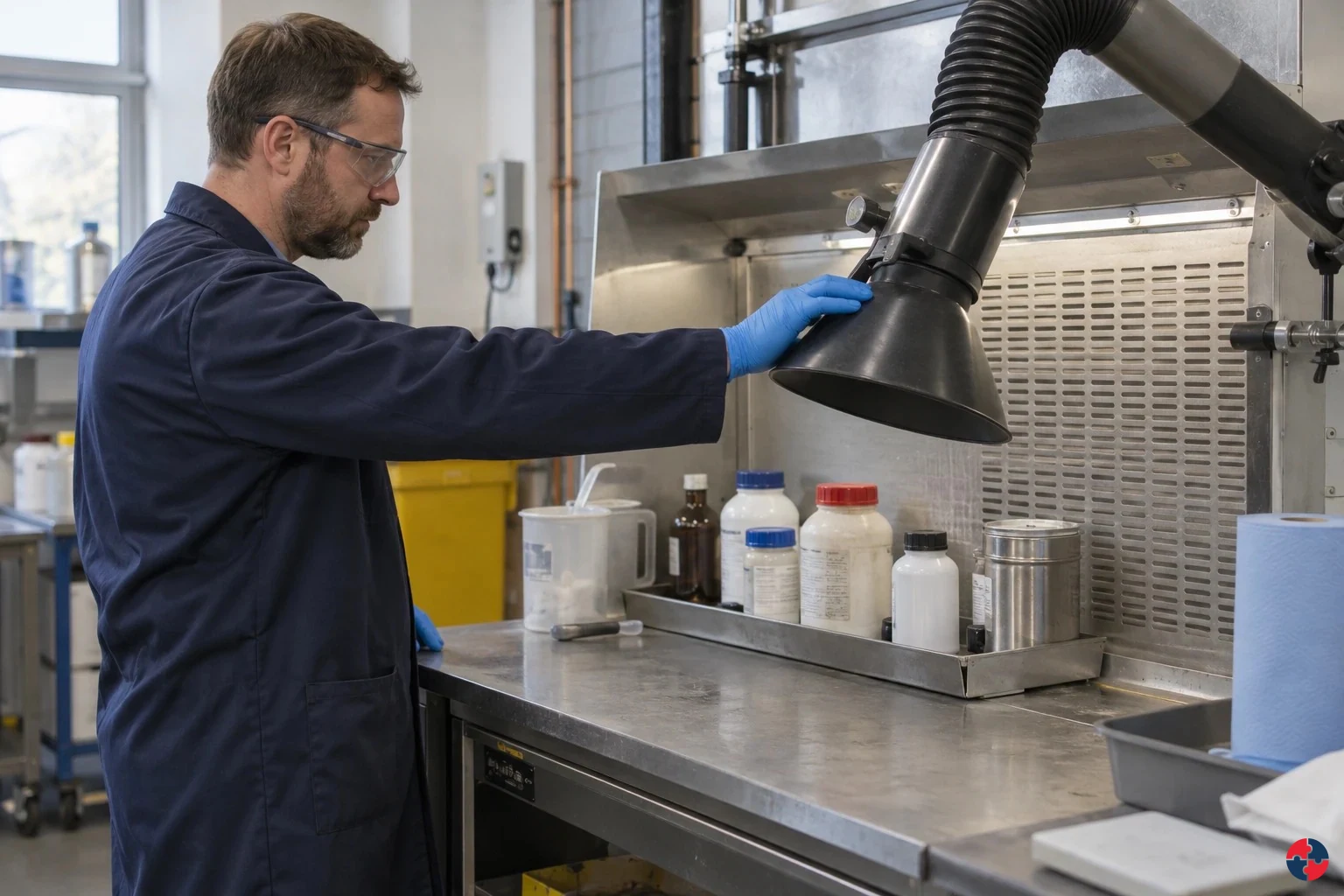
Make the route from splash point to water usable
Practise from a credible splash point using a safe simulation. A person whose vision is impaired may be unable to find a doorway, operate a tap or communicate alone. A chemical splash, powder or mist in the eye can threaten vision.
Turn chemical eye injuries knowledge into a decision
A chemical splash, powder or mist in the eye can threaten vision. Stop exposure, call 999 for a suspected strong chemical or chemical burn, and start immediate continuous rinsing with clean cool or lukewarm water while urgent help is arranged. Chemical register, task COSHH assessments, SDS review and risk register entries.
the leisure operator worked example
Assessing and analysing: Builds a COSHH register covering pool plant, cleaning, kitchens, workshops and contractors, then maps which tasks can expose eyes. Evidence / response: Chemical register, task COSHH assessments, SDS review and risk register entries. Implementing controls: Uses closed dosing where possible, segregated chemical storage, low-splash transfer, ventilation, goggles, face shields and accessible eyewash. Evidence / response: Inspection records, plant checks, PPE issue logs and eyewash test records.
Damage mechanisms
Alkali injury: Sodium hydroxide can cause painful eye inflammation and burns; contact needs prompt response. Acid injury: Sulphuric acid can cause corrosive injury through local pH change; severity needs clinical assessment. Irritant inflammation: The eye becomes red, watery, painful or sensitive.
Choose controls for chemical eye injuries
Elimination: Remove unnecessary manual decanting by using a suitably designed supply and dosing arrangement. Substitution: Evaluate a compatible lower-hazard treatment method or supplied formulation without compromising the required treatment performance. Engineering controls: Segregate hypochlorite from acids and other incompatibles; protect the receiving area and restrict access during replenishment. Engineering controls: Use compatible dedicated connections, containment, ventilation and safeguards against filling the wrong tank. Administrative controls: Confirm exact product, receiving tank and available capacity; agree withdrawal, alarm and emergency communications before connection. Read the full control table for qualifications, ownership and verification. Use the actual task and applicable jurisdiction; existing technical approval remains unchanged.
Use the full chemical eye injuries lesson
Use the full topic for the decision points, practical examples, detailed control tables and source scope. HSE guidance applies to Great Britain; use HSENI for the Northern Ireland route and the source’s stated jurisdiction. A simplified guide does not change the page’s technical-review or approval status.

Read all six steps as text
1. Make the route from splash point to water usable
Practise from a credible splash point using a safe simulation.
- Avoid / redesign: Remove unnecessary manual decanting by using a suitably designed supply and dosing arrangement.
- Control the task: Segregate hypochlorite from acids and other incompatibles; protect the receiving area and restrict access during replenishment.
- Verify before release: If the hazardous step remains, retain a task assessment and select the stronger feasible remaining controls.
Practise from a credible splash point using a safe simulation. A person whose vision is impaired may be unable to find a doorway, operate a tap or communicate alone. A chemical splash, powder or mist in the eye can threaten vision.
Apply it: Which part of this plan would you check at the workface before authorising the task?
2. Turn chemical eye injuries knowledge into a decision
Use the evidence to improve the actual work arrangement.
- Change at source: Remove unnecessary manual decanting by using a suitably designed supply and dosing arrangement.
- Make it observable: If the hazardous step remains, retain a task assessment and select the stronger feasible remaining controls.
- Keep useful evidence: Chemical register, task COSHH assessments, SDS review and risk register entries.
A chemical splash, powder or mist in the eye can threaten vision. Stop exposure, call 999 for a suspected strong chemical or chemical burn, and start immediate continuous rinsing with clean cool or lukewarm water while urgent help is arranged. Chemical register, task COSHH assessments, SDS review and risk register entries.
Apply it: What evidence would show that the change improves this task, rather than only completing a record?
3. the leisure operator worked example
Example: a practical application of the existing topic lesson.
- Assessing and analysing: Builds a COSHH register covering pool plant, cleaning, kitchens, workshops and contractors, then maps which tasks can expose eyes.
- Implementing controls: Uses closed dosing where possible, segregated chemical storage, low-splash transfer, ventilation, goggles, face shields and accessible eyewash.
- Training and competence: Provides awareness for all staff, task training for cleaners and pool teams, and supervisor training on checking controls and stopping unsafe work.
Assessing and analysing: Builds a COSHH register covering pool plant, cleaning, kitchens, workshops and contractors, then maps which tasks can expose eyes. Evidence / response: Chemical register, task COSHH assessments, SDS review and risk register entries. Implementing controls: Uses closed dosing where possible, segregated chemical storage, low-splash transfer, ventilation, goggles, face shields and accessible eyewash. Evidence / response: Inspection records, plant checks, PPE issue logs and eyewash test records.
Apply it: At which point would you hold this example, and what evidence would allow it to proceed?
4. Damage mechanisms
Connect the task, the route to the person and the control that can fail.
- Alkali injury: Sodium hydroxide can cause painful eye inflammation and burns; contact needs prompt response.
- Acid injury: Sulphuric acid can cause corrosive injury through local pH change; severity needs clinical assessment.
- Irritant inflammation: The eye becomes red, watery, painful or sensitive.
Alkali injury: Sodium hydroxide can cause painful eye inflammation and burns; contact needs prompt response. Acid injury: Sulphuric acid can cause corrosive injury through local pH change; severity needs clinical assessment. Irritant inflammation: The eye becomes red, watery, painful or sensitive.
Apply it: Who could be exposed, including other trades, cleaners, maintainers and people nearby?
5. Choose controls for chemical eye injuries
Start with the stronger practicable options and verify their effect.
- Elimination: Remove unnecessary manual decanting by using a suitably designed supply and dosing arrangement.
- Substitution: Evaluate a compatible lower-hazard treatment method or supplied formulation without compromising the required treatment performance.
- Engineering controls: Segregate hypochlorite from acids and other incompatibles; protect the receiving area and restrict access during replenishment.
- Engineering controls: Use compatible dedicated connections, containment, ventilation and safeguards against filling the wrong tank.
- Administrative controls: Confirm exact product, receiving tank and available capacity; agree withdrawal, alarm and emergency communications before connection.
Elimination: Remove unnecessary manual decanting by using a suitably designed supply and dosing arrangement. Substitution: Evaluate a compatible lower-hazard treatment method or supplied formulation without compromising the required treatment performance. Engineering controls: Segregate hypochlorite from acids and other incompatibles; protect the receiving area and restrict access during replenishment. Engineering controls: Use compatible dedicated connections, containment, ventilation and safeguards against filling the wrong tank. Administrative controls: Confirm exact product, receiving tank and available capacity; agree withdrawal, alarm and emergency communications before connection. Read the full control table for qualifications, ownership and verification. Use the actual task and applicable jurisdiction; existing technical approval remains unchanged.
Apply it: Which stronger option can be used here, and who will verify it before accepting the remaining risk?
6. Use the full chemical eye injuries lesson
Follow the official sources below and retain the task-specific evidence.
- Official guidance: UKHSA sodium hypochlorite and incompatible mixing
- Official guidance: HSE five-level hierarchy
- Task decision: Chemical register, task COSHH assessments, SDS review and risk register entries.
Use the full topic for the decision points, practical examples, detailed control tables and source scope. HSE guidance applies to Great Britain; use HSENI for the Northern Ireland route and the source’s stated jurisdiction. A simplified guide does not change the page’s technical-review or approval status.
Apply it: Which official source and full-topic section will you use to resolve the next decision?
For an actual strong-chemical eye exposure, follow the first-response guidance below and continue rinsing while urgent help is arranged. The NHS eye-washing minimum is not a countdown that proves a suspected burn is treated. Keep incident details and safe access to product information available for responders without delaying the immediate response.
Riverside: the nearest eyewash is behind a blocked door
Illustrative example. A pool-plant rehearsal finds that a delivery obstructs the shortest route from dosing work to water.
Decision. The facilities lead pauses the splash-risk task, restores usable access and verifies the alternative response with the trained team.
Evidence to check. A clear route, working water, communication, safe helper positions and a task rehearsal.
Hold or escalation point. Do not restart merely because an eyewash unit exists elsewhere in the building.
Follow-up. Check access during deliveries and maintenance, then test the revised arrangement at a different shift.
Control the splash and keep help immediately reachable
Dosing connections and mortar mixing create different splash scenarios. The source controls and the appropriate immediate-response route must both be planned.
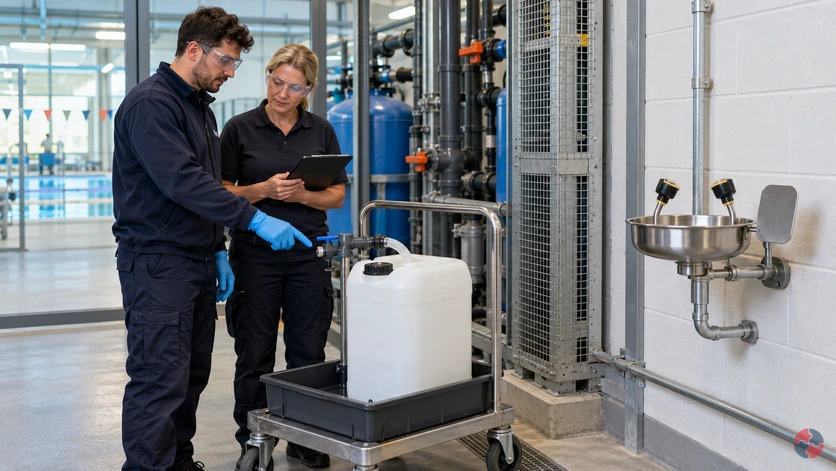
Hold the connection gap; keep immediate help usable
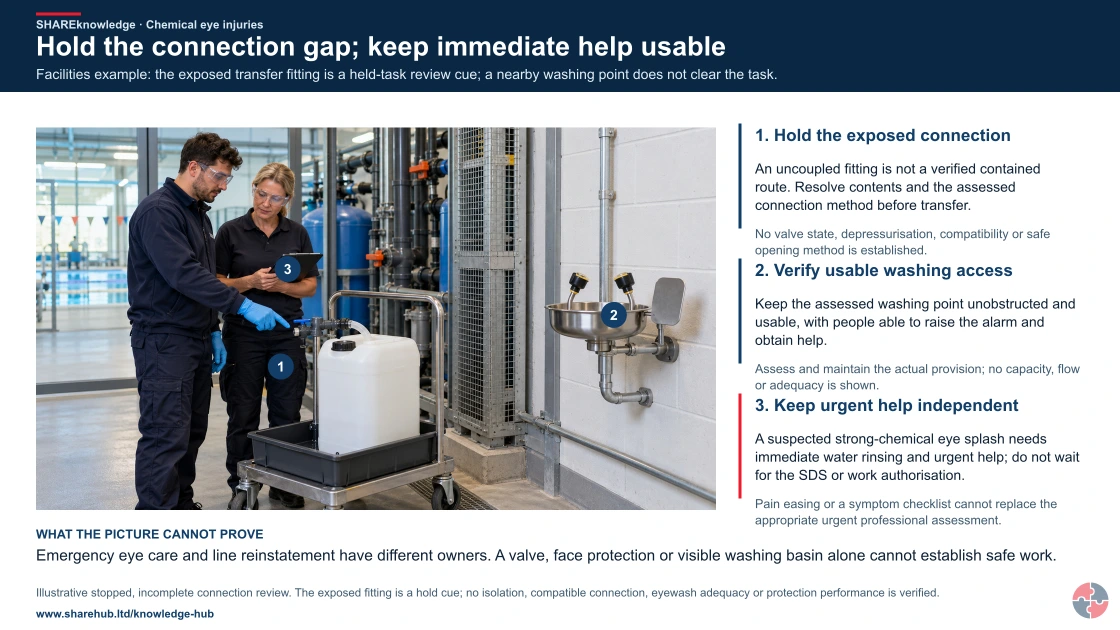
Full written explanation
Facilities example: the exposed transfer fitting is a held-task review cue; a nearby washing point does not clear the task.
- Hold the exposed connection. An uncoupled fitting is not a verified contained route. Resolve contents and the assessed connection method before transfer.
- Verify usable washing access. Keep the assessed washing point unobstructed and usable, with people able to raise the alarm and obtain help.
- Keep urgent help independent. A suspected strong-chemical eye splash needs immediate water rinsing and urgent help; do not wait for the SDS or work authorisation.
Change the pathway
- A handle is not isolation evidence. No valve state, depressurisation, compatibility or safe opening method is established.
- A visible basin is not a design check. Assess and maintain the actual provision; no capacity, flow or adequacy is shown.
- No workplace severity verdict. Pain easing or a symptom checklist cannot replace the appropriate urgent professional assessment.
Evidence check: Emergency eye care and line reinstatement have different owners. A valve, face protection or visible washing basin alone cannot establish safe work.
Full clinically sourced immediate eye-splash response and substance-specific guidance
Primary references: NHS: eye injuries · NHS: acid and chemical burns
Open the complete HD image (new tab)Download image

Full clinically sourced immediate eye-splash response and substance-specific guidance
Primary references: NHS: eye injuries · NHS: acid and chemical burns

Prevention
Avoid or contain the splash-generating task and assess compatible eye/face protection for the actual substance and method.
Usable response
Keep the assessed washing point accessible and ensure people know how to raise the alarm and obtain assistance.
Medical route
Follow the clinically sourced guidance on this page for the actual injury and product; provide relevant substance information safely.
An anatomy view or symptom checklist must not delay appropriate urgent first aid and medical help.
What is a chemical eye injury?
A chemical eye injury is harm to the eye caused by contact with a hazardous substance or chemical release.
The eye is highly vulnerable because the cornea and conjunctiva are delicate, moist tissues. Chemicals can irritate the surface, burn the cornea, damage eyelids, trigger inflammation or penetrate into deeper eye structures. Even short exposure can matter when the substance is corrosive, under pressure, hot, concentrated or difficult to wash away.
Chemical eye injuries are not limited to laboratory acids. They can occur during cleaning, pool-plant dosing, wet cement work, battery handling, spray painting, drain cleaning, vehicle maintenance, pest control, water treatment, chemical manufacture, decanting from bulk containers, waste handling, emergency spill response and maintenance on contaminated equipment.
A good workplace approach does not wait for a first-aid incident. It identifies where substances can reach the eye, removes or redesigns the task where possible, selects controls in the right order, trains people in first response and checks that eyewash, PPE and supervision are reliable at the point of work.
| Aspect | What it means | Why it matters |
|---|---|---|
| Eye contact route | The substance reaches the eye as liquid, dust, mist, aerosol, vapour, gas or contaminated hand contact. | The route determines whether goggles, face protection, ventilation, enclosure, hygiene or emergency washing is needed. |
| Irritant injury | The chemical causes redness, watering, burning or inflammation. | Irritation may still indicate poor COSHH control and can precede more serious harm. |
| Corrosive injury | The chemical damages tissue by acid or alkali action. | Corrosive eye exposures need immediate washing and medical assessment route. |
| Mechanical plus chemical injury | Powder, grit or cement particles injure the surface while also reacting chemically. | Do not treat dusty eye exposure as ordinary foreign-body irritation if the material is hazardous. |
| Delayed deterioration | Symptoms continue or worsen after the worker leaves the area. | Workers should be monitored and escalated where symptoms persist or exposure was significant. |
Where do chemical eye injuries happen in workplaces?
Chemical eye injuries usually happen during transfer, mixing, cleaning, maintenance, pressure release, spraying, dust generation or emergency response.
Many eye injuries occur during routine work that has become normal: tipping concentrate into a bucket, opening a valve, changing a chemical drum, using a spray bottle, cutting hardened concrete, clearing a blockage, rinsing equipment or pouring waste into a container. The exposure happens when the work method allows energy, splash height, incompatible connection, poor container design or human error to place chemicals near the face.
Non-routine work deserves particular attention. Line breaking, drain clearing, maintenance, contractor work, plant cleaning and spill response often involve unknown residues, pressure, awkward positions, degraded containers or people unfamiliar with the local chemicals. These tasks should be assessed as tasks, not just as products listed on a chemical register.
Eye-injury risk is also affected by the people involved. Agency workers, young workers, new starters, contractors, lone workers, workers with limited English and workers wearing prescription glasses or contact lenses may need additional instruction, supervision or PPE arrangements.
| Situation | How the eye exposure happens | Practical control focus |
|---|---|---|
| Decanting and dilution | Splash from pouring, glugging containers, shoulder-height work or wrong valves. | Low-level dispensing, pumps, closed transfer, stable containers, splash guards and goggles. |
| Cleaning and disinfection | Spray, mist, bleach, descaler, caustic cleaner or accidental mixing. | Approved products, no mixing, task instruction, ventilation and correct eye protection. |
| Wet cement and lime | Alkaline slurry or powder enters the eye during mixing, cutting, drilling or splashing. | Avoid splashing, use goggles, wash stations and prevent contaminated glove-to-eye contact. |
| Pool and water treatment | Acids, hypochlorite, dosing chemicals or chlorine-releasing substances splash or fume. | Segregation, dosing systems, ventilation, eyewash, training and emergency plan. |
| Maintenance and line breaking | Residual chemical or trapped pressure releases at face height. | Isolation, drain-down, permit control, face protection and proved zero energy. |
| Spraying and aerosols | Fine droplets drift behind glasses or around poorly fitting protection. | Substitution, enclosure, extraction, spray control and sealed goggles where needed. |
| Waste and spill response | Unknown contents, incompatible waste or contaminated absorbents splash. | Waste approval, labelling, trained responders and suitable PPE/RPE. |
What forms and exposure routes create chemical eye injuries?
Chemical eye injuries can be caused by liquids, powders, dusts, aerosols, vapours, gases and contaminated hands or PPE.
A splash is the obvious route, but it is not the only one. Dust from cement, lime, powders or cutting work can lodge in the eye and react with tears. Aerosols and sprays can pass around ordinary spectacles. Vapours and gases can irritate or chemically affect the eye surface, especially in poorly ventilated areas. Contaminated gloves can transfer chemicals when a worker adjusts eyewear or rubs an irritated eye.
The form of the substance should drive the control method. A low-volatility liquid used in a closed dip tank creates different eye risk from a pressurised caustic spray, powdered cement, solvent mist, ammonia gas or chlorine released by incompatible cleaning products. The COSHH assessment should describe the form created by the task, not just the supplied form in the container.
| Form or route | Typical examples | Control implications |
|---|---|---|
| Liquid splash | Acids, alkalis, solvents, drain cleaners, pool chemicals and disinfectants. | Closed handling, pumps, splash guards, goggles, face shield and eyewash. |
| Powder or dust | Cement, lime, cleaning powder, powdered chemicals and process dust. | Dust suppression, local exhaust ventilation, sealed goggles and hygiene. |
| Mist or aerosol | Spraying, pressure washing, misting, atomising and aerosol cleaners. | Spray control, enclosure, ventilation, goggles and respiratory protection if needed. |
| Vapour or gas | Ammonia, chlorine, solvent vapours and reactive gas releases. | Substitution, ventilation, gas detection, evacuation plan and medical assessment route. |
| Pressurised release | Hoses, blocked lines, pumps, valves and bulk containers. | Isolation, pressure release, maintenance, permits and face protection. |
| Hand-to-eye transfer | Contaminated gloves, sleeves, tools, rags or eyewear. | Glove discipline, doffing, handwashing, clean eyewear storage and supervision. |
How do chemicals damage the eye?
Chemicals can irritate or burn the eye at the point of contact. The substance, concentration, exposure route and contact time affect the harm; heat, pressure and particles may add other injury risks.
The injury mechanism must be checked for the actual chemical. UKHSA describes sulphuric acid injury as a result of local pH change and identifies corrosive eye effects. Its sodium hydroxide information describes eye pain, watering, inflammation, light sensitivity and burns. These are specific substance examples; do not assume all acids, alkalis, solvents or oxidisers behave identically. Prevent eye contact and follow the immediate-rinsing and urgent-help route below.
Cement is a practical work-related example. HSE identifies highly alkaline wet cement and warns that cement can cause chemical burns to the eyes. Keep dry-dust contact and wet splashes under control; do not treat concrete cutting dust as chemically identical to wet cement. Assess lime, caustic cleaners and other products against their own hazard information. See HSE cement guidance.
Eye injuries also have practical work consequences: inability to see clearly, loss of depth perception, pain, distraction, loss of driving ability, problems wearing PPE, absence from work and potential long-term visual impairment. This is why eye injury prevention belongs in the main risk register, not only in a first-aid box check.
| Mechanism | What happens | Typical workplace trigger |
|---|---|---|
| Alkali injury | Sodium hydroxide can cause painful eye inflammation and burns; contact needs prompt response. | Wet cement, lime, caustic soda, ammonia solutions and alkaline cleaners. |
| Acid injury | Sulphuric acid can cause corrosive injury through local pH change; severity needs clinical assessment. | Battery acid, descalers, laboratory acids and some cleaning products. |
| Irritant inflammation | The eye becomes red, watery, painful or sensitive. | Mild chemicals, vapours, fumes, sprays and dusts. |
| Solvent irritation | Check the actual solvent classification and SDS for eye effects; prevent vapour or liquid contact. | Paints, thinners, degreasers, adhesives and spray work. |
| Particle plus chemical harm | A particle scratches or lodges while chemical action continues. | Cement dust, lime dust, contaminated grinding dust or powdered chemicals. |
| Thermal or pressure-assisted injury | Chemical energy combines with pressure, heat or force. | Burst hoses, blocked lines, hot liquids or pressurised sprays. |
For the specific examples, see UKHSA sulphuric acid toxicology and UKHSA sodium hydroxide information. These links explain chemical harm; use the first-response section for immediate action.
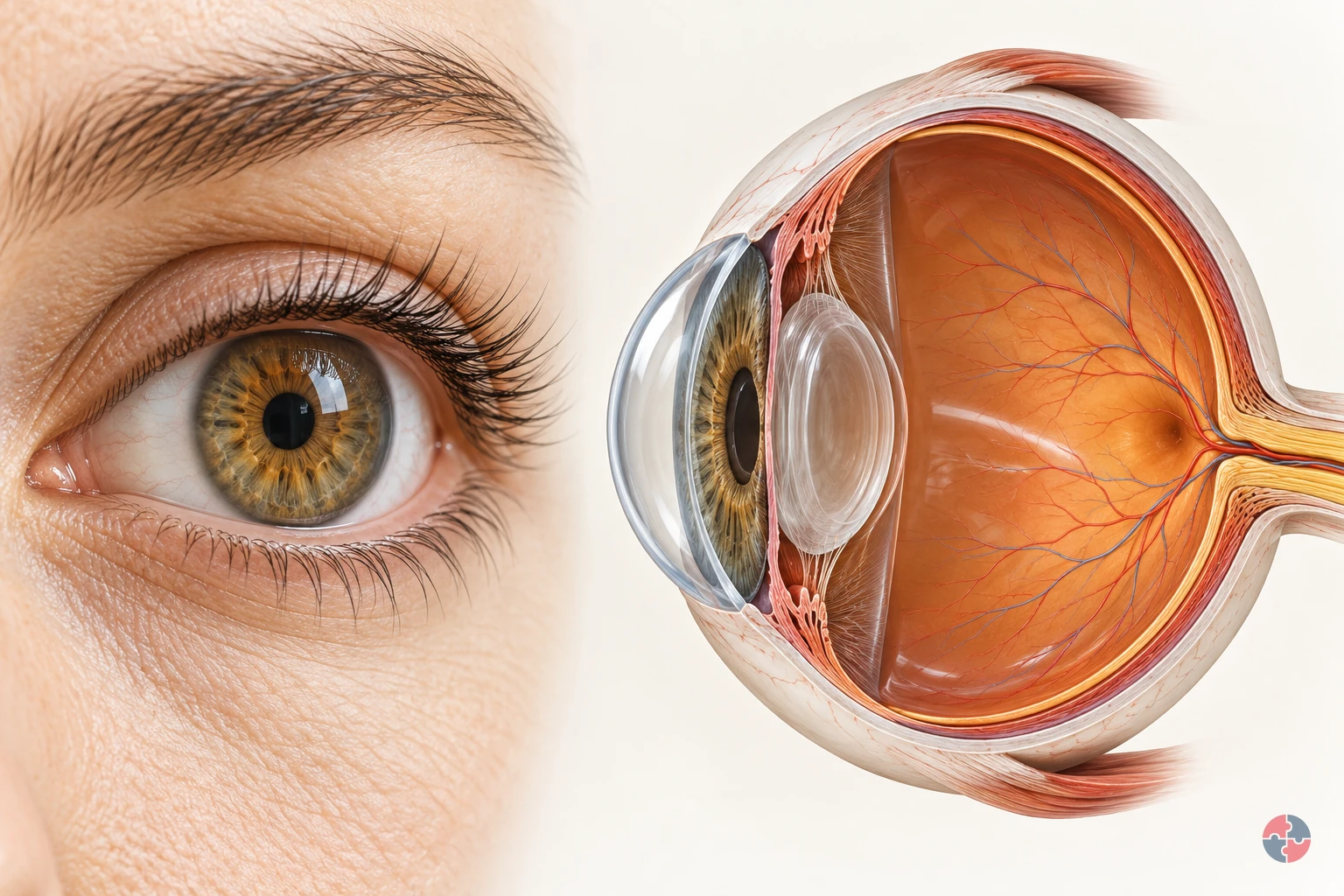

How does the eye turn light into vision, and how do workplace hazards injure it?
Interactive anatomy · Eye function and injury · Updated 2026-10-23
Read all anatomy and process explanations without the viewer
Educational illustration, not a diagnostic symptom checker or a reproduction of an individual’s vision. No acuity/brightness challenge, flashing screen, camera permission, eye-drop prescription, patching instruction, lens-removal manoeuvre or home-neutralisation exercise. Ordinary DSE comfort is separate from trauma; eyesight correction is separate from hazard protection.
Eyelids
Blinking spreads tears over the front of the eye. The eyelids pass over the exposed front of the eye when a person blinks. Their movement spreads the tear film, helping keep that surface moist and smooth. In the surface view, use the lid margins to locate the area they cover. This surface-maintenance role supports the optical pathway; the lid does not carry visual signals to the brain. Moorfields Eye Hospital NHS Foundation Trust: Dry eye: the tear film
Tear film
A thin tear layer keeps the surface moist and smooth. A thin film of tears covers the front of the eye. It lubricates the surface and contributes to a smooth boundary through which light passes. Blinking redistributes this film. Its thickness is enlarged in the teaching view so its position can be seen; it is a surface layer rather than a pool of liquid inside the eyeball. Moorfields Eye Hospital NHS Foundation Trust: Dry eye: the tear film
Cornea
The clear front surface bends incoming light. The transparent cornea forms the curved front of the eye, providing an outer protective boundary and bending incoming light. It works with the lens to focus the light towards the retina. Follow the rays through the front curve in the cutaway, then compare its location with the tear film lying over the surface. Moorfields Eye Hospital NHS Foundation Trust: What makes up your eye
Iris
The coloured ring controls the pupil opening. The iris is the coloured ring around the pupil. Its muscles change the size of the opening and so control how much light can enter the eye. Locate the ring separately from the transparent lens behind it. This light-entry role is different from the focusing work performed by the cornea and lens. Moorfields Eye Hospital NHS Foundation Trust: What makes up your eye
Pupil
An opening lets light enter the eye. The pupil is the central opening in the iris through which light passes. It looks dark when viewed from the front because it opens into the inside of the eye. It is not a solid black disc. In the cutaway, follow the route through this opening towards the transparent lens behind it. Moorfields Eye Hospital NHS Foundation Trust: What makes up your eye
Lens
The clear lens helps focus light on the retina. The transparent lens sits behind the iris and adds to the focusing action of the cornea. In a living eye its shape can change to help focus on objects at different distances. Use the cutaway to locate the lens between the pupil opening and the retina; the simplified ray diagram is not an eyesight test. Moorfields Eye Hospital NHS Foundation Trust: What makes up your eye
Retina
The light-sensitive layer lines the back of the eye. The retina is the light-sensitive tissue lining the inside of the back of the eye. Light focused by the cornea and lens reaches this layer, where specialised cells begin converting it into electrical information. Its position against the inner wall connects the whole-eye view with the separate enlarged photoreceptor inset. Moorfields Eye Hospital NHS Foundation Trust: What makes up your eye · Oxford University Hospitals NHS Foundation Trust: Tackling vision loss: normal signal pathway
Photoreceptors
Specialised retinal cells begin the light-to-signal conversion. Photoreceptors are specialised cells in the retina that respond to light and begin the conversion into electrical signals. Locate the retinal lining first, then connect it with the enlarged cell inset. That inset explains a change of process and scale; it does not represent a separate organ or every cell involved in retinal processing. Oxford University Hospitals NHS Foundation Trust: Tackling vision loss: normal signal pathway
Optic nerve
Visual signals travel from the eye towards the brain. The optic nerve carries electrical information from the retina towards the brain. In the model, the symbol changes from a light ray to a neural signal at the retina to distinguish these processes. Locate where the nerve leaves the back of the eye. Light itself does not travel along the nerve as a beam. Oxford University Hospitals NHS Foundation Trust: Tackling vision loss: normal signal pathway
Brain destination
The brain processes the incoming visual signals. The brain processes the visual information arriving from the eyes, helping us make sense of what we see. This marker shows a destination outside the eyeball rather than a structure within it. Follow the optic-nerve route to the marker after locating the retina; the detailed pathways inside the brain are not depicted here. Oxford University Hospitals NHS Foundation Trust: Tackling vision loss: normal signal pathway
Open the complete process transcript
The process, step by step
1 · Refresh the surface
A blink carries a thin layer of tears across the exposed front of the eye. This tear film keeps the surface moist and helps create a smooth first surface for incoming light. Look at the eyelids and the enlarged tear layer together: the lid spreads the film rather than pushing tears into the eyeball. The surface view separates these structures so their relationship is easier to see. This is the preparation for the optical pathway that follows; a clear view depends on the condition of the front surface as well as the structures deeper inside. Moorfields Eye Hospital NHS Foundation Trust: Dry eye: the tear film
What to watch: Locate the eyelid margins and the thin tear layer in front of the cornea, using the surface view to separate them.
Why it matters: The refreshed film lubricates the front of the eye and helps keep its surface smooth. It supports the passage of light before the cornea and lens focus that light deeper inside.
Explore this step: Select the eyelids, then the tear film, and describe which structure moves and which surface it covers.
2 · Bend incoming light
The cornea is the transparent, curved front of the eye. Incoming light changes direction as it passes through this surface, beginning the focusing process. In the whole-eye cutaway, trace the illustrative rays from outside the eye towards the lens. Their bend shows the cornea doing optical work rather than acting only as a window. The cornea also forms part of the protective outer boundary, so its clarity and shape matter to seeing. The rays simplify the route through a healthy eye; they are not a measurement of an individual person’s focus or vision. Moorfields Eye Hospital NHS Foundation Trust: What makes up your eye
What to watch: Find the clear curved front of the eye and follow where the incoming light rays change direction as they pass through it.
Why it matters: Beginning to direct the light here allows the cornea and lens to work together. A transparent front surface lets light enter while forming part of the eye’s protective boundary.
Explore this step: Trace one ray from outside the cornea to the lens and identify the first place its direction changes.
3 · Focus towards the back
After passing through the cornea, light enters through the pupil, the opening in the coloured iris. The iris changes the size of that opening to control how much light enters. Behind it, the transparent lens works with the cornea to bring light towards the retina at the back. Follow the model from front to back and distinguish the pupil opening from the solid lens. In a living eye the lens can change shape to help focus at different distances. This simplified view explains the route and the relationship between the structures, rather than testing accommodation or eyesight. Moorfields Eye Hospital NHS Foundation Trust: What makes up your eye
What to watch: Identify the iris around the pupil opening, the transparent lens behind it and the light-sensitive retina lining the back of the eye.
Why it matters: Controlling light entry and focusing it are different jobs. Together they allow light to reach the sensitive tissue at the back in a useful pattern for the next stage of vision.
Explore this step: Name the opening light passes through, then the transparent structure it reaches next; follow the route to the retina.
4 · Convert at the retina
The retina is the light-sensitive tissue lining the back of the eye. Its photoreceptor cells respond to light and begin converting it into electrical information. Locate the retinal lining, then use the enlarged cell inset to connect the whole-eye view with this smaller-scale event. The inset makes the conversion easier to discuss without suggesting that the cells are that large inside the eye. At this point the lesson changes from the path of light to the path of a nerve signal. The model does not show every retinal cell or all the processing that takes place between them. Oxford University Hospitals NHS Foundation Trust: Tackling vision loss: normal signal pathway
What to watch: Locate the retina on the inner back wall, then connect it with the enlarged photoreceptor inset outside the whole-eye cutaway.
Why it matters: This conversion connects the eye’s optical system with its nervous system. The focused light pattern can now be represented by signals that travel from the retina towards the brain.
Explore this step: Point to where the light pathway ends and explain why the enlarged cells are an inset rather than another organ.
5 · Carry and interpret the signal
Visual information leaves the retina through the optic nerve and travels towards the brain. The brain processes this incoming information so that we can recognise and make sense of what we see. Follow the model’s neural-signal symbol from the back of the eye to the external brain marker, and compare it with the earlier light rays. The symbols represent different processes: a nerve carries signals, not a beam of light or a miniature picture travelling through a tube. The brain marker identifies the destination outside the eyeball; the detailed visual pathways within the brain are beyond this simplified model. Oxford University Hospitals NHS Foundation Trust: Tackling vision loss: normal signal pathway
What to watch: Find where the optic nerve leaves the back of the eye and trace its route towards the separate brain destination marker.
Why it matters: The earlier stages deliver and convert light; this stage carries the resulting information onwards. Vision therefore depends on the retina, its nerve connection and the brain working with the eye’s optical structures.
Explore this step: Compare the light-ray and neural-signal symbols, then explain what travels through the pupil and what travels through the optic nerve.
Mechanisms and their limits
Chemical injury A chemical splash can harm the surface and front of the eye. The substance and exposure affect the injury; the overlay shows possible affected regions rather than a fixed depth. Immediate rinsing and emergency help take priority over the illustration. Acids, alkalis and named irritants are not interchangeable presets. No pH or penetration simulation is provided. University Hospitals Dorset NHS Foundation Trust: Chemical injury to the eye
Select suitable splash protection
Read current NHS chemical-eye first aid
Chemical injury — follow the anatomy
Look at: The front surface of the eye and the tissues beneath it.
What changes: A chemical can damage the surface and, depending on the substance, penetrate deeper.
Why it matters: A chemical burn can threaten sight even when the outside appearance seems limited.
What to do: Rinse immediately with plenty of clean, non-hot water; for a strong chemical, go to A&E or call 999 and keep rinsing while waiting.
A concentrated-cleaner splash to the eye
During cleaning, liquid splashes from an open transfer close to a worker’s face. Irrigation and help start immediately in reality. Thirty-two seconds is only the explanation length, not an acceptable delay or a complete rinse. Chemical type and exposure affect injury. The older chemical-eye leaflet supports the broad mechanism only; current NHS eye-injury guidance controls the immediate action.
Reduce the splash opportunity An open container is being handled at face level. Review transfer arrangements and eye/face protection selected for the chemical and task. HSE: Using the right type of PPE
Chemical reaches the eye surface The splash contacts the cornea and surrounding surface. This is a chemical-contact route, not a flying shard or a mechanical surface graze. University Hospitals Dorset NHS Foundation Trust: Chemical injury to the eye · NHS: Eye injuries
Surface and anterior injury are possible An annotated region shows possible injury to the front of the eye; some chemicals can penetrate further. The diagram does not predict depth from splash size, pH or pain. University Hospitals Dorset NHS Foundation Trust: Chemical injury to the eye
Rinse now and get emergency help Begin copious clean-water irrigation and follow the eye guidance for at least 20 minutes while arranging emergency assessment. Keep rinsing as directed; do not neutralise with another chemical or wait for playback. NHS: Eye injuries
Read the practice situations and all answer explanations
EY-Q1: What should happen first?
A strong cleaning chemical splashes into an eye. Immediate help is displayed before the question.
Watch the demonstration before taking action. — Do not delay rinsing or medical help for this lesson.
Begin rinsing with plenty of clean, non-hot water and get emergency help. — Hold the eye open and use a gentle water flow for at least 20 minutes; keep rinsing while waiting for help.
Add a household chemical to neutralise it. — Use the water-rinsing route and medical help, not improvised chemical neutralisation.
NHS: Eye injuries · University Hospitals Dorset NHS Foundation Trust: Chemical injury to the eyeEY-Q2: What is the appropriate response?
A fragment strikes an eye during grinding.
Seek emergency assessment; leave any pierced object in place. — High-speed impact needs emergency assessment. Do not rub the eye or remove a pierced object.
Pull out anything that appears to be stuck. — Do not attempt removal. Get emergency help.
Return to work if vision seems unchanged. — Feeling able to see is not clearance after a high-speed injury.
NHS: Eye injuries · University Hospital Southampton NHS Foundation Trust: Eye emergency departmentEY-Q3: Which statement is correct?
A worker is close to welding without a task-specific eye-protection assessment.
No immediate pain proves the eyes are unharmed. — Arc-eye pain may start several hours later. Lack of immediate pain does not establish safety.
Ordinary spectacles protect against every welding hazard. — Corrective spectacles are not a complete hazard assessment. Impact, splash and radiation protection require suitable selection.
Protection must match the radiation hazard, and pain may be delayed. — Correct. Control exposure and select appropriate protection for the task and nearby people. The lesson provides no safe viewing time.
HSE: Health risks from welding: arc-eye · HSE: Using the right type of PPESources and how the model is made
The opening images are AI-generated anatomical illustrations. The interactive 3D models and labelled SVG diagrams use original procedural artwork. These teaching images are not medical scans or diagnostic tools. Source references support the learner explanations and do not grant artwork rights.
- Moorfields Eye Hospital NHS Foundation Trust: What makes up your eye — Normal cornea, iris, pupil, lens and posterior eye layout; use anatomy text selectively. No image copied.
- Moorfields Eye Hospital NHS Foundation Trust: Dry eye: the tear film — Blinking spreads the tear film, which lubricates the eye and supports a smooth surface. No treatment instructions copied.
- Guy’s and St Thomas’ NHS Foundation Trust: Corneal abrasion — A scratch/graze of the cornea and the distinction between a superficial injury and complications; no healing-time promise or eye treatment prescribed.
- NHS: Eye injuries — March 2026 guidance: immediate chemical irrigation and emergency help; high-speed/penetrating injury; severe pain or sight changes. Minimum rinsing time is not a clearance test.
- University Hospitals Dorset NHS Foundation Trust: Chemical injury to the eye — Possible surface/anterior-segment damage only. Printed review date November 2023 is overdue; current emergency actions rely on EY-S4, not this leaflet alone.
- HSE: Health risks from welding: arc-eye — Welding radiation can injure the cornea, cause delayed pain and harm other eye structures; no safe viewing time.
- HSE: Using the right type of PPE — Eye protection must match impact, splash, dust or radiation hazards and fit the task/user.
- Oxford University Hospitals NHS Foundation Trust: Tackling vision loss: normal signal pathway — Photoreceptors convert light to electrical signals, carried through the optic nerve to the brain. Research treatment content is not reused.
- NHS Organ Donation: About cornea donation — Injury or disease can leave the cornea cloudy/distorted and affect vision. Source is factual context, not donation advice in this lesson.
- University Hospital Southampton NHS Foundation Trust: Eye emergency department — Chemical injury, penetrating trauma and severe visual symptoms require emergency eye care. Local opening hours/contact instructions are not generalised.
What should happen after a chemical enters the eye?
Start flushing immediately and get urgent help; call 999 for a suspected strong chemical or chemical burn in the eye.
Move away from the release without putting a helper in danger. Rinse with plentiful clean cool or lukewarm running water, gently keeping the eyelids open, and continue while emergency help is arranged. The NHS chemical-burn page advises about one hour of flushing; its eye-injury guidance says rinse for at least 20 minutes. Do not interpret the shorter minimum as a reason to stop when a chemical burn is suspected. Do not delay for a branded eyewash or SDS, and do not try to neutralise the chemical. Do not delay washing to remove a contact lens; follow first-aider or clinician advice about removal. Clinicians and the product SDS guide exceptional substances and further treatment.
Give clinicians the product identity, concentration, SDS, exposure time and irrigation start time. Keep the task stopped until the splash route and eyewash access are corrected. Even if pain settles, a suspected chemical eye injury needs urgent professional assessment; only clinicians determine severity and return-to-work advice.
On a small screen, scroll this table sideways to read all columns.
| Step/owner | Do now | Stop/repair cue |
|---|---|---|
| Worker/helper | Stop exposure, call 999 for suspected chemical burn and start water rinse. | Do not wait for supervisor or specialist bottle. |
| First aider | Keep eyelids open gently and continue irrigation while help is arranged. | Do not neutralise or force out a stuck lens. |
| Supervisor | Hand SDS/exposure facts to clinicians; isolate task. | No restart before failed splash and eyewash controls are repaired. |
How should chemical eye-injury risk be assessed?
Chemical eye-injury risk should be assessed by substance, task, form, route, people, control reliability and emergency response.
A strong COSHH assessment asks what can actually reach the eye during normal, abnormal and emergency conditions. It should consider the product classification, pH, concentration, quantity, temperature, pressure, container design, transfer height, task duration, worker posture, location of eyewash and whether the worker can self-rescue.
The assessment should also include foreseeable misuse and error. People may use a stronger product, mix chemicals, remove goggles because they mist, use a damaged spray head, open the wrong valve, work above shoulder height, take shortcuts during cleaning or wear prescription glasses that do not provide splash protection.
For higher-risk work, the assessment should connect to permits, isolation, line-breaking, contractor management, emergency showers, spill response, respiratory protective equipment and process safety barriers. Eye exposure may be the visible outcome of a wider containment failure.
| Assessment area | Questions to answer | Evidence to keep |
|---|---|---|
| Substance hazard | Is it corrosive, irritant, toxic, sensitising, volatile, reactive or under pressure? | SDS, CLP classification, label and COSHH assessment. |
| Task route | Can it splash, spray, mist, dust, fume, drip, squirt or transfer from gloves? | Task observation, photos, work method and worker feedback. |
| People affected | Are new starters, contractors, visitors, cleaners, first aiders or contact-lens wearers affected? | Induction, briefing and specific arrangements. |
| Control reliability | Do controls work when the task is rushed, awkward, wet, cold, fogging goggles or outside normal hours? | Inspections, observations and defect reports. |
| Emergency arrangements | Can workers reach eyewash quickly and do they know what to do? | Eyewash checks, drills, first-aid needs assessment and training records. |
| Learning triggers | Have splashes, near misses, eye irritation or PPE defects been reported? | Incident reports, trend reviews and corrective actions. |
How can the hierarchy of controls prevent chemical splashes and eye injuries?
ERICPD keeps chemical eye-injury control focused on removing and reducing splash risk before relying on PPE and behaviour.
Eye protection is important, but it is rarely the first control. The stronger approach is to eliminate unnecessary chemicals, buy safer products, dilute automatically, use closed transfer, lower the work height, reduce pressure, avoid sprays, fit splash guards, improve container design and keep faces out of the line of fire.
PPE then protects against residual risk. If goggles are the only meaningful control, the system is fragile: goggles may mist, be removed, fit poorly over prescription glasses, become scratched or fail to protect the face from a pressurised jet. Discipline, training and supervision are needed, but they should support a well-designed task.
Choose the activity
How can the ERICPD hierarchy of controls reduce risks while replenishing hypochlorite dosing stock?

| Control level | Control for this activity | Owner and verification | Stop / restart decision |
|---|---|---|---|
| Eliminate | Remove unnecessary manual decanting by using a suitably designed supply and dosing arrangement. | Process owner verifies that the revised workflow achieves the required output and the hazardous step is genuinely removed. | If the hazardous step remains, retain a task assessment and select the stronger feasible remaining controls. |
| Reduce, including substitution | Evaluate a compatible lower-hazard treatment method or supplied formulation without compromising the required treatment performance. | Process/technical owner validates the alternative, its compatibility and any new risks before adoption. | Reject the alternative if suitability is unproved or its new hazards are unresolved. |
| Isolate | Segregate hypochlorite from acids and other incompatibles; protect the receiving area and restrict access during replenishment. | Supervisor verifies the task boundaries and that the separation or isolation protects affected people and connected work. | Hold or stop for wrong connection, leak, gas alarm, unexpected reaction or uncertain product identity. |
| Control: physical safeguards | Use compatible dedicated connections, containment, ventilation and safeguards against filling the wrong tank. | Competent equipment/process owner checks product and tank identity, connection compatibility, capacity and ventilation. | Hold or stop for wrong connection, leak, gas alarm, unexpected reaction or uncertain product identity. |
| Control: work method and response | Confirm exact product, receiving tank and available capacity; agree withdrawal, alarm and emergency communications before connection. | Supervisor confirms the limits, response, communication and restart authority with the people doing this activity. | Stop if the agreed method, communication, competent cover or task limits cannot be maintained. |
| PPE | Select chemical splash protection for the product and method; ordinary masks do not protect against chlorine gas. | Assessor confirms whether PPE is needed and checks selection, condition, compatibility and any required face-fit evidence. | Do not rely on unsuitable or defective protection, or use PPE to continue after an essential source control fails. |
| Discipline | Inspect connections, close the delivery record and reconcile stock; investigate wrong-product or residue concerns before reuse. | Release only after operations verifies a secure system and closes the replenishment record. Retain the checks and unresolved restrictions at handover. | Keep the activity on hold while defects or required reinstatement evidence remain unresolved. |
How can the ISO 45001 hierarchy of controls reduce risks while replenishing hypochlorite dosing stock?

| Control level | Control for this activity | Owner and verification | Stop / restart decision |
|---|---|---|---|
| Elimination | Remove unnecessary manual decanting by using a suitably designed supply and dosing arrangement. | Process owner verifies that the revised workflow achieves the required output and the hazardous step is genuinely removed. | If the hazardous step remains, retain a task assessment and select the stronger feasible remaining controls. |
| Substitution | Evaluate a compatible lower-hazard treatment method or supplied formulation without compromising the required treatment performance. | Process/technical owner validates the alternative, its compatibility and any new risks before adoption. | Reject the alternative if suitability is unproved or its new hazards are unresolved. |
| Engineering controls | Segregate hypochlorite from acids and other incompatibles; protect the receiving area and restrict access during replenishment. | Supervisor verifies the task boundaries and that the separation or isolation protects affected people and connected work. | Hold or stop for wrong connection, leak, gas alarm, unexpected reaction or uncertain product identity. |
| Engineering controls | Use compatible dedicated connections, containment, ventilation and safeguards against filling the wrong tank. | Competent equipment/process owner checks product and tank identity, connection compatibility, capacity and ventilation. | Hold or stop for wrong connection, leak, gas alarm, unexpected reaction or uncertain product identity. |
| Administrative controls | Confirm exact product, receiving tank and available capacity; agree withdrawal, alarm and emergency communications before connection. | Supervisor confirms the limits, response, communication and restart authority with the people doing this activity. | Stop if the agreed method, communication, competent cover or task limits cannot be maintained. |
| PPE | Select chemical splash protection for the product and method; ordinary masks do not protect against chlorine gas. | Assessor confirms whether PPE is needed and checks selection, condition, compatibility and any required face-fit evidence. | Do not rely on unsuitable or defective protection, or use PPE to continue after an essential source control fails. |
| Administrative controls | Inspect connections, close the delivery record and reconcile stock; investigate wrong-product or residue concerns before reuse. | Release only after operations verifies a secure system and closes the replenishment record. Retain the checks and unresolved restrictions at handover. | Keep the activity on hold while defects or required reinstatement evidence remain unresolved. |
How can the ERICPD hierarchy of controls reduce risks while mixing mortar from bagged cement?

| Control level | Control for this activity | Owner and verification | Stop / restart decision |
|---|---|---|---|
| Eliminate | Use suitable ready-mixed mortar or preformed components where that removes the local bag-emptying or mixing task. | Process owner verifies that the revised workflow achieves the required output and the hazardous step is genuinely removed. | If the hazardous step remains, retain a task assessment and select the stronger feasible remaining controls. |
| Reduce, including substitution | Select a suitable less dusty supplied form or alternative construction method after checking strength and other task hazards. | Process/technical owner validates the alternative, its compatibility and any new risks before adoption. | Reject the alternative if suitability is unproved or its new hazards are unresolved. |
| Isolate | Place the mixing station away from occupied routes and protect nearby people from dust and splashes. | Supervisor verifies the task boundaries and that the separation or isolation protects affected people and connected work. | Hold or stop for uncontrolled dust, splash exposure, defective protection or unavailable washing. |
| Control: physical safeguards | Use suitable controlled charging, stable mixer access and source dust control; avoid high drop heights and uncontrolled pouring. | Competent equipment/process owner checks cement identity, mixer access, charging method and accessible washing facilities. | Hold or stop for uncontrolled dust, splash exposure, defective protection or unavailable washing. |
| Control: work method and response | Follow the mixer procedure, prohibit reaching into moving equipment and keep immediate washing facilities available. | Supervisor confirms the limits, response, communication and restart authority with the people doing this activity. | Stop if the agreed method, communication, competent cover or task limits cannot be maintained. |
| PPE | Use suitable eye protection for dust or splashes and compatible alkaline-resistant skin protection; avoid contaminated gloves touching the face. | Assessor confirms whether PPE is needed and checks selection, condition, compatibility and any required face-fit evidence. | Do not rely on unsuitable or defective protection, or use PPE to continue after an essential source control fails. |
| Discipline | Check the charging method, protection and washing facilities; record and correct splash or dust incidents before repeating the task. | Release only after supervisor confirms the controlled method and functioning washing provision. Retain the checks and unresolved restrictions at handover. | Keep the activity on hold while defects or required reinstatement evidence remain unresolved. |
How can the ISO 45001 hierarchy of controls reduce risks while mixing mortar from bagged cement?

| Control level | Control for this activity | Owner and verification | Stop / restart decision |
|---|---|---|---|
| Elimination | Use suitable ready-mixed mortar or preformed components where that removes the local bag-emptying or mixing task. | Process owner verifies that the revised workflow achieves the required output and the hazardous step is genuinely removed. | If the hazardous step remains, retain a task assessment and select the stronger feasible remaining controls. |
| Substitution | Select a suitable less dusty supplied form or alternative construction method after checking strength and other task hazards. | Process/technical owner validates the alternative, its compatibility and any new risks before adoption. | Reject the alternative if suitability is unproved or its new hazards are unresolved. |
| Engineering controls | Place the mixing station away from occupied routes and protect nearby people from dust and splashes. | Supervisor verifies the task boundaries and that the separation or isolation protects affected people and connected work. | Hold or stop for uncontrolled dust, splash exposure, defective protection or unavailable washing. |
| Engineering controls | Use suitable controlled charging, stable mixer access and source dust control; avoid high drop heights and uncontrolled pouring. | Competent equipment/process owner checks cement identity, mixer access, charging method and accessible washing facilities. | Hold or stop for uncontrolled dust, splash exposure, defective protection or unavailable washing. |
| Administrative controls | Follow the mixer procedure, prohibit reaching into moving equipment and keep immediate washing facilities available. | Supervisor confirms the limits, response, communication and restart authority with the people doing this activity. | Stop if the agreed method, communication, competent cover or task limits cannot be maintained. |
| PPE | Use suitable eye protection for dust or splashes and compatible alkaline-resistant skin protection; avoid contaminated gloves touching the face. | Assessor confirms whether PPE is needed and checks selection, condition, compatibility and any required face-fit evidence. | Do not rely on unsuitable or defective protection, or use PPE to continue after an essential source control fails. |
| Administrative controls | Check the charging method, protection and washing facilities; record and correct splash or dust incidents before repeating the task. | Release only after supervisor confirms the controlled method and functioning washing provision. Retain the checks and unresolved restrictions at handover. | Keep the activity on hold while defects or required reinstatement evidence remain unresolved. |
Worked control choice: pool-plant dosing and eye splash
Use HSE’s five-level hierarchy to choose stronger measures before PPE. ERICPD is a useful six-part teaching mnemonic; it is not a separate legal test. The example maps both approaches to the real task. Apply HSENI COSHH guidance for a Northern Ireland workplace. Emergency washing and evacuation limit consequences; they do not prevent the original contact or mixing.
What eye and face protection is suitable for chemical work?
Eye and face protection must match the chemical form, splash energy, task position, wearer and other PPE.
The question is not whether the worker is wearing something over their eyes; it is whether the protection can stop the foreseeable exposure reaching the eye. Ordinary safety spectacles may protect from some impact hazards but usually leave gaps around the eye. Chemical splash goggles give better enclosure. Face shields protect more of the face but may allow liquid to travel underneath or around the sides, so they are often used over goggles for splash tasks.
Selection should also consider fogging, prescription eyewear, compatibility with respiratory protective equipment, cleaning, scratches, chemical resistance, comfort, storage and replacement. If PPE is uncomfortable or makes the task hard to see, workers are more likely to lift it at the worst moment.
| Protection type | Where it may fit | Limitations to manage |
|---|---|---|
| Safety spectacles | Lower splash probability and mainly impact or nuisance dust tasks. | Side gaps mean they may be unsuitable for liquids, powders or sprays. |
| Chemical goggles | Liquid splash, dust, powders, aerosols or corrosive handling. | Need correct fit, anti-mist management, cleaning and compatibility with prescription eyewear. |
| Face shield | Higher splash energy, face exposure, pouring, decanting or pressure risk. | Usually needs goggles underneath because a shield alone may not seal the eyes. |
| Full-face respirator | Combined eye, face and respiratory protection for defined higher-risk tasks. | Requires RPE assessment, face fit, maintenance, cartridge selection and user competence. |
| Prescription safety eyewear | Workers needing vision correction during eye-hazard work. | Must be suitable safety eyewear; ordinary glasses are not chemical splash goggles. |
What eyewash and emergency facilities are needed?
Provide immediate access to enough clean water for the foreseeable eye exposure, with a practised route to urgent help.
Assess concentration, transfer method, likely splash volume and distance to washing. A small bottle may start irrigation at a remote task but must not be treated as sufficient for a major corrosive splash if continued water is needed. Check access while a person may have impaired vision, suitable flow and drainage, maintenance, winter protection, signs, staff knowledge and 999 communications. A supervisor should test the actual route and hold the job if the eyewash is blocked or unavailable. The emergency plan needs competent review for exceptional chemicals and other site hazards.
On a small screen, scroll this table sideways to read all columns.
| Control and owner | Check | Failure response |
|---|---|---|
| Access — supervisor | Walk from actual task to water without entering hazard. | Hold task if blocked or too slow. |
| Capacity — first-aid lead | Check water supply supports prolonged flushing. | Provide suitable alternative before work. |
| Maintenance — facilities lead | Inspect cleanliness, function and signs. | Tag out faulty unit and stop exposed work. |
| Drill — first-aid lead | Worker demonstrates rinse, help call and SDS handover. | Retrain and correct failed step. |
Which duties apply to chemical eye-injury prevention?
Use COSHH and location-specific first-aid and PPE duties to prevent contact and prepare for an immediate response; reportability needs a case-specific test.
GB COSHH 2002 and NI COSHH 2003 require prevention or adequate control of hazardous substance exposure. Eye and face PPE must suit the substance and task after source controls, and first-aid provision must reflect the site needs assessment. A splash is not automatically RIDDOR-reportable; the actual injury, outcome and jurisdiction decide. Record and investigate near misses even when statutory reporting is not triggered.
On a small screen, scroll this table sideways to read all columns.
| Decision | Great Britain | Northern Ireland |
|---|---|---|
| Substance exposure | GB COSHH 2002, HSE task guidance. | NI COSHH 2003, HSENI guidance. |
| PPE and first aid | Suitable PPE and GB first-aid needs assessment. | Suitable PPE and NI first-aid needs assessment. |
| Report and restart | Check GB RIDDOR against facts; repair control. | Check NI RIDDOR against facts; repair control. |
Use HSE reportable-incident categories for Great Britain and HSENI reporting guidance for Northern Ireland. Test the actual injury/outcome against the applicable criteria; keep investigation and control repair moving even when a splash is not reportable.
What should the risk register include for chemical eye injuries?
The risk register should describe the credible eye-injury event, route of exposure, controls, emergency response and assurance evidence.
A useful risk register entry names the activity, not just the chemical. For example, 'caustic drain cleaner decanting into small containers' is more useful than 'cleaning chemicals'. It should state who may be harmed, how the exposure could occur, how severe it could be, what controls prevent it and what proves those controls are working.
Eye injury controls should also appear in inspection and assurance plans. Eyewash checks, PPE condition, task observations, SDS availability, product approval and training records provide early warning before a serious splash.
| Event or issue | Risk route | Preventing controls | Evidence to check |
|---|---|---|---|
| Corrosive liquid splash during decanting | Liquid released at face height or from wrong valve. | Closed transfer, low-level dispensing, goggles, face shield and supervision. | Task observation, PPE checks, work instruction and incident review. |
| Powder or cement dust in eyes | Dust generated during mixing, cutting, emptying bags or cleaning. | Dust suppression, LEV, wet methods, goggles and cleaning controls. | COSHH assessment, inspections and worker feedback. |
| Spray or mist bypassing spectacles | Aerosol travels around glasses or enters from side gaps. | Avoid sprays, use enclosure, ventilation and sealed goggles. | PPE selection record and supervision checks. |
| Eyewash unavailable or inadequate | Blocked, empty, dirty, frozen, too far away or not known by workers. | Suitable provision, inspection, signage and drills. | Eyewash inspection log, first-aid needs assessment and drill notes. |
| Poor learning after minor splash | Small incidents are treated as personal carelessness. | Investigation, trend review and corrective action. | Incident reports, action tracker and management review. |
How could Riverside Leisure Ltd manage chemical eye injuries?

Riverside Leisure Ltd could manage chemical eye injuries by connecting pool plant, cleaning work, contractor control, training and first-aid arrangements into one practical system.
Urgent eye care and line reinstatement are separate routes
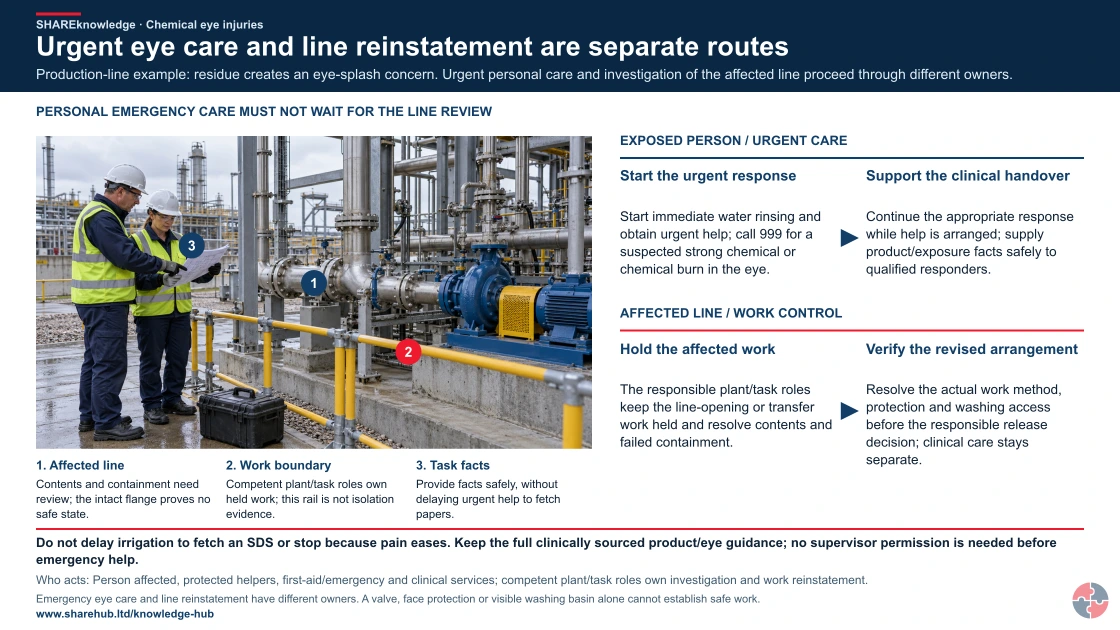
Full written explanation
Two independent lanes distinguish urgent personal care from control of the affected production line. A detailed process-plant scene shows an intact flanged line, pump, physical work boundary and normal uninjured colleagues reviewing inert task papers from outside. Picture key: 1 identifies the affected line; 2 identifies the work boundary; 3 identifies task facts. The physical picture supports the affected-line work-control context only: it demonstrates no exposure, injured person, clinical care or emergency performance. Intact pipework and a rail establish no contents, residue identity, pressure, isolation, containment performance or permission to open or resume work. Task facts can support separate competent review and safe factual handover without delaying urgent help to fetch paperwork. Urgent personal care and affected-line work control each follow their own two-stage route, with unnumbered headings and within-lane order. The line review does not authorise, delay or condition urgent personal care. Read the full response, handover, held-work and revised-arrangement requirements together with the linked clinical guidance. A visible washing basin, valve, face protection or source document cannot establish suitable provision, protection or work readiness. No eye injury, anatomy, splash, irrigation method, treatment demonstration, timer, numerical condition or new emergency procedure is depicted.
Production-line example: residue creates an eye-splash concern. Urgent personal care and investigation of the affected line proceed through different owners.
- Start the urgent response. Start immediate water rinsing and obtain urgent help; call 999 for a suspected strong chemical or chemical burn in the eye.
- Support the clinical handover. Continue the appropriate response while help is arranged; supply product/exposure facts safely to qualified responders.
- Hold the affected work. The responsible plant/task roles keep the line-opening or transfer work held and resolve contents and failed containment.
- Verify the revised arrangement. Resolve the actual work method, protection and washing access before the responsible release decision; clinical care stays separate.
When the evidence does not fit: Do not delay irrigation to fetch an SDS or stop because pain eases. Keep the full clinically sourced product/eye guidance; no supervisor permission is needed before emergency help.
Who acts: Person affected, protected helpers, first-aid/emergency and clinical services; competent plant/task roles own investigation and work reinstatement.
Changed workplace
Facilities transfer: Resolve the source and keep immediate washing/help usable; a nearby basin does not correct an exposed connection.
Production line with residue: Use urgent personal care independently while competent roles investigate the affected work and verify the revised controls.
Evidence check: Emergency eye care and line reinstatement have different owners. A valve, face protection or visible washing basin alone cannot establish safe work.
Full clinically sourced immediate eye-splash response and substance-specific guidance
Primary references: NHS: eye injuries · NHS: acid and chemical burns
Open the complete HD image (new tab)Download image

Full clinically sourced immediate eye-splash response and substance-specific guidance
Primary references: NHS: eye injuries · NHS: acid and chemical burns
Riverside Leisure Ltd is used here as an example: a leisure, hospitality and outdoor activity business with swimming pools, plant rooms, cleaning teams, maintenance contractors, kitchens, workshops and public areas. Its chemical eye-injury risks include pool chemicals, acids, hypochlorite, descalers, cleaning sprays, dishwasher chemicals, battery products, maintenance fluids and contractor substances.
The business starts with a chemical register and COSHH assessment for each substance and task. It separates storage for incompatible pool chemicals, restricts access to plant rooms, replaces high-splash manual decanting with closed dosing where practicable, and requires contractors to declare chemicals before work starts. The risk register records credible events such as acid splash during cleaning, hypochlorite exposure during dosing, dishwasher chemical splash, and vapour irritation in poorly ventilated areas.
Supervisors check controls at the point of work: labelled containers, locked stores, clean goggles, eyewash access, SDS availability, no blocked plant-room exit, and workers able to explain what to do after a splash. Incidents and near misses are reviewed by location and task so the organisation can improve procurement, training, signage, equipment and maintenance rather than treating each event as isolated behaviour.
| Management area | How Riverside applies the control | Evidence and improvement |
|---|---|---|
| Assessing and analysing | Builds a COSHH register covering pool plant, cleaning, kitchens, workshops and contractors, then maps which tasks can expose eyes. | Chemical register, task COSHH assessments, SDS review and risk register entries. |
| Implementing controls | Uses closed dosing where possible, segregated chemical storage, low-splash transfer, ventilation, goggles, face shields and accessible eyewash. | Inspection records, plant checks, PPE issue logs and eyewash test records. |
| Training and competence | Provides awareness for all staff, task training for cleaners and pool teams, and supervisor training on checking controls and stopping unsafe work. | Training matrix, observed task sign-off, refresher triggers and supervisor coaching notes. |
| Contractor and procurement control | Approves products before use and requires contractors to provide SDS, method statements and PPE details for chemical tasks. | Approved chemical list, contractor RAMS review and induction records. |
| Oversight and audit | Duty managers complete short checks, facilities managers review trends, and the H&S adviser audits higher-risk areas. | First-line checks, second-line audits, action tracker and management review. |
| Learning and improvement | Reviews splashes, eye irritation, blocked eyewash, missing goggles and worker feedback to improve the system. | Incident reports, lessons learned briefings and procurement or procedure changes. |
What should each role learn and demonstrate?
Learning must match the decisions people make, from recognising danger to checking that controls work.
Briefings should tell people how to act, but attendance alone does not show competence. Assess the real decision or task, record who assessed it and revisit after a material change, failed control or incident. A local authorisation is task-specific; no universal external certificate is implied.
On a small screen, scroll this table sideways to read all columns.
| Role and learning | Demonstration and assessor | Record and reassessment trigger |
|---|---|---|
| Worker: splash avoidance and immediate rinse. | First-aid lead observes a simulated eye splash: stop, 999 and prompt running-water flush. | Scenario result; repeat after task/layout change. |
| Handler: decanting and eye protection. | Supervisor observes low-splash transfer, shield/goggle suitability and doffing. | Task authorisation; repeat after product change. |
| Facilities/first-aid lead: water readiness. | Walk-through tests access, flow, maintenance and handover. | Check/drill log; repair after failure. |
| Safety adviser: jurisdiction and review. | Competent reviewer checks GB/NI route, assessment and incident criteria. | Dated decision; revisit after injury or new chemical. |
How does chemical eye-injury risk support study and professional development?
Chemical eye-injury risk helps learners apply COSHH, the hierarchy of control, first aid, PPE and incident investigation to a realistic workplace scenario.
For NEBOSH-style study, the topic is useful because it forces practical application. A good answer would not only say 'provide PPE'. It would identify the substance, route of exposure, form of the chemical, task method, people affected, emergency provision, training, supervision and review after an incident.
A scenario question might describe a worker decanting corrosive cleaner from a bulk container into small bottles, with goggles not worn, eyewash bottles too far away and agency workers unclear about the task. A strong response would identify failures in COSHH assessment, work design, PPE selection, first-aid provision, information and supervision, then propose controls in ERICPD order.
For professional development, useful learning routes include COSHH assessor training, chemical safety awareness, first-aid needs assessment training, incident investigation, supervisor safety leadership and PPE selection training.
| Learning area | What to understand | How to apply it |
|---|---|---|
| COSHH assessment | How hazardous substances harm the eyes and how to prevent exposure. | Describe substance, route, task, controls, emergency provision and review. |
| Hierarchy of control | Why elimination and engineering controls come before PPE. | Suggest safer product, closed transfer, splash guard and eyewash before relying on goggles alone. |
| First aid | Why immediate irrigation and product information handover matter. | Set out first-response steps and first-aid needs assessment. |
| PPE selection | How to choose protection for splash, dust, spray and vapour. | Differentiate spectacles, goggles, face shields and full-face RPE. |
| Incident investigation | How to learn from near misses and splashes. | Look at task design, training, supervision, eyewash and similar tasks elsewhere. |
How can a management system sustain effective decisions?
Give each hazard or support route an owner, a control, a check and a response to failure.
Link product approval, splash prevention, eyewash readiness, first-aid practice and incident learning. Verify water access from the real task and close the failed control before authorising restart. An owner should sample actual work and corrective actions, not accept a policy or certificate as evidence that the controls work.
The free GB regulator guide HSE Managing for health and safety (HSG65) explains a plan–do–check–act approach: assign controls and owners, involve workers, check work as done, and correct failures. For Northern Ireland, use HSENI risk assessment guidance for the local duty. A certificate alone does not demonstrate that a control works.
Which HSE enforcement learning is relevant to chemical eye injuries?
A relevant HSE prosecution shows that chemical eye injuries often involve weak work methods, training, PPE, supervision and first-aid provision.
In February 2026, HSE reported a prosecution after an agency worker was splashed with corrosive drain-unblocker liquid to the face, eye, neck and arm. HSE described a system where liquid was being decanted from bulk containers, the wrong valve was opened, PPE was not routinely worn, supervision and monitoring were inadequate, training arrangements were inadequate and first-aid provision did not take account of the potential scale of exposure.
The learning is directly relevant to eye-injury prevention. The issue was not simply that a worker opened the wrong valve. The controls around the task allowed the wrong valve, missing end cap, shoulder-height decanting, language/training weakness, PPE non-use and limited emergency facilities to align. A strong management system would redesign the task, verify valves and hoses, control PPE, train workers effectively and provide emergency washing proportionate to the exposure.
| Learning point | Why it matters | What to check locally |
|---|---|---|
| Decanting method | Bulk containers and shoulder-height work can increase splash energy and exposure to the face. | Can the task be closed, lowered, pumped or redesigned? |
| Valve and hose verification | Wrong-valve or wrong-connection errors are foreseeable. | Are outlets capped, labelled, locked or physically differentiated? |
| PPE use | Providing PPE is not enough if it is not routinely worn or supervised. | Do supervisors check goggles and face protection at the task? |
| Training and language | Workers may not understand hazards or instructions if training is weak. | Are temporary and agency workers trained and checked for understanding? |
| First-aid provision | Eyewash bottles alone may be inadequate for significant corrosive exposure. | Does the first-aid needs assessment match the worst credible splash? |
What are the warning signs that chemical eye-injury risk is not controlled?
Warning signs include irritation reports, missing goggles, blocked eyewash, weak decanting methods and repeated small splashes.
| Warning sign | How it can cause harm | What to do |
|---|---|---|
| People say chemicals 'always splash a bit' | Normalising splashes means workers may accept eye exposure until a serious corrosive injury occurs. | Redesign the task and investigate all splash events. |
| Workers wear spectacles instead of goggles | Liquid, dust or mist can enter around the sides and reach the eye. | Review PPE selection and supervise use. |
| Eyewash is blocked, empty or unknown | Delayed washing can allow chemicals to continue damaging tissue. | Fix provision, inspect routinely and brief workers. |
| Spray bottles or containers are unlabelled | Workers may not know the chemical or first-aid response. | Remove unlabelled chemicals and enforce decanting controls. |
| Goggles mist or are scratched | Workers may lift or remove protection during the task. | Provide better equipment and maintain it. |
| Agency or contractor workers are unclear | People may miss first-response steps or use the wrong PPE. | Improve induction, language support and supervision. |
| Minor eye irritation is not recorded | Weak signals are lost before a larger exposure occurs. | Record, trend and investigate symptoms and near misses. |
Chemical hazard symbols: what do they mean?
Exploding bomb
Explosive, self-reactive or organic peroxide hazards.
Flame
Flammable, self-heating or pyrophoric substances.
Flame over circle
Oxidising substances that can intensify fire.

Gas cylinder
Gas under pressure.
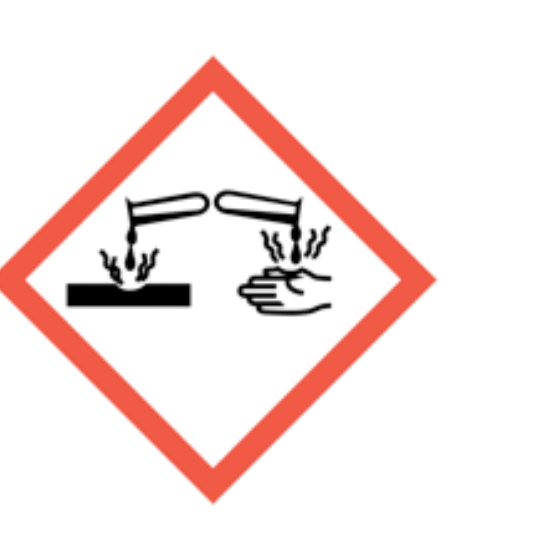
Corrosion
Skin burns, eye damage or corrosive to metals.
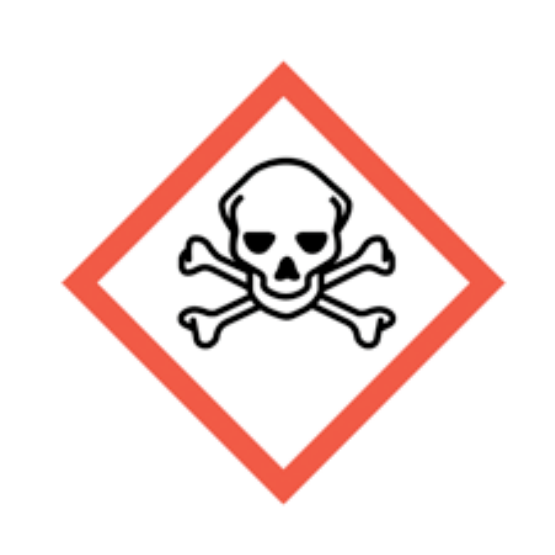
Skull and crossbones
Acute toxicity.
Exclamation mark
Irritation, harmful effects or skin sensitisation; some classifications cover drowsiness, dizziness or ozone-layer hazard. Read the actual hazard statements. Skin sensitisation differs from respiratory sensitisation.
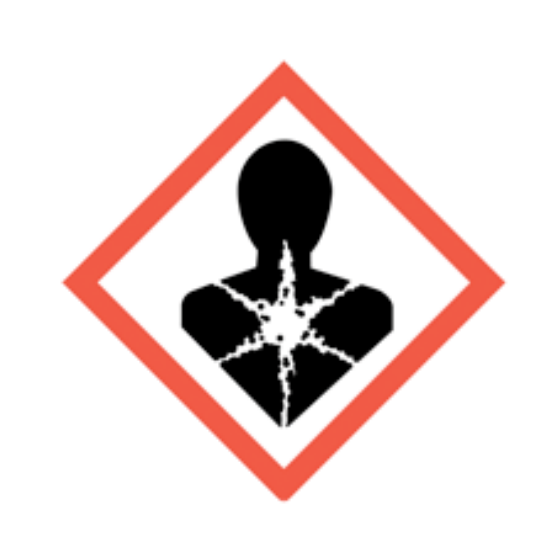
Health hazard
Serious health hazards, including organ damage, aspiration hazard, respiratory sensitisation, cancer and reproductive effects; some can follow a single exposure.
Environment
Hazardous to the aquatic environment.
What acronyms are used on this chemical eye injury page?
Acronyms should be clear because many readers will be new to COSHH, PPE and emergency-response language.
| Acronym | Meaning | Why it matters |
|---|---|---|
| COSHH | Control of Substances Hazardous to Health | The main UK regulations for hazardous substances that can harm health. |
| PPE | Personal protective equipment | Includes goggles, face shields, gloves, protective clothing and other wearer protection. |
| RPE | Respiratory protective equipment | Relevant where vapours, gases, mists or aerosols also create inhalation risk. |
| SDS | Safety data sheet | Provides product hazards, first aid, PPE, handling, storage and emergency information. |
| CLP | Classification, Labelling and Packaging | The system behind many chemical hazard pictograms and labels. |
| LEV | Local exhaust ventilation | Engineering control that captures airborne contaminants near source. |
| RIDDOR | Reporting of Injuries, Diseases and Dangerous Occurrences Regulations | Reporting rules that may apply after certain serious incidents or outcomes. |