SHARE Knowledge Hub
What should you know about documentary evidence for health and safety legal actions?
Documentary evidence in health and safety legal actions is the recorded proof that shows what was known, decided, controlled, checked, communicated and learned before and after an incident, claim, enforcement action or inquest. It includes risk assessments, method statements, training records, permits, maintenance logs, inspection sheets, health surveillance records, monitoring data, emails, photographs, CCTV, witness statements, meeting minutes, contractor documents, policies, audit reports, RIDDOR submissions and action trackers. Good evidence is accurate, contemporaneous, complete, attributable, version-controlled, retrievable and honestly interpreted; poor evidence, missing records or retrospective alteration can damage credibility even where the underlying controls were better than the paperwork suggests.
Understanding What should you know about documentary evidence for health and safety legal actions?
Documentary evidence in health and safety legal actions is the recorded proof that shows what was known, decided, controlled, checked, communicated and learned before and after an incident, claim, enforcement action or inquest. It includes risk assessments, method statements, training records, permits, maintenance logs, inspection sheets, health surveillance records, monitoring data, emails, photographs, CCTV, witness statements, meeting minutes, contractor documents, policies, audit reports, RIDDOR submissions and action trackers. Good evidence is accurate, contemporaneous, complete, attributable, version-controlled, retrievable and honestly interpreted; poor evidence, missing records or retrospective alteration can damage credibility even where the underlying controls were better than the paperwork suggests.
Why this matters at work
HSG245 distinguishes immediate, underlying and root causes. Immediate causes are the direct events or conditions closest to the adverse event; underlying causes include unsafe acts, conditions, work practices and organisational factors; root causes are the deeper management-system weaknesses that allowed the conditions to develop. Use this distinction to avoid stopping at an individual's last action. An investigation should consider task design, equipment, information, competence, supervision, workload, maintenance, procurement, change, monitoring, communication, culture, emergency response and prior learning.
The quality of evidence depends on whether people can report what they saw, did, feared or could not control. Workers, agency staff, contractors, supervisors and representatives need a practical route to report defects, near misses, unsafe conditions, workload, missing information, pressure, ill health, harassment and process failure. Reports should be welcomed, triaged by risk, acknowledged, investigated proportionately and closed with feedback. A system that captures only minor housekeeping issues while people avoid reporting high-consequence concerns has a culture and evidence problem.
How organisations manage this in practice
Audit and inspection evidence should answer whether the management system and controls operate in reality. Use planned audits, supervisor checks, technical inspections, worker consultation, reactive investigation, performance data and leadership review together. An audit should sample the full path: source requirement, local procedure, implementation, field condition, records, worker understanding, defects, action closure and repeat performance. Do not score paperwork as compliant when the inspection finds the required guard, welfare facility, isolation, route, tool or supervision is absent.
Review actions at the appropriate level. A supervisor can resolve a local housekeeping defect; a systemic staffing, design, maintenance, contractor, data or financial barrier requires a manager or leader with authority to change it. Escalation should be a designed route, not a personal favour. Track whether the decision produced the intended risk reduction and whether frontline workers experienced an unintended burden or work-around. Integrate outcomes into policy, risk-register, investment and assurance review.
Evidence is strongest when it is built into normal work rather than assembled after an incident. Map the safety-critical decisions and work stages: design, procurement, contractor appointment, induction, competence, risk assessment, work planning, permit issue, plant/equipment release, inspection, maintenance, monitoring, change, emergency response, review and close-out. For each stage, define the minimum usable record, owner, user, approval, location, review trigger, retention category and how it connects to the next stage. Make the system proportionate: a low-risk routine task may need a brief check, while high-consequence work requires deeper authorisation and traceability.
Preserve the record when a notice or claim arrives
Protect people and preserve originals, timestamps and audit history. Notify the appropriate legal or insurer owner and follow the authorised disclosure process; a factual correction must remain distinguishable from the original record.
An old record contains a mistaken equipment number
Illustrative example. A notice arrives and the team spots an error in a contemporaneous inspection entry.
Decision. Retain the original and add an attributable correction explaining the factual basis.
Evidence to check. Original version, correction date, author, reason and supporting evidence.
Hold or escalation point. Do not backdate, overwrite history or assume a privileged label establishes legal privilege.
Follow-up. Follow the authorised retention and disclosure decisions and record who owns them.
Protect the original and log every clarification
A working copy and a chronology help analysis while the original source remains intact. Late clarification should be a transparent addition, rather than a reconstructed historical record.

Preserve the original; explain change in a separate record
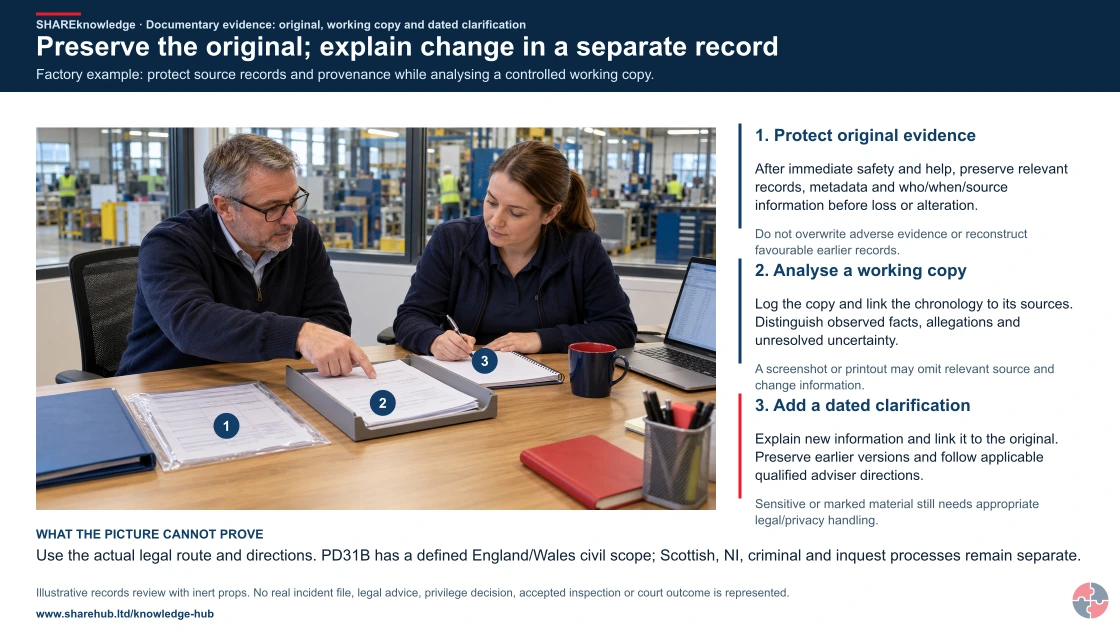
Full written explanation
Factory example: protect source records and provenance while analysing a controlled working copy.
- Protect original evidence. After immediate safety and help, preserve relevant records, metadata and who/when/source information before loss or alteration.
- Analyse a working copy. Log the copy and link the chronology to its sources. Distinguish observed facts, allegations and unresolved uncertainty.
- Add a dated clarification. Explain new information and link it to the original. Preserve earlier versions and follow applicable qualified adviser directions.
Change the pathway
- Never rewrite history. Do not overwrite adverse evidence or reconstruct favourable earlier records.
- Keep provenance visible. A screenshot or printout may omit relevant source and change information.
- A label is not privilege. Sensitive or marked material still needs appropriate legal/privacy handling.
Evidence check: Use the actual legal route and directions. PD31B has a defined England/Wales civil scope; Scottish, NI, criminal and inquest processes remain separate.
Immediate safety first, authentic originals, controlled copies and adviser-led legal boundaries
Primary references: HSE: factual incident investigation, HSG245 (GB) · Justice: PD31B electronic documents — applicable England/Wales civil proceedings
Open the complete HD image (new tab)Download image

Immediate safety first, authentic originals, controlled copies and adviser-led legal boundaries
Primary references: HSE: factual incident investigation, HSG245 (GB) · Justice: PD31B electronic documents — applicable England/Wales civil proceedings

Source integrity
Preserve the original, relevant metadata and who/when/source information.
Controlled analysis
Use a logged working copy and separate facts, allegations and uncertainty in the chronology.
Transparent correction
Date and explain a clarification linked to the original; control access and follow qualified adviser directions.
Do not overwrite adverse evidence, fabricate earlier records or assume a label creates legal privilege.
What key facts should people know first about documentary evidence?
Documentary evidence should be treated as factual workplace guidance, not legal advice.
This page does not advise on litigation strategy, disclosure decisions, privilege claims, admissions of liability or settlement. Those matters should be handled by qualified legal advisers. The role of the safety professional is normally to help identify facts, records, chronology, control evidence and learning without stepping outside competence.
The most useful evidence is created before anything goes wrong. A good risk assessment, signed briefing, inspection record, closed action, maintenance log or permit hand-back can show that the organisation understood the risk and controlled it. A poor record can create uncertainty even when people believe the work was well managed.
After an incident, the priority is to make the situation safe, support affected people, preserve evidence and avoid contamination. Records should not be tidied, rewritten, backdated or selectively deleted. If a record needs correction, the correction should be transparent and attributable. See HSE - Investigating accidents and incidents HSG245.
| Key fact | Why it matters |
|---|---|
| Records are evidence | Ordinary workplace documents can become central in criminal proceedings, civil claims, inquests, insurance reviews and enforcement decisions. Source: HSE - Investigating accidents and incidents HSG245. |
| Accuracy beats polish | A rough but accurate contemporaneous record is usually better than a perfect-looking document created later. Source: HSE - Investigating accidents and incidents HSG245. |
| Metadata matters | Dates, authors, versions, approvals, access logs and file history can affect credibility. Source: HSE - Investigating accidents and incidents HSG245. |
| Evidence includes bad news | Documents that reveal weaknesses may still be disclosable or relevant; hiding problems creates greater risk. Source: HSE - Investigating accidents and incidents HSG245. |
| Privilege is specialist | Legal professional privilege and litigation privilege should be managed with legal advice, not workplace guesswork. Sources: Justice UK - Civil Procedure Rules Part 31 (England and Wales civil proceedings); NI Rules of the Court of Judicature 1980, Order 24; Court of Session rules, Chapter 35 recovery of evidence. |
| Learning still matters | Defending a legal action should not prevent honest learning, corrective action and prevention of recurrence. Source: HSE - Investigating accidents and incidents HSG245. |
What is documentary evidence in health and safety legal actions?
Documentary evidence is any recorded information that helps prove what happened, what was required, what was known and what was done.
A document is not limited to paper. It can be an email, photograph, CCTV clip, digital inspection record, maintenance database entry, permit, induction record, risk assessment, text message, spreadsheet, sign-in sheet, meeting minute, contractor approval, calibration certificate, exposure monitoring result or action tracker.
In health and safety cases, evidence usually needs to answer four practical questions: what was the risk; what controls were required; were those controls actually implemented; and did the organisation check and improve them? That is why evidence from before the incident is often more powerful than explanation after the incident.
Good documentary evidence is not a defence trick. It is part of competent management. If records are accurate and used properly, they help prevent harm, support learning, show accountability and make legal decisions more informed. See HSE - Investigating accidents and incidents HSG245.
| Evidence question | What the evidence needs to show | Example records |
|---|---|---|
| What was foreseeable? | The organisation identified hazards, legal duties, affected people and credible harm. | Risk assessments, design reviews, legal register, pre-construction information. Source: HSE - Investigating accidents and incidents HSG245. |
| What controls were required? | Controls were selected, resourced and communicated. | RAMS, permits, procedures, training plans, procurement specifications. Source: HSE - Investigating accidents and incidents HSG245. |
| Were controls implemented? | People actually used the controls at the relevant time. | Briefing records, inspection sheets, permit handover, photographs, supervisor checks. Source: HSE - Investigating accidents and incidents HSG245. |
| Were controls maintained? | Equipment, systems and competence were kept effective. | Maintenance logs, calibration, competence records, audit findings, close-out actions. Source: HSE - Investigating accidents and incidents HSG245. |
| Was learning acted on? | Weak signals, incidents and audit findings led to improvement. | Investigation reports, action trackers, management review and lessons learned. Source: HSE - Investigating accidents and incidents HSG245. |
What is the professional boundary when legal action is possible?
The professional boundary is to support factual accuracy, risk understanding and learning while leaving legal advice to qualified legal advisers.
Safety professionals may be asked to help during a claim, prosecution, enforcement action, inquest or internal review. They can identify relevant documents, explain control systems, build a chronology, support investigation quality, interpret health and safety records and advise on corrective actions.
They should be careful not to overstep. Do not decide privilege status, coach witnesses improperly, rewrite records, make admissions of liability without authority, speculate about guilt, or give legal conclusions unless professionally qualified and instructed to do so.
The ethical position is straightforward: tell the truth, preserve records, separate fact from opinion, state uncertainty, escalate serious risk and seek specialist legal advice where legal rights, privilege, disclosure or prosecution decisions are involved.
For factual investigation, consult HSE - Investigating accidents and incidents HSG245. For England and Wales civil disclosure, check Justice UK - Civil Procedure Rules Part 31 (England and Wales civil proceedings); for Northern Ireland civil discovery, check NI Rules of the Court of Judicature 1980, Order 24. A legal adviser should determine the applicable court route and order.
| Activity | Usually appropriate for HSE professional | Needs legal or specialist direction |
|---|---|---|
| Collecting records | Identify likely relevant HSE records and where they are stored. | Deciding disclosure strategy or withholding documents. Source: HSE - Investigating accidents and incidents HSG245. |
| Chronology | Build a factual timeline using records and witness information. | Framing legal arguments from the chronology. Source: HSE - Investigating accidents and incidents HSG245. |
| Witness support | Explain process and help workers understand factual accuracy. | Coaching, influencing or rehearsing evidence improperly. Source: HSE - Investigating accidents and incidents HSG245. |
| Corrections | Flag inaccurate records and preserve original versions. | Changing records where proceedings are contemplated. Source: HSE - Investigating accidents and incidents HSG245. |
| Privilege | Recognise that legal privilege may be relevant and escalate promptly. | Deciding privilege status without legal advice. Source: Justice UK - Civil Procedure Rules Part 31 (England and Wales civil proceedings). |
| Learning | Recommend control improvements and action tracking. | Assuming improvement action is an admission of liability. Source: HSE - Investigating accidents and incidents HSG245. |
Which types of evidence are commonly relevant?
Relevant evidence usually spans risk, competence, equipment, supervision, communication, monitoring, incidents, contracts and management review.
The best evidence file mirrors how the organisation manages risk. If the allegation concerns an unsafe machine, the file should contain PUWER assessment, guarding records, maintenance, defects, training, supervision, inspection and prior incidents. If the allegation concerns exposure, it should include COSHH assessment, monitoring data, LEV checks, RPE records and health surveillance where relevant.
Do not collect randomly. Start with the issue and map evidence to it. A training matrix is useful only if it shows the right people were competent for the specific task. A risk assessment is useful only if it matches the real activity. An audit is useful only if findings were closed or knowingly escalated.
Contractor evidence often matters because serious events happen at interfaces. Pre-qualification, RAMS review, inductions, permits, competence, supervision, site rules, handovers and change control may all become central. See HSE - Investigating accidents and incidents HSG245.
| Evidence type | What it can prove | Common weakness |
|---|---|---|
| Risk assessments and RAMS | Foreseeability, control selection and communication. | Generic wording that does not match the task. Source: HSE - Investigating accidents and incidents HSG245. |
| Training and competence records | People were trained, briefed, assessed or authorised. | Attendance record without competence or task relevance. Source: HSE - Investigating accidents and incidents HSG245. |
| Inspection and maintenance records | Equipment or premises were checked and defects managed. | Open defects, missing dates or no evidence of close-out. Source: HSE - Investigating accidents and incidents HSG245. |
| Permits and isolations | High-risk work was planned, authorised, controlled and handed back. | Copied permits, missing isolations or no handover record. Source: HSE - Investigating accidents and incidents HSG245. |
| Monitoring data | Exposure, performance or control effectiveness was measured. | Data without interpretation, calibration or action. Source: HSE - Investigating accidents and incidents HSG245. |
| Emails and messages | Knowledge, decisions, warnings, escalation and timing. | Informal commitments not captured in action systems. Source: HSE - Investigating accidents and incidents HSG245. |
| Photographs and CCTV | Conditions, sequence, position, guarding, housekeeping or behaviour. | No timestamp, poor custody or missing preservation. Source: HSE - Investigating accidents and incidents HSG245. |
| Meeting minutes and actions | Governance, decisions, resourcing and follow-up. | Actions not owned, dated or closed. Source: HSE - Investigating accidents and incidents HSG245. |
What makes documentary evidence reliable?
Reliable evidence is accurate, timely, complete, attributable, controlled, retrievable and supported by the wider facts.
Good records have basic integrity. They show who created them, when, what was checked, what was found, what action was required, who owned the action and when it was closed. They avoid vague ticks, unexplained initials and entries that cannot be linked to a real inspection or activity.
Version control matters. If a risk assessment was revised after an incident, both the previous and revised versions may matter. The organisation should be able to explain what changed, why it changed and when workers were briefed.
Evidence also needs context. A policy may say work at height is controlled, but the court, regulator, insurer or investigator may ask whether the scaffold was inspected, whether workers were trained, whether edge protection was present and whether supervision picked up drift. See HSE - Investigating accidents and incidents HSG245.
| Quality test | Question to ask | Good evidence |
|---|---|---|
| Contemporaneous | Was it created at the time or reconstructed later? | Dated record from the work period. Source: HSE - Investigating accidents and incidents HSG245. |
| Attributable | Can we identify who made the record and their role? | Name, role, signature, login or audit trail. Source: HSE - Investigating accidents and incidents HSG245. |
| Complete | Does it include findings, actions and closure? | Observation, action owner, due date and close-out evidence. Source: HSE - Investigating accidents and incidents HSG245. |
| Specific | Does it match the task, site, equipment and people? | Site-specific RAMS, permit or inspection. Source: HSE - Investigating accidents and incidents HSG245. |
| Controlled | Can changes be tracked? | Version history, approvals and superseded copies retained. Source: HSE - Investigating accidents and incidents HSG245. |
| Corroborated | Does it align with other evidence? | Photos, logs, witness accounts and maintenance data support the same chronology. Source: HSE - Investigating accidents and incidents HSG245. |
How should evidence be preserved after an incident or claim?
Evidence should be preserved quickly, systematically and without altering original records.
After making the area safe and supporting affected people, the organisation should identify records at risk of being overwritten, deleted, moved or contaminated. CCTV, access-control logs, telematics, maintenance system entries, shift handover notes and temporary messages may have short retention periods.
A preservation instruction should be clear and proportionate. It should tell relevant people what to keep, what not to delete, who is coordinating the file and how to secure physical or digital evidence. Where legal action is likely, legal advisers should guide preservation and disclosure handling.
Preservation is not the same as secrecy. The aim is to keep records accurate and available, not to hide them. Originals should be protected; working copies can be used for investigation with clear version control. See HSE - Investigating accidents and incidents HSG245; Justice UK - Practice Direction 31B electronic documents (England and Wales civil proceedings).
In an England and Wales civil case to which Practice Direction 31B applies, paragraph 7 requires legal representatives to notify clients about preserving disclosable documents when litigation is contemplated. This includes electronic records that routine deletion would otherwise remove. Its ordinary scope is proceedings allocated, or likely to be allocated, to the multi-track, subject to the court’s directions. For example, ask the instructed lawyer to identify the relevant systems, custodians and period, then arrange a documented suspension of the affected deletion process. Preserve native records and relevant metadata: a printout or screenshot may omit information about creation, changes or communications. This is a practical preservation example, not a command to retain every personal record indefinitely. Check any applicable PD57AD regime, criminal/inquest requirements, and the separate Scottish or NI procedure with the relevant adviser.
| Step | What to do | Evidence to retain |
|---|---|---|
| Make safe first | Control immediate risk and protect people before document gathering. | Emergency records and scene safety notes. Source: HSE - Investigating accidents and incidents HSG245. |
| Freeze vulnerable data | Preserve CCTV, access logs, telematics, system logs and digital messages. | Export files, timestamps and chain-of-custody note. Source: HSE - Investigating accidents and incidents HSG245. |
| Secure originals | Prevent alteration to permits, inspection sheets, equipment and physical documents. | Scanned copies plus secure storage of originals. Source: HSE - Investigating accidents and incidents HSG245. |
| Create chronology | Record key times, decisions, actions and evidence sources. | Timeline with references to documents and witnesses. Source: HSE - Investigating accidents and incidents HSG245. |
| Appoint coordinator | Name one person to control the evidence register and requests. | Evidence log and request tracker. Source: HSE - Investigating accidents and incidents HSG245. |
| Seek legal direction | Escalate privilege, disclosure and regulator contact questions. | Record of instruction route and legal liaison. Source: HSE - Investigating accidents and incidents HSG245. |
How should evidence be mapped to allegations, duties and controls?
Evidence mapping links each issue to the records that prove or challenge it.
A legal action or enforcement issue normally turns on specific questions. Was the risk foreseeable? Was there a suitable assessment? Were controls reasonably practicable? Were workers trained? Was equipment maintained? Was supervision effective? Was previous learning ignored?
An evidence map stops the organisation drowning in paperwork. It groups records by issue and shows gaps clearly. If an allegation concerns poor training, the evidence map should not simply point to a training folder; it should identify the relevant course, attendance, competence assessment, refresher status and whether the training covered the task involved.
Evidence mapping should include unfavourable material. A near miss, overdue inspection or email warning may be difficult, but ignoring it weakens integrity and can prevent proper learning. See HSE - Investigating accidents and incidents HSG245.
| Issue or allegation | Evidence that may help | Evidence that may challenge |
|---|---|---|
| Risk was not assessed | Task risk assessment, review dates, worker consultation and specific controls. | Generic assessment, missing review or mismatch with actual work. Source: HSE - Investigating accidents and incidents HSG245. |
| Worker was not trained | Training matrix, induction, task briefing, competence sign-off and refresher record. | Attendance-only record, expired training or no assessment of competence. Source: HSE - Investigating accidents and incidents HSG245. |
| Equipment was defective | Inspection logs, maintenance records, defect close-out and pre-use checks. | Open defects, missed servicing or repeated failures. Source: HSE - Investigating accidents and incidents HSG245. |
| Supervision was weak | Supervisor inspections, toolbox talks, permit checks and intervention records. | No site presence, no challenge of unsafe practice or ignored reports. Source: HSE - Investigating accidents and incidents HSG245. |
| Organisation ignored warning signs | Near-miss investigations, action trackers and management review minutes. | Repeated incidents, overdue actions or emails showing known concern. Source: HSE - Investigating accidents and incidents HSG245. |
| Controls worked in practice | Photos, observation records, monitoring data and closed audit findings. | Paper controls with no field verification. Source: HSE - Investigating accidents and incidents HSG245. |
Choose controls using HSE’s hierarchy and the task-specific guidance cited below.
How can the hierarchy of controls prevent machinery injury when responding to a reported interlock defect?
Start by removing the hazard where practicable, then consider substitution, engineering controls and work-method controls. Use PPE for residual risk. These priorities follow HSE’s hierarchy of controls; the task-specific examples below must still be checked against the relevant HSE guidance and local conditions.
Protect the original facts through system design, access control and a clear preservation decision before relying on reminders or late reconstruction.
How should controls be prioritised?
How can the ERICPD hierarchy of controls prevent machinery injury when responding to a reported interlock defect?

| Control level | Control for this activity | Owner and verification | Stop / restart decision |
|---|---|---|---|
| Eliminate | Remove the need to open the guard through external inspection or redesigned access where feasible. | Task owner verifies that the proposed change removes the named hazardous step, including foreseeable cleaning, maintenance and work transferred elsewhere. | If the hazardous step remains, keep it within the task assessment and select the stronger feasible remaining controls. |
| Reduce, including substitution | Use an approved off-line test rig or replaceable module where it safely removes hazardous live diagnosis. | Competent task/process owner validates suitability, compatibility and new hazards against the actual operating requirements before the alternative is adopted. | Reject an alternative if its performance is unproved or its new hazards are unresolved. |
| Isolate | Securely isolate hazardous motion and stored energy before repair; restrict access to the test zone. | Supervisor checks the actual boundary, affected people and connected work; verify separation or isolation before allowing access. | Hold or stop for unexpected motion, a defeated safeguard or an incomplete function test. |
| Control: physical safeguards | Repair and function-test the guard interlock and stopping behaviour using the approved machine procedure. | Competent equipment/process owner checks guard alignment, interlock function, stopping response and removal of temporary test arrangements. | Hold or stop for unexpected motion, a defeated safeguard or an incomplete function test. |
| Control: work method and response | Agree test authority, restart communication and any controlled diagnostic mode; never improvise a bypass to continue production. | Supervisor confirms the work limits, competent cover, communication and stop/restart authority with the people doing this activity. | Hold work when the agreed limits, competent cover or effective communication cannot be maintained. |
| PPE | Use protection for assessed maintenance contact hazards; PPE cannot compensate for a defective interlock. | Assessor confirms whether personal protection is needed and checks suitability, condition, compatibility and any required fit evidence. | Do not use unsuitable protection or rely on PPE to continue after an essential source control fails. |
| Discipline | Retain the test result and defect closure evidence; escalate overdue tests and repeated failures to the equipment owner. | Release only after competent maintainer and operations sign the tested return to service. Retain verification and unresolved restrictions at handover. | Keep the task on hold until required reinstatement evidence and unresolved defects are accepted by the responsible owner. |
How can the ISO 45001 hierarchy of controls prevent machinery injury when responding to a reported interlock defect?

| Control level | Control for this activity | Owner and verification | Stop / restart decision |
|---|---|---|---|
| Elimination | Remove the need to open the guard through external inspection or redesigned access where feasible. | Task owner verifies that the proposed change removes the named hazardous step, including foreseeable cleaning, maintenance and work transferred elsewhere. | If the hazardous step remains, keep it within the task assessment and select the stronger feasible remaining controls. |
| Engineering controls | Use an approved off-line test rig or replaceable module where it safely removes hazardous live diagnosis. | Competent task/process owner validates suitability, compatibility and new hazards against the actual operating requirements before the alternative is adopted. | Reject an alternative if its performance is unproved or its new hazards are unresolved. |
| Engineering controls | Securely isolate hazardous motion and stored energy before repair; restrict access to the test zone. | Supervisor checks the actual boundary, affected people and connected work; verify separation or isolation before allowing access. | Hold or stop for unexpected motion, a defeated safeguard or an incomplete function test. |
| Engineering controls | Repair and function-test the guard interlock and stopping behaviour using the approved machine procedure. | Competent equipment/process owner checks guard alignment, interlock function, stopping response and removal of temporary test arrangements. | Hold or stop for unexpected motion, a defeated safeguard or an incomplete function test. |
| Administrative controls | Agree test authority, restart communication and any controlled diagnostic mode; never improvise a bypass to continue production. | Supervisor confirms the work limits, competent cover, communication and stop/restart authority with the people doing this activity. | Hold work when the agreed limits, competent cover or effective communication cannot be maintained. |
| PPE | Use protection for assessed maintenance contact hazards; PPE cannot compensate for a defective interlock. | Assessor confirms whether personal protection is needed and checks suitability, condition, compatibility and any required fit evidence. | Do not use unsuitable protection or rely on PPE to continue after an essential source control fails. |
| Administrative controls | Retain the test result and defect closure evidence; escalate overdue tests and repeated failures to the equipment owner. | Release only after competent maintainer and operations sign the tested return to service. Retain verification and unresolved restrictions at handover. | Keep the task on hold until required reinstatement evidence and unresolved defects are accepted by the responsible owner. |
A manufacturing plant may preserve machine-controller logs after a near miss; a logistics depot may preserve vehicle footage and loading checks. In each setting the original system, owner and time source must be identified before collection, and an uncertain chain of custody is flagged rather than silently filled in.
How should digital records, metadata and emails be handled?
Digital records should be preserved with their context, audit trail, metadata and access history where relevant.
Digital evidence can be powerful because it shows timing, authorship, versions and sequence. It can also be fragile. Auto-deletion, system overwriting, device replacement, message expiry, shared folders and informal chat tools can remove important evidence if preservation is delayed.
Emails and messages often reveal knowledge and decisions, but they can be misunderstood without context. A short message may be part of a longer chain, a document, a forwarded instruction or an informal comment. Preserve the full thread where relevant and avoid cherry-picking.
Electronic documents may also include personal data. Data protection does not stop lawful evidence handling, but it does require purpose, minimisation, security, access control and careful sharing. Redaction may be needed before wider circulation.
| Digital source | What to preserve | Risk if mishandled |
|---|---|---|
| CCTV | Original footage, export method, timestamps and camera location. | Footage overwritten or edited without audit trail. Source: HSE - Investigating accidents and incidents HSG245. |
| Emails and chats | Full thread, attachments, dates, recipients and context. | Selective extracts distort meaning. Source: HSE - Investigating accidents and incidents HSG245. |
| Maintenance systems | Work orders, defect history, user, timestamps and closure notes. | Database updates overwrite prior status. Source: HSE - Investigating accidents and incidents HSG245. |
| Training platforms | Completion, assessment scores, content version and due dates. | Training record proves attendance but not topic content. Source: HSE - Investigating accidents and incidents HSG245. |
| Shared documents | Version history, approvals, comments and superseded versions. | Final version hides what was in force at the relevant date. Source: HSE - Investigating accidents and incidents HSG245. |
| Monitoring data | Calibration, raw data, interpretation and action decisions. | Numbers are retained but no one can explain meaning. Source: HSE - Investigating accidents and incidents HSG245. |
How should privilege and sensitive documents be approached?
Privilege and sensitive document issues should be recognised early and escalated to legal advisers.
Legal professional privilege and litigation privilege are specialist legal concepts. A safety adviser should know they exist and should avoid casual handling of legal correspondence, investigation documents or solicitor instructions, but should not decide privilege status alone.
A practical rule is to separate ordinary safety investigation from legal advice. Keep factual evidence secure and accurate. If legal proceedings are likely or legal advice has been requested, agree the document creation route, distribution list, file naming and storage with legal advisers.
Sensitive does not automatically mean privileged. Worker health information requires a lawful basis, a special-category condition and appropriate security. Commercial material and confidential statements may require controlled handling, but withholding documents in litigation depends on the relevant court process and legal advice.
| Issue | Why it matters | Practical response |
|---|---|---|
| Solicitor advice | May attract legal professional privilege if handled correctly. | Keep separate and follow legal adviser instructions. Source: Justice UK - Civil Procedure Rules Part 31 (England and Wales civil proceedings). |
| Investigation documents | May contain fact, opinion and legal-sensitive material. | Control versions and distribution. Source: HSE - Investigating accidents and incidents HSG245. |
| Witness accounts | Need accuracy, voluntariness and confidentiality boundaries. | Record process and avoid coaching. Source: HSE - Investigating accidents and incidents HSG245. |
| Health information | May be special category personal data. | Limit access, redact where appropriate and use lawful basis. Source: ICO - Data protection and workers’ health information. |
| Commercial sensitivity | May need controlled disclosure or redaction. | Flag for legal review rather than hiding. Source: Justice UK - Civil Procedure Rules Part 31 (England and Wales civil proceedings). |
| Mixed documents | Operational, legal and personal data can sit in one file. | Index carefully and seek advice on handling. Source: ICO - Data protection and workers’ health information. |
How long should health and safety records be kept?
Retention should be based on legal requirements, limitation periods, business need, risk profile and data protection principles.
There is no single retention period for all health and safety records. Some records have specific legal or practical retention needs. Others should be kept long enough to support risk management, claims handling, audit, occupational health, asset history and learning. Over-retention can create data protection and management problems; under-retention can leave the organisation unable to prove what happened.
A good retention schedule names the record type, owner, system, retention period, reason, deletion rule and hold trigger. A legal hold should suspend ordinary deletion where a claim, investigation, enforcement action or serious incident makes records relevant.
Retention must also protect integrity. If records are moved between systems, archived or deleted, the organisation should know what happened and why. For digital systems, access and deletion permissions are part of evidence governance. See ICO - Keeping employment records; Data Protection Act 2018.
| Record type | Retention consideration | Management control |
|---|---|---|
| Risk assessments and procedures | Keep current and superseded versions where relevant to historical work. | Version control and review schedule. Source: HSE - Investigating accidents and incidents HSG245. |
| Training and competence | Retain while role, exposure or claim relevance continues. | Training matrix and archive rules. Source: HSE - Investigating accidents and incidents HSG245. |
| Maintenance and inspection | Keep in line with equipment life, statutory inspection and incident relevance. | Asset register and maintenance system controls. Source: HSE - Investigating accidents and incidents HSG245. |
| Incident and RIDDOR records | Keep long enough for investigation, reporting, claims and trend analysis. | Incident database and legal hold trigger. Source: HSE - Investigating accidents and incidents HSG245. |
| Health or exposure records | Some health surveillance/exposure records require long retention depending on regulation. | Occupational health governance and restricted access. Source: ICO - Data protection and workers’ health information. |
| Emails and digital logs | Retention depends on relevance, system policy and legal hold requirements. | Preservation notice and IT deletion controls. Source: ICO - Keeping employment records. |
Where can documentary evidence be used in legal actions?
Documentary evidence can be used in criminal proceedings, civil claims, inquests, enforcement decisions, insurance reviews and internal learning.
In criminal health and safety proceedings, evidence may be used to decide whether duties were breached and whether enforcement or prosecution is appropriate. HSE's enforcement approach considers risk, seriousness and enforcement policy. Records may show what was known, what controls existed and whether failures were isolated or systemic.
In civil claims, documentary evidence may be used to establish negligence, causation, loss, contributory issues and what was reasonably done. Disclosure can require documents that help or harm a party's case, so selective thinking is dangerous.
Inquests and fatal incident processes may focus on how, when and where a person died and whether future deaths can be prevented. Evidence quality, chronology and learning actions can be central to public confidence.
Different routes use different evidence rules and decisions. Consult HSE - Enforcement principles and standards; Justice UK - Civil Procedure Rules Part 31 (England and Wales civil proceedings); Chief Coroner Guidance No. 44: Disclosure; HSE - Investigating accidents and incidents HSG245; HSE - Managing for health and safety HSG65. Apply each source only to its stated jurisdiction and process.
| Route | Evidence focus | Practical point |
|---|---|---|
| HSE investigation | Risk, breach, causation, notices, prosecution decision and dutyholder response. | Cooperate truthfully and preserve relevant records. Source: HSE - Enforcement principles and standards. |
| Civil claim | Duty of care, breach, causation, loss and reasonable conduct. | Maintain disclosure-ready records and seek legal advice. Source: Justice UK - Civil Procedure Rules Part 31 (England and Wales civil proceedings). |
| Coroner’s inquest (England and Wales) | Chronology, circumstances, system weaknesses and prevention of future deaths. | Provide accurate timeline and learning evidence. Source: Chief Coroner Guidance No. 44: Disclosure. |
| Insurance claim | Factual incident chronology and records; insurer notification and policy terms depend on the contract. | Preserve the factual incident file and check the actual insurance policy and notification process. Source: HSE - Investigating accidents and incidents HSG245. |
| Internal investigation | Immediate, underlying and root causes plus action plan. | Use HSG245-style investigation and close actions. Source: HSE - Investigating accidents and incidents HSG245. |
| Audit and management review | Whether evidence proves controls are effective. | Trend gaps and improve the management system. Source: HSE - Managing for health and safety HSG65. |
Which legal duties and rules are relevant to documentary evidence?
The main duties sit across health and safety law, RIDDOR, civil disclosure rules and data protection law.
Health and safety law does not require perfect paperwork for its own sake. It requires risks to be managed. However, records are often the only practical way to prove that assessment, training, maintenance, supervision and review happened.
RIDDOR adds reporting and record-related duties for specified work-related events. In England and Wales, Part 31 and Practice Direction 31B can apply to civil disclosure; Practice Direction 57AD has a distinct disclosure regime for relevant Business and Property Courts proceedings. A legal adviser should identify the actual court route and order. Data protection law affects how employment records, health information and personal data are collected, retained, shared and secured.
Because legal proceedings are fact-specific, this table is a learning guide rather than legal advice. Organisations should obtain legal advice where claims, prosecution, privilege or disclosure decisions are live.
Civil disclosure is jurisdiction-specific: CPR Part 31 (England and Wales civil proceedings) is an England-and-Wales route, while NI Order 24 and Scottish Court of Session Chapter 35 are distinct. Preserve facts, then let legal advisers identify the actual proceeding, privilege and disclosure order. GB and NI incident-reporting routes also differ; HSENI confirms NI RIDDOR 1997.
| Duty, rule or source | Jurisdiction | How it applies | Practical evidence |
|---|---|---|---|
| Health and Safety at Work etc. Act 1974 | Great Britain | Primary duties may be tested through evidence of risk control, supervision, systems and decisions. | Risk assessments, procedures, training, maintenance and management review. Source: Health and Safety at Work etc. Act 1974. |
| Management of Health and Safety at Work Regulations 1999 | Great Britain | Risk assessment, preventive arrangements, competence and cooperation often require evidence. | Suitable and sufficient assessments, action plans and competence records. Source: Management of Health and Safety at Work Regulations 1999. |
| Reporting of Injuries, Diseases and Dangerous Occurrences Regulations 2013 | Great Britain | Specified incidents, diseases and dangerous occurrences may require reporting and records. | RIDDOR assessment, submission receipt and incident file. Source: Reporting of Injuries, Diseases and Dangerous Occurrences Regulations 2013. |
| Civil Procedure Rules Part 31 | England and Wales | Sets civil disclosure and inspection rules in applicable England and Wales proceedings; Business and Property Courts may use Practice Direction 57AD. | Disclosure list, search statement and document control. Source: Justice UK - Civil Procedure Rules Part 31 (England and Wales civil proceedings). |
| Practice Direction 31B - Electronic Documents | England and Wales | Addresses electronic document preservation and disclosure in applicable England and Wales Part 31 cases; check whether Practice Direction 57AD governs instead. | Preservation notice, IT hold and digital evidence register. Source: Justice UK - Practice Direction 31B electronic documents (England and Wales civil proceedings). |
| Data Protection Act 2018 | United Kingdom | Applies to personal data, worker records and health information. | Privacy controls, access restrictions, redaction and retention schedule. Source: Data Protection Act 2018. |
Northern Ireland and other court routes
Use the NI sources and the actual work or court location; a GB rule is not automatically the NI provision.
| Duty or rule | Jurisdiction | How it applies | Evidence or decision |
|---|---|---|---|
| Health and Safety at Work (NI) Order 1978 — direct source | Northern Ireland | NI employer duties; records should show actual controls and decisions. | Assessment, training and control records. |
| NI Management Regulations 2000 — direct source | Northern Ireland | NI risk assessment and preventive arrangements. | Assessment and review record. |
| NI RIDDOR 1997 — direct source | Northern Ireland | NI reportable-event rules differ from GB RIDDOR 2013. | HSENI report and incident record where required. |
| NI Rules of Court of Judicature, Order 24 — direct source | Northern Ireland | NI discovery and inspection in relevant proceedings; counsel applies the current court route. | Preservation instruction and lawyer-directed discovery record. |
| Scotland Court of Session, Chapter 35 — direct source | Scotland | Scottish recovery of evidence follows a different court procedure from CPR Part 31. | Lawyer-directed preservation and recovery process. |
How could BuildOut Ltd manage documentary evidence?

BuildOut Ltd could manage evidence by treating records as operational proof, not admin afterthoughts.
A contractor handover must match the work actually done
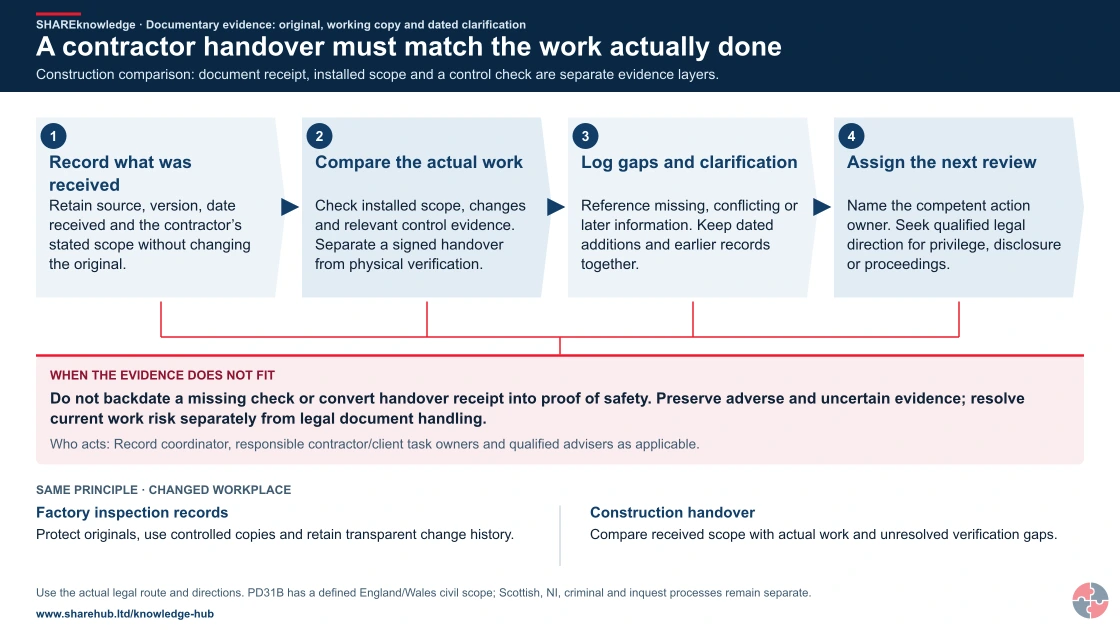
Full written explanation
A construction handover sequence keeps the received original, compares its scope/version with the actual work and changes, logs gaps and dated clarifications, and allocates follow-up with the relevant competent owner. A complete-looking file does not prove a control worked or authorise the task. Legal handling follows the applicable jurisdiction, process, court directions and qualified adviser, not a single UK-wide disclosure rule.
Construction comparison: document receipt, installed scope and a control check are separate evidence layers.
- Record what was received. Retain source, version, date received and the contractor’s stated scope without changing the original.
- Compare the actual work. Check installed scope, changes and relevant control evidence. Separate a signed handover from physical verification.
- Log gaps and clarification. Reference missing, conflicting or later information. Keep dated additions and earlier records together.
- Assign the next review. Name the competent action owner. Seek qualified legal direction for privilege, disclosure or proceedings.
When the evidence does not fit: Do not backdate a missing check or convert handover receipt into proof of safety. Preserve adverse and uncertain evidence; resolve current work risk separately from legal document handling.
Who acts: Record coordinator, responsible contractor/client task owners and qualified advisers as applicable.
Changed workplace
Factory inspection records: Protect originals, use controlled copies and retain transparent change history.
Construction handover: Compare received scope with actual work and unresolved verification gaps.
Evidence check: Use the actual legal route and directions. PD31B has a defined England/Wales civil scope; Scottish, NI, criminal and inquest processes remain separate.
Immediate safety first, authentic originals, controlled copies and adviser-led legal boundaries
Primary references: HSE: factual incident investigation, HSG245 (GB) · Justice: PD31B electronic documents — applicable England/Wales civil proceedings
Open the complete HD image (new tab)Download image

Immediate safety first, authentic originals, controlled copies and adviser-led legal boundaries
Primary references: HSE: factual incident investigation, HSG245 (GB) · Justice: PD31B electronic documents — applicable England/Wales civil proceedings
BuildOut Ltd
BuildOut Ltd is a construction contractor. Its legal-action exposure can arise from falls, lifting operations, buried services, plant movement, subcontractor work, temporary works, occupational health exposures and site welfare. Documentary evidence must show what was planned, briefed, checked and corrected on real projects.
BuildOut creates a project evidence plan at mobilisation. The plan lists the records needed for each high-risk activity: CDM appointments, construction phase plan, RAMS, inductions, permits, temporary works checks, plant inspections, lifting plans, scaffold handovers, training, subcontractor approvals, welfare inspections and incident reports.
After a serious incident or claim notification, BuildOut issues an evidence preservation instruction. The site manager freezes relevant CCTV, access logs, permits, inspection sheets, WhatsApp or email chains, photographs, subcontractor RAMS, maintenance records and toolbox talks. Originals are secured; working copies are used for investigation.
The company uses evidence mapping rather than folder dumping. Each allegation or duty is linked to specific documents, witnesses and gaps. Where records reveal weaknesses, actions are raised and tracked. Legal advisers handle disclosure and privilege; HSE professionals focus on factual accuracy, risk control and learning.
Worked example: preserving a crane-lift near-miss record
Task material and setting: A lifting accessory fails during a site lift at BuildOut. No one is injured, but CCTV, radio logs, crane telemetry, permits, inspection records and subcontractor messages may become relevant; the site spans a GB project with NI contractor records.
People and prerequisites: The site manager secures the area and reports through the applicable incident route; the investigator records facts; IT and the document controller preserve systems; legal advisers decide litigation hold, privilege and any disclosure procedure. The lifting specialist assesses safe restart.
Before: Freeze automatic deletion for the relevant cameras and platforms, identify original custodians and timestamps, and issue a written preservation instruction. Keep routine safety investigation separate from legal advice. Do not rewrite or backdate the original permit.
During: Collect read-only copies where practical, log who collected what and when, preserve originals and metadata, record gaps and contradictory accounts, and restrict personal or health data to those with a real need.
Hold or stop: If a source is missing, timestamps conflict, a device is still live, a worker proposes to alter a record, or privilege/disclosure is uncertain, stop informal copying and escalate to IT, the investigation lead and legal adviser. No one enters an unsafe lift zone to retrieve evidence.
Completion and hand back: The investigator reconciles the evidence inventory and corrective actions with the actual lift failure. The lifting lead signs a separate safe-restart decision; legal advisers control any court-facing production. The document controller confirms preservation and access restrictions.
Evidence: Retain the original and copy inventory, checksums or equivalent integrity record, custodian receipts, preservation instruction, collection log, factual chronology, risk/control review, action close-out and legal handoff record with restricted access.
| Management area | How BuildOut applies it | Evidence, oversight and improvement |
|---|---|---|
| Project evidence plan | Defines required records by risk activity and project phase. | Project file index, document owner and audit schedule. Source: HSE - Investigating accidents and incidents HSG245. |
| Record creation | Requires contemporaneous inspection, briefing, permit and handover records from supervisors and subcontractors. | Daily records, signed briefings and digital timestamps. Source: HSE - Investigating accidents and incidents HSG245. |
| Contractor evidence | Checks subcontractor RAMS, competence, plant records, inductions and supervision arrangements. | Pre-qualification, approval log and site audit results. Source: HSE - Investigating accidents and incidents HSG245. |
| Incident preservation | Freezes CCTV, digital messages, permits, photos, equipment records and witness information. | Preservation notice and evidence register. Source: HSE - Investigating accidents and incidents HSG245. |
| Evidence mapping | Links allegations to risk assessments, controls, inspections, training and actions. | Evidence matrix and chronology. Source: HSE - Investigating accidents and incidents HSG245. |
| Legal boundary | Escalates privilege, disclosure, admissions and claims handling to legal advisers and insurers. | Legal liaison log and controlled distribution. Sources: Justice UK - Civil Procedure Rules Part 31 (England and Wales civil proceedings); NI Rules of the Court of Judicature 1980, Order 24; Court of Session rules, Chapter 35 recovery of evidence. |
| Learning and improvement | Uses gaps to update training, inspections, procurement, supervision and action tracking. | Lessons learned, action closure and management review. Source: HSE - Investigating accidents and incidents HSG245. |
What training helps people create and protect good evidence?
Training should be tiered so everyday record creators, investigators, managers and specialists understand their evidence role.
Most evidence problems start before an incident. Workers and supervisors need practical training on making accurate records: write what was checked, what was found, what action was taken, who owns it and when it was closed. A tick without context is weak.
Investigators and managers need deeper training on evidence preservation, interviewing, chronology, document control, digital evidence, root cause analysis, legal boundaries and action tracking.
Senior leaders, HR, insurers, IT and legal contacts need to know how their systems affect evidence integrity: retention settings, access permissions, health information, reporting routes, legal holds and disclosure requests.
| Level | Audience | Content |
|---|---|---|
| General awareness | Workers and supervisors who create workplace records. | Accurate entries, no backdating, defect reporting, action close-out and why records matter. Demonstration, assessor, record and reassessment: Line manager checks a sample contemporaneous defect entry and correction, then keeps the induction and observation record. Reassess after a changed form or missing record. Source: HSE - Investigating accidents and incidents HSG245. |
| Task-specific record training | Permit issuers, inspectors, maintenance teams, auditors and trainers. | Record standards, evidence fields, photographs, digital logs and version control. Demonstration, assessor, record and reassessment: Document controller assesses a real permit/inspection upload with version and photo metadata, retaining signed task authorisation. Reassess after system or process change. Source: HSE - Investigating accidents and incidents HSG245. |
| Investigator training | Incident investigators, HSE advisers and managers. | HSG245 process, evidence gathering, interview records, chronology and root cause methods. Demonstration, assessor, record and reassessment: Lead investigator reviews a practical chronology and evidence-preservation exercise against HSG245; retain case assessment and feedback. Reassess after a flawed investigation or guidance change. Source: HSE - Investigating accidents and incidents HSG245. |
| Manager/legal-action awareness | Managers, HR, insurers and claims contacts. | Preservation, legal boundary, privilege escalation, disclosure prompts and data protection. Demonstration, assessor, record and reassessment: Legal lead tests a mock preservation and privilege-escalation decision; retain manager briefing and handoff record. Reassess after a claim, court-route or retention-rule change. Sources: Justice UK - Civil Procedure Rules Part 31 (England and Wales civil proceedings); ICO - Keeping employment records. |
| Specialist support | Legal advisers, data protection, IT, occupational health and technical experts. | Privilege, disclosure, electronic records, health data and expert evidence handling. Demonstration, assessor, record and reassessment: Relevant professional lead checks a sample legal, IT or OH evidence decision within that discipline; retain scoped authorisation. Reassess after case type, system or law changes. Sources: Justice UK - Civil Procedure Rules Part 31 (England and Wales civil proceedings); Justice UK - Practice Direction 31B electronic documents (England and Wales civil proceedings); ICO - Data protection and workers’ health information. |
How should the controls be managed and reviewed?
Assign owners to the significant risks, put the chosen controls into the work plan, check that they work in practice and change them when conditions or evidence change.
HSE describes this as a continuing plan, do, check and act process. For documentary evidence and defending health and safety legal actions, record who checks the controls, what evidence shows they are working, and which failure stops the work or triggers review. A formal management system is a choice, not a substitute for the applicable legal duties. Read HSE management guidance.
What are the warning signs that evidence management is failing?
Warning signs include missing records, generic documents, open actions, uncontrolled versions, selective retention and records created after the event.
Evidence problems often reflect management problems. If records are missing, vague or late, it may mean people were under pressure, systems were hard to use, supervisors did not check, or leaders valued paperwork completion more than control quality.
The danger is not only legal. Poor evidence makes it harder to learn. If the organisation cannot show which scaffold was inspected, which worker was briefed or which defect was closed, it cannot confidently prevent recurrence.
When evidence weaknesses are found, the response should be improvement, not blame. Fix the forms, train record creators, reduce duplicated systems, set retention rules and audit whether records match reality. See HSE - Investigating accidents and incidents HSG245.
| Warning sign | How harm can manifest | Action to take |
|---|---|---|
| Generic RAMS | Controls do not match site conditions and are hard to defend. | Require task-specific review and worker briefing. Source: HSE - Investigating accidents and incidents HSG245. |
| Backdated or altered records | Credibility is damaged and legal risk increases. | Preserve originals and escalate to legal/management. Source: HSE - Investigating accidents and incidents HSG245. |
| Open actions with no owner | Known defects remain unresolved. | Assign owner, due date and verification. Source: HSE - Investigating accidents and incidents HSG245. |
| Missing contractor records | Dutyholder cannot show control of supply chain risk. | Tighten pre-qualification and site document checks. Source: HSE - Investigating accidents and incidents HSG245. |
| Evidence stored in personal inboxes | Records are lost when people leave or devices change. | Use controlled systems and retention schedules. Source: HSE - Investigating accidents and incidents HSG245. |
| Training records without content | Attendance cannot prove what was taught or understood. | Keep course content, assessment and competence evidence. Source: HSE - Investigating accidents and incidents HSG245. |
| CCTV overwritten after incident | Important sequence evidence is lost. | Introduce preservation triggers and IT/legal hold process. Source: HSE - Investigating accidents and incidents HSG245. |
What do the acronyms and key terms mean?
Acronyms should be explained because legal-action topics can quickly become inaccessible.
| Term | Meaning | Meaning in this topic |
|---|---|---|
| CPR | Civil Procedure Rules. | England and Wales civil disclosure rules; not the Northern Ireland route. |
| RIDDOR | Reporting of Injuries, Diseases and Dangerous Occurrences Regulations. | Determines reportable-event records; reporting is separate from civil disclosure. |
| HSG245 | HSE guidance workbook on investigating accidents and incidents. | Investigation structure for collecting facts and corrective actions. |
| HSG65 | HSE guidance on managing for health and safety. | Management-system context for creating and checking evidence. |
| DPIA | Data Protection Impact Assessment. | Assess high-risk personal-data processing before deployment. |
| ICO | Information Commissioner's Office. | UK data-protection regulator guidance for record handling. |
| PFD report | Prevention of Future Deaths report issued by a coroner where action may prevent future deaths. | Coroner concern requiring a response from the addressee; seek legal advice. |
| RAMS | Risk assessment and method statement. | Risk and method record that should match actual site work. |
| OH | Occupational health. | Health evidence needs restricted access and a proper purpose. |