SHARE Knowledge Hub
Drugs and Alcohol at Work
Drugs and alcohol at work should be managed as a fitness-for-work, health, wellbeing and safety-critical risk topic, not simply as a disciplinary issue. Alcohol, illegal drugs, misused medicines, solvents and some prescribed or over-the-counter medicines can impair judgement, reaction time, coordination, concentration, mood, sleep and risk perception; in safety-critical work this can lead to vehicle collisions, machinery incidents, falls from height, electrical errors, loss of containment, violence, public harm and serious injury. A strong UK workplace approach combines clear policy, worker consultation, support and self-referral routes, safety-critical role mapping, fair testing governance, confidential handling of worker health information, competent manager response and evidence-led review.
Understanding Drugs and Alcohol at Work
Drugs and alcohol at work should be managed as a fitness-for-work, health, wellbeing and safety-critical risk topic, not simply as a disciplinary issue. Alcohol, illegal drugs, misused medicines, solvents and some prescribed or over-the-counter medicines can impair judgement, reaction time, coordination, concentration, mood, sleep and risk perception; in safety-critical work this can lead to vehicle collisions, machinery incidents, falls from height, electrical errors, loss of containment, violence, public harm and serious injury. A strong UK workplace approach combines clear policy, worker consultation, support and self-referral routes, safety-critical role mapping, fair testing governance, confidential handling of worker health information, competent manager response and evidence-led review.
Why this matters at work
Confusion or poor coordination can arise from illness, medication, fatigue, injury or other causes. The appropriate immediate decision concerns safe work and care, not proof of misconduct. Keep the factual account and assistance requested restricted to relevant people. A later investigation or justified testing process has its own competence, consent and interpretation requirements. Ensure that removing the person from the task also results in a safe next step; do not leave an unwell worker to drive themselves away or return to plant because no test is available.
Respond to immediate risk, not an assumption about cause. If a person appears unable to perform work safely, stop or prevent the hazardous activity, keep people away from immediate danger, arrange a private conversation with an appropriate colleague present where suitable, and obtain emergency medical help if needed. Do not allow someone who may be impaired to drive themselves, operate plant, work at height, continue lone work, enter a confined space or make a safety-critical decision. Preserve dignity and use calm factual language.
How organisations manage this in practice
Manufacturing and heavy industrial operations should identify plant operation, process control, maintenance, electrical isolation, lifting, confined spaces, work at height, hot work and emergency response as potential safety-critical activities. Controls include task reassignment, access restriction, permit controls, supervision, safe handover, fatigue management and technical authority escalation. Energy and petrochemical sites should integrate fit-for-work arrangements with permit-to-work, isolation, SIMOPS, control-room duties, emergency response and security without turning medical information into broad operational data. Rail, aviation, marine and other specialist transport work may have separate fitness and testing rules. Use its competent authority and actual sector record; this general chapter establishes no universal sector programme.
HSE's human-factors guidance warns against treating 'take more care' as a sufficient control. Work design can make error more likely through fatigue, excessive hours, unclear roles, poor supervision, high workload, conflicting priorities, inadequate training, weak handover, stress, bullying, temperature, noise, inaccessible procedures or poor equipment. Drugs and alcohol may be a contributing factor, but an investigation should still examine the conditions that allowed an unsafe task to proceed or a barrier to fail.
Review after an event, law or guidance change, feedback, contractor change, new safety-critical process, merger, evidence of unequal access, data breach or testing dispute. Test scenarios: a driver reports drowsy medication, a supervisor observes possible impairment at a plant start-up, a worker self-refers, a positive test is disputed, an agency worker needs support, or a person requires urgent medical help. Learn whether the policy led to a safe, respectful and timely response.
Act on the unsafe task before debating its cause
Observed impairment, prescribed medication and a testing-policy question require different follow-up. Make the immediate task safe, arrange competent cover and use a private fair support process without diagnosing or treating rumour as evidence.
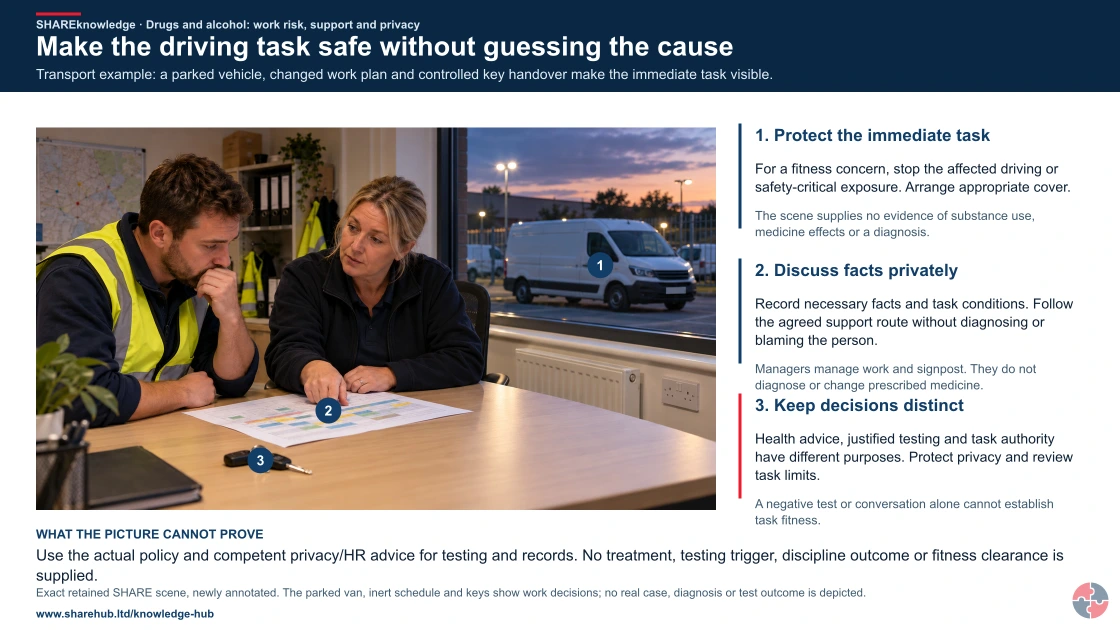
Make the driving task safe without guessing the cause
Full written explanation
Transport example: a parked vehicle, changed work plan and controlled key handover make the immediate task visible.
- Protect the immediate task. For a fitness concern, stop the affected driving or safety-critical exposure. Arrange appropriate cover.
- Discuss facts privately. Record necessary facts and task conditions. Follow the agreed support route without diagnosing or blaming the person.
- Keep decisions distinct. Health advice, justified testing and task authority have different purposes. Protect privacy and review task limits.
Change the pathway
- Cause remains unknown. The scene supplies no evidence of substance use, medicine effects or a diagnosis.
- Support within role. Managers manage work and signpost. They do not diagnose or change prescribed medicine.
- No automatic clearance. A negative test or conversation alone cannot establish task fitness.
Evidence check: Use the actual policy and competent privacy/HR advice for testing and records. No treatment, testing trigger, discipline outcome or fitness clearance is supplied.
Immediate safety, medical/HR boundaries, qualified support and proportionate records
Primary references: HSE: work risk, support and drugs/alcohol policy (GB) · HSE: screening and testing as part of a wider policy (GB) · ICO: health examinations and testing; guidance under review
Open the complete HD image (new tab)Download image

Immediate safety, medical/HR boundaries, qualified support and proportionate records
Primary references: HSE: work risk, support and drugs/alcohol policy (GB) · HSE: screening and testing as part of a wider policy (GB) · ICO: health examinations and testing; guidance under review
Best-practice guide: Drugs and Alcohol at Work

Act on the unsafe task before debating its cause
Observed impairment, prescribed medication and a testing-policy question require different follow-up. Make the immediate task safe, arrange competent cover and use a private fair support process without diagnosing or treating rumour as evidence. Drugs and alcohol at work should be managed as a fitness-for-work, health, wellbeing and safety-critical risk topic, not simply as a disciplinary issue.
Turn drugs and alcohol at work knowledge into a decision
Drugs and alcohol at work should be managed as a fitness-for-work, health, wellbeing and safety-critical risk topic, not simply as a disciplinary issue. Alcohol, illegal drugs, misused medicines, solvents and some prescribed or over-the-counter medicines can impair judgement, reaction time, coordination, concentration, mood, sleep and risk perception; in safety-critical work this can lead to vehicle collisions, machinery incidents, falls from height, electrical errors, loss of containment, violence, public harm and serious injury. Safety-critical role register, impairment risk assessment and risk-register entries.
the process operator management approach
Assess and analyse: Maps safety-critical roles, credible impairment scenarios, driving exposure, permit work, lone work and emergency response duties. Evidence / response: Safety-critical role register, impairment risk assessment and risk-register entries. Policy and consultation: Consults workers before policy issue and explains why some roles have stricter rules or testing triggers. Evidence / response: Consultation records, policy acknowledgements and briefing material.
Warning signs and how harm can manifest
No safety-critical role map: High-risk roles may have no clear fitness-for-work controls. Managers rely on rumours: People may be treated unfairly or real impairment may be missed. Workers fear self-referral: Dependence or medication issues stay hidden until an incident occurs.
Choose controls for drugs and alcohol at work
Elimination: Remove or defer the non-essential journey while the worker is unfit to drive. Administrative controls: Use a suitable non-driving duty, fit replacement driver or safe alternative transport while competent advice and the task assessment resolve fitness; do not change prescribed treatment. Administrative controls: Do not release the vehicle to a driver who is unfit; keep the worker away from driving and other safety-critical duties. Engineering controls: Provide a safe collection/waiting location and suitable vehicle arrangements; driver-assistance systems do not make drowsy driving safe. Administrative controls: Agree immediate duty restrictions and a confidential occupational-health or clinical advice route. Read the full control table for qualifications, ownership and verification. Use the actual task and applicable jurisdiction; existing technical approval remains unchanged.
Use the full drugs and alcohol at work lesson
Use the full topic for the decision points, practical examples, detailed control tables and source scope. HSE guidance applies to Great Britain; use HSENI for the Northern Ireland route and the source’s stated jurisdiction. A simplified guide does not change the page’s technical-review or approval status.

Read all six steps as text
1. Act on the unsafe task before debating its cause
Observed impairment, prescribed medication and a testing-policy question require different follow-up.
- Avoid / redesign: Remove or defer the non-essential journey while the worker is unfit to drive.
- Control the task: Do not release the vehicle to a driver who is unfit; keep the worker away from driving and other safety-critical duties.
- Verify before release: If the hazardous step remains, keep it within the task assessment and select the stronger feasible remaining controls.
Observed impairment, prescribed medication and a testing-policy question require different follow-up. Make the immediate task safe, arrange competent cover and use a private fair support process without diagnosing or treating rumour as evidence. Drugs and alcohol at work should be managed as a fitness-for-work, health, wellbeing and safety-critical risk topic, not simply as a disciplinary issue.
Apply it: Which part of this plan would you check at the workface before authorising the task?
2. Turn drugs and alcohol at work knowledge into a decision
Use the evidence to improve the actual work arrangement.
- Change at source: Remove or defer the non-essential journey while the worker is unfit to drive.
- Make it observable: If the hazardous step remains, keep it within the task assessment and select the stronger feasible remaining controls.
- Keep useful evidence: Safety-critical role register, impairment risk assessment and risk-register entries.
Drugs and alcohol at work should be managed as a fitness-for-work, health, wellbeing and safety-critical risk topic, not simply as a disciplinary issue. Alcohol, illegal drugs, misused medicines, solvents and some prescribed or over-the-counter medicines can impair judgement, reaction time, coordination, concentration, mood, sleep and risk perception; in safety-critical work this can lead to vehicle collisions, machinery incidents, falls from height, electrical errors, loss of containment, violence, public harm and serious injury. Safety-critical role register, impairment risk assessment and risk-register entries.
Apply it: What evidence would show that the change improves this task, rather than only completing a record?
3. the process operator management approach
Example: a practical application of the existing topic lesson.
- Assess and analyse: Maps safety-critical roles, credible impairment scenarios, driving exposure, permit work, lone work and emergency response duties.
- Policy and consultation: Consults workers before policy issue and explains why some roles have stricter rules or testing triggers.
- Testing governance: Uses for-cause and post-incident testing where justified and considers random testing only for defined safety-critical groups after privacy assessment.
Assess and analyse: Maps safety-critical roles, credible impairment scenarios, driving exposure, permit work, lone work and emergency response duties. Evidence / response: Safety-critical role register, impairment risk assessment and risk-register entries. Policy and consultation: Consults workers before policy issue and explains why some roles have stricter rules or testing triggers. Evidence / response: Consultation records, policy acknowledgements and briefing material.
Apply it: At which point would you hold this example, and what evidence would allow it to proceed?
4. Warning signs and how harm can manifest
Connect the task, the route to the person and the control that can fail.
- No safety-critical role map: High-risk roles may have no clear fitness-for-work controls.
- Managers rely on rumours: People may be treated unfairly or real impairment may be missed.
- Workers fear self-referral: Dependence or medication issues stay hidden until an incident occurs.
No safety-critical role map: High-risk roles may have no clear fitness-for-work controls. Managers rely on rumours: People may be treated unfairly or real impairment may be missed. Workers fear self-referral: Dependence or medication issues stay hidden until an incident occurs.
Apply it: Who could be exposed, including other trades, cleaners, maintainers and people nearby?
5. Choose controls for drugs and alcohol at work
Start with the stronger practicable options and verify their effect.
- Elimination: Remove or defer the non-essential journey while the worker is unfit to drive.
- Administrative controls: Use a suitable non-driving duty, fit replacement driver or safe alternative transport while competent advice and the task assessment resolve fitness; do not change prescribed treatment.
- Administrative controls: Do not release the vehicle to a driver who is unfit; keep the worker away from driving and other safety-critical duties.
- Engineering controls: Provide a safe collection/waiting location and suitable vehicle arrangements; driver-assistance systems do not make drowsy driving safe.
- Administrative controls: Agree immediate duty restrictions and a confidential occupational-health or clinical advice route.
Elimination: Remove or defer the non-essential journey while the worker is unfit to drive. Administrative controls: Use a suitable non-driving duty, fit replacement driver or safe alternative transport while competent advice and the task assessment resolve fitness; do not change prescribed treatment. Administrative controls: Do not release the vehicle to a driver who is unfit; keep the worker away from driving and other safety-critical duties. Engineering controls: Provide a safe collection/waiting location and suitable vehicle arrangements; driver-assistance systems do not make drowsy driving safe. Administrative controls: Agree immediate duty restrictions and a confidential occupational-health or clinical advice route. Read the full control table for qualifications, ownership and verification. Use the actual task and applicable jurisdiction; existing technical approval remains unchanged.
Apply it: Which stronger option can be used here, and who will verify it before accepting the remaining risk?
6. Use the full drugs and alcohol at work lesson
Follow the official sources below and retain the task-specific evidence.
- Official guidance: HSE - Managing drug and alcohol misuse at work
- Official guidance: HSE - Look at safety-critical work
- Task decision: Safety-critical role register, impairment risk assessment and risk-register entries.
Use the full topic for the decision points, practical examples, detailed control tables and source scope. HSE guidance applies to Great Britain; use HSENI for the Northern Ireland route and the source’s stated jurisdiction. A simplified guide does not change the page’s technical-review or approval status.
Apply it: Which official source and full-topic section will you use to resolve the next decision?
A supervisor notices reduced alertness
Illustrative example. A worker is about to begin safety-critical work and appears unable to perform it safely.
Decision. Pause the task, arrange a safe handover and follow the established escalation and support process.
Evidence to check. Factual observations, task demands, available cover and the applicable policy.
Hold or escalation point. A negative test or an unverified explanation is not automatic clearance for an unsafe task.
Follow-up. Review work factors and necessary support; handle health or testing records through authorised channels.
Separate an unsafe task, clinical advice and the policy route
An observed concern about safe work does not establish a diagnosis or explain its cause. Make the task safe while using the appropriate confidential and authorised processes.

Make safe
Restrict or reassign unsafe work through the agreed competent route and address safe travel without assuming the cause.
Clinical advice
Keep medication and health questions in the confidential appropriate health lane; managers need necessary functional advice, not unrestricted clinical records.
Policy and return
Apply the justified authorised policy/testing process and a named task-specific return decision; a test icon is not automatic clearance.
Avoid guessing impairment or substance use from appearance. Preserve privacy and the applicable policy/legal safeguards.
What is the medical, legal, HR and confidentiality boundary?
This is general workplace guidance, not medical, legal or HR advice.
Dependence, withdrawal, overdose, acute intoxication, mental-health crisis, self-harm concern or medication side effects should be handled through qualified medical, occupational-health, emergency, safeguarding or specialist support routes as appropriate. Managers should not diagnose addiction, assess withdrawal clinically or make treatment recommendations beyond signposting.
Testing, refusal to test, positive results, discipline, dismissal, disclosure, reasonable adjustments and contractor removal can all create legal, HR and data-protection risk. Employers should use competent advice when decisions may affect employment, privacy rights, equality considerations, contractual duties or safety-critical authorisation.
Confidentiality should be visible from the start. Health information, test results, occupational-health advice and support disclosures should be collected only where needed, used for a clear purpose, stored securely, retained only as long as justified and shared only with people who genuinely need to know.
Immediate safety still comes first. If a worker appears impaired in safety-critical work, the practical action is to stop the exposure, keep the person and others safe, arrange supervision or safe transport if required, and then follow the agreed policy. See HSE - Managing drug and alcohol misuse at work; ICO - Medical examinations and drugs and alcohol testing.
What key facts should people know first?
The main fact is that a good workplace system protects people while also offering a fair route to support.
Drug and alcohol risk is not limited to illegal drug use or drinking at work. It can involve hangover effects, withdrawal, prescribed medicine, over-the-counter medicine, solvents, fatigue, dependency, social drinking culture, mental-health stressors and substances used outside work that still affect fitness for duty.
Warning signs are not proof. Absence, lateness, mood change, poor concentration, conflict, reduced productivity, smell of alcohol, near misses or unsafe behaviour can also point to stress, grief, illness, fatigue or domestic difficulty. That is why managers should record observable work facts rather than make personal assumptions.
Safety-critical work needs more explicit control because the consequence of impairment is higher. A person may be able to attend an ordinary meeting while tired or recovering, but the same state may be unacceptable for driving, plant operation, confined-space entry, hot work, electrical isolation, working at height or responding to alarms. See HSE - Managing drug and alcohol misuse at work.
| Key fact | Why it matters | Practical response |
|---|---|---|
| Impairment can be short term or longer term | Reaction time, judgement, mood and coordination can be affected by alcohol, drugs, medicines or withdrawal. | Define fitness-for-work expectations and stop safety-critical work when there is a credible concern. Source: HSE - Managing drug and alcohol misuse at work. |
| Misuse is not the same as dependence | A person may misuse substances occasionally or may have a health condition requiring qualified support. | Separate immediate risk control from support, occupational-health referral and HR process. Source: HSE - Managing drug and alcohol misuse at work. |
| Testing is not a complete control | A negative test does not prove good culture, and a positive test needs fair handling. | Use testing only with clear purpose, reliable process, consent, transparency and support routes. Source: HSE - Managing drug and alcohol misuse at work. |
| Medication can impair safety | Some prescribed or over-the-counter medicines can cause drowsiness, slower reactions or judgement issues. | Provide confidential disclosure routes and task-adjustment processes. Source: HSE - Managing drug and alcohol misuse at work. |
| Culture can increase risk | Long hours, travel, client entertaining, stress, bullying or normalised drinking can undermine policy. | Review work design and leadership signals, not just individual behaviour. Source: HSE - Managing drug and alcohol misuse at work. |
| Records need careful handling | Testing and health information can be sensitive worker health information. | Apply data minimisation, access control, retention review and privacy information. Source: HSE - Managing drug and alcohol misuse at work. |
What does drugs and alcohol at work mean?
Drugs and alcohol at work means any substance-related issue that may affect health, wellbeing, conduct, attendance, performance or safety.
The workplace topic is broader than a worker arriving visibly drunk or using illegal drugs on site. It includes alcohol consumed the night before, residual drug effects, prescription medicines, over-the-counter medicines, solvents, dependence, withdrawal, recovery, relapse, workplace social culture and the effect of stress or fatigue on substance use.
For health and safety purposes the central question is fitness for work. Can the person complete the task safely, reliably and without creating unacceptable risk to themselves, colleagues, the public, the environment or the business? The answer depends on the task, not just the substance. A minor office task and a high-risk lifting operation do not carry the same tolerance for impairment.
A mature approach uses three linked routes: prevention through clear standards and work design; early support through confidential routes and manager capability; and control of safety-critical exposure where impairment could cause serious harm. See HSE - Managing drug and alcohol misuse at work.
| Term | Plain-language meaning | Workplace relevance |
|---|---|---|
| Misuse | Using alcohol, drugs, medicines or substances in a way that creates harm, risk or breach of policy. | May affect attendance, conduct, safety, quality or wellbeing. Source: HSE - Managing drug and alcohol misuse at work. |
| Dependence | A health condition where the person may struggle to control use or experience withdrawal. | Needs qualified support; sudden stopping can be medically unsafe for some people. Source: HSE - Managing drug and alcohol misuse at work. |
| Intoxication | Short-term impairment from alcohol or drugs. | Requires immediate control where work is safety-critical. Source: HSE - Managing drug and alcohol misuse at work. |
| Withdrawal | Physical or psychological symptoms when a dependent person reduces or stops use. | Can affect fitness for work and may need medical input. Source: HSE - Managing drug and alcohol misuse at work. |
| Fitness for work | Being physically and mentally able to carry out the required work safely. | Should be assessed by task risk and observable capability, not moral judgement. Source: HSE - Managing drug and alcohol misuse at work. |
| Safety-critical work | Work where impaired performance could cause serious harm. | Requires explicit controls, rules, supervision and sometimes testing. Source: HSE - Managing drug and alcohol misuse at work. |
How can drugs and alcohol impair work?
Drugs and alcohol can impair work by changing the way a person thinks, moves, reacts, communicates and judges risk.
Alcohol commonly affects coordination, reaction time, inhibition, concentration, balance, judgement and sleep quality. A worker may not be over a legal driving limit and may still be unfit for a particular task. Hangover effects can include fatigue, headache, reduced concentration, dehydration, sickness and slower response.
Different drugs produce different patterns of harm. Sedatives and opioids may slow breathing, alertness and reaction. Stimulants may increase confidence, impulsivity, agitation or fatigue crash. Cannabis may affect concentration, coordination and perception. Some medicines, including certain painkillers, antihistamines, anti-anxiety medicines and sleeping tablets, may affect driving or machinery even when taken lawfully.
The workplace effect is often indirect. Impairment may show as missed steps in a procedure, unsafe shortcuts, poor communication, failure to hear alarms, conflict with colleagues, poor handover, overconfidence, loss of fine motor control, increased manual-handling errors or a delayed emergency response. See HSE - Managing drug and alcohol misuse at work.
| Work situation | Possible impairment effect | How harm can occur |
|---|---|---|
| Driving and mobile plant | Slower reaction, lane drift, poor judgement, risk-taking or fatigue. | Vehicle collision, pedestrian strike, rollover, property damage or public harm. Source: HSE - Managing drug and alcohol misuse at work. |
| Machinery and tools | Reduced coordination, missed guards, wrong controls or delayed stop response. | Entanglement, crushing, cutting, amputation, flying object or equipment damage. Source: HSE - Managing drug and alcohol misuse at work. |
| Work at height | Poor balance, misjudged footing, reduced attention to edge protection or harness use. | Fall, dropped object or failed rescue response. Source: HSE - Managing drug and alcohol misuse at work. |
| Hazardous substances | Procedure errors, wrong chemical selection, poor PPE use or missed exposure controls. | Burns, inhalation, dermatitis, spill, fire or toxic release. Source: HSE - Managing drug and alcohol misuse at work. |
| Process safety work | Poor isolation, weak permit checks, missed alarms or poor handover. | Loss of containment, fire, explosion, toxic release or escalation. Source: HSE - Managing drug and alcohol misuse at work. |
| Public-facing work | Conflict escalation, poor judgement, inconsistent decisions or unsafe restraint. | Violence, complaint, safeguarding failure or reputational harm. Source: HSE - Managing drug and alcohol misuse at work. |
Which substances and routes should a workplace consider?
A workplace should consider alcohol, illegal drugs, misused medicines, prescribed medicines, over-the-counter medicines and volatile substances where they can affect work.
The policy should avoid becoming a narrow list of banned substances only. The practical risk is impairment and harm. A worker lawfully taking prescribed medication may need temporary adjustment if it affects safe driving. A worker using illegal drugs may create disciplinary, safety and criminal concerns. A person misusing solvents, painkillers or sleeping tablets may need support and risk control.
For most employers, the policy should cover being under the influence at work, possession or supply on company premises, alcohol during working time, safety-critical work after drinking or drug use, prescription and over-the-counter medication, contractor rules, social events, client entertainment, call-out arrangements and driving for work.
The language matters. The aim is not to shame people for seeking help. The aim is to make expectations clear enough that people know when they must not work, when to disclose safety-relevant medication confidentially, how to ask for help and what happens if rules are breached. See HSE - Managing drug and alcohol misuse at work.
| Substance route | Typical issue | Control focus |
|---|---|---|
| Alcohol | Residual impairment, drinking before or during work, hangover effects, dependence or withdrawal. | Clear limits, fitness-for-work rules, support, safety-critical restrictions and return-to-work planning. Source: HSE - Managing drug and alcohol misuse at work. |
| Illegal drugs | Impairment, possession, supply, criminal risk, driving risk or safety-critical failure. | Policy rules, testing governance where justified, contractor control, support and disciplinary route. Source: HSE - Managing drug and alcohol misuse at work. |
| Prescription medication | Lawful medication may still affect alertness, driving, machinery or decision-making. | Confidential disclosure route, occupational-health advice and temporary work adjustment. Source: HSE - Managing drug and alcohol misuse at work. |
| Over-the-counter medication | Antihistamines, cold remedies or sleep aids may cause drowsiness or reduced concentration. | Worker awareness, pharmacist/doctor advice and supervisor escalation where safety-critical. Source: HSE - Managing drug and alcohol misuse at work. |
| Solvents and volatile substances | Intentional misuse or exposure may affect judgement and health. | COSHH controls, welfare support, supervision and substance-security arrangements. Source: HSE - Managing drug and alcohol misuse at work. |
| Polydrug or mixed use | Alcohol mixed with medicines or drugs can increase impairment unpredictably. | Policy awareness, support routes and cautious fitness-for-work decisions. Source: HSE - Managing drug and alcohol misuse at work. |
How should safety-critical work be identified?
Safety-critical work should be identified by asking where impaired performance could cause serious harm.
HSE specifically advises employers to look at work where drug or alcohol misuse could have a serious outcome. This includes obvious activities such as driving, operating machinery and using ladders, but it also includes decision-making roles, lone work, public safety work, supervision of high-risk activities and work where a missed step could escalate quickly.
The assessment should be role and task based. Job titles can mislead: a manager may not operate plant every day but may authorise isolations, permit work, lift plans or emergency decisions. A cleaner may use chemicals, drive between sites or work alone. A contractor may enter high-risk areas for a short job but still create major exposure.
Once safety-critical work is identified, the organisation can decide what controls are justified: fitness-for-work checks, shift-start briefings, stop-work authority, medication disclosure route, supervisor competence, for-cause testing, random testing for specified roles, temporary transfer after self-referral and clear rules for contractors. See HSE - Look at safety-critical work.
| Task or role | Why impairment matters | Possible controls |
|---|---|---|
| Driving for work | Impairment can cause road collisions, public harm and criminal consequences. | Licence checks, driver policy, medication declaration route, fatigue controls, no alcohol/drug rules and incident review. Source: HSE - Look at safety-critical work. |
| Forklift, telehandler and plant operation | Slow reaction or poor judgement can strike pedestrians or overturn equipment. | Authorisation, pre-start fitness, supervisor observation, traffic management and for-cause testing. Source: HSE - Look at safety-critical work. |
| Work at height | Balance, judgement and rescue response are critical. | Pre-task briefing, supervisor check, stop-work route and exclusion from task if impairment suspected. Source: HSE - Look at safety-critical work. |
| Confined spaces | Rescue, atmospheric monitoring and communication require clear judgement. | Permit control, competent entrant/attendant, fitness check and no lone entry. Source: HSE - Look at safety-critical work. |
| Process safety activities | Poor isolation, hot work, line breaking or alarm response can escalate into major accident hazards. | Permit-to-work, independent verification, control-room rules, handover discipline and testing governance where justified. Source: HSE - Look at safety-critical work. |
| Public-facing or care work | Judgement, safeguarding and conflict management can be affected. | Manager escalation, safeguarding routes, support and clear conduct expectations. Source: HSE - Look at safety-critical work. |
What should a drug and alcohol policy include?
A drug and alcohol policy should set clear expectations while explaining support, testing, confidentiality and fair process.
The policy should be practical enough for a worker and supervisor to use at the moment of concern. It should not sit only in a handbook. It should explain what is prohibited, what must be disclosed, what support is available, when testing may occur, what happens after a concern and who is allowed to make decisions.
Worker consultation improves legitimacy. People are more likely to trust the system if they understand why the rules exist, how privacy is protected, why some roles have stricter controls, what happens after self-referral and how the organisation prevents misuse of testing or rumours.
Policy should also cover contractors and visitors. A contractor working on site may not be an employee, but the client still has to manage risks arising from site rules, permits, plant, hazardous areas, driving, lifting or work at height. Bridging arrangements should make the host's minimum expectations clear. See HSE - Managing drug and alcohol misuse at work.
| Policy element | What it should say | Why it matters |
|---|---|---|
| Purpose | Protect health, safety, wellbeing, public safety, operational integrity and fair treatment. | Sets the tone as prevention and support, not just punishment. Source: HSE - Managing drug and alcohol misuse at work. |
| Scope | Employees, agency workers, contractors, visitors, work travel, call-out, company events and safety-critical work. | Avoids gaps where risk sits outside normal working hours or employment status. Source: HSE - Managing drug and alcohol misuse at work. |
| Fitness for work | Workers must attend work fit for duty and must not undertake safety-critical work while impaired. | Creates a clear operational standard. Source: HSE - Managing drug and alcohol misuse at work. |
| Medication | Workers should confidentially disclose medication that could affect safety-critical duties. | Allows adjustment without unnecessary medical disclosure. Source: HSE - Managing drug and alcohol misuse at work. |
| Testing | When testing may occur, who is selected, what is tested, how results are handled and consequences. | Supports fairness, transparency and data-protection compliance. Source: HSE - Managing drug and alcohol misuse at work. |
| Support and self-referral | How workers can seek help and how self-referral interacts with safety-critical duties and discipline. | Encourages early help before incidents. Source: HSE - Managing drug and alcohol misuse at work. |
| Manager action | Observable signs, immediate risk control, record keeping, HR/OH referral and dignity. | Prevents inconsistent or unsafe manager responses. Source: HSE - Managing drug and alcohol misuse at work. |
| Review | How incidents, test trends, absence, near misses and feedback will improve the policy. | Keeps the system alive. Source: HSE - Managing drug and alcohol misuse at work. |
How should drug and alcohol testing be managed?
Testing should be justified, transparent, proportionate, reliable and part of a wider risk-management and support system.
HSE is clear that screening on its own will not solve drug and alcohol problems. It may have a place, especially in safety-critical jobs, but employers should first know what they want testing to achieve, what they will do with results and how the testing fits the wider health and safety policy.
A testing programme should define the type of testing. Pre-employment testing may be used for some safety-critical roles. Random testing may be justified for clearly defined safety-critical groups. For-cause testing may be used where there are observable signs or reliable information. Post-incident testing may be relevant where impairment could have contributed, but it should not distract from investigating equipment, supervision, work design and management factors.
The table describes possible local policy categories, not mandatory or universal testing triggers. Each category needs a defined safety purpose, less-intrusive-option review, worker information, reliable method and separate lawful data-processing basis. Contractor and follow-up processes depend on the agreed policy, contract and individual facts.
Reliability matters. Collection should be performed by trained people using appropriate equipment, identity checks, chain of custody, contamination control, confirmatory testing where needed, clear thresholds and an appeal or review process. Poor testing can damage trust and create legal risk.
For screening limits and worker-health data safeguards, consult HSE - Screening and testing for drugs and alcohol; ICO - Medical examinations and drugs and alcohol testing. Apply the source to its task and jurisdiction.
The GB HSE screening guidance says employees cannot be made to take a test, although refusal where the employer has good grounds may lead to disciplinary action. That is not an automatic dismissal rule or proof of impairment. For example, if a machinery operator refuses a proposed test, address the immediate work risk, record the actual concern and refusal, and obtain appropriate HR/legal advice under the agreed policy before deciding any employment response. This illustrative sequence does not establish that testing was justified in the individual case. Agreement to take a test also does not settle the separate lawful basis for processing health information; retain the data-protection review described below. HSE advises proper sample handling and accurate testing as part of a wider policy, not screening as a complete solution. Use the NI route for NI duties.
| Testing type | When it may be used | Good governance |
|---|---|---|
| Pre-employment or pre-assignment | For specified safety-critical roles where fitness is relevant and the requirement is transparent. | Limit to justified roles, tell applicants clearly and avoid collecting excessive health information. Source: ICO - Medical examinations and drugs and alcohol testing. |
| Random testing | For safety-critical roles where the risk justifies random selection. | Define the population, use genuine random selection, complete a data-protection impact assessment where appropriate and avoid blanket testing without justification. Source: ICO - Medical examinations and drugs and alcohol testing. |
| For-cause testing | Where observable signs, behaviour, credible information or circumstances suggest possible impairment. | Record facts, remove immediate risk, involve trained managers and follow the policy. Source: ICO - Medical examinations and drugs and alcohol testing. |
| Post-incident testing (local policy example) | After an accident or near miss where impairment could reasonably be relevant. | Test promptly but still investigate the full system, including equipment, supervision and organisational factors. Source: ICO - Medical examinations and drugs and alcohol testing. The cited guidance sets safeguards, not a prescribed trigger. |
| Follow-up testing (local policy example) | As part of an agreed return-to-work or rehabilitation plan in safety-critical work. | Use occupational health/HR advice, clear consent, proportionality, privacy and review. Source: ICO - Medical examinations and drugs and alcohol testing. The cited guidance sets safeguards, not a prescribed trigger. |
| Contractor testing (local policy example) | Where host site rules or safety-critical work require testing standards. | Set expectations in contracts and bridging documents before work starts. Source: HSE - Screening and testing for drugs and alcohol. The cited guidance sets safeguards, not a prescribed trigger. |
How should confidentiality and data protection be managed?
Confidentiality and data protection should be built into the policy before any testing or health disclosure takes place.
ICO guidance treats worker health information as particularly sensitive. Drug and alcohol testing can reveal health-related information, behaviour, medication, dependence, treatment or private life. Employers should be able to explain why they need the information, why less intrusive methods are not enough, who will see it, how long it will be kept and what workers are told before testing.
Transparency is essential. Workers should know when testing may take place, what substances are tested for, what threshold or rule is being applied, what happens if they refuse, how positive results are handled, whether confirmatory testing is used, how records are retained and how they can raise concerns.
Data minimisation means collecting only what is needed. A manager may need to know whether someone is fit for a safety-critical task or requires temporary adjustment; they usually do not need the full clinical history. Access to results should be tightly controlled. See ICO - Data protection and workers' health information.
Before testing or collecting a result, the employer must identify and record an Article 6 lawful basis and a separate special-category condition for worker health data. A worker’s consent to provide a sample is part of a fair practical process; it does not by itself settle the employer’s data-processing basis. Define the purpose, consider less intrusive means, minimise what is collected and check the current ICO guidance, which is under review after the Data (Use and Access) Act. ICO worker testing guidance.
| Control | What good looks like | Why it matters |
|---|---|---|
| Clear purpose | Testing and disclosures are linked to safety, fitness for work, policy compliance or support. | Prevents unjustified or intrusive collection. Source: ICO - Data protection and workers' health information. |
| Transparency | Workers are told what will happen before testing or medical information is requested. | Supports fairness and trust. Source: ICO - Data protection and workers' health information. |
| Data minimisation | Only necessary results, dates, decisions and fitness information are retained. | Reduces privacy risk. Source: ICO - Data protection and workers' health information. |
| Access control | Information is limited to HR, occupational health, trained decision-makers or managers with a need to know. | Protects sensitive worker information. Source: ICO - Data protection and workers' health information. |
| Retention rule | Records are reviewed and deleted when no longer needed, subject to legal and policy requirements. | Prevents indefinite retention of sensitive data. Source: ICO - Data protection and workers' health information. |
| Quality and accuracy | Tests are reliable, confirmatory where needed and interpreted by competent people. | Reduces false conclusions and unfair action. Source: ICO - Data protection and workers' health information. |
| Data protection impact assessment | Higher-risk testing programmes are assessed before introduction. | Helps justify proportionality, random testing and safeguards. Source: ICO - Data protection and workers' health information. |
How should workers be supported?
Workers should have confidential, visible and non-judgemental routes to qualified support.
Support should be available before a crisis or incident. A worker who is worried about alcohol, drug use, medicine dependence or relapse should know how to ask for help, who will see the information and what happens to safety-critical duties while support is arranged.
Support can include a GP, NHS addiction services, occupational health, employee assistance programmes, counselling, peer support, rehabilitation providers, mental-health support and temporary work adjustments. The employer's role is to signpost, adjust work where needed, manage risk and treat people fairly; it is not to provide clinical treatment unless it employs qualified clinicians.
Self-referral policy needs careful wording. Organisations often encourage self-referral before an incident, but they must still control immediate risk and may need separate rules where a serious policy breach, criminal issue or safety-critical event has occurred. See HSE - Managing drug and alcohol misuse at work; HSENI drugs and alcohol: what employers can do.
| Support route | What it can help with | Workplace caution |
|---|---|---|
| GP or NHS services | Assessment, treatment, withdrawal risk, medication and referral. | Managers should encourage medical help where health risk is suspected but avoid giving clinical advice. Source: NHS - Alcohol misuse. |
| Occupational health | Fitness-for-work advice, adjustments, rehabilitation plans and return-to-work guidance. | OH advice should be functional and shared only as necessary. Source: HSE - Managing drug and alcohol misuse at work. |
| Employee assistance programme | Confidential counselling, early support and signposting. | EAP is support, not a substitute for safety-critical risk control. Source: HSE - Managing drug and alcohol misuse at work. |
| Specialist addiction support | Recovery planning, relapse prevention and structured treatment. | Use consent and confidentiality safeguards. Source: NHS - Drug addiction: getting help. |
| Temporary adjustment | Alternative duties, removed safety-critical work, phased return or supervision. | Adjustments should be reviewed and documented. Source: HSE - Managing drug and alcohol misuse at work. |
| Manager check-ins | Work-focused support, attendance review and agreed actions. | Managers should stay within role boundaries and avoid diagnosis. Source: HSE - Managing drug and alcohol misuse at work. |
What should managers do when they are concerned?
Managers should control immediate risk, record observable facts and follow the agreed route without diagnosing the person.
A good manager response is calm, specific and fair. The manager should focus on what they have observed: smell of alcohol, slurred speech, unsteady movement, unsafe act, confusion, aggression, near miss, poor handover, unexplained absence or information from a credible source. They should avoid labels such as drunk, addict or user unless there is confirmed evidence.
If the work is safety-critical, the first decision is removal from exposure. That may mean stopping a vehicle journey, preventing plant operation, pausing permit work, moving the person away from public-facing duties or assigning a second person while the situation is escalated. The worker's dignity and welfare should still be protected.
The next steps depend on the policy. They may include a private conversation with a second manager present, HR involvement, occupational health referral, for-cause testing, safe transport home, welfare contact, investigation or temporary alternative duties. See HSE - Managing drug and alcohol misuse at work.
| Step | Action | Evidence to keep |
|---|---|---|
| 1. Make the task safe | Stop safety-critical work or remove the worker from the risk area if impairment is reasonably suspected. | Time, location, task, immediate control and who was informed. Source: HSE - Managing drug and alcohol misuse at work. |
| 2. Preserve dignity | Speak privately, calmly and with a witness where policy requires it. | Names present and factual notes. Source: HSE - Managing drug and alcohol misuse at work. |
| 3. Record observations | Write observable facts rather than assumptions or medical labels. | Speech, movement, behaviour, smell, error, incident or credible report. Source: HSE - Managing drug and alcohol misuse at work. |
| 4. Follow policy | Escalate to HR, senior manager, occupational health or testing provider as defined. | Policy route followed and decision-maker. Source: HSE - Managing drug and alcohol misuse at work. |
| 5. Arrange welfare and safety | Consider safe transport, supervision, emergency response or contact arrangements. | Welfare actions and any refusal. Source: HSE - Managing drug and alcohol misuse at work. |
| 6. Review work factors | Check fatigue, workload, conflict, shift pattern, culture, supervision and incident context. | Learning actions beyond the individual case. Source: HSE - Managing drug and alcohol misuse at work. |
How can the hierarchy of controls control driving risk when alertness or fitness is uncertain?
Start by removing the hazard where practicable, then consider substitution, engineering controls and work-method controls. Use PPE for residual risk. These priorities follow HSE’s hierarchy of controls; the task-specific examples below must still be checked against the relevant HSE guidance and local conditions.
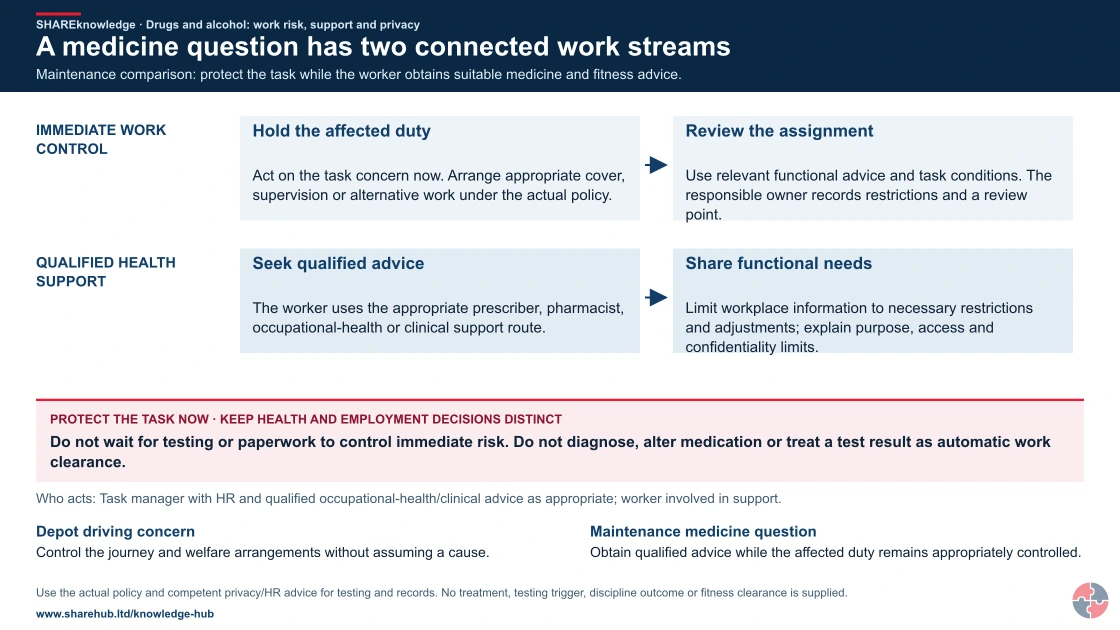
A medicine question has two connected work streams
Full written explanation
Maintenance comparison: protect the task while the worker obtains suitable medicine and fitness advice.
- Hold the affected duty. Act on the task concern now. Arrange appropriate cover, supervision or alternative work under the actual policy.
- Review the assignment. Use relevant functional advice and task conditions. The responsible owner records restrictions and a review point.
- Seek qualified advice. The worker uses the appropriate prescriber, pharmacist, occupational-health or clinical support route.
- Share functional needs. Limit workplace information to necessary restrictions and adjustments; explain purpose, access and confidentiality limits.
When the evidence does not fit: Do not wait for testing or paperwork to control immediate risk. Do not diagnose, alter medication or treat a test result as automatic work clearance.
Who acts: Task manager with HR and qualified occupational-health/clinical advice as appropriate; worker involved in support.
Changed workplace
Depot driving concern: Control the journey and welfare arrangements without assuming a cause.
Maintenance medicine question: Obtain qualified advice while the affected duty remains appropriately controlled.
Evidence check: Use the actual policy and competent privacy/HR advice for testing and records. No treatment, testing trigger, discipline outcome or fitness clearance is supplied.
Immediate safety, medical/HR boundaries, qualified support and proportionate records
Primary references: HSE: work risk, support and drugs/alcohol policy (GB) · HSE: screening and testing as part of a wider policy (GB) · ICO: health examinations and testing; guidance under review
Open the complete HD image (new tab)Download image

Immediate safety, medical/HR boundaries, qualified support and proportionate records
Primary references: HSE: work risk, support and drugs/alcohol policy (GB) · HSE: screening and testing as part of a wider policy (GB) · ICO: health examinations and testing; guidance under review
Start by removing the exposure, then test substitution and engineering before relying on procedures or PPE.
A tanker driver reports a new medicine that may cause drowsiness before a loading shift. The transport manager controls immediate work risk without diagnosing the worker or treating a test as the only answer. A confidential occupational-health route determines function and return-to-duty advice.
Choose controls using HSE’s hierarchy and the task-specific guidance cited below.
How can the ERICPD hierarchy of controls control driving risk when alertness or fitness is uncertain?

| Control level | Control for this activity | Owner and verification | Stop / restart decision |
|---|---|---|---|
| Eliminate | Remove or defer the non-essential journey while the worker is unfit to drive. | Task owner verifies that the proposed change removes the named hazardous step, including foreseeable cleaning, maintenance and work transferred elsewhere. | If the hazardous step remains, keep it within the task assessment and select the stronger feasible remaining controls. |
| Reduce, including substitution | Use a suitable non-driving duty, fit replacement driver or safe alternative transport while competent advice and the task assessment resolve fitness; do not change prescribed treatment. | Competent task/process owner validates suitability, compatibility and new hazards against the actual operating requirements before the alternative is adopted. | Reject an alternative if its performance is unproved or its new hazards are unresolved. |
| Isolate | Do not release the vehicle to a driver who is unfit; keep the worker away from driving and other safety-critical duties. | Supervisor checks the actual boundary, affected people and connected work; verify separation or isolation before allowing access. | Hold or stop for sleepiness, impaired concentration or pressure to drive despite being unfit. |
| Control: physical safeguards | Provide a safe collection/waiting location and suitable vehicle arrangements; driver-assistance systems do not make drowsy driving safe. | Competent equipment/process owner checks driver fitness, alternative transport, duty history and realistic journey timing. | Hold or stop for sleepiness, impaired concentration or pressure to drive despite being unfit. |
| Control: work method and response | Agree immediate duty restrictions and a confidential occupational-health or clinical advice route. Supervisors receive the functional limits and return-to-duty criteria they need, rather than unnecessary medical details. | Supervisor confirms the work limits, competent cover, communication and stop/restart authority with the people doing this activity. | Hold work when the agreed limits, competent cover or effective communication cannot be maintained. |
| PPE | Seat belts remain necessary but do not control driver fatigue; there is no PPE that makes an unfit driver safe. | Assessor confirms whether personal protection is needed and checks suitability, condition, compatibility and any required fit evidence. | Do not use unsuitable protection or rely on PPE to continue after an essential source control fails. |
| Discipline | Track fatigue-related journey changes and revise scheduling when repeated late finishes create the same problem. | Release only after transport owner confirms a fit driver or a safe non-driving alternative. Retain verification and unresolved restrictions at handover. | Keep the task on hold until required reinstatement evidence and unresolved defects are accepted by the responsible owner. |
How can the ISO 45001 hierarchy of controls control driving risk when alertness or fitness is uncertain?

| Control level | Control for this activity | Owner and verification | Stop / restart decision |
|---|---|---|---|
| Elimination | Remove or defer the non-essential journey while the worker is unfit to drive. | Task owner verifies that the proposed change removes the named hazardous step, including foreseeable cleaning, maintenance and work transferred elsewhere. | If the hazardous step remains, keep it within the task assessment and select the stronger feasible remaining controls. |
| Administrative controls | Use a suitable non-driving duty, fit replacement driver or safe alternative transport while competent advice and the task assessment resolve fitness; do not change prescribed treatment. | Competent task/process owner validates suitability, compatibility and new hazards against the actual operating requirements before the alternative is adopted. | Reject an alternative if its performance is unproved or its new hazards are unresolved. |
| Administrative controls | Do not release the vehicle to a driver who is unfit; keep the worker away from driving and other safety-critical duties. | Supervisor checks the actual boundary, affected people and connected work; verify separation or isolation before allowing access. | Hold or stop for sleepiness, impaired concentration or pressure to drive despite being unfit. |
| Engineering controls | Provide a safe collection/waiting location and suitable vehicle arrangements; driver-assistance systems do not make drowsy driving safe. | Competent equipment/process owner checks driver fitness, alternative transport, duty history and realistic journey timing. | Hold or stop for sleepiness, impaired concentration or pressure to drive despite being unfit. |
| Administrative controls | Agree immediate duty restrictions and a confidential occupational-health or clinical advice route. Supervisors receive the functional limits and return-to-duty criteria they need, rather than unnecessary medical details. | Supervisor confirms the work limits, competent cover, communication and stop/restart authority with the people doing this activity. | Hold work when the agreed limits, competent cover or effective communication cannot be maintained. |
| PPE | Seat belts remain necessary but do not control driver fatigue; there is no PPE that makes an unfit driver safe. | Assessor confirms whether personal protection is needed and checks suitability, condition, compatibility and any required fit evidence. | Do not use unsuitable protection or rely on PPE to continue after an essential source control fails. |
| Administrative controls | Track fatigue-related journey changes and revise scheduling when repeated late finishes create the same problem. | Release only after transport owner confirms a fit driver or a safe non-driving alternative. Retain verification and unresolved restrictions at handover. | Keep the task on hold until required reinstatement evidence and unresolved defects are accepted by the responsible owner. |
Which legal duties apply to drugs and alcohol at work?
Legal duties depend on the work, risk, employment context and information being collected, but health and safety, road traffic, drugs, equality and data-protection law may all be relevant.
Health and safety law requires employers to manage risks to workers and others affected by the undertaking. That includes foreseeable impairment risk in safety-critical work. The Management Regulations support a risk-assessment approach: identify where impairment could cause serious harm, decide proportionate controls, appoint competent people, provide information and review arrangements.
Great Britain and Northern Ireland have distinct work-safety regulations. The first table gives the Great Britain route where marked; the second gives Northern Ireland sources. A calculator, policy or management standard supports decisions but does not replace the applicable legal duty.
Road traffic law is relevant where workers drive for work. Employers should not treat driving as private simply because it happens on public roads. Drink driving, drug driving and prescription-medicine impairment can have criminal, licence, insurance and employment consequences. GB and NI road-law routes: Road Traffic Act 1988; Road Traffic (Northern Ireland) Order 1995.
Data-protection law becomes central if the employer collects test results, health disclosures, occupational-health advice or support records. The ICO explains testing and health-data safeguards: ICO - Medical examinations and drugs and alcohol testing; ICO - Data protection and workers' health information.
Equality and adjustment duties may also arise; check the separate GB and NI routes: Equality Act 2010; Disability discrimination in Northern Ireland.
| Duty or regulation | Jurisdiction | How it applies | Practical evidence |
|---|---|---|---|
| Health and Safety at Work etc. Act 1974 | Great Britain | Requires employers to protect health, safety and welfare and protect others affected by work so far as reasonably practicable. | Policy, risk assessment, training, safety-critical controls, supervision and incident learning. Source: Health and Safety at Work etc. Act 1974. |
| Management of Health and Safety at Work Regulations 1999 | Great Britain | Requires suitable risk assessment, preventive arrangements, competent assistance and review. | Safety-critical role map, impairment risk assessment, manager process and assurance review. Source: Management of Health and Safety at Work Regulations 1999. |
| Misuse of Drugs Act 1971 | United Kingdom | Controls possession, production and supply of controlled drugs. | Rules on possession/supply on premises and escalation route. Source: Misuse of Drugs Act 1971. |
| Road Traffic Act 1988 | Great Britain | Relevant to driving while unfit through drink or drugs and specified drug-driving offences. | Driving-for-work policy, licence checks, medication guidance and incident response. Source: Road Traffic Act 1988. |
| Data Protection Act 2018 | United Kingdom | Applies to handling worker health information, testing data and related records. | Privacy information, access control, retention schedule, DPIA and secure records. Source: Data Protection Act 2018. |
| Equality Act 2010 | Great Britain | May be relevant to disability, medication, mental health, reasonable adjustments or discrimination risks. | HR advice, occupational-health referral, adjustment decisions and fair treatment. Source: Equality Act 2010. |
| Control of Substances Hazardous to Health Regulations 2002 | Great Britain | Applies to hazardous substances used or generated by work, including occupational solvent exposure; it does not automatically govern private substance use. | COSHH assessment, substance security, supervision and exposure controls. Source: Control of Substances Hazardous to Health Regulations 2002. |
| Duty or guidance | Jurisdiction | How it applies | Evidence or decision |
|---|---|---|---|
| Health and Safety at Work (Northern Ireland) Order 1978 | Northern Ireland | NI work-safety duty for credible impairment risk. | Record the applicable risk assessment, competent decision and control evidence. |
| Management of Health and Safety at Work Regulations (Northern Ireland) 2000 | Northern Ireland | NI risk assessment and prevention arrangements. | Record the applicable risk assessment, competent decision and control evidence. |
| HSENI drugs and alcohol: what employers can do | Northern Ireland | NI regulator guidance on policy, consultation and screening. | Record the applicable risk assessment, competent decision and control evidence. |
| Road Traffic (Northern Ireland) Order 1995 | Northern Ireland | NI Article 15 concerns driving or attempting to drive while unfit through drink or drugs on a road or other public place. | Record the applicable risk assessment, competent decision and control evidence. |
| Disability discrimination in Northern Ireland | Northern Ireland | NI disability and adjustment route where a qualifying condition is present. | Record the applicable risk assessment, competent decision and control evidence. |
What should a risk register include?
A drug and alcohol risk register should focus on credible impairment routes, safety-critical consequences and evidence that controls work.
A useful risk register does not simply say 'employee under influence'. It should describe the task, substance route, exposure, consequence, prevention, detection, response and evidence. The controls for a depot forklift driver, a lone leisure worker, a construction subcontractor and a control-room operator will be different.
The register should also include cultural and organisational contributors. Long shifts, fatigue, high stress, bullying, poor supervision, drinking norms, weak contractor onboarding, lack of support and unclear testing rules can all undermine control. See HSE - Look at safety-critical work.
| Risk | Possible harm | Preventive controls | Detection and response | Assurance evidence |
|---|---|---|---|---|
| Impaired driver or plant operator | Collision, pedestrian strike, rollover, public harm or fatality. | Safety-critical role map, driving/plant policy, medication disclosure, fatigue control and supervisor briefings. | For-cause testing, incident response, safe removal from duty and licence review. | Training records, authorisation records, telematics trends, test governance and incident investigations. Source: HSE - Look at safety-critical work. |
| Impairment during permit-controlled work | Wrong isolation, fire, loss of containment, toxic exposure or failed rescue. | Permit rules, supervision, two-person verification, contractor induction and stop-work authority. | Pause permit, reassess, test if justified and investigate system factors. | Permit audits, handover records, observations and lessons learned. Source: HSE - Look at safety-critical work. |
| Medication affecting safety-critical task | Drowsiness, poor reaction or error during driving, machinery or work at height. | Confidential medication disclosure route and temporary adjustment process. | Manager escalation, occupational-health advice and return-to-task review. | Privacy notices, OH recommendations, adjustment records and policy briefings. Source: HSE - Look at safety-critical work. |
| Weak testing governance | Unfair treatment, privacy breach, unreliable result or loss of trust. | Clear policy, worker consultation, provider competence and DPIA where required. | Confirmatory testing, appeal route and HR/OH review. | Testing procedure, chain-of-custody records, provider audits and retention checks. Source: HSE - Look at safety-critical work. |
| Hidden dependence or withdrawal | Unsafe work, absence, conflict, health crisis or relapse. | Support routes, manager training, wellbeing culture and self-referral pathway. | Private support conversation, OH referral and temporary task restriction. | EAP uptake trends, absence review, anonymised wellbeing reporting and case review. Source: HSE - Look at safety-critical work. |
How could Crownway Fuels Ltd manage drugs and alcohol at work?

Crownway Fuels Ltd would manage this topic by linking safety-critical operations, worker support, testing governance and contractor rules into one controlled system.
Crownway Fuels Ltd
Crownway Fuels Ltd is a fuel storage and distribution business with tanker drivers, terminal operators, maintenance contractors, hot work, confined spaces, loading gantries, control-room decisions and public-road exposure.
Crownway starts by identifying safety-critical roles: tanker drivers, forklift operators, gantry operators, control-room staff, maintenance supervisors, permit issuers, confined-space entrants, fire-team members and contractors who work on live plant. Each role is mapped to the potential consequence of impairment, such as road collision, overfill, wrong valve line-up, failed isolation, delayed emergency response or ignition during hot work.
The policy is built through consultation with workers, trade representatives, HR, occupational health, transport management, process safety and contractor procurement. It explains fitness-for-work expectations, alcohol and drug rules, medication disclosure, self-referral, reasonable-suspicion response, testing, refusal, support, confidentiality, data protection and the different expectations for safety-critical work.
Crownway uses a bridging document for contractors. It states that anyone entering operational areas must follow Crownway's drug and alcohol rules, testing triggers, medication declaration process, permit-to-work requirements and stop-work authority. Contractors are vetted before assignment and supervisors check induction, training and authorisation before access to high-risk work. See HSE - Managing drug and alcohol misuse at work.
| Element | How Crownway manages it | Evidence |
|---|---|---|
| Assess and analyse | Maps safety-critical roles, credible impairment scenarios, driving exposure, permit work, lone work and emergency response duties. | Safety-critical role register, impairment risk assessment and risk-register entries. Source: HSE - Managing drug and alcohol misuse at work. |
| Policy and consultation | Consults workers before policy issue and explains why some roles have stricter rules or testing triggers. | Consultation records, policy acknowledgements and briefing material. Source: HSE - Managing drug and alcohol misuse at work. |
| Testing governance | Uses for-cause and post-incident testing where justified and considers random testing only for defined safety-critical groups after privacy assessment. | Testing procedure, chain-of-custody records, DPIA, provider competence review and result-retention controls. Source: HSE - Managing drug and alcohol misuse at work. |
| Training and onboarding | Trains all workers on expectations and support routes; gives supervisors deeper training on observable signs, immediate risk control and private conversations. | Training matrix, induction records, supervisor competency checks and contractor onboarding records. Source: HSE - Managing drug and alcohol misuse at work. |
| Support and occupational health | Provides EAP, occupational-health referral, temporary alternative duties and return-to-work plans for workers seeking help. | OH referrals, functional advice, adjustment records and support pathway review. Source: HSE - Managing drug and alcohol misuse at work. |
| Operational control | Stops safety-critical work if impairment is suspected, reassigns duties where needed and prevents affected workers driving home unsafely. | Shift logs, incident records, transport arrangements and management sign-off. Source: HSE - Managing drug and alcohol misuse at work. |
| Oversight and audit | Audits policy use, testing triggers, contractor compliance, near misses, absence trends, supervisor decisions and privacy controls. | Audit reports, action tracker, leadership review minutes and improvement actions. Source: HSE - Managing drug and alcohol misuse at work. |
| Learning and improvement | Reviews events for wider causes such as fatigue, shift pattern, work pressure, drinking culture, weak induction or unclear rules. | Investigation findings, lessons learned briefings and revised controls. Source: HSE - Managing drug and alcohol misuse at work. |
The following is an illustrative decision record. It joins the task, exposed people, owner, sequence, hold point and hand-back evidence so the control can be checked in practice.
| Decision field | Task-specific application |
|---|---|
| Task and setting | A tanker driver discloses a new medicine with possible drowsiness before a fuels-depot loading and road journey. Sources: HSE - Look at safety-critical work. |
| People and prerequisites | The driver, depot team and road users may be affected; confirm a safe reporting route, competent cover, secure loading and occupational-health access. Sources: HSE - Look at safety-critical work. |
| Decision owner | The transport manager removes the driver from safety-critical duty; HR and occupational health advise on support and functional fitness. Sources: HSE - Look at safety-critical work. |
| Before work | Thank the worker, ask only work-relevant functional questions, pause driving/loading, arrange safe transport or alternative duty and explain confidentiality. Sources: HSE - Look at safety-critical work. |
| During support | Seek qualified advice, review the task and medication effect without diagnosing, use testing only if justified by policy and evidence, and restrict records to need-to-know. Sources: HSE - Look at safety-critical work. |
| Hold, hand-back and evidence | Keep the hold until authorised functional advice and reassessment support return. Record duty changes, owner, review date and limited access; do not place private diagnosis in shift notes. Sources: HSE - Look at safety-critical work. |
| Residual risk and transfer | Fatigue, relapse or interaction may change; recheck before driving, plant operation, permit work or emergency response, with stop-work authority retained. Sources: HSE - Look at safety-critical work. |
What training should support drugs and alcohol management?
Training should be tiered so everyone understands the basics and higher-risk roles receive deeper practical learning.
General awareness should be short, accessible and repeated periodically. It should explain fitness for work, alcohol and drug effects, medication disclosure, support routes, policy expectations, confidentiality and how to raise concerns.
Targeted face-to-face or live training should be used for safety-critical workers and supervisors. It should use scenarios: a driver reporting medication, a worker smelling of alcohol before a lifting task, a contractor refusing a test, a positive post-incident result, a self-referral before a confined-space job and a manager receiving a rumour.
Managers, HR, HSE advisers and testing administrators need more detailed training because their decisions can affect safety, privacy, employment and trust. They should understand observable evidence, dignity, record keeping, escalation, testing limitations, data protection and the difference between support and discipline. See HSE - Managing drug and alcohol misuse at work.
| Level | Typical audience | Content | Demonstration and assessor | Record and reassessment trigger |
|---|---|---|---|---|
| General awareness | All workers, agency workers and contractors. | Fitness for work, policy basics, effects of alcohol/drugs/medicine, confidential support, reporting routes and stop-work expectations. Source: HSE - Managing drug and alcohol misuse at work. | Explain the fitness-for-work and confidential support route without diagnosing a colleague; the line manager observes. | Keep a dated induction and understanding check. Reassess after policy change or an unsafe response. |
| Safety-critical worker training | Drivers, plant operators, permit workers, lone workers and emergency responders. | Task-specific impairment risk, medication disclosure, start-of-shift fitness, fatigue, testing triggers and temporary removal from duty. Source: HSE - Managing drug and alcohol misuse at work. | Work through a medication/fatigue scenario and choose stop, alternative duty and escalation; a transport or task supervisor assesses. | Keep role authorisation and scenario outcome. Reassess after new task, incident or changed medicine disclosure process. |
| Supervisor training | Line managers, shift leaders, site supervisors and transport managers. | Observable signs, private conversations, immediate risk control, notes, HR/OH escalation, safe transport and avoiding diagnosis. Source: HSE - Managing drug and alcohol misuse at work. | Handle a simulated impairment concern using observable facts, dignity, safe transport and no diagnosis; HR and HSE jointly assess. | Keep a manager competency record. Reassess after a case review, policy change or failed response. |
| HR and HSE specialist training | HR, HSE, wellbeing, transport and process safety leads. | Policy governance, investigation interface, data protection, equality considerations, occupational-health referral and trend review. Source: HSE - Managing drug and alcohol misuse at work. | Review a testing proposal for purpose, less-intrusive option, lawful basis, special-category condition and fair support; privacy and HR leads assess. | Keep the decision audit and training record. Reassess after ICO guidance or law changes and case-audit findings. |
| Testing administrator training | Nominated testing coordinators and approved providers. | Consent, identity, chain of custody, contamination prevention, equipment limits, confirmatory testing and secure records. Source: HSE - Managing drug and alcohol misuse at work. | Demonstrate identity checks, consent-to-sample process, chain of custody, contamination prevention and secure handoff; an accredited provider or competent testing lead observes. | Keep an observed practical assessment and provider authorisation. Reassess after method change, quality failure or expired authorisation. |
| Leadership briefing | Senior leaders and directors. | Policy tone, culture, legal duties, assurance indicators, resourcing, contractor standards and review of serious cases. Source: HSE - Managing drug and alcohol misuse at work. | Challenge a mock board report that confuses positive tests with causal proof and confirm support resources; the responsible director or HSE lead assesses. | Keep leadership briefing and decision minutes. Reassess after serious incident, audit trend or policy revision. |
How should the controls be managed and reviewed?
Assign owners to the significant risks, put the chosen controls into the work plan, check that they work in practice and change them when conditions or evidence change.
HSE describes this as a continuing plan, do, check and act process. For drugs and alcohal, record who checks the controls, what evidence shows they are working, and which failure stops the work or triggers review. A formal management system is a choice, not a substitute for the applicable legal duties. Read HSE management guidance.
What are the warning signs that drugs and alcohol are not being managed well?
Warning signs are weak controls, poor trust and repeated events that show the system is not working in practice.
Weak arrangements usually become visible before a serious incident. People may be unsure whether medication should be disclosed, supervisors may ignore obvious concerns, workers may fear asking for help, testing may be used inconsistently, or contractors may arrive without understanding site rules.
These warning signs can cause harm because they allow impairment risk to remain hidden until it appears as a crash, dropped load, missed isolation, violence incident, machinery injury, unsafe driving event, poor emergency response or unfair employment dispute.
The response should not be to add more slogans. It should be to check whether policy, training, support, supervision, contractor control, testing governance and privacy arrangements are understood and used. See HSE - Managing drug and alcohol misuse at work.
| Warning sign | How it can cause harm | What to check |
|---|---|---|
| No safety-critical role map | High-risk roles may have no clear fitness-for-work controls. | Task risk assessment, role list, contractor exposure and authorisation rules. Source: HSE - Managing drug and alcohol misuse at work. |
| Managers rely on rumours | People may be treated unfairly or real impairment may be missed. | Observable evidence training and escalation route. Source: HSE - Managing drug and alcohol misuse at work. |
| Workers fear self-referral | Dependence or medication issues stay hidden until an incident occurs. | Support route, confidentiality wording and leadership messages. Source: HSE - Managing drug and alcohol misuse at work. |
| Testing is inconsistent | Trust is damaged and results may be legally or operationally challenged. | Selection rules, provider competence, chain of custody and HR oversight. Source: HSE - Managing drug and alcohol misuse at work. |
| No medication disclosure route | Lawful medicine may impair driving, plant operation or work at height without adjustment. | Policy wording, OH access and supervisor awareness. Source: HSE - Managing drug and alcohol misuse at work. |
| Contractor rules are vague | A visiting worker may undertake high-risk work under weaker standards. | Procurement, onboarding, site rules and bridging documents. Source: HSE - Managing drug and alcohol misuse at work. |
| Incidents blame only the worker | Fatigue, culture, supervision, work pressure or policy gaps remain unchanged. | Investigation quality and corrective action closure. Source: HSE - Managing drug and alcohol misuse at work. |
What do the acronyms and key terms mean?
Acronyms should be understood before they are used in policy, training or manager conversations.
| Acronym or term | Meaning | Meaning in this topic |
|---|---|---|
| DPIA | Data Protection Impact Assessment. Source: ICO - Medical examinations and drugs and alcohol testing. | Privacy-impact assessment of testing before worker health data are collected. |
| EAP | Employee Assistance Programme. Source: HSE - Managing drug and alcohol misuse at work. | Confidential employee-assistance support alongside immediate safety controls. |
| GP | General Practitioner. Source: NHS - Alcohol misuse. | A clinician for health assessment and referral; managers should not diagnose dependence. |
| HSE | Health and Safety Executive. Source: HSE - Managing drug and alcohol misuse at work. | Great Britain safety regulator guidance; HSENI gives Northern Ireland routes. |
| HR | Human Resources. Source: HSE - Managing drug and alcohol misuse at work. | Supports fair employment process while the supervisor controls immediate safety risk. |
| ICO | Information Commissioner's Office. Source: ICO - Medical examinations and drugs and alcohol testing. | The UK data-protection regulator for testing and worker health information. |
| NHS | National Health Service. Source: NHS - Alcohol misuse. | Clinical support and referral route, distinct from employer safety decisions. |
| OH | Occupational Health. Source: HSE - Managing drug and alcohol misuse at work. | Occupational health advice on work function and adjustments, not manager diagnosis. |
| PPE | Personal Protective Equipment. Source: HSE hierarchy of controls. | No personal protective equipment makes impairment during driving or loading safe. |
| UK GDPR | UK General Data Protection Regulation. Source: ICO - Data protection and workers' health information. | The data-protection regime relevant to worker health data and testing records. |
| Fitness for work | The ability to perform work safely and effectively considering the task and risk. Source: HSE - Look at safety-critical work. | Assessed against the actual task and consequence; a diagnosis alone is not the work decision. |
| Safety-critical work | Work where impaired performance could lead to serious harm. Source: HSE - Look at safety-critical work. | Roles where an impairment error could seriously harm workers, public or environment. |