SHARE Knowledge Hub
Electrical contractors
Electrical contractors install, test, maintain and alter systems that can expose workers and others to shock, burns, fire and unexpected energisation. The client and contractor must agree the task, electrical boundaries, competence, isolation, live-work decision and hand-back so that danger is controlled across the whole job. A minor office repair and work on industrial switchgear need different levels of planning, supervision and evidence.
Understanding Electrical contractors
Electrical contractors install, test, maintain and alter systems that can expose workers and others to shock, burns, fire and unexpected energisation. The client and contractor must agree the task, electrical boundaries, competence, isolation, live-work decision and hand-back so that danger is controlled across the whole job. A minor office repair and work on industrial switchgear need different levels of planning, supervision and evidence.
Why this matters at work
Process failure: Broad labels hide task limits | How control is lost: Unqualified/unauthorised person accepts specialist, HV or live-work task | Possible consequence: Incorrect isolation, shock, fire, equipment damage and delayed recovery | Management measures assurance and recovery: Avoid: do not allocate outside competence; Limit scope: limit task/system; Restrict release: access/authorisation control; Management arrangements: task matrix, evidence, supervision and technical support; Residual task protection: defined PPE; Implementation assurance: contract manager checks named individuals against the task matrix and excludes work beyond their verified authorisation.
Process failure: RAG answer gives technical instruction outside context | How control is lost: User applies generic advice to live, HV, hazardous-area or unknown system | Possible consequence: Shock, arc, fire, explosion and delayed specialist support | Management measures assurance and recovery: Avoid: do not authorise uncertain task; Limit scope: limit work/exposure; Restrict release: restrict area/system; Management arrangements: state assumptions, use official source and escalate to competence; Residual task protection: only role-authorised PPE; Implementation assurance: answer reviewer checks jurisdiction, evidence scope and competence boundaries before the response is used.
How organisations manage this in practice
Process failure: Legal table is used instead of practical arrangements | How control is lost: Responsibilities, isolation and site controls are not actually implemented | Possible consequence: Preventable injury, enforcement, rework and loss of essential services | Management measures assurance and recovery: Avoid: halt unsafe scope; Limit scope: simplify/phased work; Restrict release: restrict system/area; Management arrangements: risk-based planning, responsibility map and assurance; Residual task protection: residual task PPE; Implementation assurance: dutyholder reviews assigned responsibilities and tests the practical arrangements against the site nation and actual work.
Process failure: Contractor selected on generic credentials | How control is lost: Specialist task is allocated without relevant capability, data or supervision | Possible consequence: Unsafe work, equipment damage, fire, shock, delay and hidden defects | Management measures assurance and recovery: Avoid: do not appoint for unsuitable scope; Limit scope: narrow/phase work; Restrict release: restrict systems and site access; Management arrangements: scope-specific capability review, references, competence matrix and mobilisation gate; Residual task protection: role-specific PPE; Implementation assurance: appointing manager verifies the proposed team, specialist support and supervision capacity before releasing the work package.
Actions should be specific, owned and verified: amend design, improve drawings, change access/isolators, remove incentive pressure, revise contractor selection, improve technical competence, repair/inspect, alter traffic layout, change permit boundaries or improve handover. Feed learning to both the contractor and the dutyholder. A low incident count is not evidence of control if workers feel unable to report unsafe conditions or work is too infrequent for problems to appear.
Follow appointment, work-point control and hand-back
If an unexpected downstream supply appears during BuildOut’s switchboard change, the electrician stops the affected work and makes the work point safe. The site manager keeps affected contractors and occupants clear while the competent electrical lead reconciles all supply sources and the isolation boundary with the system owner.
- Client: appoint and define the scope — Check competence for this system, interfaces and deliverables.
- Contractor: control the work point — Identify all supplies, secure isolation and prove dead.
- Client and contractor: release the system — Verify tests, drawings, defects and the authorised energisation decision.
The revised work pack states who verifies the boundary, who tests and who authorises re-energisation after people are clear. Brief everyone affected before restarting. Scheme membership and certificates support an appointment decision; they do not prove competence for an unfamiliar system or justify live work.
Content amended 19 October 2026 by the SHARE Knowledge Hub editorial team. This records an editorial content change; the existing technical-review and approval status still applies.
Agree the outage boundary before work starts
The client knows affected operations and other users; the electrical lead establishes sources and the technical work boundary. Their evidence needs to join before release and again at hand-back.

Agree the work boundary before the refurbishment starts
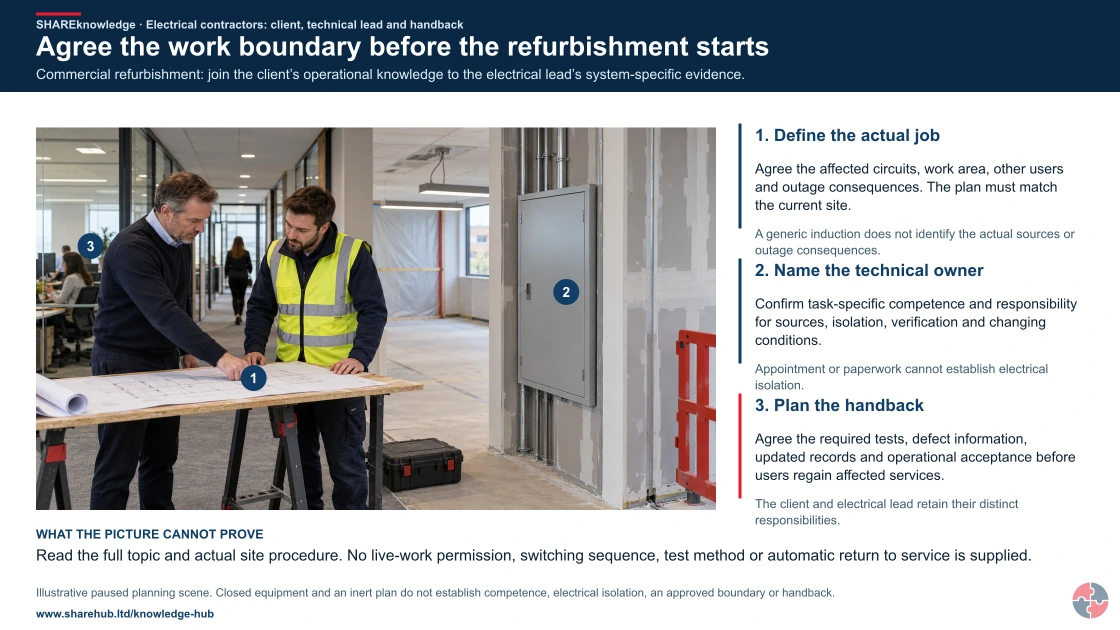
Full written explanation
Commercial refurbishment: join the client’s operational knowledge to the electrical lead’s system-specific evidence.
- Define the actual job. Agree the affected circuits, work area, other users and outage consequences. The plan must match the current site.
- Name the technical owner. Confirm task-specific competence and responsibility for sources, isolation, verification and changing conditions.
- Plan the handback. Agree the required tests, defect information, updated records and operational acceptance before users regain affected services.
Change the pathway
- Site information must join up. A generic induction does not identify the actual sources or outage consequences.
- A closed panel proves no state. Appointment or paperwork cannot establish electrical isolation.
- Handback needs evidence. The client and electrical lead retain their distinct responsibilities.
Evidence check: Read the full topic and actual site procedure. No live-work permission, switching sequence, test method or automatic return to service is supplied.
Client coordination, system-specific competence and evidence-based handback
Primary references: HSE: using contractors · HSE: electrical safe working practices, HSG85
Open the complete HD image (new tab)Download image

Client coordination, system-specific competence and evidence-based handback
Primary references: HSE: using contractors · HSE: electrical safe working practices, HSG85

Coordinate
Identify affected users, outage consequences, access and concurrent work with the client and electrical lead.
Verify the boundary
Establish all relevant sources and the competent isolation/verification arrangements for the actual work.
Control change and return
Hold a changed or uncertain boundary, reassess and brief affected people. Confirm technical completion and operational hand-back through the authorised route.
A contractor appointment or permit signature does not itself prove electrical safety.
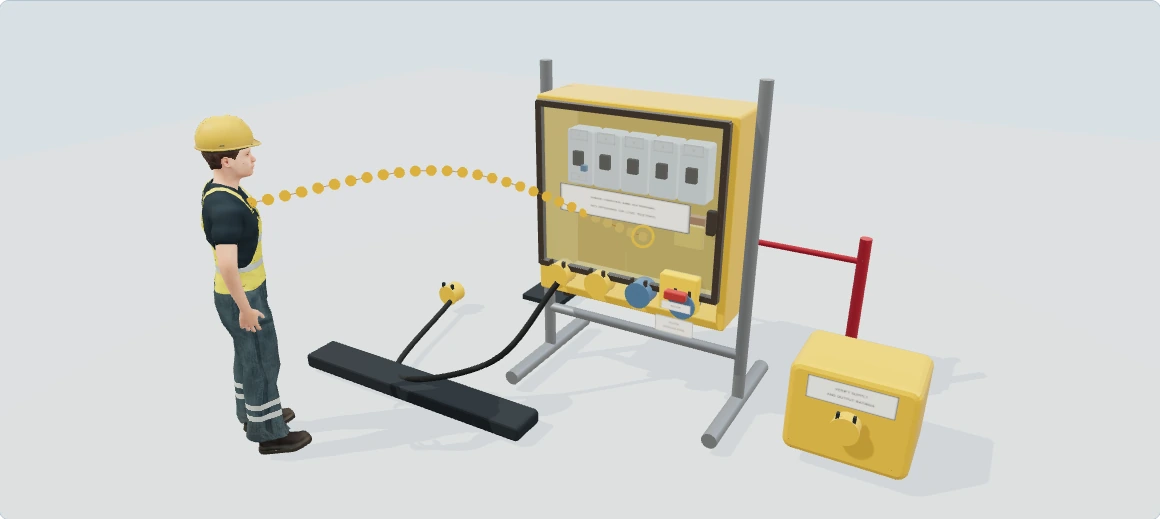

Temporary electrical supplies: follow the path to shock and fire
Explore how this equipment can harm its users and other people, then follow the practical measures that interrupt each pathway. This is a hazards and good-practice lesson; the separate checklist remains the pre-use/safety-check activity.
Hazards and good practice: learn what can hurt people during use, change and maintenance. Pre-use and safety checks stay in the separate checklist.
Checksheets and risk assessments
Equipment checksheets
- Site electrical distribution and RCD checks — 3D checks · Word · PDF
- Generators and temporary power supplies — 3D checks · Word · PDF
Risk assessment examples
Full written walkthrough — all 8 steps
1. Plan a suitable supply and work setting
What is happening: The distribution unit connects a source, protective devices, cables and equipment in a changing workplace.
How harm can occur: Unsuitable equipment or arrangements can expose users and other trades to shock, burns, arc or fire.
Best practice to apply: Use competent design and selection for the actual work, supply and environment; reduce avoidable electrical exposure.
Why this works: Suitable selection controls the hazard before a person has to work near the system.
Electrical hazards and risks · How should an electrical hazard be traced?2. Understand the contact pathway
What is happening: A live part or fault can connect the supply through a person to another conductive surface.
How harm can occur: Current through the body can cause serious injury; arcing can cause burns without the same direct contact.
Best practice to apply: Keep live parts enclosed and inaccessible and use the actual protective arrangements; never open this example as a user instruction.
Why this works: Preventing access interrupts contact; appearance and a healthy-looking cable do not establish an electrically safe system.
Electrical hazards and risks · Separate contact, arc, ignition and secondary injury3. Protect cables in the real work route
What is happening: Leads cross areas where vehicles, sharp edges, water and other operations may affect them.
How harm can occur: Damage or unsuitable routing can expose conductors, start a fire or create a trip leading to secondary injury.
Best practice to apply: Use appropriate routing and mechanical/environmental protection and respond to damage without makeshift live repairs.
Why this works: The route is part of the electrical risk, even when the connected tool has no visible defect.
Electrical hazards and risks · Why do wet environments increase electrical risk?4. Keep protective functions in context
What is happening: An RCD is one protective measure within a complete system, not permission to use a damaged supply.
How harm can occur: Some faults, contact conditions and other hazards are not removed simply because an RCD is fitted.
Best practice to apply: Use suitable competent selection, installation and verification; retain other required protection and the instructed user checks.
Why this works: A single protective device cannot stand in for correct system design and continued condition.
Electrical hazards and risks · How can the hierarchy of controls reduce risks while using portable power for a site repair?5. Maintain enclosure and access boundaries
What is happening: The sealed cover separates users from internal components and keeps the operating interface distinct.
How harm can occur: Opening or defeating protection can create access to energy that a routine user cannot safely assess.
Best practice to apply: Keep covers and restricted areas secure; refer faults or access needs to the responsible competent electrical person.
Why this works: Routine operation and intrusive electrical work require different competence and control arrangements.
Electrical hazards and risks · What training and competence are needed for electrical hazards?6. Recognise stop and isolation as different actions
What is happening: A switch indication or an inactive tool does not identify every source of electrical or other stored energy.
How harm can occur: A backup, battery, control circuit or other source can cause unexpected energisation or movement.
Best practice to apply: Plan dead work through the actual competent isolation, securing and verification procedure; this lesson does not teach live testing.
Why this works: System-specific identification and verification address sources that a simple stop can leave present.
Electrical hazards and risks · How can electricity injure the body, and why can a small mark hide a serious incident?7. Deal with an unsafe condition without touching danger
What is happening: A damaged supply or casualty may still be connected to continuing electrical danger.
How harm can occur: A rescuer or colleague can become a second casualty by approaching or touching too soon.
Best practice to apply: Keep people clear, use the site's emergency arrangements and have the continuing danger controlled; do not improvise a repair or rescue contact.
Why this works: Preventing additional contact protects people while competent emergency help and isolation are arranged.
Electrical hazards and risks · What are the secondary effects of electrical incidents?8. Return equipment only after competent resolution
What is happening: A replaced cable or reset trip does not by itself explain the fault or prove that the installation is suitable.
How harm can occur: The same fault can recur and harm the next user or an adjacent trade.
Best practice to apply: Record and restrict defective equipment, resolve the cause and have the necessary verification and handover completed.
Why this works: A verified repair and clear restrictions prevent a temporary reset being mistaken for a safe hand-back.
Electrical hazards and risks · How can the hierarchy of controls reduce risks while using portable power for a site repair?
Illustrative awareness learning. Geometry, colours and movement do not establish safe distances, capacity, exposure, isolation or work permission. Use the actual assessment, equipment information and competent arrangements.
The wider workplace has its own account and subscription access. Exploring this lesson does not grant access, record course completion or authorise work.
UK guidance for further reading
HSE: Temporary electrical suppliesWhat are the key points about managing electrical contractors?
The key points are competence, scope, isolation, supervision and handover evidence.
What are the key points about managing electrical contractors? — part 1 of 3


Read the complete visual as text
- The key points are competence, scope, isolation, supervision and…: The key points are competence, scope, isolation, supervision and handover evidence.
- Do not outsource the duty: Using a specialist contractor does not remove the client's duty to plan, coordinate and monitor the work.
- Match competence to the actual job: Domestic, commercial, industrial, high-voltage, hazardous-area, construction and testing work require different competence profiles.
What are the key points about managing electrical contractors? — part 2 of 3


Read the complete visual as text
- Dead work should be the normal expectation: Electrical work should normally be carried out dead unless live work is justified and tightly controlled.
- Isolation must be verified: Assumptions about dead circuits kill people. Isolation, lock-off and proof dead need clear ownership and evidence.
What are the key points about managing electrical contractors? — part 3 of 3


Read the complete visual as text
- Supervision should match risk: Higher-risk work needs active supervision, inspections and escalation routes, not a one-off induction.
- Completion evidence matters: Certificates, test records, updated drawings and defect close-out are part of safety, not administration.
Best-practice guide: Electrical contractors
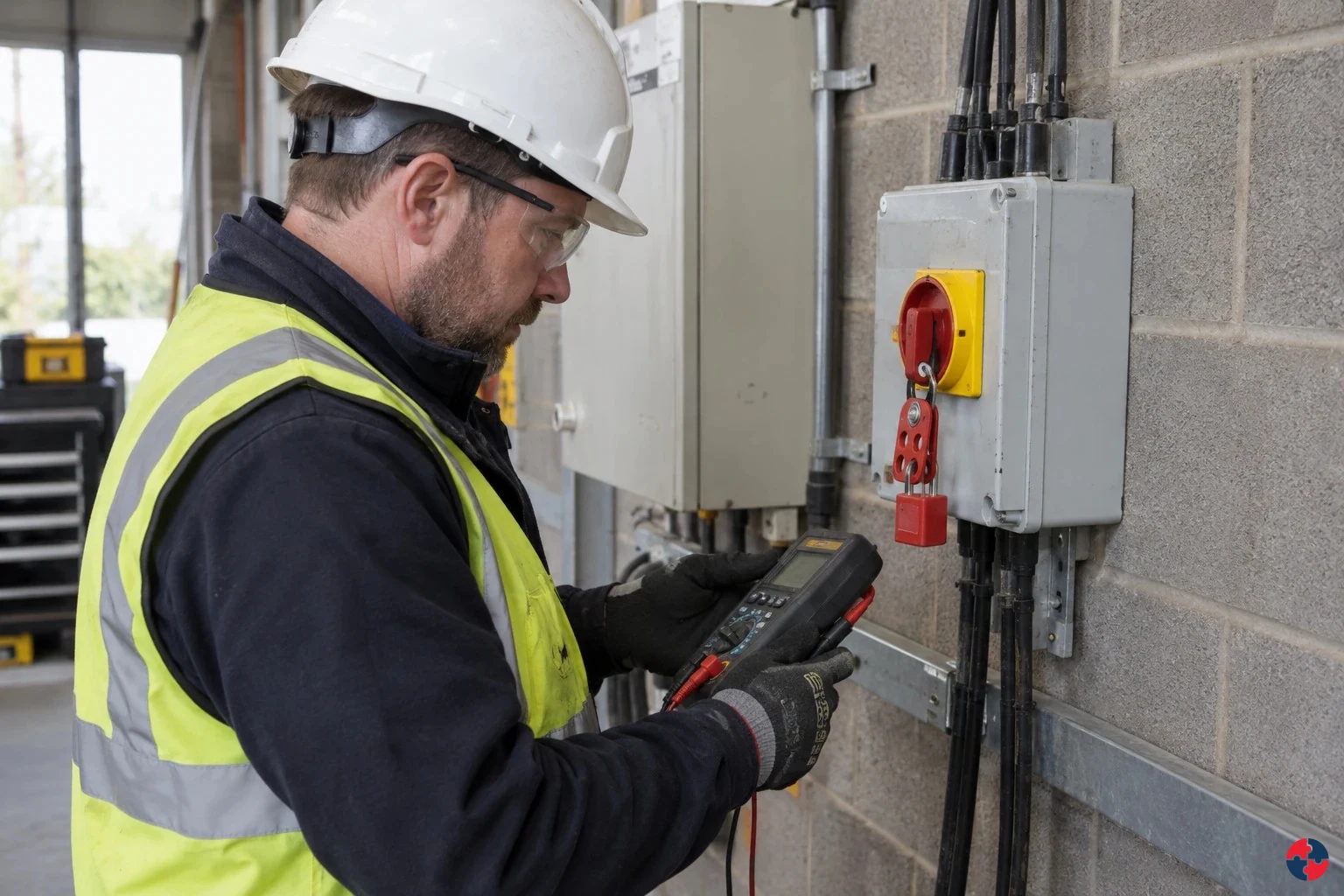
What are the key points about managing electrical contractors?
The key points are competence, scope, isolation, supervision and handover evidence. Electrical contractors install, test, maintain and alter systems that can expose workers and others to shock, burns, fire and unexpected energisation.
Turn electrical contractors knowledge into a decision
Electrical contractors install, test, maintain and alter systems that can expose workers and others to shock, burns, fire and unexpected energisation. The client and contractor must agree the task, electrical boundaries, competence, isolation, live-work decision and hand-back so that danger is controlled across the whole job. Named responsible persons, isolation and test records, completion certificate, defect list and hand-back record.
Switchboard change: decision from start to hand-back
Prove dead with suitable equipment, maintain lock-off and stop on any unexplained conductor or changed scope. Inspect and test the installation, update drawings, brief affected users and authorise controlled re-energisation.
Electrical work harm chain
Live conductor contacted directly or via a tool: Shock, cardiac disturbance, contact burns or a fall Fault energy arcs across equipment or a tool: Severe skin or eye burns, fire and blast injury Wrong circuit, backfeed or remote switching: Unexpected energisation and shock or arc
Choose controls for electrical contractors
Eliminate: Plan a shutdown or redesign the board so inspection or replacement is done dead; this removes the worker–live-conductor contact route. Substitute; reduce residual exposure: Prefabricate and test an assembly off site so only planned connection remains. Engineering isolation: Identify main, backup and stored sources; securely isolate, lock off and prove dead at the point of work with a suitable checked tester. Engineering barrier; administrative control: Fit barriers to prevent access to adjacent live parts, then use a permit, switching schedule, competent supervision and a defined test method for remaining interfaces. PPE for residual risk: Where a justified task still exposes a residual arc or contact risk, select suitable arc-rated clothing, face and hand protection and footwear from the task assessment; inspect fit, condition and compatibility. Read the full control table for qualifications, ownership and verification. Use the actual task and applicable jurisdiction; existing technical approval remains unchanged.
Use the full electrical contractors lesson
Use the full topic for the decision points, practical examples, detailed control tables and source scope. HSE guidance applies to Great Britain; use HSENI for the Northern Ireland route and the source’s stated jurisdiction. A simplified guide does not change the page’s technical-review or approval status.

Read all six steps as text
1. What are the key points about managing electrical contractors?
The key points are competence, scope, isolation, supervision and handover evidence.
- Avoid / redesign: Plan a shutdown or redesign the board so inspection or replacement is done dead; this removes the worker–live-conductor contact route.
- Control the task: Identify main, backup and stored sources; securely isolate, lock off and prove dead at the point of work with a suitable checked tester.
- Verify before release: Client authorises outage; electrical lead checks all affected circuits and users before work.
The key points are competence, scope, isolation, supervision and handover evidence. Electrical contractors install, test, maintain and alter systems that can expose workers and others to shock, burns, fire and unexpected energisation.
Apply it: Which part of this plan would you check at the workface before authorising the task?
2. Turn electrical contractors knowledge into a decision
Use the evidence to improve the actual work arrangement.
- Change at source: Plan a shutdown or redesign the board so inspection or replacement is done dead; this removes the worker–live-conductor contact route.
- Make it observable: Client authorises outage; electrical lead checks all affected circuits and users before work.
- Keep useful evidence: Named responsible persons, isolation and test records, completion certificate, defect list and hand-back record.
Electrical contractors install, test, maintain and alter systems that can expose workers and others to shock, burns, fire and unexpected energisation. The client and contractor must agree the task, electrical boundaries, competence, isolation, live-work decision and hand-back so that danger is controlled across the whole job. Named responsible persons, isolation and test records, completion certificate, defect list and hand-back record.
Apply it: What evidence would show that the change improves this task, rather than only completing a record?
3. Switchboard change: decision from start to hand-back
Example: a practical application of the existing topic lesson.
- Setting: Occupied refurbishment site with a shared switchboard and two contractors.
- Act: Confirm circuit ownership and drawings, coordinate access, secure isolation and define test and permit boundaries.
- Hold / review: No work while the isolation boundary, test result or downstream users remain unclear.
Prove dead with suitable equipment, maintain lock-off and stop on any unexplained conductor or changed scope. Inspect and test the installation, update drawings, brief affected users and authorise controlled re-energisation.
Apply it: At which point would you hold this example, and what evidence would allow it to proceed?
4. Electrical work harm chain
Connect the task, the route to the person and the control that can fail.
- Live conductor contacted directly or via a tool: Shock, cardiac disturbance, contact burns or a fall
- Fault energy arcs across equipment or a tool: Severe skin or eye burns, fire and blast injury
- Wrong circuit, backfeed or remote switching: Unexpected energisation and shock or arc
Live conductor contacted directly or via a tool: Shock, cardiac disturbance, contact burns or a fall Fault energy arcs across equipment or a tool: Severe skin or eye burns, fire and blast injury Wrong circuit, backfeed or remote switching: Unexpected energisation and shock or arc
Apply it: Who could be exposed, including other trades, cleaners, maintainers and people nearby?
5. Choose controls for electrical contractors
Start with the stronger practicable options and verify their effect.
- Eliminate: Plan a shutdown or redesign the board so inspection or replacement is done dead; this removes the worker–live-conductor contact route.
- Substitute; reduce residual exposure: Prefabricate and test an assembly off site so only planned connection remains.
- Engineering isolation: Identify main, backup and stored sources; securely isolate, lock off and prove dead at the point of work with a suitable checked tester.
- Engineering barrier; administrative control: Fit barriers to prevent access to adjacent live parts, then use a permit, switching schedule, competent supervision and a defined test method for remaining interfaces.
- PPE for residual risk: Where a justified task still exposes a residual arc or contact risk, select suitable arc-rated clothing, face and hand protection and footwear from the task assessment; inspect fit, condition and compatibility.
Eliminate: Plan a shutdown or redesign the board so inspection or replacement is done dead; this removes the worker–live-conductor contact route. Substitute; reduce residual exposure: Prefabricate and test an assembly off site so only planned connection remains. Engineering isolation: Identify main, backup and stored sources; securely isolate, lock off and prove dead at the point of work with a suitable checked tester. Engineering barrier; administrative control: Fit barriers to prevent access to adjacent live parts, then use a permit, switching schedule, competent supervision and a defined test method for remaining interfaces. PPE for residual risk: Where a justified task still exposes a residual arc or contact risk, select suitable arc-rated clothing, face and hand protection and footwear from the task assessment; inspect fit, condition and compatibility. Read the full control table for qualifications, ownership and verification. Use the actual task and applicable jurisdiction; existing technical approval remains unchanged.
Apply it: Which stronger option can be used here, and who will verify it before accepting the remaining risk?
6. Use the full electrical contractors lesson
Follow the official sources below and retain the task-specific evidence.
- Official guidance: HSE - Electricity at work: safe working practices HSG85
- Official guidance: HSE - Managing contractors
- Task decision: Named responsible persons, isolation and test records, completion certificate, defect list and hand-back record.
Use the full topic for the decision points, practical examples, detailed control tables and source scope. HSE guidance applies to Great Britain; use HSENI for the Northern Ireland route and the source’s stated jurisdiction. A simplified guide does not change the page’s technical-review or approval status.
Apply it: Which official source and full-topic section will you use to resolve the next decision?
Do not outsource the duty
Using a specialist contractor does not remove the client's duty to plan, coordinate and monitor the work.
Match competence to the actual job
Domestic, commercial, industrial, high-voltage, hazardous-area, construction and testing work require different competence profiles.
Dead work should be the normal expectation
Electrical work should normally be carried out dead unless live work is justified and tightly controlled.
Isolation must be verified
Assumptions about dead circuits kill people. Isolation, lock-off and proof dead need clear ownership and evidence.
Supervision should match risk
Higher-risk work needs active supervision, inspections and escalation routes, not a one-off induction.
Completion evidence matters
Certificates, test records, updated drawings and defect close-out are part of safety, not administration.
What does electrical contractor management mean?
Electrical contractor management means controlling electrical work from appointment through to safe handover.
Electrical contractors may install new circuits, modify distribution boards, test installations, maintain plant, fault-find, connect temporary supplies, work near buried or overhead services, support construction projects, commission equipment or work in hazardous areas. The danger is not only electric shock. Poor electrical work can create fire, arc flash, explosion, business interruption, hidden defects, failed protection, unsafe isolation and future maintenance risk.
A strong system treats contractor work as a controlled lifecycle. It starts with selecting the right contractor and defining the job clearly. It continues through RAMS review, drawings, isolation planning, permits, induction, supervision, inspection, testing, defects, certification and lessons learned. The client should always be able to answer: who is doing the work, what exactly are they doing, what could go wrong, what prevents harm, who checks it and what evidence proves completion is safe?
The standard of control should be proportionate. Replacing a light fitting in a low-risk office is not the same as modifying live switchgear, working in a fuel depot, connecting temporary construction supplies or tracing unidentified cables in a refurbishment. The more uncertainty, stored energy, live exposure, vulnerable people, fire load or business-critical equipment involved, the stronger the controls must be.
| Stage | Purpose | Typical evidence |
|---|---|---|
| Pre-qualification | Confirm the contractor is suitable before appointment. | Approval record, qualifications, insurance, references and competence evidence. |
| Planning | Define the scope, method, isolation, coordination and standards. | Scope, RAMS, drawings, programme and communication plan. |
| Authorisation | Control access to higher-risk electrical work. | Permit, switching schedule, isolation certificate or authorisation. |
| Execution | Check work follows the agreed safe system. | Supervisor inspections, permits, briefings and defect records. |
| Testing and handover | Verify the installation or repair is safe for use. | Certificates, test records, commissioning sheets and updated drawings. |
| Review | Learn from performance and improve future contractor control. | Scorecard, close-out review and action tracker. |
The stages are a chain, not separate paperwork exercises. If the scope changes after appointment, revisit the contractor’s competence and isolation plan before work resumes; the final certificate cannot repair an unsafe method used earlier.
How can electrical contractor work harm people?
An exposed or unexpectedly energised conductor can send current through a person or release an arc; defective installation can start a fire or leave hidden danger for the next worker.
Contact depends on the system voltage and available energy, the route through the body, contact duration and the worker's position. Shock can disrupt the heart and cause burns or falls; an arc can burn skin and eyes. Poor earthing, protection, connections or testing may not injure anyone on the day of installation but can create a later fire or shock when another worker uses the system. HSE's HSG85 and GS38 place safe isolation and suitable test equipment at the centre of the method.
Before intrusive work, identify every source, including generators, uninterruptible power supplies and photovoltaic circuits where present. Stop if drawings, labelling, access, isolation points or the actual circuit differ from the plan. Heat, burning smell, damage, unexplained trips or an exposed conductor call for withdrawal and competent assessment; do not test an unknown part by touch. For excavation and overhead-line interfaces, use the separate HSE HSG47 and GS6 routes.
| Source and route | Likely harm | Strongest control and stop point |
|---|---|---|
| Live conductor contacted directly or via a tool | Shock, cardiac disturbance, contact burns or a fall | Plan dead work; isolate, lock off and prove dead. Unknown source: stop. |
| Fault energy arcs across equipment or a tool | Severe skin or eye burns, fire and blast injury | De-energise where practicable; use suitable equipment, barriers and task-assessed residual protection. |
| Wrong circuit, backfeed or remote switching | Unexpected energisation and shock or arc | Identify all supplies, agree switching authority, secure isolation and test at the work point. |
| Poor connection, protection or incomplete testing | Delayed fire or shock after handover | Inspect, test and record defects before energisation and release. |
| Excavator or MEWP reaches a cable or overhead line | Shock, burns or vehicle fire affecting worker and bystanders | Locate/mark services or keep plant outside controlled distances; stop on uncertain location. |
How should electrical contractors be pre-qualified and appointed?
Electrical contractors should be appointed through a risk-based pre-qualification process that checks competence for the exact work.
Pre-qualification should be more than collecting insurance and a generic policy. The client needs to know whether the contractor has done this type of work before, whether their workers are qualified and supervised, whether their RAMS are site-specific, whether they understand the relevant standards, whether they learn from incidents and whether they have enough resource to do the job safely.
Competence should be matched to the scope. A contractor competent for domestic work may not be suitable for industrial switchgear. A general electrician may not be competent for hazardous areas, high-voltage systems, complex testing, temporary site supplies, electric vehicle infrastructure, fire alarm interfaces or process plant isolations. Falsified, expired or irrelevant certificates should be treated as a serious warning sign.
| Check | What to ask for | Why it matters |
|---|---|---|
| Technical competence | Qualifications, trade cards, specialist training and supervisor competence. | Confirms people are suitable for the task, not just the company name. |
| Relevant experience | Similar jobs, project history and references. | Shows whether the contractor understands the environment and complexity. |
| Accreditation/registration | Relevant scheme membership or professional body evidence where applicable. | Provides extra assurance but does not replace site control. |
| Insurance | Employers' liability, public liability and professional cover if design/advice is included. | Checks commercial protection and scope alignment. |
| RAMS quality | Examples of risk assessments and method statements for similar work. | Shows whether the contractor can plan rather than copy generic text. |
| Incident history | RIDDOR, enforcement, near-miss learning and corrective action examples. | Honest learning is more valuable than claiming nothing ever goes wrong. |
Registration or a qualification may support selection only when it matches the job. Ask the proposed supervisor to walk through an analogous isolation and test method, identify the equipment they have used and explain who will check unfamiliar work. If the answer relies on a company logo rather than named, task-relevant capability, hold the appointment.
What planning information should be agreed before work starts?
Before work starts, the client and contractor should agree the scope, drawings, hazards, interfaces, method, standards and evidence required.
Many electrical contractor failures begin before anyone touches a tool. The scope is vague, drawings are outdated, isolation points are unclear, simultaneous operations are not coordinated, the contractor is not told about asbestos or buried services, or the programme pressures the contractor into shortcuts. Planning needs to make hidden risk visible.
The agreed work pack should describe the equipment, circuits, location, drawings, isolation points, access arrangements, adjacent live parts, testing requirements, temporary supplies, emergency controls, waste, fire precautions, handover documents and who can authorise change. Where the work is construction, the CDM arrangements should also be clear.
| Item | What should be clear | Common weakness |
|---|---|---|
| Scope of work | Exact equipment, boundaries, deliverables and exclusions. | Contractor expands the job without review. |
| Drawings and records | Current circuit diagrams, layouts, labels and asset information. | Old drawings treated as reliable without verification. |
| RAMS | Task-specific hazards, controls, sequence and emergency arrangements. | Generic RAMS copied from another site. |
| Coordination | Other trades, shutdown windows, public areas and operational constraints. | Electrical work clashes with production or other contractors. |
| Standards | Applicable legal, technical, client and insurer requirements. | No agreement on test standard or certificate format. |
| Handover evidence | Certificates, defect lists, drawings, photos, commissioning and O&M records. | Work finished physically but not proven safe. |
The client should mark any drawing that is unverified and identify the person who can answer questions at the equipment. A contractor who uncovers an extra cable or a different panel must pause, make the area safe and obtain a revised method; a generic instruction to “follow the RAMS” is not enough.
When can live electrical work be justified?
Live electrical work should be exceptional and justified only where dead work is unreasonable, live work is reasonable and injury is prevented by suitable precautions.
The normal control position is to make electrical systems dead before work starts. Live testing and diagnostic work may sometimes be necessary, but live repair, modification or installation should be challenged hard. Convenience, speed, production pressure or avoiding a shutdown are not good reasons on their own.
A live-work decision should be recorded and authorised. It should identify why the work cannot reasonably be done dead, what live parts are exposed, what fault energy exists, who is competent, what barriers and tools are needed, what PPE is required, who supervises, what emergency arrangements exist and when the job must stop.
| Question | Good answer | Poor answer |
|---|---|---|
| Can the system be made dead? | Shutdown, isolation or alternative supply has been properly considered. | It is inconvenient or would delay the job. |
| Is live work reasonable? | The task genuinely requires energisation, such as certain tests. | The contractor usually does it this way. |
| Can injury be prevented? | Barriers, tools, test equipment, PPE, supervision and competence are in place. | The electrician is experienced, so it should be fine. |
| Is the work authorised? | A competent person has reviewed and authorised the live-work method. | The decision is left to whoever is on site. |
| Is there an emergency plan? | Shock, arc, fire and rescue arrangements are understood. | First aid is assumed but not briefed. |
For the GB legal test and work method, see Electricity at Work Regulations 1989, regulation 14 and HSE HSG85 safe working practices. Northern Ireland has its own electricity-at-work instrument; confirm the applicable site route.
The three legal tests are cumulative. A need for a measurement may justify a limited energised test, but it does not automatically justify replacing a component live. The authorising person should record the exact test boundary and what would trigger a return to dead work.
How should isolation, lock-off and proof dead be controlled?
Isolation should identify every source of electrical energy, lock it off, prove it dead and prevent re-energisation until the work is complete.
Isolation controls — part 1 of 2


Read the complete visual as text
- Identify all supplies: What good looks like: Main, backup, temporary, control and stored-energy sources are identified. Evidence: Isolation plan or switching schedule.
- Lock-off: What good looks like: Isolation cannot be removed accidentally or by unauthorised people. Evidence: Lock, tag and lock register.
- Prove dead: What good looks like: Suitable test equipment is used and checked before and after testing. Evidence: Test record or permit confirmation.
Isolation controls — part 2 of 2


Read the complete visual as text
- Define boundary: What good looks like: Workers know exactly what is dead and what remains live nearby. Evidence: Briefing, marked area and drawings.
- Control keys: What good looks like: Keys, remote devices and switching authority are controlled. Evidence: Key register or authorised person control.
- Reinstatement: What good looks like: System is inspected, tools removed and people clear before energisation. Evidence: Handover and energisation checklist.
Isolation is one of the most important controls in electrical contractor management. It should not rely on labels alone. Multiple supplies, backfeeds, UPS systems, generators, solar PV, capacitors, control circuits, borrowed neutrals or incorrect drawings can all defeat a poor isolation plan.
A robust isolation process identifies the circuit, isolates at the right point, secures the isolation, proves the tester, tests the circuit dead, proves the tester again, controls keys or locks, marks the work area and makes sure everyone understands the boundary of the isolation. Where several people work on the same system, personal lock-off or group lock arrangements should be clear.
| Control | What good looks like | Evidence |
|---|---|---|
| Identify all supplies | Main, backup, temporary, control and stored-energy sources are identified. | Isolation plan or switching schedule. |
| Lock-off | Isolation cannot be removed accidentally or by unauthorised people. | Lock, tag and lock register. |
| Prove dead | Suitable test equipment is used and checked before and after testing. | Test record or permit confirmation. |
| Define boundary | Workers know exactly what is dead and what remains live nearby. | Briefing, marked area and drawings. |
| Control keys | Keys, remote devices and switching authority are controlled. | Key register or authorised person control. |
| Reinstatement | System is inspected, tools removed and people clear before energisation. | Handover and energisation checklist. |
Use the HSE HSG85 isolation and dead-work method and the HSE GS38 test-equipment guidance alongside the site switching plan.
The decisive check happens at the point of work. A labelled breaker or a remote switching confirmation is not proof that the exposed conductor is dead. The competent worker verifies the tester before and after the dead test and keeps control of the isolation until all affected people are clear.
When should permits and authorisations be used for electrical contractor work?
Permits should be used where electrical contractor work needs formal control of scope, isolation, live exposure, interfaces or hand-back.
A permit is not a permission slip. It is a communication and verification process. It should describe the job, hazards, isolation, restrictions, people authorised, time limits, emergency arrangements, handover and cancellation rules. For electrical work, the permit may be linked to an isolation certificate, switching schedule or lock-off record.
Permits are especially useful for high-risk electrical work, work in operational areas, work with multiple contractors, work near live parts, intrusive work, temporary supplies, confined spaces, hot work, DSEAR areas, switchgear rooms, plant shutdowns and re-energisation after maintenance.
| Trigger | Why a permit helps | Linked document |
|---|---|---|
| Work near live conductors | Confirms barriers, restrictions and authorisation. | Electrical work permit. |
| Isolation-critical work | Confirms the system is isolated and cannot be re-energised. | Isolation certificate. |
| Shutdown or switching | Controls sequence, responsibility and communication. | Switching schedule. |
| Multiple contractors | Controls interfaces and simultaneous operations. | Coordination plan. |
| DSEAR or confined areas | Links electrical work with atmosphere, ignition and rescue controls. | PTW, gas test or confined space permit. |
| Hand-back energisation | Confirms inspections, tests and people clear before re-energising. | Energisation certificate. |
Choose the permit or authorisation for the interface it controls, then verify the physical condition separately. A signed permit does not make an unidentified cable dead; a lock-off record does not coordinate a second contractor entering the room. Close or amend the authority when the task, people or isolation boundary changes.
How should electrical contractors be supervised and monitored on site?
Supervision should confirm that the agreed method is being followed and that changing conditions are managed before risk increases.
The level of supervision should reflect the risk. A familiar contractor doing low-risk work may need routine checks. A new contractor, high-energy equipment, live testing, construction interfaces or process plant work needs more active oversight. Supervision is not about standing over a competent electrician; it is about controlling interfaces, change, site rules and evidence.
Useful checks include whether the contractor has signed in, attended induction, understands the RAMS, has the right tools and test equipment, is using PPE correctly, has isolated as agreed, is keeping panels closed when not working, is managing leads and temporary power, is protecting others nearby and is reporting defects or change.
| Check | What to look for | Action if weak |
|---|---|---|
| Pre-start briefing | Contractor explains the task, hazards, isolation and emergency arrangements. | Stop start-up until the method is understood. |
| RAMS in use | Work matches the written method and site conditions. | Pause and revise RAMS if conditions change. |
| Tool and test equipment | Insulated tools, calibrated testers and GS38-style probes where relevant. | Remove unsuitable equipment. |
| Work area control | Barriers, signs, closed panels and safe access are maintained. | Correct immediately and rebrief. |
| Permit compliance | Permit conditions are followed and time limits observed. | Suspend permit if conditions are breached. |
| Defect reporting | Unexpected issues are reported before being improvised around. | Raise change control or engineering review. |
A useful site check asks the contractor to explain the next step and the remaining live boundary, then compares that answer with the work pack and actual panel. If those disagree, the supervisor stops the task and brings in the competent electrical lead; simply adding a note to an inspection form leaves the exposure in place.
How should quality assurance be built into electrical contractor work?
Quality assurance should verify that electrical work is safe, compliant, tested and maintainable before it is accepted.
Electrical quality is a safety issue. Poor labelling, loose terminations, wrong protective devices, incomplete testing, hidden cable damage or undocumented changes can sit unnoticed until a fault, fire or maintenance job exposes them. Quality control should be planned before the work starts, not discovered during handover.
For larger or higher-risk jobs, staged inspections may be needed before work is covered up or energised. Someone competent should check whether the installation matches the design, whether deviations are authorised, whether protective devices are correct, whether earthing and bonding are adequate, and whether testing has been completed by competent people.
| Control | Purpose | Evidence |
|---|---|---|
| Inspection hold points | Check hidden or critical work before it is covered or energised. | Signed inspection record. |
| Testing | Verify continuity, insulation resistance, polarity, RCD operation and other relevant tests. | Inspection and test certificate. |
| Labelling | Make circuits, isolators and panels clear for future users and maintainers. | Updated labels and schedules. |
| Defect management | Record and close out non-conformances before acceptance. | Defect log and evidence of closure. |
| Independent check | Use independent or client verification for critical systems. | QA sign-off or audit record. |
| Change control | Review design or scope changes before implementation. | Approved variation and updated drawings. |
Inspection before a cable is concealed and testing before energisation are hold points, not retrospective paperwork. The client’s competent reviewer should resolve deviations and defects with the designer and contractor, identify any limitation on use, and accept the system only when the evidence matches the delivered installation.
What should be handed over after electrical contractor work?
Handover should prove that the work is complete, tested, documented, safe to energise and safe to maintain.
A job is not finished because the contractor has packed up. The client needs evidence that the electrical system is safe and that future workers can understand it. Missing certificates, unlabelled circuits, undocumented deviations or incomplete drawings create hidden risk for years.
The handover pack should be proportionate to the job. Minor work may need a small certificate and defect record. A major installation may need design documents, commissioning records, test certificates, updated drawings, manuals, warranties, residual risk information, spares, training records, fire-stopping evidence and maintenance requirements.
| Record | Why it matters | Who reviews it |
|---|---|---|
| Inspection and test certificate | Confirms the work has been tested and is safe for use. | Competent electrical reviewer. |
| Updated drawings | Prevents future isolation and maintenance errors. | Facilities or asset owner. |
| Circuit schedules and labels | Helps users and maintainers identify supplies correctly. | Site electrical responsible person. |
| Defect list | Shows what remains outstanding and who owns it. | Project manager and client. |
| O&M information | Explains operation, maintenance and limitations. | Facilities and maintenance team. |
| Lessons learned | Improves future contractor selection and controls. | Client, project team and contractor. |
Hand-back transfers knowledge as well as equipment. A facilities lead should be able to locate the correct isolator, see what has changed, understand open defects and know which tests support use. If a critical certificate or circuit schedule is missing, keep the affected system out of normal service until a competent person resolves the gap.
How can the hierarchy of controls reduce electrical risks during contractor work?
Use HSE’s hierarchy to eliminate or substitute a hazard where practicable, then apply engineering and administrative controls before relying on PPE. Check each chosen control against the actual task and stop when it fails.
An unclear maintenance boundary keeps the affected task on hold
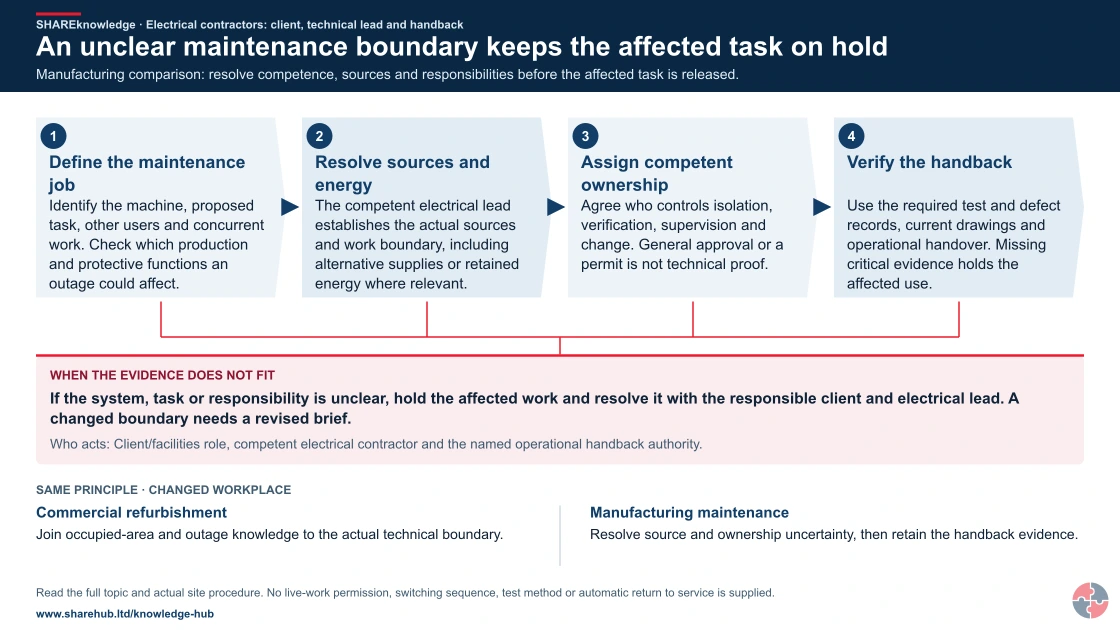
Full written explanation
A complete four-stage manufacturing maintenance review connects the actual job, source and energy information, named competent ownership, and verified handback. Unresolved information or a changed boundary returns the affected work to review. These are coordination checks, not switching, testing or live-work instructions.
Manufacturing comparison: resolve competence, sources and responsibilities before the affected task is released.
- Define the maintenance job. Identify the machine, proposed task, other users and concurrent work. Check which production and protective functions an outage could affect.
- Resolve sources and energy. The competent electrical lead establishes the actual sources and work boundary, including alternative supplies or retained energy where relevant.
- Assign competent ownership. Agree who controls isolation, verification, supervision and change. General approval or a permit is not technical proof.
- Verify the handback. Use the required test and defect records, current drawings and operational handover. Missing critical evidence holds the affected use.
When the evidence does not fit: If the system, task or responsibility is unclear, hold the affected work and resolve it with the responsible client and electrical lead. A changed boundary needs a revised brief.
Who acts: Client/facilities role, competent electrical contractor and the named operational handback authority.
Changed workplace
Commercial refurbishment: Join occupied-area and outage knowledge to the actual technical boundary.
Manufacturing maintenance: Resolve source and ownership uncertainty, then retain the handback evidence.
Evidence check: Read the full topic and actual site procedure. No live-work permission, switching sequence, test method or automatic return to service is supplied.
Client coordination, system-specific competence and evidence-based handback
Primary references: HSE: using contractors · HSE: electrical safe working practices, HSG85
Open the complete HD image (new tab)Download image

Client coordination, system-specific competence and evidence-based handback
Primary references: HSE: using contractors · HSE: electrical safe working practices, HSG85
The hierarchy of control is especially important in electrical work because PPE is not a substitute for isolation, good design or preventing access to live parts. Contractor management should start by removing the need for dangerous work where possible, then reducing exposure through design, segregation and competent systems.
For electrical contractors, the best control is often planned dead work with clear isolation and suitable design. Administrative controls such as permits, RAMS and briefings are still important, but they work best when they support strong engineering controls rather than trying to compensate for weak ones.
ERICPD and HSE’s five levels must be cross-mapped to this job. Eliminate the need to work live through a planned shutdown or redesign; substitute prefabrication or a lower-exposure method where it genuinely removes an intrusive step; isolate and lock off every relevant source as an engineering barrier; control residual interfaces with physical barriers plus a defined permit and test method; select PPE for the assessed residual arc or shock exposure; and use Discipline for competence, audit and stop-work follow-through. In HSE’s five levels, elimination and substitution retain those names, secured isolation and physical barriers are engineering controls, permits and supervision are administrative controls, and PPE remains last. The client and authorised electrical lead verify the work boundary and stop if any source, test result or responsible owner is uncertain.
How can the ERICPD hierarchy of controls reduce electrical risks during contractor work?

| HSE control option | Practical application | Owner, check and stop condition |
|---|---|---|
| Eliminate | Plan a shutdown or redesign the board so inspection or replacement is done dead; this removes the worker–live-conductor contact route. | Client authorises outage; electrical lead checks all affected circuits and users before work. No agreed shutdown or unidentified live part: hold the job. |
| Substitute; reduce residual exposure | Prefabricate and test an assembly off site so only planned connection remains. This substitutes a lower-exposure method; shorter time near live parts alone is an administrative reduction, not substitution. | Designer and contractor lead confirm compatibility and test evidence before fitting. Wrong rating, changed scope or missing test record: stop and redesign. |
| Engineering isolation | Identify main, backup and stored sources; securely isolate, lock off and prove dead at the point of work with a suitable checked tester. This interrupts the electrical energy path. | Authorised electrician owns the lock and verifies tester before and after proving dead; supervisor checks the boundary. Unexpected voltage, backfeed or lost lock control: stop and re-plan. |
| Engineering barrier; administrative control | Fit barriers to prevent access to adjacent live parts, then use a permit, switching schedule, competent supervision and a defined test method for remaining interfaces. A permit cannot prove a circuit dead. | Site lead checks barrier and access before start; authorised person checks permit against switching record during work. Barrier breach, changed circuit or unclear handover: stop. |
| PPE for residual risk | Where a justified task still exposes a residual arc or contact risk, select suitable arc-rated clothing, face and hand protection and footwear from the task assessment; inspect fit, condition and compatibility. PPE cannot justify avoidable live work. | Electrical lead selects and records task suitability; wearer checks before use. Missing assessment, damaged or incompatible PPE, or unplanned exposure: stop. |
| Discipline; administrative assurance | Brief the exact isolation and live-work boundary, observe compliance, record defects and hand back only after inspection, people-clear confirmation and controlled re-energisation. | Client and contractor supervisors check observed practice and close corrective actions. Bypassed isolation, unresolved defect or missing hand-back owner: hold restart. |
How can the ISO 45001 hierarchy of controls reduce electrical risks during contractor work?

| HSE control option | Practical application | Owner, check and stop condition |
|---|---|---|
| Eliminate | Plan a shutdown or redesign the board so inspection or replacement is done dead; this removes the worker–live-conductor contact route. | Client authorises outage; electrical lead checks all affected circuits and users before work. No agreed shutdown or unidentified live part: hold the job. |
| Substitute; reduce residual exposure | Prefabricate and test an assembly off site so only planned connection remains. This substitutes a lower-exposure method; shorter time near live parts alone is an administrative reduction, not substitution. | Designer and contractor lead confirm compatibility and test evidence before fitting. Wrong rating, changed scope or missing test record: stop and redesign. |
| Engineering isolation | Identify main, backup and stored sources; securely isolate, lock off and prove dead at the point of work with a suitable checked tester. This interrupts the electrical energy path. | Authorised electrician owns the lock and verifies tester before and after proving dead; supervisor checks the boundary. Unexpected voltage, backfeed or lost lock control: stop and re-plan. |
| Engineering barrier; administrative control | Fit barriers to prevent access to adjacent live parts, then use a permit, switching schedule, competent supervision and a defined test method for remaining interfaces. A permit cannot prove a circuit dead. | Site lead checks barrier and access before start; authorised person checks permit against switching record during work. Barrier breach, changed circuit or unclear handover: stop. |
| PPE for residual risk | Where a justified task still exposes a residual arc or contact risk, select suitable arc-rated clothing, face and hand protection and footwear from the task assessment; inspect fit, condition and compatibility. PPE cannot justify avoidable live work. | Electrical lead selects and records task suitability; wearer checks before use. Missing assessment, damaged or incompatible PPE, or unplanned exposure: stop. |
| Discipline; administrative assurance | Brief the exact isolation and live-work boundary, observe compliance, record defects and hand back only after inspection, people-clear confirmation and controlled re-energisation. | Client and contractor supervisors check observed practice and close corrective actions. Bypassed isolation, unresolved defect or missing hand-back owner: hold restart. |
Planned dead work and secured isolation interrupt the electrical energy path before a worker approaches it. Barriers, permits and supervision then protect the remaining interfaces; task-selected PPE limits residual harm if those controls fail. Briefings and stop-work authority sustain the method, but cannot replace a missing isolation.
Which electrical contractor duties apply in Great Britain and Northern Ireland?
Both jurisdictions require safe work, competent people and control of electrical danger, but their core instruments differ. Select the rules for the work location, and apply construction and building rules only where the actual activity falls within their scope.
In Great Britain the Electricity at Work Regulations 1989 require electrical systems and work activities to prevent danger; regulation 14 constrains work on or near live conductors. Northern Ireland has its own Electricity at Work Regulations (Northern Ireland) 1991, including corresponding live-work and competence provisions. The client must still coordinate site hazards, access, information and other contractors; hiring a specialist does not transfer away every site duty. A permit, trade registration or certificate is evidence for a defined purpose, not a universal legal licence to do all electrical work.
| Where and when | Governing framework | Practical decision and evidence |
|---|---|---|
| Great Britain: general workplace | Health and Safety at Work etc. Act 1974; Management Regulations 1999 | Client and contractor assess, cooperate, coordinate and supervise to match the work. |
| Great Britain: electrical activity | Electricity at Work Regulations 1989 | Control danger through safe systems, isolation and task competence; test a proposed live-work case against regulation 14. |
| Northern Ireland: general workplace | Health and Safety at Work (NI) Order 1978; Management Regulations (NI) 2000 | Use NI dutyholder and coordination route, not GB instrument numbers. |
| Northern Ireland: electrical activity | Electricity at Work Regulations (NI) 1991 | Plan dead work, control live exposure and verify competence under the NI instrument. |
| Great Britain: construction work where applicable | CDM Regulations 2015 | Apply construction dutyholder, planning and coordination duties when the electrical job is construction work; routine use alone is not CDM. |
| England: building work where applicable | Approved Document P and Building Regulations | Check whether the particular dwelling installation is notifiable and the competent-person or building-control route; this is not a general industrial contractor rule. |
Work equipment, PPE, fire, hazardous-area and sector rules may add duties when the task creates those exposures. Current site-specific law and the competent designer's instructions govern the job; the table is a framework, not a permit to start work.
What should an electrical contractor risk register include?
The risk register should connect electrical hazards to the controls, owners and evidence that prove the work is safe.
A good register does not simply say 'electricity: electrocution'. It should describe the specific scenario: contractor cuts into unidentified live cable during refurbishment; live testing in switchroom exposes worker to arc flash; temporary site supply is overloaded; contractor energises before panels are secure; fire alarm interface is left untested. Each scenario should have clear controls and evidence.
The register should be used before work starts, during inspections and at close-out. If the same failures appear repeatedly, such as weak RAMS, missing certificates or poor isolation records, the contractor approval system should be strengthened.
| Scenario | Controls | Evidence |
|---|---|---|
| Contractor works on a circuit assumed to be dead. | Isolation plan, lock-off, proof dead and authorised person review. | Permit, lock record and test confirmation. |
| Temporary electrical supply on a construction site becomes damaged. | Site electrical plan, RCD protection, inspection and cable protection. | Temporary supply inspection records. |
| Contractor works near buried electrical services. | HSG47 planning, service drawings, CAT and Genny use and trial holes. | Permit to dig and service-location record. |
| Live testing exposes worker to arc flash. | Live-work justification, barriers, PPE, competent tester and emergency plan. | Live-work authorisation and briefing record. |
| Completed installation has hidden defects. | Inspection, testing, defect close-out and independent review. | Certificate, defect log and commissioning record. |
| Multiple contractors conflict in a switchroom. | Coordination meeting, access control, permit board and stop-work rules. | SIMOPS or coordination record. |
Each scenario needs an owner who can test the stated control. For example, a facilities manager can require a labelled isolation plan, but a competent electrical person must verify the circuit at the work point. Repeated missing handover evidence should change procurement and acceptance rules, not merely add another risk-register entry.
How do electrical contractor controls transfer between workplaces?
The safe-isolation principle travels between sectors, but the sources, people nearby and hand-back tests change with the setting. Agree those interfaces before selecting a contractor or permit.
A factory may have several feeds and process plant that restarts remotely; a construction site may have temporary supplies and buried services. A hotel kitchen has occupied spaces and fire continuity to protect, while a depot combines chargers, loading traffic and distribution equipment. Each client must identify its actual energy sources, affected people and work owner, then hold the job when that information is incomplete.
| Setting and task | Harm route and people | Strongest control and residual check |
|---|---|---|
| Manufacturing: motor-control board change | Backfeed or remote restart exposes electrician and operators to shock or arc. | Plan shutdown, identify every supply and secure/prove dead; supervisor stops on an unlisted feed. |
| Construction: temporary supply alteration | Damaged leads or unexpected energisation affects trades and visitors. | Coordinate under the applicable CDM route, protect and isolate supplies; site lead checks changing work fronts. |
| Hospitality: kitchen circuit repair during occupancy | Unprotected parts or poor handover expose kitchen staff and guests to shock or fire. | Schedule dead work, control access and test before reopening; manager checks service continuity and defects. |
| Logistics: depot charger and distribution-board service | Vehicle movement and electrical work expose contractors and drivers. | Separate traffic, isolate charger/supply and verify equipment; depot lead holds use until test and handover. |
How could BuildOut Ltd manage electrical contractors?

BuildOut Ltd would manage electrical contractors through approval, project planning, site control, technical review and close-out evidence.
Switchboard change: decision from start to hand-back — part 1 of 3


Read the complete visual as text
- 1. Task and setting: Occupied refurbishment site with a shared switchboard and two contractors.
- 2. People and prerequisites: Contractors and occupants face shock, arc injury or unexpected re-energisation; current drawings, competent leads and a work owner are needed.
- 3. Before the task: Confirm circuit ownership and drawings, coordinate access, secure isolation and define test and permit boundaries.
Switchboard change: decision from start to hand-back — part 2 of 3


Read the complete visual as text
- 1. Check during work: Prove dead with suitable equipment, maintain lock-off and stop on any unexplained conductor or changed scope.
- 2. Stop, hold or refer: No work while the isolation boundary, test result or downstream users remain unclear.
Switchboard change: decision from start to hand-back — part 3 of 3


Read the complete visual as text
- 1. Completion and hand-back: Inspect and test the installation, update drawings, brief affected users and authorise controlled re-energisation.
- 2. Retained evidence: Named responsible persons, isolation and test records, completion certificate, defect list and hand-back record.
BuildOut Ltd
BuildOut Ltd is a construction and refurbishment contractor, so electrical contractor management matters during fit-outs, temporary site supplies, live-building refurbishment, welfare units, plant rooms, lighting, testing, commissioning and handover.
BuildOut starts with a contractor approval register. Electrical subcontractors provide insurance, qualifications, supervisor competence, relevant project history, examples of RAMS, accident/near-miss learning and evidence of ability to work to the required electrical standards. Higher-risk work, such as temporary site supplies or live-building switchgear modifications, requires senior review before appointment.
At tender and pre-start stage, BuildOut defines the scope in writing: drawings, access, isolation boundaries, asbestos or buried-service information, temporary power requirements, emergency arrangements, certification deliverables and handover format. RAMS are reviewed by both the project manager and a competent electrical reviewer. Where work falls under CDM, the contractor is integrated into the construction phase plan, induction, site logistics and daily coordination.
On site, supervisors check that permits, isolation, lock-off and proof-dead arrangements are in place before intrusive work begins. Electrical contractors attend pre-start briefings, report change before improvising, protect temporary cables, keep panels secure, control access to switchrooms and provide evidence of inspections. BuildOut records observations in its assurance system, ranks findings, assigns actions and reviews recurring issues at project meetings.
At close-out, BuildOut does not accept practical completion without electrical certificates, updated drawings, circuit schedules, test records, fire-stopping evidence where relevant, O&M information, defect closure and a handover conversation with the facilities or client team. Contractor performance is scored for safety, quality, communication, documentation and learning, and that score affects future appointment.
Switchboard change: decision from start to hand-back
Task, material and setting: Occupied refurbishment site with a shared switchboard and two contractors.
People and prerequisites: Contractors and occupants face shock, arc injury or unexpected re-energisation; current drawings, competent leads and a work owner are needed.
Before: Confirm circuit ownership and drawings, coordinate access, secure isolation and define test and permit boundaries.
During: Prove dead with suitable equipment, maintain lock-off and stop on any unexplained conductor or changed scope.
Hold or stop: No work while the isolation boundary, test result or downstream users remain unclear.
Completion and hand-back: Inspect and test the installation, update drawings, brief affected users and authorise controlled re-energisation.
Evidence: Named responsible persons, isolation and test records, completion certificate, defect list and hand-back record.
What competence should each electrical contractor role demonstrate?
Competence is task and equipment specific. A general induction, trade membership or course certificate alone does not prove a person can isolate, test or authorise work on an unfamiliar system.
The client should define the job and ask for evidence matched to it: experience with the voltage and equipment, assessed practical skill, supervision arrangements and current safe methods. Domestic-installation experience does not automatically transfer to high-voltage switchgear, hazardous areas or complex process isolations. The client-side manager need not perform specialist electrical tests, but must know when to hold the job and obtain a competent technical decision. Record the authorised task boundary and reassess after equipment, work scope, guidance or performance changes.
| Role | Learning and practical test | Assessor and retained evidence | Reassessment trigger |
|---|---|---|---|
| Nearby workers and new starters | Recognise barriers, damaged equipment, electric shock warning and emergency route; demonstrate stop/report. | Site supervisor checks understanding and records induction. | Layout, access or emergency plan changes. |
| Electrical contractor and specialist tester | Demonstrate task-specific identification, isolation, lock-off, prove-dead, test-equipment checks, live-work boundary and hand-back on relevant equipment. | Competent electrical supervisor assesses practical work and records scope, experience and authorisation. | New voltage/system, equipment, task or failed observation. |
| Site supervisor or permit issuer | Challenge RAMS, identify interfaces, verify isolation evidence and stop changed work. | Appointed technical lead samples decisions and retains permit, inspection and corrective-action record. | A near miss, changed scope, contractor or switching plan. |
| Project, facilities and procurement managers | Specify task and standard, check competence evidence, coordinate shutdown, defects and handover. | Competent electrical adviser reviews scope and manager retains appointment and acceptance decisions. | New plant, supplier, project type or repeated defects. |
| Safety adviser and auditor | Trace GB/NI route, inspect control evidence and test whether findings close. | Competent specialist reviews sampled audit decisions and action log. | Legal/standard change or audit finding. |
How does electrical contractor management support NEBOSH study?
Electrical contractor management helps learners connect legal duties, competence, contractor control, CDM, electrical hazards and evidence-based assurance.
For the NEBOSH National General Certificate, this topic supports core ideas around employer duties, contractor selection, cooperation, coordination, risk assessment, permits, workplace transport interfaces and electrical safety. In scenario questions, candidates may need to explain why a client remains responsible even when specialist contractors are used.
For the NEBOSH Construction Certificate, electrical contractors sit strongly in CDM planning, contractor competence, temporary site supplies, buried services, overhead lines, permits, inductions, supervision and construction phase planning. Good answers should describe practical controls, not simply say 'use competent contractors'.
For Diploma-level study, the stronger answer is assurance based: what evidence proves competence, what failures create latent risk, how isolation is verified, how live-work decisions are challenged, how contractor performance is reviewed and how findings are used to improve procurement and management systems.
How can management arrangements support this topic?
HSE’s Plan–Do–Check–Act guidance helps assign ownership, deliver controls, check evidence and improve weak arrangements. Apply the relevant legal duties and task-specific technical evidence separately.
Official management guidance: HSE Managing for health and safety (HSG65)
HSE’s Plan–Do–Check–Act guidance helps assign ownership, deliver controls, check evidence and improve weak arrangements. Apply the relevant legal duties and task-specific technical evidence separately.
This page does not claim exact clauses from licensed technical standards without a rights-cleared full text. HSE's HSG85 and GS38 are regulator guidance for the safe method and test equipment, not substitutes for the law or an applicable installation standard.
What are the warning signs that electrical contractor control is weak?
Warning signs are usually visible before an incident: vague scope, poor isolation evidence, weak supervision, missing certificates and repeated improvisation.
Weak contractor control often looks tidy in paperwork but messy in the field. The contractor may be approved, but their workers cannot explain the isolation. The RAMS may exist, but it does not match the job. The permit may be signed, but nobody can say what remains live. The work may be complete, but certificates and drawings are missing.
These signs should trigger action because they can lead to electrocution, arc-flash injury, fire, unsafe handover, future maintenance exposure, insurance problems and legal enforcement.
| Warning sign | Why it matters | Action |
|---|---|---|
| Generic RAMS | The method may not control the real site hazards. | Require task-specific revision before work starts. |
| No proof-dead evidence | Workers may rely on assumption rather than verification. | Stop work and verify isolation. |
| Contractor cannot explain scope | The job boundary is unclear and may drift. | Rebrief and update the work pack. |
| Panels left open or barriers missing | Others may contact live or exposed equipment. | Make area safe and review supervision. |
| Missing certificates | The installation may not be proven safe for use. | Withhold acceptance until evidence is supplied. |
| Repeated small defects | May indicate poor culture or weak supervision. | Escalate through contractor performance review. |
The first response to an unexplained live boundary, failed dead test or exposed panel is to make the area safe and stop. Restart requires a competent decision on the cause, a revised method and a fresh briefing to everyone affected. Track repeat issues back to selection, scope or supervision so the same defect is not inherited by the next job.
What do the acronyms and key terms mean?
Acronyms should be explained because contractor meetings often mix legal, electrical and management-system language.
| Term | Full expansion | Meaning in this work |
|---|---|---|
| AP | Authorised person | A person appointed by the organisation for a defined electrical-control role; title alone does not grant every task. |
| BS 7671 | British Standard 7671 | UK wiring rules for electrical installations within scope; the competent designer selects the applicable edition. |
| CDM | Construction (Design and Management) Regulations | Great Britain construction framework when the electrical job is construction work. |
| EAWR | Electricity at Work Regulations | GB 1989 or NI 1991 electrical-duty instrument, depending on work location. |
| EICR | Electrical Installation Condition Report | A report on the condition of an existing installation, distinct from a new-work certificate. |
| GS38 | HSE Guidance Series 38 | HSE guide on suitable electrical test equipment for low-voltage systems. |
| HV | High voltage | A system classification requiring equipment- and task-specific competence; do not infer safety from a label. |
| LOTO | Lock out/tag out | Method of securing isolation and identifying who controls it; prove dead remains necessary. |
| LV | Low voltage | Electrical-system classification; low voltage can still cause fatal shock or arc injury. |
| O&M | Operation and maintenance | Handover information for safe future use, maintenance and isolation. |
| PPE | Personal protective equipment | Last-resort residual protection selected for the actual task, after stronger controls. |
| PTW | Permit to work | Formal coordination/authorisation for specified higher-risk work; not proof of isolation by itself. |
| PUWER | Provision and Use of Work Equipment Regulations | GB work-equipment duties; NI uses its own instrument. |
| RAMS | Risk assessment and method statement | Task plan and control sequence that must match the actual work and changing conditions. |
| RCD | Residual current device | Protective device that can reduce some electric-shock risk; it does not make live work safe. |
| UPS | Uninterruptible power supply | Backup energy source that can backfeed equipment thought to be isolated. |