SHARE Knowledge Hub
Electrical hazards and risks
Electrical hazards arise when energy can reach a person, ignite material or disable a system; risk depends on the exposure route and the conditions of work. Shock, arc burns, fire and secondary falls can follow damaged equipment, exposed conductors, poor isolation or a service strike. Identify the source and route first, then prevent contact or fault and verify that protection remains effective.
Understanding Electrical hazards and risks
Electrical hazards are often invisible until a fault, contact, damage or unsafe work action exposes them. Electricity can kill or severely injure people and can start fires or explosions. HSE identifies electric shock and burns from live parts, arcing, fire from faulty equipment or installations, explosion from unsuitable apparatus and static electricity igniting flammable vapours or dusts as principal hazards. Harm may affect workers, contractors, cleaners, visitors, customers, drivers, emergency responders and the public.
Why this matters at work
Consider contact shock, electrical and thermal burns, arcing, fire, explosion and secondary injury such as a fall. Assess the route from the source to people: accessible live parts, faulted metalwork, damaged insulation, unsuitable equipment, wet conditions or work disturbing services. Voltage alone cannot establish safety; current path, duration, supply characteristics and environment affect consequences. Low-voltage batteries can also deliver substantial fault energy or ignite materials even where ordinary shock assumptions differ. Describe the actual users and bystanders, including cleaners, contractors, visitors and people working at height or in conductive spaces. Select suitable equipment and supplies, robust physical protection, segregation, maintenance and safe systems before relying on warnings or PPE. Identify what users can safely check, when equipment must be removed and who provides competent assessment. Record important assumptions and review when use or conditions change. A successful operation yesterday or an absence of previous injuries does not establish that the protective barriers remain effective today.
Stopping and securing the immediate danger is only the first stage. Competent people must establish the fault, relevant damage and required repair or verification. For re-energisation, confirm that work is complete, people and tools are clear, covers and guards are restored, protective functions are correct, testing is acceptable and all affected work parties have released their boundaries. Include backup supplies and temporary connections in the checks. Record who controls restoration, remaining restrictions and the expected response when power returns. Brief operators and other affected people so an unexpected start or process response cannot cause harm. Monitor the initial result under the approved plan and stop if heat, noise, smell, tripping, indications or movement differ from expectations. Update labels, drawings, maintenance and defect records and investigate wider causes where necessary. A machine running again, a reset breaker or the absence of an alarm does not itself establish safe return to service; the release needs evidence matched to the actual system and consequences.
How organisations manage this in practice
Process failure: Electrical controls are not assured after change | How control is lost: Deterioration, new use or damaged equipment invalidates earlier assumptions | Possible consequence: Shock, fire, service loss, repeat incident and enforcement | Management measures assurance and recovery: Avoid: stop unsafe/unknown use; Limit scope: restrict exposure until reviewed; Restrict release: isolate/restrict asset and area; Management arrangements: change control, inspection, worker consultation and leadership review; Residual task protection: residual PPE; Implementation assurance: assurance owner samples actual field conditions and closes actions only after effective correction.
Prevent contact by changing the location, route or method before relying on detection. For construction/refurbishment, collect drawings and owner information, survey, identify/mark services, use a permit-to-dig or equivalent control where appropriate, select safe tools and methods, control mechanical excavation, establish exclusion zones and supervise. Drawings may be inaccurate or incomplete; a cable locator has limitations. Controls should be designed for the actual site and reviewed when discovery changes the assumptions.
Review the assessment and arrangements after a new or altered installation, equipment/supply change, building change, change of process or cleaning method, new contractor, relocation, extreme weather/water event, collision/impact, repeated fault, electrical incident, fire alarm, enforcement outcome or evidence that staff work around the intended control. Update procedures, drawings, training, inspection plans, emergency information and related topics before routine work resumes.
Connect the electrical hazard to the next control
The existing BuildOut case already stops mechanical excavation when a drawing and scan disagree. The supervisor obtains a competent location decision with the service owner, then records the revised route, method and briefing before release. A low score on a risk matrix cannot make an exposed conductor or unresolved service safe.
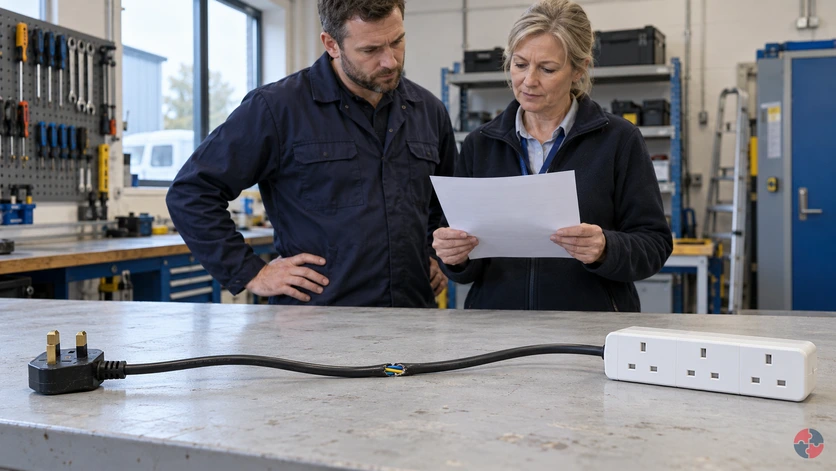
A damaged lead is a warning, not a test of the hidden condition
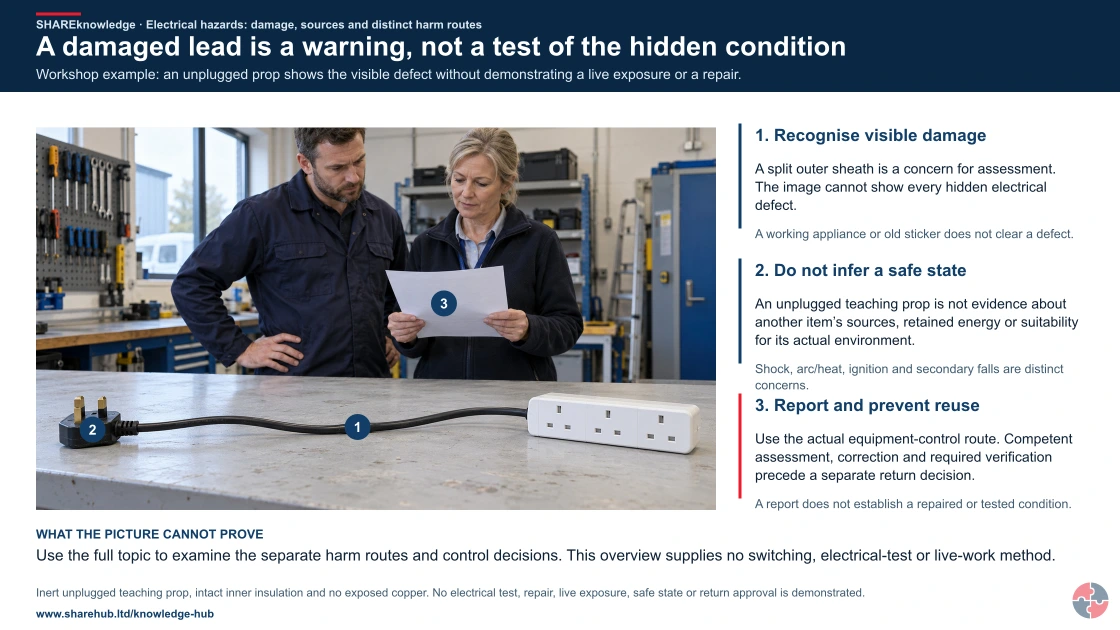
Full written explanation
Workshop example: an unplugged prop shows the visible defect without demonstrating a live exposure or a repair.
- Recognise visible damage. A split outer sheath is a concern for assessment. The image cannot show every hidden electrical defect.
- Do not infer a safe state. An unplugged teaching prop is not evidence about another item’s sources, retained energy or suitability for its actual environment.
- Report and prevent reuse. Use the actual equipment-control route. Competent assessment, correction and required verification precede a separate return decision.
Change the pathway
- Appearance is incomplete. A working appliance or old sticker does not clear a defect.
- Harm has several routes. Shock, arc/heat, ignition and secondary falls are distinct concerns.
- No improvised repair. A report does not establish a repaired or tested condition.
Evidence check: Use the full topic to examine the separate harm routes and control decisions. This overview supplies no switching, electrical-test or live-work method.
Visible and hidden defects, alternative sources and separate harm mechanisms
Primary references: HSE: electrical injuries and separate mechanisms · HSE: portable-equipment checks and tests
Open the complete HD image (new tab)Download image

Visible and hidden defects, alternative sources and separate harm mechanisms
Primary references: HSE: electrical injuries and separate mechanisms · HSE: portable-equipment checks and tests
- Contact with a conductor or arc exposure — Prevent access; use competent isolation and verification.
- Fire or damaged equipment — Stop affected use and obtain a safe defect and return decision.
- Buried-service uncertainty — Hold intrusive work and resolve location and service ownership.
- A person has been shocked — Protect the rescuer and use the emergency response route.
Content amended 19 October 2026 by the SHARE Knowledge Hub editorial team. This records an editorial content change; the existing technical-review and approval status still applies.
Separate contact, arc, ignition and secondary injury
Electricity can injure through body current, an arc without current passing through the body, ignition or a secondary fall. Each route changes what the assessment and barriers must address.
Trace the real source-to-person route before maintenance
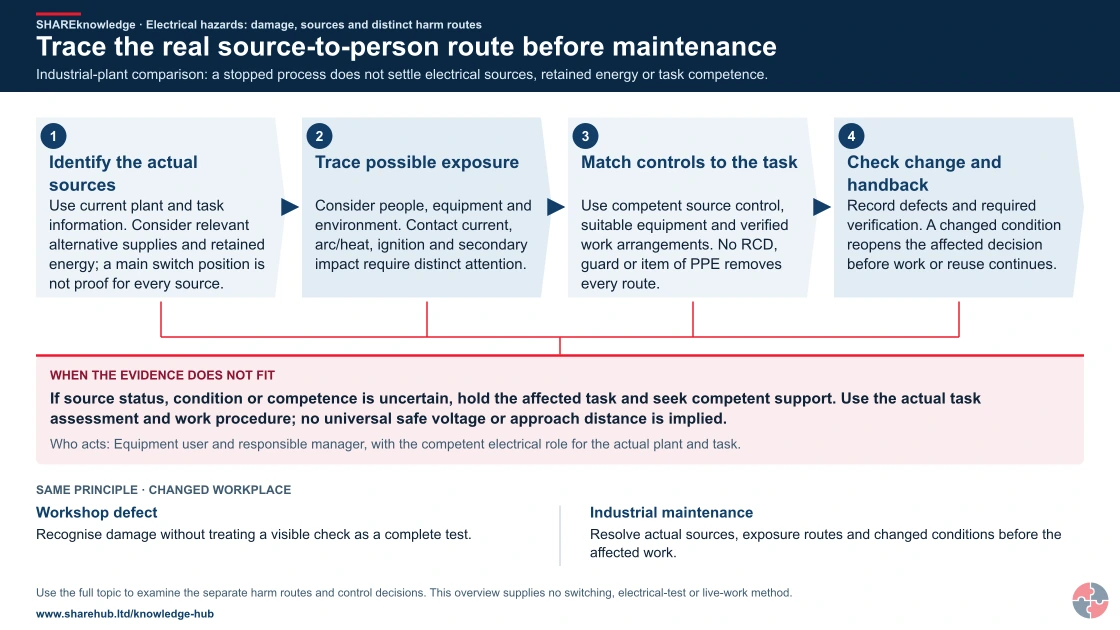
Full written explanation
A four-check industrial maintenance review identifies actual sources, possible contact/arc/ignition and secondary harm routes, suitable control arrangements and verified correction/handback. Alternative supplies and retained energy remain questions for competent task-specific assessment. No single protective device is presented as covering every harm pathway.
Industrial-plant comparison: a stopped process does not settle electrical sources, retained energy or task competence.
- Identify the actual sources. Use current plant and task information. Consider relevant alternative supplies and retained energy; a main switch position is not proof for every source.
- Trace possible exposure. Consider people, equipment and environment. Contact current, arc/heat, ignition and secondary impact require distinct attention.
- Match controls to the task. Use competent source control, suitable equipment and verified work arrangements. No RCD, guard or item of PPE removes every route.
- Check change and handback. Record defects and required verification. A changed condition reopens the affected decision before work or reuse continues.
When the evidence does not fit: If source status, condition or competence is uncertain, hold the affected task and seek competent support. Use the actual task assessment and work procedure; no universal safe voltage or approach distance is implied.
Who acts: Equipment user and responsible manager, with the competent electrical role for the actual plant and task.
Changed workplace
Workshop defect: Recognise damage without treating a visible check as a complete test.
Industrial maintenance: Resolve actual sources, exposure routes and changed conditions before the affected work.
Evidence check: Use the full topic to examine the separate harm routes and control decisions. This overview supplies no switching, electrical-test or live-work method.
Visible and hidden defects, alternative sources and separate harm mechanisms
Primary references: HSE: electrical injuries and separate mechanisms · HSE: portable-equipment checks and tests
Open the complete HD image (new tab)Download image

Visible and hidden defects, alternative sources and separate harm mechanisms
Primary references: HSE: electrical injuries and separate mechanisms · HSE: portable-equipment checks and tests

Trace the route
Identify accessible live parts and possible arcs, including switching, faults and maintenance conditions.
Assess surroundings
Consider flammable materials and the consequences of involuntary movement or loss of balance, particularly at height.
Verify protection
Use the relevant competent electrical assessment and task controls; confirm the actual boundary before access or work.
Protecting against one mechanism does not automatically control the others. No arc category, working distance or PPE rating is inferred.
How should an electrical hazard be traced?
Trace the energy source, the route to contact or ignition, the person or material exposed, and the protection that could fail. A risk score without that chain can conceal a live part, fault current or nearby service.
Best-practice guide: Electrical hazards and risks
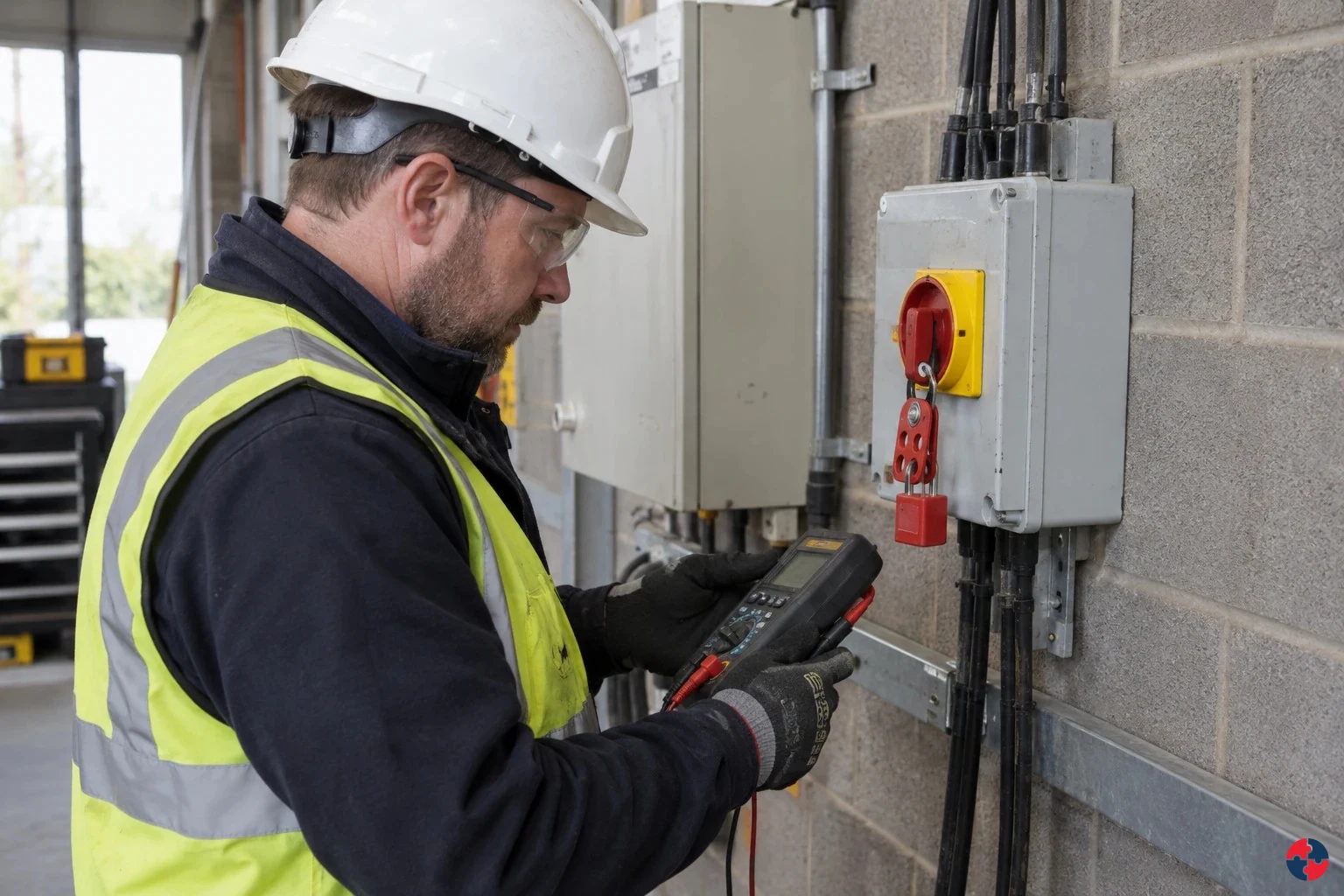
How should an electrical hazard be traced?
Trace the energy source, the route to contact or ignition, the person or material exposed, and the protection that could fail. A risk score without that chain can conceal a live part, fault current or nearby service. Electrical hazards arise when energy can reach a person, ignite material or disable a system; risk depends on the exposure route and the conditions of work.
Turn electrical hazards and risks knowledge into a decision
Electrical hazards arise when energy can reach a person, ignite material or disable a system; risk depends on the exposure route and the conditions of work. Shock, arc burns, fire and secondary falls can follow damaged equipment, exposed conductors, poor isolation or a service strike. Service-owner advice, scan record, permit, revised drawing and close-out of any near miss.
A field decision from start to hand-back
Use the agreed locate and dig method while keeping plant and bystanders out of the exposure zone. Confirm protection and update the as-found route before covering or leaving the site.
Electrical harm routes
Electric shock: Current passes through the body after contact with live or faulty parts. Electrical burn: Current heats tissue or arc energy burns exposed skin. Arc flash: Fault energy travels through air and releases heat/light/pressure.
Choose controls for electrical hazards and risks
Elimination: Use a suitable non-electrical method or a service that avoids bringing exposed electrical power into the work area. Substitution: Choose suitable cordless or reduced-voltage equipment where it reduces the assessed shock risk, while checking battery, fire and task limitations. Engineering controls: Keep cables, connections and users away from water, traffic and unauthorised access; isolate defective equipment against reuse. Engineering controls: Provide suitable equipment, supply protection, enclosures and cable routing for the actual environment; an RCD is an additional measure, not proof of safety. Administrative controls: Competent people confirm supply suitability and inspection/test needs; users check damage and stop before adjusting or clearing a tool. Read the full control table for qualifications, ownership and verification. Use the actual task and applicable jurisdiction; existing technical approval remains unchanged.
Use the full electrical hazards and risks lesson
Use the full topic for the decision points, practical examples, detailed control tables and source scope. HSE guidance applies to Great Britain; use HSENI for the Northern Ireland route and the source’s stated jurisdiction. A simplified guide does not change the page’s technical-review or approval status.

Read all six steps as text
1. How should an electrical hazard be traced?
Trace the energy source, the route to contact or ignition, the person or material exposed, and the protection that could fail.
- Avoid / redesign: Use a suitable non-electrical method or a service that avoids bringing exposed electrical power into the work area.
- Control the task: Keep cables, connections and users away from water, traffic and unauthorised access; isolate defective equipment against reuse.
- Verify before release: If the hazardous step remains, keep it within the task assessment and select the stronger feasible remaining controls.
Trace the energy source, the route to contact or ignition, the person or material exposed, and the protection that could fail. A risk score without that chain can conceal a live part, fault current or nearby service. Electrical hazards arise when energy can reach a person, ignite material or disable a system; risk depends on the exposure route and the conditions of work.
Apply it: Which part of this plan would you check at the workface before authorising the task?
2. Turn electrical hazards and risks knowledge into a decision
Use the evidence to improve the actual work arrangement.
- Change at source: Use a suitable non-electrical method or a service that avoids bringing exposed electrical power into the work area.
- Make it observable: If the hazardous step remains, keep it within the task assessment and select the stronger feasible remaining controls.
- Keep useful evidence: Service-owner advice, scan record, permit, revised drawing and close-out of any near miss.
Electrical hazards arise when energy can reach a person, ignite material or disable a system; risk depends on the exposure route and the conditions of work. Shock, arc burns, fire and secondary falls can follow damaged equipment, exposed conductors, poor isolation or a service strike. Service-owner advice, scan record, permit, revised drawing and close-out of any near miss.
Apply it: What evidence would show that the change improves this task, rather than only completing a record?
3. A field decision from start to hand-back
Example: a practical application of the existing topic lesson.
- Setting: the site team excavates near a buried electrical service at a live client site.
- Act: Compare drawings with field scan and mark a controlled route; select a non-intrusive alternative where feasible.
- Hold / review: A conflicting drawing, ambiguous locator signal or exposed unknown service stops the job.
Use the agreed locate and dig method while keeping plant and bystanders out of the exposure zone. Confirm protection and update the as-found route before covering or leaving the site.
Apply it: At which point would you hold this example, and what evidence would allow it to proceed?
4. Electrical harm routes
Connect the task, the route to the person and the control that can fail.
- Electric shock: Current passes through the body after contact with live or faulty parts.
- Electrical burn: Current heats tissue or arc energy burns exposed skin.
- Arc flash: Fault energy travels through air and releases heat/light/pressure.
Electric shock: Current passes through the body after contact with live or faulty parts. Electrical burn: Current heats tissue or arc energy burns exposed skin. Arc flash: Fault energy travels through air and releases heat/light/pressure.
Apply it: Who could be exposed, including other trades, cleaners, maintainers and people nearby?
5. Choose controls for electrical hazards and risks
Start with the stronger practicable options and verify their effect.
- Elimination: Use a suitable non-electrical method or a service that avoids bringing exposed electrical power into the work area.
- Substitution: Choose suitable cordless or reduced-voltage equipment where it reduces the assessed shock risk, while checking battery, fire and task limitations.
- Engineering controls: Keep cables, connections and users away from water, traffic and unauthorised access; isolate defective equipment against reuse.
- Engineering controls: Provide suitable equipment, supply protection, enclosures and cable routing for the actual environment; an RCD is an additional measure, not proof of safety.
- Administrative controls: Competent people confirm supply suitability and inspection/test needs; users check damage and stop before adjusting or clearing a tool.
Elimination: Use a suitable non-electrical method or a service that avoids bringing exposed electrical power into the work area. Substitution: Choose suitable cordless or reduced-voltage equipment where it reduces the assessed shock risk, while checking battery, fire and task limitations. Engineering controls: Keep cables, connections and users away from water, traffic and unauthorised access; isolate defective equipment against reuse. Engineering controls: Provide suitable equipment, supply protection, enclosures and cable routing for the actual environment; an RCD is an additional measure, not proof of safety. Administrative controls: Competent people confirm supply suitability and inspection/test needs; users check damage and stop before adjusting or clearing a tool. Read the full control table for qualifications, ownership and verification. Use the actual task and applicable jurisdiction; existing technical approval remains unchanged.
Apply it: Which stronger option can be used here, and who will verify it before accepting the remaining risk?
6. Use the full electrical hazards and risks lesson
Follow the official sources below and retain the task-specific evidence.
- Official guidance: HSE electrical safety introduction
- Official guidance: HSE - Electricity at work: safe working practices HSG85
- Task decision: Service-owner advice, scan record, permit, revised drawing and close-out of any near miss.
Use the full topic for the decision points, practical examples, detailed control tables and source scope. HSE guidance applies to Great Britain; use HSENI for the Northern Ireland route and the source’s stated jurisdiction. A simplified guide does not change the page’s technical-review or approval status.
Apply it: Which official source and full-topic section will you use to resolve the next decision?
For a buried cable, the source is the network supply, the exposure route is a tool strike and arc, and the people at risk include the excavator and bystanders. Drawings alone do not locate the cable; competent detection and a controlled dig method must answer where work can start.
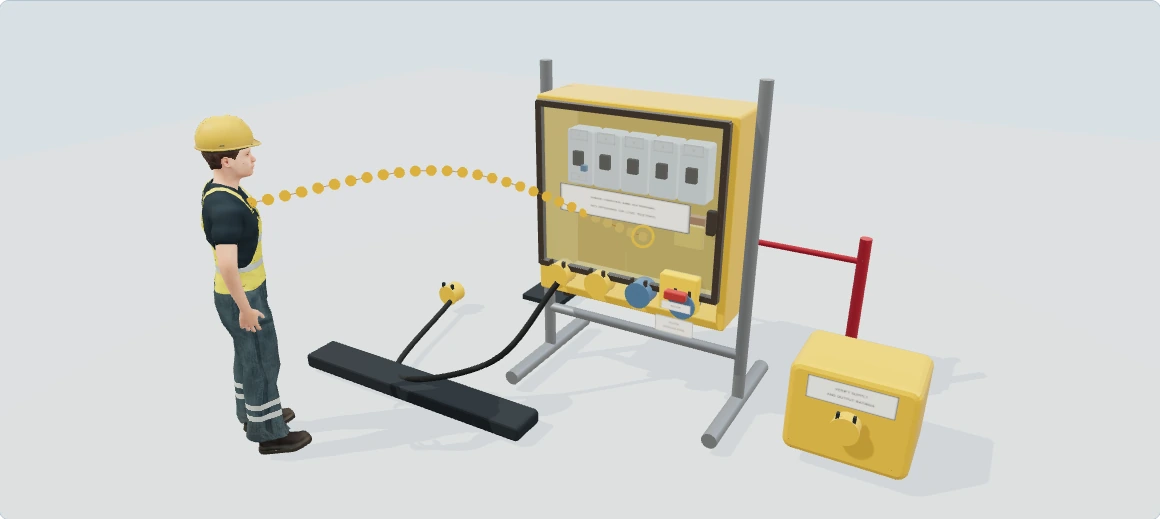

Temporary electrical supplies: follow the path to shock and fire
Explore how this equipment can harm its users and other people, then follow the practical measures that interrupt each pathway. This is a hazards and good-practice lesson; the separate checklist remains the pre-use/safety-check activity.
Hazards and good practice: learn what can hurt people during use, change and maintenance. Pre-use and safety checks stay in the separate checklist.
Checksheets and risk assessments
Equipment checksheets
- Site electrical distribution and RCD checks — 3D checks · Word · PDF
- Generators and temporary power supplies — 3D checks · Word · PDF
Risk assessment examples
Full written walkthrough — all 8 steps
1. Plan a suitable supply and work setting
What is happening: The distribution unit connects a source, protective devices, cables and equipment in a changing workplace.
How harm can occur: Unsuitable equipment or arrangements can expose users and other trades to shock, burns, arc or fire.
Best practice to apply: Use competent design and selection for the actual work, supply and environment; reduce avoidable electrical exposure.
Why this works: Suitable selection controls the hazard before a person has to work near the system.
Electrical hazards and risks · How should an electrical hazard be traced?2. Understand the contact pathway
What is happening: A live part or fault can connect the supply through a person to another conductive surface.
How harm can occur: Current through the body can cause serious injury; arcing can cause burns without the same direct contact.
Best practice to apply: Keep live parts enclosed and inaccessible and use the actual protective arrangements; never open this example as a user instruction.
Why this works: Preventing access interrupts contact; appearance and a healthy-looking cable do not establish an electrically safe system.
Electrical hazards and risks · Separate contact, arc, ignition and secondary injury3. Protect cables in the real work route
What is happening: Leads cross areas where vehicles, sharp edges, water and other operations may affect them.
How harm can occur: Damage or unsuitable routing can expose conductors, start a fire or create a trip leading to secondary injury.
Best practice to apply: Use appropriate routing and mechanical/environmental protection and respond to damage without makeshift live repairs.
Why this works: The route is part of the electrical risk, even when the connected tool has no visible defect.
Electrical hazards and risks · Why do wet environments increase electrical risk?4. Keep protective functions in context
What is happening: An RCD is one protective measure within a complete system, not permission to use a damaged supply.
How harm can occur: Some faults, contact conditions and other hazards are not removed simply because an RCD is fitted.
Best practice to apply: Use suitable competent selection, installation and verification; retain other required protection and the instructed user checks.
Why this works: A single protective device cannot stand in for correct system design and continued condition.
Electrical hazards and risks · How can the hierarchy of controls reduce risks while using portable power for a site repair?5. Maintain enclosure and access boundaries
What is happening: The sealed cover separates users from internal components and keeps the operating interface distinct.
How harm can occur: Opening or defeating protection can create access to energy that a routine user cannot safely assess.
Best practice to apply: Keep covers and restricted areas secure; refer faults or access needs to the responsible competent electrical person.
Why this works: Routine operation and intrusive electrical work require different competence and control arrangements.
Electrical hazards and risks · What training and competence are needed for electrical hazards?6. Recognise stop and isolation as different actions
What is happening: A switch indication or an inactive tool does not identify every source of electrical or other stored energy.
How harm can occur: A backup, battery, control circuit or other source can cause unexpected energisation or movement.
Best practice to apply: Plan dead work through the actual competent isolation, securing and verification procedure; this lesson does not teach live testing.
Why this works: System-specific identification and verification address sources that a simple stop can leave present.
Electrical hazards and risks · How can electricity injure the body, and why can a small mark hide a serious incident?7. Deal with an unsafe condition without touching danger
What is happening: A damaged supply or casualty may still be connected to continuing electrical danger.
How harm can occur: A rescuer or colleague can become a second casualty by approaching or touching too soon.
Best practice to apply: Keep people clear, use the site's emergency arrangements and have the continuing danger controlled; do not improvise a repair or rescue contact.
Why this works: Preventing additional contact protects people while competent emergency help and isolation are arranged.
Electrical hazards and risks · What are the secondary effects of electrical incidents?8. Return equipment only after competent resolution
What is happening: A replaced cable or reset trip does not by itself explain the fault or prove that the installation is suitable.
How harm can occur: The same fault can recur and harm the next user or an adjacent trade.
Best practice to apply: Record and restrict defective equipment, resolve the cause and have the necessary verification and handover completed.
Why this works: A verified repair and clear restrictions prevent a temporary reset being mistaken for a safe hand-back.
Electrical hazards and risks · How can the hierarchy of controls reduce risks while using portable power for a site repair?
Illustrative awareness learning. Geometry, colours and movement do not establish safe distances, capacity, exposure, isolation or work permission. Use the actual assessment, equipment information and competent arrangements.
The wider workplace has its own account and subscription access. Exploring this lesson does not grant access, record course completion or authorise work.
UK guidance for further reading
HSE: Temporary electrical suppliesHow can I practise this topic in 3D?

A cable defect is reported after a vehicle crossing

Vehicle charging and battery damage
All related inspection points 3 across 2 locations
Construction site 2 inspection points
Aerosystems Engineering 1 inspection point
Practice in the SHAREhub environment. Browser practice is separate from workplace competence and formal learning records.
What are the key points about electrical hazards and risks?
The key points are that electricity is often invisible, fast-acting and unforgiving when contact, fault or poor control occurs.
What are the key points about electrical hazards and risks? — part 1 of 3


Read the complete visual as text
- The key points are that electricity is often invisible,…: The key points are that electricity is often invisible, fast-acting and unforgiving when contact, fault or poor control occurs.
- Electric shock can be fatal: Current through the body can disrupt the heart, breathing and muscle control, even where the contact time is short.
- Burns can be external and internal: Electrical burns may damage skin and deeper tissue; arc energy can also cause severe thermal burns.
What are the key points about electrical hazards and risks? — part 2 of 3


Read the complete visual as text
- Defects matter immediately: A cut cable, cracked plug, missing cover, exposed conductor or overheating socket can create danger before the next formal inspection.
- Environment changes the risk: Wet, outdoor, cramped, conductive, dusty, explosive or construction settings increase the need for stronger controls.
What are the key points about electrical hazards and risks? — part 3 of 3


Read the complete visual as text
- Overhead and underground services are high consequence: The hazard may not be obvious until plant, excavation, drilling or lifting work enters the danger zone.
- Risk assessment must explain the pathway: A useful assessment describes how electricity could reach a person or ignite materials, not just that electricity exists.
Electric shock can be fatal
Current through the body can disrupt the heart, breathing and muscle control, even where the contact time is short.
Burns can be external and internal
Electrical burns may damage skin and deeper tissue; arc energy can also cause severe thermal burns.
Defects matter immediately
A cut cable, cracked plug, missing cover, exposed conductor or overheating socket can create danger before the next formal inspection.
Environment changes the risk
Wet, outdoor, cramped, conductive, dusty, explosive or construction settings increase the need for stronger controls.
Overhead and underground services are high consequence
The hazard may not be obvious until plant, excavation, drilling or lifting work enters the danger zone.
Risk assessment must explain the pathway
A useful assessment describes how electricity could reach a person or ignite materials, not just that electricity exists.
What does electrical hazard and risk mean?
An electrical hazard is a source of electrical energy that can cause harm; electrical risk is the chance and severity of that harm occurring.
Electrical hazards exist wherever electrical energy is generated, supplied, stored, transformed, distributed, charged, tested, used, maintained or disturbed. They include fixed wiring, switchgear, chargers, batteries, portable tools, extension leads, temporary supplies, overhead lines, buried services, machinery controls and hidden cables in buildings.
Risk depends on context. A low-power office charger may be low risk when undamaged and used correctly, but risk rises if it overheats under a desk, is used with a damaged extension lead, is covered by paper or is plugged into an overloaded adaptor. A construction cable may be safe when protected and inspected, but dangerous when crushed by vehicles, lying in water or repaired with tape.
A good electrical hazard assessment follows the chain: source of electricity, exposed or faulty part, route to contact or ignition, person or material affected, severity factors, existing controls, missing controls and evidence that controls work. See HSE electrical safety introduction
| Stage | What to ask | Example |
|---|---|---|
| Source | Where is electrical energy present? | Distribution board, charger, tool, cable, overhead line or battery. |
| Failure or exposure | What could expose live parts or create fault energy? | Damaged insulation, missing cover, overload or incorrect isolation. |
| Contact or ignition route | How could a person touch it or how could it start a fire? | Wet hands, metal ladder, crushed lead, arcing or overheating. |
| People affected | Who could be harmed? | User, cleaner, contractor, pedestrian, visitor or emergency responder. |
| Severity factor | What makes the harm worse? | Higher voltage, wet conditions, duration, height, flammable atmosphere or inability to escape. |
| Evidence | What proves risk is controlled? | Inspection, isolation, maintenance, training, permits and defect close-out. |
How can electricity harm people?
Electricity harms people through shock, burns, arcing, fire, explosion, loss of muscle control and secondary events.
Electric shock occurs when current passes through the body. Depending on the route, duration and current level, it can cause pain, muscle contraction, inability to let go, breathing difficulty, heart rhythm disturbance or death. The person may also fall, strike equipment or pull others into the incident.
Electrical burns can occur where current enters and leaves the body, and deeper tissue damage may be more serious than the visible skin injury suggests. Arc flash and short-circuit events can release intense heat, light, pressure and molten metal, causing burns, eye injury, hearing damage and fire.
Electricity can also harm without anyone touching live parts. Overloaded circuits, loose connections, damaged chargers, poor maintenance and unsuitable equipment can overheat and start fires. In flammable or explosive atmospheres, electrical equipment can provide the ignition source.
| Harm route | How it happens | Typical workplaces |
|---|---|---|
| Electric shock | Current passes through the body after contact with live or faulty parts. | Maintenance, offices, workshops, construction, catering and outdoors. |
| Electrical burn | Current heats tissue or arc energy burns exposed skin. | Switchgear, testing, repairs and fault conditions. |
| Arc flash | Fault energy travels through air and releases heat/light/pressure. | Switchrooms, panels, industrial maintenance and testing. |
| Fire | Faults, overloads or damaged equipment create heat or sparks. | Any workplace with electrical equipment. |
| Explosion | Electrical ignition occurs in flammable atmospheres or dust clouds. | Fuel depots, spray booths, chemical areas and dusty plant. |
| Secondary injury | Shock causes a fall, collision or sudden movement. | Ladders, MEWPs, roofs, machinery areas and confined spaces. |
A person may be injured directly through current crossing the body, or without touching a conductor when an arc burns skin and eyes. A startled worker can then fall from height or into moving plant. Assessment must therefore include bystanders, rescue attempts and secondary events, not just the first person who touches equipment. See HSE electrical injuries
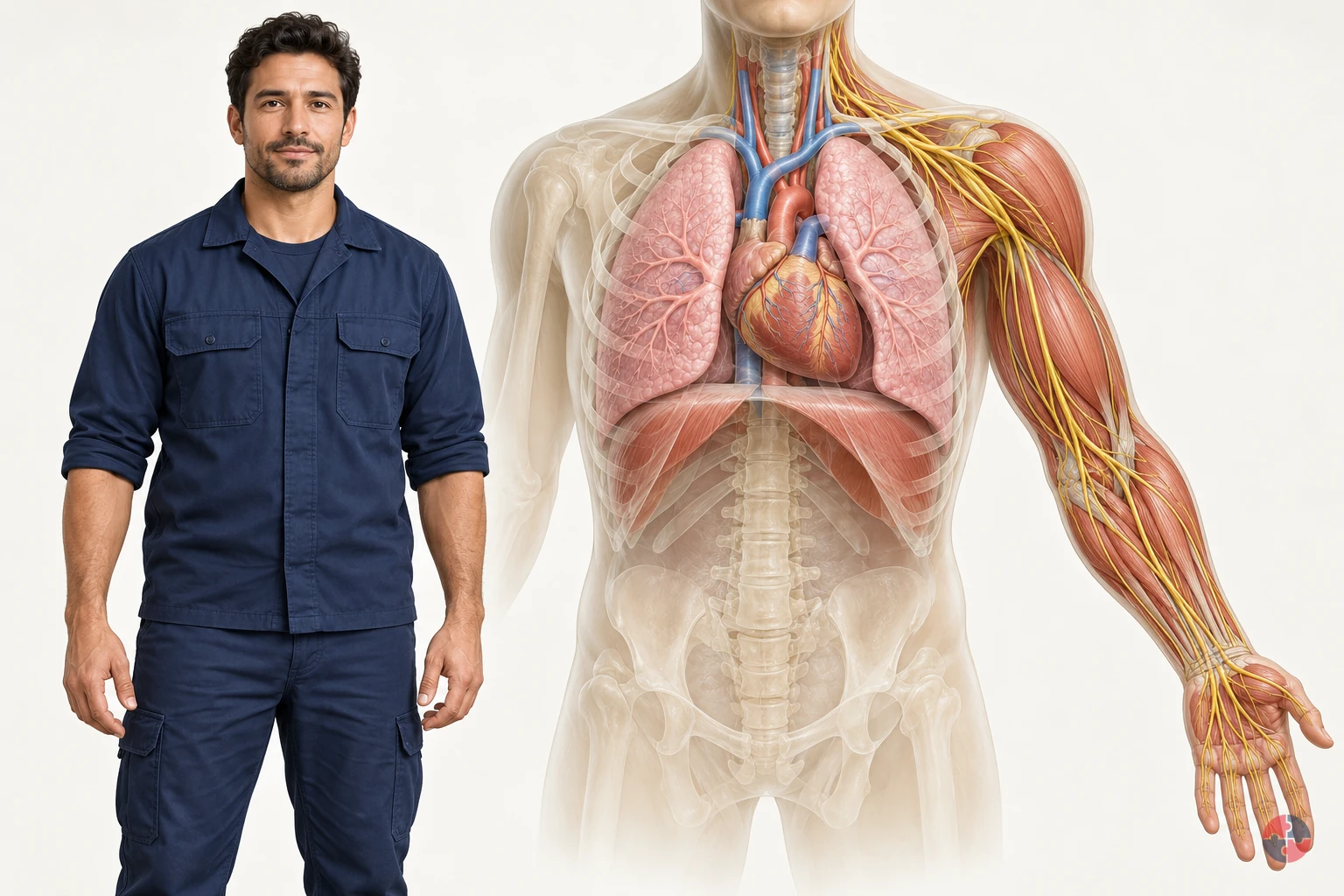
How can electricity injure the body, and why can a small mark hide a serious incident?
Interactive anatomy · Electrical injury · Updated 2026-10-23
Electrical injury terms
A broad term for injury associated with electrical exposure.
An external current affecting the body.
Tissue injury caused by electrical heating.
Death from electric shock.
Health and Safety Executive: Electrical injuries · Health and Safety Executive: Selection and use of electric handlamps, PM38 · NHS: Burns and scaldsRead all anatomy and process explanations without the viewer
General occupational awareness of anatomy and incident mechanisms. A broad term for injury associated with electrical exposure. An external current affecting the body. Tissue injury caused by electrical heating. Death from electric shock. Electrical rescue, live testing, isolation or energised work instruction An energise-person control, contact timer, voltage or resistance input Safe current paths, survival percentages or shock-severity scores ECG interpretation, rhythm selection or AED shock decisions Medical or workplace clearance from a mark, diagram or feeling well The hazard-avoidance and medical-help panel is visible before model loading and quiz completion.
Nerve pathway
Nerves communicate using electrical and chemical signals. Nerves carry biological signals, and communication at the nerve-to-muscle connection helps activate muscle. The travelling cue is a simplified way of directing attention to that relationship. It does not show household current circulating through a person, and its colour, speed or brightness cannot be used to interpret nerve function or electrical injury. Alder Hey Children’s NHS Foundation Trust: Nerve service — normal nerve function · NHS: Lambert-Eaton myasthenic syndrome — normal nerve-to-muscle signalling · Oxford University Hospitals NHS Foundation Trust: Nerve Conduction Studies and Electromyography
Skeletal muscle
The nervous system normally coordinates muscle contraction. A slow hand movement demonstrates normal function; it does not imitate a casualty’s involuntary movements. Alder Hey Children’s NHS Foundation Trust: Nerve service — normal nerve function · NHS: Lambert-Eaton myasthenic syndrome — normal nerve-to-muscle signalling
Breathing muscles
Coordinated muscle activity helps move air into and out of the lungs. The diaphragm and chest movement belong to the respiratory lesson. This example shows no breathing-rate measurement. Cambridge University Hospitals NHS Foundation Trust: Breathing pattern disorders and physiotherapy — normal diaphragm role
Heart conduction
Coordinated electrical activity helps organise the heart’s pumping. A labelled sequence illustrates normal biological activation. It is not an ECG or a rhythm-interpretation exercise. St George’s University Hospitals NHS Foundation Trust: Catheter Ablation for Supra-Ventricular Tachycardia — normal electrical system · NHS 111 Wales: Cardiac Arrest
Skin contact region
Contact conditions influence how an electrical exposure affects the body. The marker identifies an example contact region. It does not calculate skin resistance or identify a safe point to touch. Health and Safety Executive: Electrical injuries · Health and Safety Executive: Electrical safety frequently asked questions
Internal tissue region
Electrical injury can extend beneath the visible surface. An electrical incident can cause effects below the surface, so visible appearance alone cannot describe the whole injury. This transparent region marks the subject of the explanation, rather than a measured boundary of damage. Its shape does not establish where current travelled or which tissues are unaffected; compare it with the selected mechanism caption. Health and Safety Executive: Electrical injuries · NHS: Burns and scalds · NHS 111 Wales: Burns and scalds — electrical burns
External source
The incident hazard comes from an electrical source outside the body. The generic equipment symbol is kept disconnected from the normal biological signalling diagram. Health and Safety Executive: Introduction to electrical safety
Illustrative exposure route
This broad region represents one possible exposure route. It cannot establish the actual route or outcome. There is no safe-path selector, voltage control or timed-contact exercise. Health and Safety Executive: Electrical injuries · Health and Safety Executive: Electrical safety frequently asked questions
Arc and thermal region
An arc or hot electrical equipment can cause injury. This separate incident panel is different from a simple through-body current diagram. No arc flash is animated. Health and Safety Executive: Electrical injuries · Health and Safety Executive: Introduction to electrical safety
Secondary injury
Loss of control can lead to falls or contact with nearby hazards. The neutral surrounding-hazard symbol recognises these injuries without staging a fall or body jerk. Health and Safety Executive: Electrical injuries · Health and Safety Executive: Introduction to electrical safety
Response boundary
Keep clear of unresolved electrical danger and get emergency help. Do not touch a person who may still be in contact with an electrical source. This node opens the safety panel, never a rescue activity. Health and Safety Executive: Introduction to electrical safety · Health and Safety Executive: Electricity — electric shock and overhead-line precautions · Health and Safety Executive: Emergency procedures
Open the complete process transcript
The process, step by step
Explore normal function
Start with the body’s own signalling: nerves communicate with muscles, breathing muscles move the chest, and organised activation coordinates the heart. Select one example at a time and read the associated label before changing systems. These are normal biological functions, not electricity from equipment moving through a person. The slow cues make the explanation easier to follow; they do not show a measured nerve signal, breathing rate or heart rhythm. This process sequence is a teaching route through the subject, not a simulation of an electrical accident. Alder Hey Children’s NHS Foundation Trust: Nerve service — normal nerve function · NHS: Lambert-Eaton myasthenic syndrome — normal nerve-to-muscle signalling · Cambridge University Hospitals NHS Foundation Trust: Breathing pattern disorders and physiotherapy — normal diaphragm role · St George’s University Hospitals NHS Foundation Trust: Catheter Ablation for Supra-Ventricular Tachycardia — normal electrical system
What to watch: Select the nerve, skeletal-muscle, breathing-muscle and heart labels individually, noticing that each belongs to a different normal biological example.
Why it matters: Normal signalling helps muscles work in a coordinated way. Keeping these biological examples distinct from the incident diagrams makes it easier to explain what an external electrical hazard can disrupt.
Explore this step: Explore one normal system, then explain its function before selecting a different system.
Locate the external hazard
Locate the generic electrical-source symbol outside the body and compare it with the normal biological labels. It represents an external workplace hazard, not the source of ordinary nerve or heart signalling. The model keeps the equipment symbol separate and does not energise the silhouette when a learner selects it. This step establishes the context before the different injury mechanisms are discussed. A picture of equipment cannot show whether real equipment is safe. Use the label to identify the distinction, rather than imagining that the model is testing a circuit. Health and Safety Executive: Introduction to electrical safety · Health and Safety Executive: Emergency procedures
What to watch: Locate the external-source symbol and the response-boundary label, then compare their positions with the normal body-system labels.
Why it matters: An external electrical supply is a hazard that requires competent control. Separating it from biological signalling avoids implying that a normal nerve pathway describes a safe route for electrical current.
Explore this step: Identify which labels describe the body and which identify the external hazard or safety boundary.
Choose an incident example
Choose one incident explanation: electric shock, electrical heating within tissue, or an arc and its thermal effects. These are different mechanisms and more than one may be relevant to an incident. Read the selected heading before examining the highlighted region so that the image and explanation remain connected. The model is a route through the concepts, not a calculation of current flow or injury severity. It provides no voltage control, safe-contact experiment or animated arc. Compare the labels to explain how the mechanisms differ without ranking an actual casualty’s injuries. Health and Safety Executive: Electrical injuries · Health and Safety Executive: Introduction to electrical safety
What to watch: Read the incident heading, then locate its contact, internal-tissue or arc-and-thermal label rather than combining every marker into one route.
Why it matters: Shock can disturb body function, while heating can injure tissue. An arc can cause thermal injury without being equivalent to the simple contact diagram; the examples can overlap in a real incident.
Explore this step: Compare two incident panels and describe the different mechanism named by each heading.
Explain possible effects
Read the caption beside the selected system and trace the labelled relationship being explained. Electric shock can interfere with muscle control, breathing or the way the heart beats; electrical heating can damage tissue. The highlighted region is a teaching focus, not a map of an individual’s injury. It cannot identify the actual route through the body or declare that an unhighlighted organ is unaffected. Compare the normal-function labels with the incident caption, keeping the possible effect separate from any claim about what has happened to a particular person. Health and Safety Executive: Electrical injuries · Health and Safety Executive: Electrical safety frequently asked questions
What to watch: Compare the breathing-muscle, heart and internal-tissue labels with the caption for the incident mechanism currently selected.
Why it matters: Interference with coordinated muscle or heart function can be serious even when an illustration shows little surface change. A teaching marker cannot determine which effects are present or absent in a real person.
Explore this step: Choose a system and describe its normal role before reading the possible effect in the incident caption.
Know the limits
Finish by comparing the questions the diagram answers with those it cannot answer. It can introduce normal signalling and distinguish several possible injury mechanisms. It cannot establish an actual exposure, the extent of damage, a safe electrical condition or medical clearance. A small-looking electrical burn or feeling well does not provide that clearance. The external-source and response-boundary labels keep these limits visible. Review them alongside the existing safety panel; completing this teaching route is not a rescue procedure, a clinical assessment or permission to resume the work. NHS: Burns and scalds · Health and Safety Executive: Electrical safety frequently asked questions · NHS 111 Wales: Burns and scalds — electrical burns
What to watch: Locate the internal-tissue and response-boundary labels, then compare the limits stated in their captions with the incident explanation.
Why it matters: Visible appearance alone cannot establish the seriousness of electrical injury. Keeping the model’s scope clear prevents an explanatory picture or completed activity being mistaken for evidence that a person or workplace is safe.
Explore this step: Name one question the model explains and one question that requires assessment beyond this teaching view.
Mechanisms and their limits
Electric shock: disruption of normal function External electrical current can interfere with muscle control, breathing or the heart’s organised activity. These are possible effects; the same diagram cannot predict the outcome of a real incident. An illustrative route does not show that a particular organ must or cannot be affected. No arbitrary arrhythmia, dramatic flatline, body jerk or calculated survival result is shown. Both alternating and direct current can be dangerous. The viewer offers no safe voltage or safe path. Health and Safety Executive: Electrical injuries · Health and Safety Executive: Electrical safety frequently asked questions
HSE: prevent electrical injury
Electrical heating: injury beneath the surface Current passing through tissues can generate heat and cause burns beneath the skin. A small visible mark is not enough to judge the internal effects. Not every shock produces extensive burns. The marked region is illustrative, not a reconstructed path, calculated burn depth or severity score. An electrical burn needs emergency medical assessment even if it appears small. Feeling well or selecting a similar image does not provide workplace or medical clearance. Health and Safety Executive: Electrical injuries · NHS: Burns and scalds · NHS 111 Wales: Burns and scalds — electrical burns
NHS: electrical burns need emergency care
HSE: electrical injury mechanisms
Arc, heat and secondary injury Arcing and hot electrical equipment can injure people without the event fitting a simple hand-to-foot contact story. Heat, fire or explosion and secondary falls or nearby machinery may add hazards. The diagram does not require a through-body route to recognise an arc or thermal hazard. Alternating and direct current equipment can both present hazards. This is an incident explanation, not a flash-energy calculation or permission to approach damaged equipment. Health and Safety Executive: Electrical injuries · Health and Safety Executive: Introduction to electrical safety · Health and Safety Executive: Electrical safety frequently asked questions
HSE: electrical hazards and controls
HSE: competent assessment of unsafe equipment
Electric shock: disruption of normal function — follow the anatomy
Look at: The contact route through the body, including nerves and muscle.
What changes: Electric current can interfere with normal nerve, muscle, breathing or heart activity.
Why it matters: A person may be unable to let go, collapse or develop a dangerous rhythm.
What to do: Keep clear, do not touch anyone still in contact with electricity, call 999 and follow competent site emergency arrangements.
Damaged portable equipment presents an unresolved electrical hazard
A worker finds damaged equipment near a damp work area; the exposure is a counterfactual failure of controls, not a rescue exercise. An acute incident is explained in 32 seconds without voltage, current or contact-duration inputs. The sequence sets no safe exposure or waiting time. Never touch a person or equipment while electrical danger is unresolved. The viewer cannot prove isolation or infer the actual current path or outcome.
Keep clear of the unresolved source Damaged equipment in a damp area is a stop-and-report situation. Do not touch a potentially live casualty; call appropriate help and use competent site emergency arrangements. Health and Safety Executive: Electrical safety frequently asked questions · Health and Safety Executive: Emergency procedures
What failed barriers could allow The counterfactual contact example marks an external source and possible exposure. It does not ask the learner to energise a person or select a supposedly safe route. Health and Safety Executive: Electrical injuries · Health and Safety Executive: Electrical safety frequently asked questions
Possible interference with normal function External current can affect muscle control, breathing or heart function. These are possible effects, not a prediction that every organ is involved or that a particular contact is survivable. Health and Safety Executive: Electrical injuries
Safety first, then urgent assessment Keep clear and obtain emergency help while danger remains. Only once the scene is safe does the separate unresponsive/abnormal-breathing CPR/AED guidance apply. Feeling well does not provide medical or equipment clearance. Health and Safety Executive: Electrical safety frequently asked questions · NHS: Burns and scalds · NHS 111 Wales: Cardiac Arrest · Health and Safety Executive: Emergency procedures
Electrical heating: injury beneath the surface — follow the anatomy
Look at: The tissue beneath the electrical contact points.
What changes: Current can generate heat inside the body as well as at the skin.
Why it matters: A small visible mark can conceal serious deeper injury.
What to do: Keep the scene safe; electrical burns need 999 or A&E assessment even when the visible mark is small.
A small external mark after an electrical incident
After an electrical incident, a worker has a small visible hand mark; the area must be made safe by competent arrangements. This is a possible injury explanation, not a burn-depth model or a simulation of tissue heating at a selected exposure time. Visible marks cannot establish the route or depth of internal injury. Not every shock produces the broad affected area used in this illustration.
Do not approach unresolved energy danger The incident is treated as an electrical emergency until the scene is safe. Keep clear, summon appropriate help and do not judge safety from a small mark. Health and Safety Executive: Electrical safety frequently asked questions · NHS: Burns and scalds
External current can heat tissues A broad translucent region represents possible tissue heating during contact. It is not a wire tracing the real route and it does not calculate dose from a contact point. Health and Safety Executive: Electrical injuries
An external mark may understate injury The selected region separates possible internal effects from the skin marker. Size or appearance of the mark cannot clear the person or tell the learner what tissues were actually injured. Health and Safety Executive: Electrical injuries · NHS 111 Wales: Burns and scalds — electrical burns
Arrange medical assessment Use emergency help for electrical burns and follow live advice once it is safe to assist. Do not continue work or reassure someone simply because the mark is small; the activity gives no treatment or return-to-work clearance. NHS: Burns and scalds · NHS 111 Wales: Burns and scalds — electrical burns · Health and Safety Executive: Emergency procedures
Arc, heat and secondary injury — follow the anatomy
Look at: The skin and eyes facing the arc, and the worker’s surroundings.
What changes: An electrical arc releases intense heat; the event may also cause a fall or other trauma.
Why it matters: Burns and secondary injuries can occur without a current path through the body.
What to do: Control arc hazards, use competent isolation procedures and plan emergency response.
An electrical fault releases heat near a work area
A fault or overheated electrical component exposes people nearby to heat and possible secondary hazards. The short explanation omits flashes, noise and blast effects. It predicts no arc boundary, burn depth, safe distance or survival probability. Arc/thermal injury is separate from the through-body current example. A person need not supply a hand-to-foot contact story for the incident to be serious.
Treat the fault as unresolved danger Keep clear of faulty or overheated equipment and activate competent emergency arrangements. The example gives no permission for live inspection or repair. Health and Safety Executive: Introduction to electrical safety · Health and Safety Executive: Electrical safety frequently asked questions · Health and Safety Executive: Emergency procedures
Heat can be released without the chosen contact route The equipment-and-person schematic marks hot material or thermal exposure. No bright flash or energise-person action is used to teach the incident. Health and Safety Executive: Electrical injuries · Health and Safety Executive: Introduction to electrical safety
Possible thermal and secondary injury Heat may injure tissue, and a loss of control or sudden movement may lead to falls or contact with surrounding hazards. These possibilities remain separate from a reconstructed internal current path. Health and Safety Executive: Electrical injuries
Control the danger and get help Follow site emergency arrangements and obtain medical help for injuries once safe to assist. Competent investigation must address the fault; no visual improvement in the model clears the equipment or the worker. NHS: Burns and scalds · Health and Safety Executive: Electrical safety frequently asked questions · Health and Safety Executive: Emergency procedures
Read the practice situations and all answer explanations
EL-Q1: What can be concluded from the mark?
A colleague has had an electrical incident and has only a small visible mark.
It proves the event was harmless. — A small mark cannot rule out internal effects. Electrical burns need emergency care.
Internal effects cannot be judged from the mark; seek appropriate medical assessment. — Correct. Do not use appearance as reassurance. Keep the area safe and obtain appropriate medical help; an electrical burn requires 999 or A&E.
Select the closest route in the model to calculate survival. — The model cannot reconstruct the incident or predict survival. Seek appropriate help instead of matching an image.
Health and Safety Executive: Electrical injuries · NHS: Burns and scalds · NHS 111 Wales: Burns and scalds — electrical burnsEL-Q2: Which response avoids creating another casualty?
Someone may still be in contact with a live electrical source.
Touch them immediately to pull them away. — Do not touch them while the electrical danger is unresolved. You could also be injured. Call for emergency help.
Keep clear, call emergency help and follow competent site emergency arrangements. — Correct. Call 999 and explain that electricity is involved. Keep others clear and follow competent emergency arrangements; this lesson does not teach electrical rescue or isolation.
Use the viewer to find the safest current path. — There is no safe-path or rescue method in this viewer. Keep clear and get emergency help.
Health and Safety Executive: Introduction to electrical safety · Health and Safety Executive: Electricity — electric shock and overhead-line precautions · Health and Safety Executive: Emergency proceduresEL-Q3: What still needs consideration?
An arc incident happens without an obvious hand-to-foot contact route.
There cannot be an injury without that route. — A simple through-body route is not required for an arc/thermal injury or a secondary fall.
Arc, heat and secondary injuries. — Yes. Consider the incident hazards and obtain appropriate help rather than forcing the event into one current-path drawing.
Direct-current equipment cannot cause harm. — Both AC and DC equipment can be hazardous. Neither label provides reassurance.
Health and Safety Executive: Electrical injuries · Health and Safety Executive: Introduction to electrical safety · Health and Safety Executive: Electrical safety frequently asked questionsSources and how the model is made
The opening images are AI-generated anatomical illustrations. The interactive 3D models and labelled SVG diagrams use original procedural artwork. These teaching images are not medical scans or diagnostic tools. Source references support the learner explanations and do not grant artwork rights.
- Health and Safety Executive: Electrical injuries — Possible shock effects, deep tissue heating, loss of muscle control, thermal and secondary injuries; AC and DC hazards. No numerical voltage/contact-time thresholds transferred.
- Health and Safety Executive: Introduction to electrical safety — Contact, arcing, fire/explosion and secondary falls; suitable equipment and competent maintenance/assessment. No isolation or live-work procedure generated.
- Health and Safety Executive: Selection and use of electric handlamps, PM38 — Page 1 defines electrocution as death from electric shock; replaces the brief’s US terminology source. No equipment specification or voltage rule copied into this awareness lesson.
- NHS: Burns and scalds — Current page reviewed 31 March 2026: electrical burns require 999 or A&E. No chemical-skin or eye-irrigation timer substituted.
- Alder Hey Children’s NHS Foundation Trust: Nerve service — normal nerve function — Basic biological electrical signalling and motor/sensory roles only. No paediatric injury prognosis or treatment transferred to the occupational module.
- NHS: Lambert-Eaton myasthenic syndrome — normal nerve-to-muscle signalling — Normal nerve signalling followed by chemical communication to activate muscle. Disease mechanisms and treatment are outside this module.
- Oxford University Hospitals NHS Foundation Trust: Nerve Conduction Studies and Electromyography — Natural electrical signals in nerves and muscle activity. No diagnostic procedure, test voltage or stimulation activity reused.
- Cambridge University Hospitals NHS Foundation Trust: Breathing pattern disorders and physiotherapy — normal diaphragm role — Diaphragm movement and air movement during breathing only. No exercise programme, self-assessment or rate target reused.
- St George’s University Hospitals NHS Foundation Trust: Catheter Ablation for Supra-Ventricular Tachycardia — normal electrical system — Page 2 normal cardiac electrical activation coordinating contraction. Printed review date October 2026 needs recheck at sign-off. No clinical procedure, ECG or third-party artwork copied.
- Health and Safety Executive: Electrical safety frequently asked questions — AC/DC hazards, multifactorial outcome uncertainty and need for competent safety assessment. No safe-voltage, resistance, RCD guarantee or risk score imported.
- NHS 111 Wales: Burns and scalds — electrical burns — A small-looking electrical burn can be very damaging and needs immediate medical attention. No household separation/rescue procedure copied.
- NHS 111 Wales: Cardiac Arrest — Unresponsive and absent/abnormal breathing, gasping, immediate 999/CPR/call-handler/AED recognition pathway. Applies only after electrical danger is resolved. No clinical ECG decision or full CPR course.
- Health and Safety Executive: Electricity — electric shock and overhead-line precautions — Do not touch a casualty while electrical danger remains; stay clear and warn others; first aid requires training. No separation technique, escape manoeuvre or rescue distance imported.
- Health and Safety Executive: Emergency procedures — Competent emergency control, calling emergency services, site arrangements and no resumption while serious danger remains. No procedural isolation instruction generated.
What affects the severity of electrical injury?
Severity depends on the electrical energy, contact route, duration, environment and the person's situation.
Two similar incidents can have very different outcomes. A brief contact through dry skin may cause pain and startle; prolonged contact through wet skin across the chest can be fatal. Voltage matters, but it is not the whole story. The current path through the body, contact time, skin condition, footwear, surface, moisture, frequency and ability to release all affect severity.
Work context adds further severity factors. A shock on a ladder can lead to a fall. A shock in a confined space can delay rescue. A fault in a flammable atmosphere can escalate into fire or explosion. A failure in critical equipment can affect emergency systems, production or public safety.
| Factor | Why it matters | Example |
|---|---|---|
| Voltage and current | Higher energy generally increases likelihood of serious harm. | Mains or industrial supplies compared with small low-power devices. |
| Current path | Current across the chest is particularly dangerous. | Hand-to-hand or hand-to-foot contact. |
| Contact duration | Longer contact can worsen shock and burns. | Muscle contraction prevents letting go. |
| Moisture | Wet skin and surfaces reduce resistance. | Outdoor tools, washdown, rain or damp basements. |
| Environment | Height, confined spaces, metalwork or flammables increase consequence. | MEWP near live cable or switchgear in DSEAR area. |
| Rescue difficulty | Delayed isolation or rescue worsens outcome. | Remote plant room or lone worker task. |
Do not use nominal voltage alone as a safe/unsafe threshold. The route through the body, contact time, available fault energy, moisture and the protective device all affect outcome. An RCD can reduce some risk but cannot make exposure to a live part acceptable.
Where do electrical hazards commonly come from?
Electrical hazards come from equipment, installations, supplies, batteries, chargers, services, maintenance work and environmental conditions.
Electrical risk is often normalised because electricity is everywhere. Offices, shops, schools, care homes, leisure sites, factories, construction projects, depots and homes used for work all rely on electrical equipment. The hazard becomes more serious when equipment is damaged, poorly installed, overloaded, used in wet conditions, modified, left unmaintained or worked on by people who are not competent.
Modern workplaces also add new electrical interfaces: lithium-ion chargers, electric vehicles, battery tools, temporary power distribution, solar PV systems, UPS units and automated machinery. These systems may store energy or remain hazardous even when a visible switch is off.
| Source | Risk example | What to check |
|---|---|---|
| Portable equipment | Damaged lead or unsuitable tool used outdoors. | Pre-use checks, RCDs and inspection frequency. |
| Fixed wiring | Old, overloaded or modified installation. | Installation inspection and defect closure. |
| Switchgear | Fault energy, arc flash or poor maintenance. | Access control, condition and competence. |
| Chargers and batteries | Overheating, damaged cables or incompatible chargers. | Approved equipment, ventilation and user rules. |
| Temporary supplies | Cables crushed, wet or poorly routed. | Site inspection and cable protection. |
| Hidden services | Drilling, cutting or excavation contacts live cables. | Drawings, scanning and permits. |
Which workplaces and tasks increase electrical risk?
Risk increases in workplaces where equipment is damaged easily, conditions are harsh, people work near live systems or services are hidden.
Clean, dry office environments are not risk-free, but electrical risk is usually lower where equipment is fixed, lightly used and rarely moved. Risk rises sharply where tools are portable, leads are dragged, work is outdoors, equipment is washed down, people work in metal structures, temporary supplies are used, or contractors are changing systems.
Construction, demolition and refurbishment are high-risk because electrical services may be temporary, buried, overhead, hidden, poorly recorded or still live in occupied buildings. Industrial and process environments may add fire, explosion, corrosive atmosphere, high fault energy and production pressure.
| Situation | Why risk increases | Typical control direction |
|---|---|---|
| Construction sites | Temporary supplies, harsh conditions and changing layout. | Reduced voltage, RCDs, inspections and protected routes. |
| Wet work | Water reduces resistance and damages equipment. | Suitable IP-rated equipment and isolation. |
| Refurbishment | Hidden wiring and uncertain drawings. | Survey, scanning, isolation and permit control. |
| Industrial switchrooms | High fault energy and critical systems. | Restricted access and competent maintenance. |
| DSEAR areas | Electrical ignition can cause fire or explosion. | Hazardous-area classification and suitable equipment. |
| Remote/lone work | Delayed rescue and poor communication. | Task planning and emergency arrangements. |
How do defective equipment and poor maintenance create electrical risk?
Defective equipment can expose live conductors, defeat protection, overheat or make normally safe parts dangerous.
Defects can be obvious or hidden. Obvious defects include cracked plugs, taped leads, exposed inner cores, scorch marks, loose sockets, missing covers, damaged casings, overheating chargers and equipment that trips repeatedly. Hidden defects include loose terminals, damaged insulation inside equipment, poor earthing, wrong fuse ratings or protective devices that no longer operate correctly.
Maintenance should focus on finding and removing deterioration before people are exposed. A sticker does not make equipment safe; it only records a check at one point in time. Users still need to look before use, report defects and keep damaged equipment out of service until repaired or replaced.
| Defect | Potential harm | Immediate action |
|---|---|---|
| Exposed copper or inner insulation | Shock, burns or short circuit. | Remove from use and quarantine. |
| Loose plug or socket | Overheating, arcing or fire. | Stop use and repair. |
| Taped cable repair | Hidden damage and poor insulation. | Replace or professionally repair. |
| Scorch marks | Evidence of overheating or arcing. | Investigate before reuse. |
| Missing cover or guard | Contact with live parts. | Secure and restrict access. |
| Frequent tripping | Possible fault, overload or unsuitable equipment. | Investigate root cause. |
Why do wet environments increase electrical risk?
Wet environments increase electrical risk because water lowers resistance, damages equipment and can make contact with live parts more likely.
Water and electricity are a dangerous combination because moisture makes it easier for current to pass through the body. Wet hands, wet clothing, damp floors, metal surfaces, rain, pressure washing, catering washdown and outdoor work can all increase shock risk. Equipment that is safe in a dry office may be unsuitable outdoors or in wet industrial work.
Risk assessment should consider ingress protection, cable routing, RCD protection, reduced voltage, isolators, inspections, weather conditions and whether the task should be postponed. Workers should not improvise with ordinary extension leads, domestic chargers or indoor tools in wet conditions. See HSE electrically powered equipment
| Example | Risk | Control focus |
|---|---|---|
| Outdoor power tools | Rain and damaged leads increase shock risk. | Suitable equipment, RCD and pre-use checks. |
| Pressure washing | Water spray reaches electrical equipment. | Isolation, IP-rated equipment and separation. |
| Commercial kitchens | Wet floors, metal surfaces and portable appliances. | Inspection, socket location and defect reporting. |
| Construction excavation | Cables and tools in damp ground. | Reduced voltage and protected supplies. |
| Leisure facilities | Public interface, water and changing areas. | Fixed installation inspection and access control. |
How can charging equipment create electrical and fire risk?
Charging equipment can create risk when chargers, batteries, leads, sockets or ventilation are unsuitable, damaged, overloaded or poorly managed.
Charging is now part of ordinary work: phones, tablets, radios, laptops, tools, cleaning equipment, e-bikes, forklifts and electric vehicles may all be charged on site. The risk is not the word 'battery' alone; it is the combination of electrical load, heat, damaged cells, incompatible chargers, poor ventilation, extension leads, blocked exits and lack of user rules.
Employers should control where charging happens, what chargers can be used, how damaged chargers are reported, whether batteries are removed from service after impact, how overnight charging is managed and whether charging areas affect fire escape routes.
| Charging issue | Why it matters | Control |
|---|---|---|
| Incompatible charger | Battery may overheat or fail. | Use manufacturer-approved chargers. |
| Damaged cable or plug | Shock, arcing or fire. | Remove from use and replace. |
| Covered charger | Heat cannot dissipate. | Keep chargers ventilated. |
| Charging near exits | Fire or smoke can block escape. | Designated charging area. |
| Overloaded extension lead | Overheating and fire. | Adequate socket provision. |
| Damaged battery | Thermal runaway or chemical release. | Quarantine and specialist advice. |
Why are overhead power lines and underground cables high-risk?
Overhead lines and underground cables are high-risk because the electrical hazard may be invisible, unexpected or capable of energising plant, equipment or the ground.
Overhead power lines can be contacted by cranes, tipper bodies, scaffold tubes, ladders, MEWPs, long materials or vehicles. People may not need to touch the line directly; at higher voltages electricity can arc across gaps. If plant contacts a live line, the vehicle or surrounding ground may become dangerous.
Underground cables are a major risk during excavation, drilling, piling, fencing and landscaping. Drawings can be incomplete or wrong, cables can be shallower than expected, and older services may not be where they should be. HSG47-style planning, locating and safe digging controls are essential.
| Hazard | Exposure route | Control focus |
|---|---|---|
| Overhead power line | Plant, vehicles, ladders or long materials enter danger zone. | Planning, exclusion zones, barriers and goalposts. |
| Underground cable | Excavation or penetration damages live cable. | Plans, locating equipment, trial holes and safe digging. |
| Hidden building wiring | Drilling or chasing strikes live wiring. | Survey, scanning and isolation. |
| Temporary cable | Vehicles crush or workers trip over cable. | Protected routing and inspections. |
| Unknown supply | System remains live because drawings are wrong. | Assume live until proved dead. |
A cable strike can generate an arc and severe burns even if a drawing shows the service elsewhere. Stop digging if a service is unlocated, the locator signal is ambiguous or unexpected material appears. The service owner and a competent locator should resolve the route before a revised method is authorised. See HSE buried-cable guidance
What are the secondary effects of electrical incidents?
Secondary effects include falls, collisions, fires, explosions, rescue exposure, equipment failure and business interruption.
Electrical incidents can escalate beyond the first contact. A worker may fall from a ladder after a shock. A rescuer may be injured by touching a casualty who is still energised. A fault may start a fire that spreads through combustible materials. An electrical failure may disable lighting, alarms, ventilation, plant controls, access systems or emergency equipment.
Risk assessment should therefore include consequence pathways. Where the electrical task is at height, near machinery, in a confined space, near flammable substances or part of a safety-critical system, the outcome can be much more serious than a simple shock scenario.
| Secondary effect | How it happens | Planning implication |
|---|---|---|
| Fall from height | Shock causes loss of balance or muscle control. | Control electricity before ladder/MEWP work. |
| Rescuer injury | Casualty remains energised. | Brief isolation and rescue method. |
| Fire spread | Fault ignites nearby materials. | Housekeeping and fire risk review. |
| Explosion escalation | Spark ignites flammable atmosphere. | DSEAR controls and suitable equipment. |
| System failure | Power loss affects alarms, controls or ventilation. | Emergency backup and testing. |
| Public exposure | Damaged service affects nearby public area. | Exclusion and emergency communication. |
How can the hierarchy of controls reduce risks while using portable power for a site repair?
Use HSE’s hierarchy to eliminate or substitute a hazard where practicable, then apply engineering and administrative controls before relying on PPE. Check each chosen control against the actual task and stop when it fails.
Verify controls: Using portable power for a site repair


Read the complete visual as text
- Actual task: A repair team needs a portable tool in a damp or damage-prone work area. Select the supply and equipment for the conditions before connecting anything.
- Evidence to check: supply identity, equipment suitability, cable condition, protection and environmental exposure
- Stop or hold condition: damaged insulation, wet connection, failed protection or uncertain supply arrangement
- Release evidence and owner: competent equipment/supply owner accepts a suitable inspected arrangement
Use HSE’s hierarchy of controls: eliminate or substitute the hazard where possible, then use engineering and administrative controls; PPE is the last resort. Apply the sequence to the task and verify that each chosen barrier works. HSE hierarchy of controls (official source).
This hazards page is not the detailed controls page, but hazard recognition is incomplete without knowing the broad control direction. The hierarchy should push the organisation towards dead work, suitable design, reduced voltage, enclosure, segregation and inspection before relying on reminders or PPE.
PPE and training are important, especially for competent electrical work, but they are not enough where equipment is unsuitable, cables are damaged, live parts are exposed or people are working too close to overhead lines.
How can the ERICPD hierarchy of controls reduce risks while using portable power for a site repair?

| Control level | Control for this activity | Owner and verification | Stop / restart decision |
|---|---|---|---|
| Eliminate | Use a suitable non-electrical method or a service that avoids bringing exposed electrical power into the work area. | Task owner verifies that the proposed change removes the named hazardous step, including foreseeable cleaning, maintenance and work transferred elsewhere. | If the hazardous step remains, keep it within the task assessment and select the stronger feasible remaining controls. |
| Reduce, including substitution | Choose suitable cordless or reduced-voltage equipment where it reduces the assessed shock risk, while checking battery, fire and task limitations. | Competent task/process owner validates suitability, compatibility and new hazards against the actual operating requirements before the alternative is adopted. | Reject an alternative if its performance is unproved or its new hazards are unresolved. |
| Isolate | Keep cables, connections and users away from water, traffic and unauthorised access; isolate defective equipment against reuse. | Supervisor checks the actual boundary, affected people and connected work; verify separation or isolation before allowing access. | Hold or stop for damaged insulation, wet connection, failed protection or uncertain supply arrangement. |
| Control: physical safeguards | Provide suitable equipment, supply protection, enclosures and cable routing for the actual environment; an RCD is an additional measure, not proof of safety. | Competent equipment/process owner checks supply identity, equipment suitability, cable condition, protection and environmental exposure. | Hold or stop for damaged insulation, wet connection, failed protection or uncertain supply arrangement. |
| Control: work method and response | Competent people confirm supply suitability and inspection/test needs; users check damage and stop before adjusting or clearing a tool. | Supervisor confirms the work limits, competent cover, communication and stop/restart authority with the people doing this activity. | Hold work when the agreed limits, competent cover or effective communication cannot be maintained. |
| PPE | Select task-related eye, hearing and other protection. Ordinary gloves and footwear do not make exposed live parts safe. | Assessor confirms whether personal protection is needed and checks suitability, condition, compatibility and any required fit evidence. | Do not use unsuitable protection or rely on PPE to continue after an essential source control fails. |
| Discipline | Remove damaged leads or tools from service and confirm competent repair and required testing before reuse. | Release only after competent equipment/supply owner accepts a suitable inspected arrangement. Retain verification and unresolved restrictions at handover. | Keep the task on hold until required reinstatement evidence and unresolved defects are accepted by the responsible owner. |
How can the ISO 45001 hierarchy of controls reduce risks while using portable power for a site repair?

| Control level | Control for this activity | Owner and verification | Stop / restart decision |
|---|---|---|---|
| Elimination | Use a suitable non-electrical method or a service that avoids bringing exposed electrical power into the work area. | Task owner verifies that the proposed change removes the named hazardous step, including foreseeable cleaning, maintenance and work transferred elsewhere. | If the hazardous step remains, keep it within the task assessment and select the stronger feasible remaining controls. |
| Substitution | Choose suitable cordless or reduced-voltage equipment where it reduces the assessed shock risk, while checking battery, fire and task limitations. | Competent task/process owner validates suitability, compatibility and new hazards against the actual operating requirements before the alternative is adopted. | Reject an alternative if its performance is unproved or its new hazards are unresolved. |
| Engineering controls | Keep cables, connections and users away from water, traffic and unauthorised access; isolate defective equipment against reuse. | Supervisor checks the actual boundary, affected people and connected work; verify separation or isolation before allowing access. | Hold or stop for damaged insulation, wet connection, failed protection or uncertain supply arrangement. |
| Engineering controls | Provide suitable equipment, supply protection, enclosures and cable routing for the actual environment; an RCD is an additional measure, not proof of safety. | Competent equipment/process owner checks supply identity, equipment suitability, cable condition, protection and environmental exposure. | Hold or stop for damaged insulation, wet connection, failed protection or uncertain supply arrangement. |
| Administrative controls | Competent people confirm supply suitability and inspection/test needs; users check damage and stop before adjusting or clearing a tool. | Supervisor confirms the work limits, competent cover, communication and stop/restart authority with the people doing this activity. | Hold work when the agreed limits, competent cover or effective communication cannot be maintained. |
| PPE | Select task-related eye, hearing and other protection. Ordinary gloves and footwear do not make exposed live parts safe. | Assessor confirms whether personal protection is needed and checks suitability, condition, compatibility and any required fit evidence. | Do not use unsuitable protection or rely on PPE to continue after an essential source control fails. |
| Administrative controls | Remove damaged leads or tools from service and confirm competent repair and required testing before reuse. | Release only after competent equipment/supply owner accepts a suitable inspected arrangement. Retain verification and unresolved restrictions at handover. | Keep the task on hold until required reinstatement evidence and unresolved defects are accepted by the responsible owner. |
Which legal duties apply to electrical hazards and risks?
Great Britain and Northern Ireland have separate electrical and general safety instruments. The duty is to prevent danger through suitable systems, competent work and maintenance; a PAT sticker or permit alone does not prove safety.
| Where | Instrument | Practical duty boundary |
|---|---|---|
| Great Britain | Electricity at Work Regulations 1989 | Construct, maintain and work on electrical systems so as to prevent danger. |
| Northern Ireland | Electricity at Work Regulations (Northern Ireland) 1991 | Apply the NI electricity-at-work duties, including control of live work. |
| Great Britain | Health and Safety at Work etc Act 1974 | Protect employees and others affected by work. |
| Northern Ireland | Health and Safety at Work (Northern Ireland) Order 1978 | Apply NI general employer and other-person duties. |
| Great Britain | Management Regulations 1999 | Assess risks and make suitable management arrangements. |
| Northern Ireland | Management of Health and Safety at Work Regulations (Northern Ireland) 2000 | Assess risks and make suitable NI management arrangements. |
Choose the row for the site location. Construction, supply-network and major-accident duties apply only where the described work or establishment falls within their scope. Match the actual circuit, process and activity to the instrument before writing a safe system.
What does HSE case learning show about electrical risk?
HSE case learning shows that electrical incidents often arise from ordinary failures: poor isolation, damaged equipment, weak maintenance or poor planning.
What does HSE case learning show about electrical risk?


Read the complete visual as text
- HSE case learning shows that electrical incidents often arise…: HSE case learning shows that electrical incidents often arise from ordinary failures: poor isolation, damaged equipment, weak maintenance or poor planning.
- HSE's isolation case learning describes severe shock during refurbishment…: HSE's isolation case learning describes severe shock during refurbishment when supply had not been properly isolated. The learning is not complicated: electrical supplies should be made dead, proved dead and protected from re-energisation before work starts. The wider lesson is that assumptions about electrical status are dangerous.
- Electrical case learning also shows the importance of line…: Electrical case learning also shows the importance of line and cable control. Overhead line and underground cable incidents often involve people planning the job without fully identifying the service hazard. The task may appear to be lifting, excavation or delivery, but the fatal energy source is electricity.
HSE's isolation case learning describes severe shock during refurbishment when supply had not been properly isolated. The learning is not complicated: electrical supplies should be made dead, proved dead and protected from re-energisation before work starts. The wider lesson is that assumptions about electrical status are dangerous.
Electrical case learning also shows the importance of line and cable control. Overhead line and underground cable incidents often involve people planning the job without fully identifying the service hazard. The task may appear to be lifting, excavation or delivery, but the fatal energy source is electricity.
What should an electrical hazards risk register include?
The risk register should describe specific electrical scenarios, not just list electricity as a generic hazard.
A useful register links the harm mechanism to the workplace activity. Examples include damaged portable tools in wet conditions, contractors opening equipment believed to be isolated, staff overloading office sockets, forklifts damaging charging cables, excavators striking underground cables or vehicles working below overhead power lines.
Each entry should have an owner, current controls, evidence, review frequency and trigger for reassessment after equipment change, layout change, incident, defect trends or updated guidance.
| Scenario | Harm route | Evidence of control |
|---|---|---|
| Damaged tool used in rain. | Shock or burns through wet contact. | Pre-use checks, RCDs and defect quarantine. |
| Contractor cuts hidden live cable. | Shock, arc flash or fire. | Survey, isolation, permit and scan record. |
| Vehicle contacts overhead line. | Plant and ground become energised. | Route plan, exclusion zone and goalposts. |
| Battery charger overheats under desk. | Fire and smoke spread. | Charging rules and inspection. |
| Switchgear fault during testing. | Arc flash and burns. | Competent testing, barriers and equipment condition. |
| Extension lead overloaded. | Overheating and fire. | Socket provision and inspection. |
How could BuildOut Ltd manage electrical hazards and risks?

BuildOut Ltd would manage electrical risk through suitable equipment and supplies, controlled access and competent electrical work, with a clear response to damaged or uncertain conditions.
BuildOut Ltd · practical example
Stop an affected work area when temporary electrics are damaged
The key lesson Electrical danger is not established or removed by appearance, a switch position or a general site induction.
The situation: Following a site move, temporary distribution and cables are exposed to vehicle movements and water. A worker reports visible damage near a work front. The response needs to protect people without asking unqualified staff to investigate electrically.
Why this matters: Damage can expose people to shock, burns or fire, and a supply change can affect more than the person using the equipment.
How BuildOut Ltd would manage it
- Plan the installation — Project Manager. Arrange suitable temporary supplies and equipment with competent electrical input. Include environmental conditions, vehicle routes and changes as the project develops.
- Protect equipment and people — Site Manager. Coordinate cable routing, mechanical protection, access and water-related precautions. Make sure the equipment and protective arrangements suit the actual construction environment.
- Respond without improvising — Trade Supervisor. Stop affected use, keep people clear and report damage through the agreed emergency or defect route. Do not ask workers to open equipment, trace faults or attempt unauthorised repairs.
- Use competent verification — Site Manager. Arrange the appropriate authorised electrical assessment and work. The competent people establish energy-control and testing arrangements for the task; a local operating switch is not assumed to make equipment safe.
- Confirm the return — Plant and Procurement Coordinator. Record the repair or replacement and required acceptance evidence. Brief affected teams, check the revised routing and review why the damage occurred to prevent the same exposure recurring.
When the conditions change
- Recognise the trigger
- Damage, water ingress or an uncertain electrical condition is reported.
- Make the immediate decision
- Prevent affected use and access to damaged temporary electrics; staff do not investigate or repair them without authorisation.
- Verify the next step
- The competent electrical authority provides the required repair and verification evidence; the Site Manager checks revised cable protection and routing before accepting the affected work area’s return.
What good looks like
Workers can stop and report electrical damage safely, competent people control the electrical work, and the site arrangement addresses the source of damage before equipment returns.
Evidence to look for: Temporary-supply plan, competent appointment, equipment checks, defect restriction, repair and verification evidence, revised route.
Common mistake to avoid: Making an untrained worker prove whether visibly damaged equipment is still live.
Apply this to your work: Who would make the area safe if a cable were damaged during your next delivery?
Guidance behind the management approach: HSE: work on electrical equipment and installations. Use the topic's legal and technical guidance for the applicable work and location.
BuildOut Ltd
BuildOut Ltd is a construction and refurbishment business, so its electrical hazards include temporary site supplies, portable tools, hidden wiring, overhead lines, buried services, client live systems and subcontractor electrical work.
BuildOut starts each project by mapping electrical interfaces: incoming services, temporary distribution, welfare units, charging points, existing client systems, overhead lines, buried services and areas where drilling, chasing, lifting or excavation could disturb live services. The project risk register separates ordinary portable-tool risk from high-consequence service-strike or live-system risks.
Procurement specifies suitable site equipment: reduced voltage where appropriate, RCD protection, robust leads, weather-rated equipment, protected cable routes and competent electrical contractors. Supervisors use daily frontline checks to look for damaged plugs, taped cables, trailing leads, overloaded extension leads, open panels and blocked isolators. Findings are binary where possible so repeated defects can be trended.
For higher-risk work, BuildOut uses permits, service drawings, scanning, trial holes, overhead-line exclusion zones, isolation plans and proof-dead evidence. Second-line checks by project managers and HSE advisers sample whether the controls match the real work. Third-line audits review electrical incidents, inspection records, contractor competence, action closure and whether procurement or planning standards need improvement.
Learning is fed back into toolbox talks, design reviews and subcontractor scorecards. If the same defect appears repeatedly, such as damaged temporary leads or poor charger use, BuildOut treats it as a management-system issue rather than blaming individual workers.
At a BuildOut excavation, a scan disagrees with a drawing. The supervisor stops mechanical digging, protects the area and obtains a competent location decision with the service owner. The revised marked route, agreed hand-dig method and briefing are recorded. A later near miss changes the project service-information process, not just that crew’s toolbox talk.
A field decision from start to hand-back
Task material and setting: BuildOut excavates near a buried electrical service at a live client site.
People and prerequisites: Excavator, spotter, supervisor, competent locator and service owner; current plans and scan are needed.
Before: Compare drawings with field scan and mark a controlled route; select a non-intrusive alternative where feasible.
During: Use the agreed locate and dig method while keeping plant and bystanders out of the exposure zone.
Hold or stop: A conflicting drawing, ambiguous locator signal or exposed unknown service stops the job.
Completion and hand back: Confirm protection and update the as-found route before covering or leaving the site.
Evidence: Service-owner advice, scan record, permit, revised drawing and close-out of any near miss.
What training and competence are needed for electrical hazards?
Training should help people recognise electrical harm routes, know their limits and report defects before someone is exposed.
Training should be layered. General awareness helps everyone recognise damaged equipment, unsafe charging, wet-use risk and overhead or buried service hazards. Task-specific training is needed for tool users, site supervisors, facilities staff and people managing contractors. Technical electrical work requires competent electrical workers, not general awareness.
Competence is not simply attendance. Supervisors should check whether people actually remove damaged equipment from use, avoid unsafe extension leads, respect exclusion zones, use permits correctly and stop work where electrical status is uncertain.
| Role | Learning | Demonstration | Assessor | Record | Reassess when |
|---|---|---|---|---|---|
| People nearby and new starters | Recognise damaged leads, barriers and alarm actions | Identify a defect and raise the alarm in a walk-through | Supervisor | Induction observation and report route | Changed area or missed report |
| Equipment users | Pre-use checks, suitability and stop-use rules | Inspect the actual tool and quarantine a defect | Task supervisor | Observed check and defect record | New tool or repeated defect |
| Electrical specialists | Isolation, proof dead, testing and task limits | Perform an observed isolation/test in scope | Competent electrical lead | Assessment and written authorisation | New system, method or incident |
| Supervisors and permit issuers | Plan the interface, challenge live work and release only when safe | Explain a changed-condition stop and restart decision | Electrical or process safety lead | Permit review and field observation | Scope change or poor permit |
| Managers, purchasers and designers | Specify suitable equipment and resource assurance | Trace a design or purchase decision to risk controls | Technical manager | Specification, review and action closure | New design or risk trend |
| Safety advisers and auditors | Sample legal scope, controls and barrier evidence | Trace a field defect through correction and learning | Independent competent reviewer | Audit trail and closed actions | New law, standard or repeat failure |
Competence is a demonstrated ability within a defined scope, not attendance alone. A supervisor should observe a relevant task or decision, record the assessor and limitation, and reassess when equipment, work conditions or an incident changes the need.
How does electrical hazards and risks support NEBOSH study?
This topic supports NEBOSH study by explaining the harm mechanisms before control measures are selected.
For the NEBOSH National General Certificate, the topic aligns with electrical hazards and risks: electric shock, severity factors, electrical burns, defective equipment, wet environments, overheating charging equipment, secondary effects, overhead power lines and underground cables. Strong answers explain why risk increases, not only what control to use.
In a scenario answer, identify the source, route, person exposed and severity factor. For example, a damaged tool in a wet excavation creates a different risk profile from overloaded office sockets or a crane working near overhead lines. Then select controls using the hierarchy and state evidence.
How can management arrangements support this topic?
HSE’s Plan–Do–Check–Act guidance helps assign ownership, deliver controls, check evidence and improve weak arrangements. Apply the relevant legal duties and task-specific technical evidence separately.
Official management guidance: HSE Managing for health and safety (HSG65)
The linked catalogues confirm designation and publication status only. Exact licensed clause application remains for a competent, rights-cleared reviewer; this lesson states standard-level use without inventing a clause requirement.
What are the warning signs that electrical hazards are not understood?
Warning signs include damaged equipment being normalised, unclear isolation, unsafe charging, wet-use shortcuts and repeated inspection defects.
A workplace that understands electrical hazards acts on weak signals. It does not wait for a serious shock. A burn mark on a plug, a taped cable, a blocked switchroom, a charger heating up, a missing panel cover or a repeated RCD trip is information about risk.
The danger is cultural drift. People stop seeing electrical defects because they are common. Workers and supervisors need to notice these signs early and treat them as warnings.
| Warning sign | Why it matters | Action |
|---|---|---|
| Taped or damaged cable | Insulation may be compromised. | Remove from use. |
| Scorch marks or heat smell | Possible overload, arcing or loose connection. | Isolate and investigate. |
| Frequent tripping | Fault or overload may exist. | Do not simply reset repeatedly. |
| Charging under desks or near exits | Heat/fire may affect escape and detection. | Move to controlled charging area. |
| Work near services without drawings | Hidden electrical energy may be struck. | Stop and plan service checks. |
| Unclear isolation | People may assume a live system is dead. | Verify and prove dead. |
What do the acronyms and key terms mean?
Explaining electrical terms helps non-specialists understand hazard routes and controls.
| Term | Full expansion | Meaning here |
|---|---|---|
| AC | Alternating current | Current that repeatedly changes direction. |
| Arc flash | Electrical arc-flash event | A fault-driven release of heat and light that can burn a person without direct conductor contact. |
| DC | Direct current | Current that flows in one direction; stored-energy sources still need isolation. |
| DSEAR | Dangerous Substances and Explosive Atmospheres Regulations | GB 2002 and NI 2003 regimes require assessment and control of dangerous-substance fire and explosion risk. |
| EAWR | Electricity at Work Regulations | The relevant GB 1989 or NI 1991 electrical work duties for the site. |
| GS6 | HSE Guidance Series 6 | HSE guidance on avoiding danger from overhead power lines. |
| GS38 | HSE Guidance Series 38 | HSE guidance on safe electrical test equipment and probes. |
| HSG47 | HSE Health and Safety Guidance 47 | HSE guidance on locating and avoiding underground services. |
| PAT | Portable appliance testing | Examination and testing of portable equipment where a risk-based maintenance plan calls for it. |
| PPE | Personal protective equipment | Task-selected protection for residual risk; it does not remove electrical energy. |
| RCD | Residual current device | A device that disconnects on detected leakage current; additional protection, not permission for unsafe work. |
| UPS | Uninterruptible power supply | An alternative or stored-energy source that can keep equipment energised after the main supply is off. |