SHARE Knowledge Hub
Environmental hazards at work
Manage environmental hazards by tracing a source, its pathway and the people or environment it could affect. Prevent release first; then contain, monitor and prepare for spill or permit failure. Because pollution and permitting rules differ across UK nations, check the site’s regulator and activity-specific authorisations before treating guidance as a legal duty.
Understanding Environmental hazards at work
Environmental hazards are workplace activities, substances, emissions, wastes, resource uses or abnormal events that can harm the natural environment, communities, property or business continuity. A reliable assessment follows source, pathway and receptor: for example, oil in a yard is a source, a surface-water drain is a pathway and a watercourse or groundwater is a receptor. This structure prevents a narrow focus on the drum or spill while missing where it can travel and who or what can be affected.
Why this matters at work
When a barrier is degraded, assess the source-pathway-receptor exposure, restrict activity, add independent interim protection and set a repair priority proportionate to consequence. Record proof of return to service and verify operational use after handover. Repeated defects may reveal design, procurement, workload or competence issues rather than poor individual care. Sources: Pollution prevention for businesses; Prevent groundwater pollution from solvents.
A garage plans to wash a greasy engine bay into a yard drain because an oil separator is fitted. The process generates emulsified oil and detergent; the drain drawing is unverified. The separator is not reliable treatment for dissolved or emulsified pollution, and a product being water based does not make discharge acceptable. Stop the proposed wash route, identify material and volume, isolate the area and verify the receiving drainage. Keep responders away from traffic and hazardous cleaning exposure.
How organisations manage this in practice
Collect factual evidence about the source, pathway, receptor, time, conditions and actions taken. For a complaint, distinguish what is confirmed from an allegation while checking whether an active release or nuisance needs immediate control. Review monitoring quality, calibration or method where relevant, maintenance, operating records and permit conditions. Protect people first and preserve evidence safely; do not reproduce a release to prove its origin. Give corrective actions owners and verify physical containment, drainage integrity, treatment or operating changes as appropriate. Use competent remediation and lawful waste routes when contamination remains. Record required regulator communication and conditions for any operational restart, keeping them separate from completion of cleanup. Review related tasks, contractors and changes that could repeat the event. Communicate proportionately with affected parties without unsupported assurances that no harm occurred. A replenished spill kit, a closed complaint or an absence of visible pollution does not demonstrate restored environmental control; the evidence must address the actual pathway and applicable national requirements.
Choose prevention and control at the source, interrupt credible pathways and protect receptors through a justified arrangement. Link worker exposure controls with environmental controls where relevant without treating them as identical duties. Select the national regime and regulators: England's Environment Agency, NRW in Wales, SEPA in Scotland and NIEA in NI have different roles and legislation, with local authorities and other bodies also relevant. Record significant aspects, applicable permissions, controls, inspection and review. Do not assume an England guidance page or a general environmental policy authorises a particular discharge elsewhere in the UK.
Audit both paperwork and reality. Sample aspect registers, permits, discharge consents, drain plans, waste descriptions and carrier checks, storage inspections, monitoring/calibration, maintenance, complaints, incident drills, energy/water data, contractor controls and action closure. Then walk the site with the people doing the work. Ask what happens during a spill, power loss, delivery, night shift or abnormal reading.
Stop the spill pathway and resolve the national response
During delivery the hose leaks beside a drain whose destination is uncertain. The driver stops transfer safely, the site lead protects access and trained responders act under the spill plan without unsafe entry. Treat the unknown drain as an unresolved pathway; obtain drainage information and competent response advice rather than washing the material away.
- Trace source, pathway and receptor — Check where the material can travel and whom or what it can affect.
- Activate the spill response — Stop safely, protect people and use trained containment and reporting arrangements.
- Choose the national legal and regulator route — Keep England, Wales, Scotland and Northern Ireland requirements distinct.
The environmental owner determines the correct national regulator and reporting or authorisation decision for the activity, pollutant and receptor. Waste disposal, discharge permission and workplace protection remain separate checks. The GOV.UK pollution-prevention guidance linked here applies to England; its contact and permit wording must not be exported as a UK-wide instruction.
Content amended 19 October 2026 by the SHARE Knowledge Hub editorial team. This records an editorial content change; the existing technical-review and approval status still applies.
Trace the hose to the drain and receiving environment
A spill can follow a surface-water route, enter soil or reach a watercourse. An unknown drain destination is an assessment gap rather than proof of containment.

Identify the route
Establish material, quantity and the relevant drains, soil and receiving environment; identify what is unknown.
Prevent and prepare
Assess source control and containment, with suitable trained response and emergency arrangements.
Jurisdiction and verification
Check the relevant nation, regulator, permit and reporting requirements and verify the actual protection.
Keep people out of danger and use the appropriate response route. No generic drain, disposal or spill-cleaning instruction is supplied.
What is the first useful environmental hazard decision?
Identify the pollutant or activity, its route to air, drain, soil or neighbour, and the receptor. Stop the pathway and make the site safe, then check whether a permit, notification or specialist response is required for that jurisdiction.
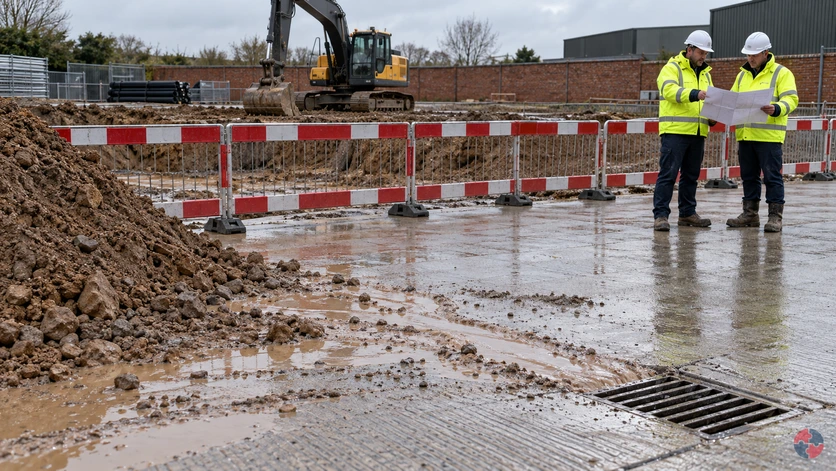
Rain changes the site: follow the silt to the drain
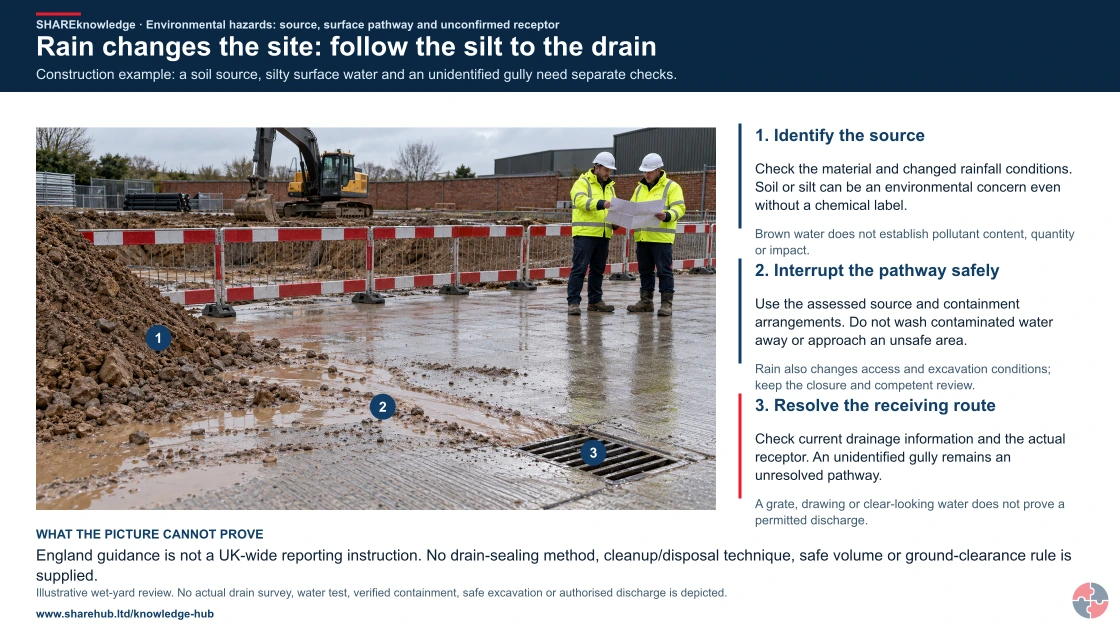
Full written explanation
Construction example: a soil source, silty surface water and an unidentified gully need separate checks.
- Identify the source. Check the material and changed rainfall conditions. Soil or silt can be an environmental concern even without a chemical label.
- Interrupt the pathway safely. Use the assessed source and containment arrangements. Do not wash contaminated water away or approach an unsafe area.
- Resolve the receiving route. Check current drainage information and the actual receptor. An unidentified gully remains an unresolved pathway.
Change the pathway
- Appearance is incomplete evidence. Brown water does not establish pollutant content, quantity or impact.
- Ground safety is separate. Rain also changes access and excavation conditions; keep the closure and competent review.
- No assumed safe destination. A grate, drawing or clear-looking water does not prove a permitted discharge.
Evidence check: England guidance is not a UK-wide reporting instruction. No drain-sealing method, cleanup/disposal technique, safe volume or ground-clearance rule is supplied.
Source, pathway, receptor and separate national response requirements
Primary references: Environment Agency: pollution prevention (England) · Source topic: national response routes and actual drainage
Open the complete HD image (new tab)Download image

Source, pathway, receptor and separate national response requirements
Primary references: Environment Agency: pollution prevention (England) · Source topic: national response routes and actual drainage
What is the first useful environmental hazard decision?


Read the complete visual as text
- Identify the pollutant or activity, its route to air,…: Identify the pollutant or activity, its route to air, drain, soil or neighbour, and the receptor. Stop the pathway and make the site safe, then check whether a permit, notification or specialist response is required for that jurisdiction.
- A diesel transfer hose leaks beside a surface-water drain.…: A diesel transfer hose leaks beside a surface-water drain. The operator stops transfer, protects people, closes the drain route with trained spill controls, calls the site response lead and follows the local regulator reporting plan. The drain destination, volume and permit status determine the next decision.
Best-practice guide: Environmental hazards at work

What is the first useful environmental hazard decision?
Identify the pollutant or activity, its route to air, drain, soil or neighbour, and the receptor. Stop the pathway and make the site safe, then check whether a permit, notification or specialist response is required for that jurisdiction. Manage environmental hazards by tracing a source, its pathway and the people or environment it could affect.
Turn environmental hazards at work knowledge into a decision
Manage environmental hazards by tracing a source, its pathway and the people or environment it could affect. Prevent release first; then contain, monitor and prepare for spill or permit failure. Delivery check, incident log, drainage map, waste record and corrective retest.
A field decision from start to hand-back
Stop transfer, protect people, contain the source and pathway, and activate the site response plan. Inspect, recover and dispose of material appropriately; notify as required and retest failed controls.
Warning signs and how harm can result
Unlabelled or misunderstood drains: Workers may wash pollutants into surface water or fail to protect the right drain during a spill. Stained yards or damaged bunds: Leaks may already be reaching ground or drains. Spill kits missing or unused: A small release may spread before response begins.
Choose controls for environmental hazards at work
Eliminate: Remove an unnecessary transfer or hazardous stock through a validated supply or process redesign. Reduce, including substitution: Evaluate a less hazardous stored material or suitable alternative supply arrangement through change review. Isolate: Separate delivery operations from people and incompatible plant; control the credible spill and escalation area. Control: Provide compatible connections, sound containment, appropriate drainage protection and the specified overfill safeguards; verify where a spill would actually travel. Control: Confirm product, tank capacity and delivery limits, the authorised drain-protection arrangement and who stops the delivery. Read the full control table for qualifications, ownership and verification. Use the actual task and applicable jurisdiction; existing technical approval remains unchanged.
Use the full environmental hazards at work lesson
Use the full topic for the decision points, practical examples, detailed control tables and source scope. HSE guidance applies to Great Britain; use HSENI for the Northern Ireland route and the source’s stated jurisdiction. A simplified guide does not change the page’s technical-review or approval status.

Read all six steps as text
1. What is the first useful environmental hazard decision?
Identify the pollutant or activity, its route to air, drain, soil or neighbour, and the receptor.
- Avoid / redesign: Remove an unnecessary transfer or hazardous stock through a validated supply or process redesign.
- Control the task: Separate delivery operations from people and incompatible plant; control the credible spill and escalation area.
- Verify before release: If the hazardous step remains, keep it within the task assessment and select the stronger feasible remaining controls.
Identify the pollutant or activity, its route to air, drain, soil or neighbour, and the receptor. Stop the pathway and make the site safe, then check whether a permit, notification or specialist response is required for that jurisdiction. Manage environmental hazards by tracing a source, its pathway and the people or environment it could affect.
Apply it: Which part of this plan would you check at the workface before authorising the task?
2. Turn environmental hazards at work knowledge into a decision
Use the evidence to improve the actual work arrangement.
- Change at source: Remove an unnecessary transfer or hazardous stock through a validated supply or process redesign.
- Make it observable: If the hazardous step remains, keep it within the task assessment and select the stronger feasible remaining controls.
- Keep useful evidence: Delivery check, incident log, drainage map, waste record and corrective retest.
Manage environmental hazards by tracing a source, its pathway and the people or environment it could affect. Prevent release first; then contain, monitor and prepare for spill or permit failure. Delivery check, incident log, drainage map, waste record and corrective retest.
Apply it: What evidence would show that the change improves this task, rather than only completing a record?
3. A field decision from start to hand-back
Example: a practical application of the existing topic lesson.
- Setting: A diesel hose leaks during delivery near a surface-water drain.
- Act: Check bund, hose, overfill protection, drain cover, spill kit and the local permit or oil-storage rule.
- Hold / review: No untrained entry or further delivery while containment, drainage or reporting decisions are uncertain.
Stop transfer, protect people, contain the source and pathway, and activate the site response plan. Inspect, recover and dispose of material appropriately; notify as required and retest failed controls.
Apply it: At which point would you hold this example, and what evidence would allow it to proceed?
4. Warning signs and how harm can result
Connect the task, the route to the person and the control that can fail.
- Unlabelled or misunderstood drains: Workers may wash pollutants into surface water or fail to protect the right drain during a spill.
- Stained yards or damaged bunds: Leaks may already be reaching ground or drains.
- Spill kits missing or unused: A small release may spread before response begins.
Unlabelled or misunderstood drains: Workers may wash pollutants into surface water or fail to protect the right drain during a spill. Stained yards or damaged bunds: Leaks may already be reaching ground or drains. Spill kits missing or unused: A small release may spread before response begins.
Apply it: Who could be exposed, including other trades, cleaners, maintainers and people nearby?
5. Choose controls for environmental hazards at work
Start with the stronger practicable options and verify their effect.
- Eliminate: Remove an unnecessary transfer or hazardous stock through a validated supply or process redesign.
- Reduce, including substitution: Evaluate a less hazardous stored material or suitable alternative supply arrangement through change review.
- Isolate: Separate delivery operations from people and incompatible plant; control the credible spill and escalation area.
- Control: Provide compatible connections, sound containment, appropriate drainage protection and the specified overfill safeguards; verify where a spill would actually travel.
- Control: Confirm product, tank capacity and delivery limits, the authorised drain-protection arrangement and who stops the delivery.
Eliminate: Remove an unnecessary transfer or hazardous stock through a validated supply or process redesign. Reduce, including substitution: Evaluate a less hazardous stored material or suitable alternative supply arrangement through change review. Isolate: Separate delivery operations from people and incompatible plant; control the credible spill and escalation area. Control: Provide compatible connections, sound containment, appropriate drainage protection and the specified overfill safeguards; verify where a spill would actually travel. Control: Confirm product, tank capacity and delivery limits, the authorised drain-protection arrangement and who stops the delivery. Read the full control table for qualifications, ownership and verification. Use the actual task and applicable jurisdiction; existing technical approval remains unchanged.
Apply it: Which stronger option can be used here, and who will verify it before accepting the remaining risk?
6. Use the full environmental hazards at work lesson
Follow the official sources below and retain the task-specific evidence.
- Official guidance: GOV.UK pollution prevention for businesses
- Official guidance: GOV.UK check if you need an environmental permit
- Task decision: Delivery check, incident log, drainage map, waste record and corrective retest.
Use the full topic for the decision points, practical examples, detailed control tables and source scope. HSE guidance applies to Great Britain; use HSENI for the Northern Ireland route and the source’s stated jurisdiction. A simplified guide does not change the page’s technical-review or approval status.
Apply it: Which official source and full-topic section will you use to resolve the next decision?
A diesel transfer hose leaks beside a surface-water drain. The operator stops transfer, protects people, closes the drain route with trained spill controls, calls the site response lead and follows the local regulator reporting plan. The drain destination, volume and permit status determine the next decision.
How can I practise this topic in 3D?


Water and a pump create new excavation risks
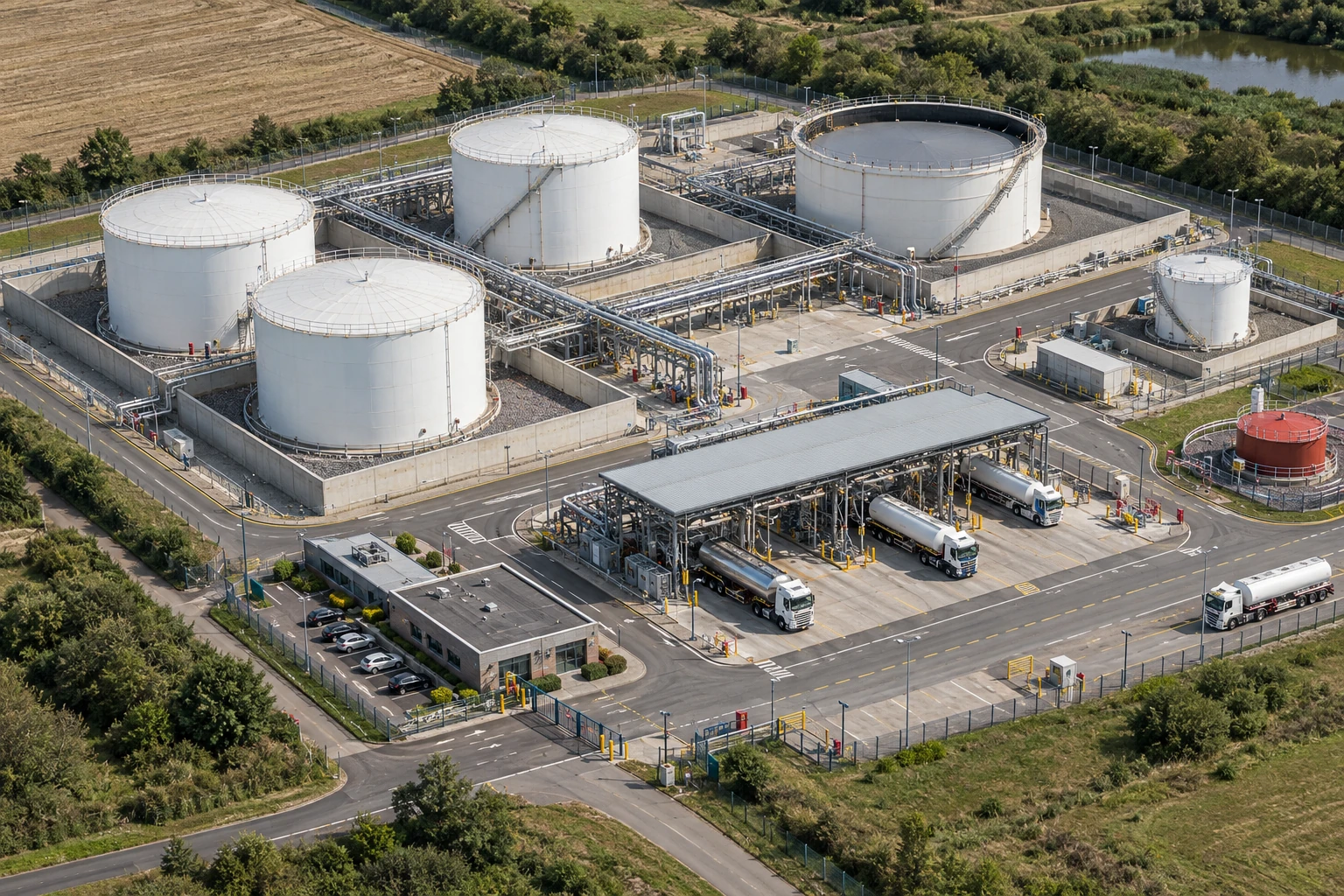
The roof drain is confused with the bund drain

Loose waste becomes windblown FOD
All related inspection points 15 across 3 locations
Construction site 3 inspection points
Crown Fuels terminal 8 inspection points
Aerosystems Engineering 4 inspection points
Practice in the SHAREhub environment. Browser practice is separate from workplace competence and formal learning records.
What are the key facts about environmental hazards?
The key facts are that environmental hazards are controlled by understanding sources, pathways, receptors, legal duties and real operational controls.
Pollution is not limited to chemicals
Oil, fuel, solvents, silt, concrete washout, milk, detergents, smoke, dust, odour and firewater can all cause environmental harm.
Drains are often the fastest pathway
A small spill can move quickly from a yard or loading bay into surface water, sewers, groundwater or a local watercourse.
Waste control starts at generation
Correct classification, segregation, labelling, authorised carriers and records are needed before waste leaves site.
Environmental nuisance can still trigger enforcement
Noise, smoke, smell, dust, artificial light, insects and waste accumulations can become statutory nuisance issues.
Permits and consents are operating boundaries
Some activities can only operate legally if permit conditions, limits, monitoring and records are maintained.
Emergency planning needs practice
Spill kits are not enough if workers do not know which drains to protect, who to call and when to stop work.
What are environmental hazards?
Environmental hazards are work-related sources of potential harm to the natural environment, communities and business continuity.
In health and safety, a hazard is something with the potential to cause harm to people. In environmental management, the idea is wider. A hazard can be an emission to air, a contaminated liquid, a waste stream, a noisy process, a leaking tank, an inefficient energy source, a firewater runoff route or a contractor activity that could pollute land, water or air.
The practical language used in environmental management is often 'aspects and impacts'. The aspect is the part of the activity that interacts with the environment; the impact is the change that could result. For example, washing concrete tools in a yard is an aspect. Cement-contaminated water entering a surface-water drain is the impact pathway, and harm to a watercourse is the consequence.
A good page, assessment or register should not stop at a broad label such as 'pollution'. It should describe the source, the pathway, the receptor, the normal controls, the abnormal conditions and what evidence proves the control is working.
| Work activity | Environmental aspect | Possible impact |
|---|---|---|
| Fuel storage | Oil or diesel stored in tanks, drums or IBCs. | Soil, groundwater or surface-water pollution if containment fails. |
| Cutting, crushing or grinding | Dust or particulate release. | Air quality nuisance, deposition on neighbouring property or contamination of surface water through runoff. |
| Vehicle washing | Dirty wash water containing oils, detergents, silt or metals. | Pollution if discharged to the wrong drain or ground. |
| Waste storage | Stored skips, containers, batteries, solvents or contaminated materials. | Litter, fire risk, leaks, odour, pests or illegal disposal. |
| Refrigeration and air conditioning | Potential release of fluorinated greenhouse gases. | Climate impact, legal non-compliance and maintenance failures. |
| Night-time plant or deliveries | Noise, reversing alarms, vibration or lighting. | Community nuisance, complaints, enforcement and loss of operating flexibility. |
How does the source-pathway-receptor model help environmental risk assessment?
The source-pathway-receptor model helps assess whether a pollutant can realistically travel from a work activity to something that could be harmed.
This is one of the most useful thinking tools for environmental risk. A source without a pathway may be well contained. A pathway without a receptor may have lower consequence. But when a source, pathway and receptor line up, the risk becomes credible and needs control.
For example, a diesel tank in a bunded store may be relatively well controlled if the bund is sound, the delivery area is supervised, drains are protected and inspections are completed. The same tank beside an unlabelled surface-water drain, with damaged containment and untrained delivery drivers, creates a very different risk profile. See GOV.UK pollution prevention for businesses.
| Source | Pathway | Receptor |
|---|---|---|
| Diesel, oil or hydraulic fluid | Yard drain, cracked concrete, soil, groundwater or surface-water drain. | River, stream, groundwater, soil, wildlife or neighbouring land. |
| Concrete washout and cement slurry | Runoff, gullies, surface-water drains or unprotected ground. | Watercourse, aquatic life, soil quality and drainage infrastructure. |
| Dust from construction or bulk handling | Air movement, rainwater runoff, vehicle tracking or open doors. | Neighbours, nearby premises, drains, vegetation and local air quality. |
| Waste containers | Leaks, windblown litter, pests, firewater runoff or unauthorised removal. | Land, water, community, waste chain and regulator confidence. |
| Noise from plant | Airborne sound, vibration through structures or out-of-hours operation. | Local residents, sensitive premises, wildlife or site neighbours. |
Which main types of environmental hazards should a workplace consider?
Most workplace environmental hazards can be grouped into air, water, waste, land, nuisance, energy and emergency-event hazards.
The categories overlap. A fire in a waste store can create smoke to air, contaminated firewater to drains, waste residues, land contamination and public nuisance. A construction task can create occupational dust exposure and environmental dust nuisance at the same time.
The useful approach is to map activities rather than departments. Walk the site from deliveries to storage, use, maintenance, waste, discharge and emergency response. Include normal work, abnormal conditions, shutdowns, start-ups, cleaning, contractor work and foreseeable failures.
| Hazard family | Typical sources | Why it matters |
|---|---|---|
| Air emissions | Boilers, generators, vehicles, solvents, dust, welding, coating, odour and refrigerant leaks. | Can affect local air quality, climate, neighbours, ecosystems and permit compliance. |
| Water contamination | Spills, washdown, trade effluent, firewater, silt, concrete washout and wrong drain connections. | Can rapidly harm watercourses, groundwater, drains, wildlife and drinking-water sources. |
| Waste | Packaging, construction waste, hazardous waste, oily rags, batteries, WEEE, solvents and contaminated PPE. | Incorrect waste handling can lead to pollution, fires, illegal disposal and prosecution. |
| Land contamination | Historic spills, tanks, made ground, buried waste, chemical stores and leaking pipework. | Can create long-term remediation, redevelopment and liability issues. |
| Noise and nuisance | Plant, deliveries, construction, dust, smoke, odour, light and pests. | Can lead to complaints, abatement notices and restrictions on work. |
| Energy and resources | Fuel, electricity, heat, compressed air, water and materials. | Impacts carbon, operating cost, reporting duties and resource efficiency. |
| Environmental emergencies | Spills, fires, explosions, floods, tank failures and uncontrolled releases. | Can escalate quickly and require regulator notification, emergency response and clean-up. |
How can emissions to air become environmental hazards?
Air emissions become environmental hazards when gases, vapours, dusts, fumes, odours or greenhouse gases are released without suitable control.
Air emissions may be obvious, such as visible smoke, dust clouds or solvent odour. They may also be less visible, such as nitrogen oxides from combustion, volatile organic compounds from coating, bioaerosols from waste operations, refrigerant leaks or fine particulate matter from cutting and combustion.
Controls should start at source. Lower-emission products, enclosed processes, dust suppression, filtration, scrubbers, well-maintained combustion equipment, leak detection and planned monitoring are stronger than dealing with complaints after release.
| Emission type | Typical controls | Evidence to check |
|---|---|---|
| Dust and particulate matter | Wet suppression, enclosure, extraction, wheel washing, housekeeping and covered loads. | Inspection records, complaints log, monitoring and maintenance. |
| Solvents and VOCs | Low-VOC products, closed containers, extraction, storage controls and substitution. | COSHH assessment, SDS review, stock control and permit conditions where relevant. |
| Combustion emissions | Efficient boilers, maintenance, fuel quality, correct operation and emissions monitoring where required. | Service records, monitoring results and permit compliance. |
| Odour and bioaerosols | Enclosure, filtration, process control, housekeeping and management plans. | Odour log, complaints review and control inspections. |
| F-gases and refrigerants | Leak checks, competent servicing, recovery, records and lower-impact alternatives. | Service certificates, leak records and equipment register. |
How can water contamination occur at work?
Water contamination occurs when polluting liquids, solids or contaminated runoff enter surface water, groundwater, foul drains, sewers, soakaways or unprotected ground.
The most common practical failure is misunderstanding drainage. Surface-water drains may discharge directly to a watercourse. Foul drains may go to sewage treatment. Some old or complex sites have misconnections, hidden drains, interceptors, soakaways or legacy pipework that workers do not understand.
Water pollution prevention should include up-to-date drainage plans, drain marking, suitable storage, bunding, controlled washing areas, interceptor maintenance, spill kits, drain covers, shut-off valves or penstocks where needed, and clear instructions for deliveries, refuelling and washdown. See GOV.UK pollution prevention for businesses.
| Pollution route | Typical failure | Control |
|---|---|---|
| Surface-water drains | Oil, silt, cement washout or chemicals enter a drain after a spill or washdown. | Label drains, protect gullies, use shut-off valves and brief workers. |
| Foul sewer | Trade effluent or chemicals are discharged without consent or unsuitable treatment. | Check consent requirements and control discharge quality. |
| Ground and groundwater | Leaks from tanks, drums or pipework soak through unsealed ground. | Use bunded storage, sealed surfaces and inspection routines. |
| Firewater runoff | Contaminated firefighting water escapes during a fire. | Plan containment, isolation and emergency response. |
| Vehicle and plant washing | Detergent, silt, oil or metals leave wash areas. | Use designated wash bays, separators and authorised disposal routes. |
How should waste hazards be controlled?
Identify and prevent waste first, then classify, segregate, store and transfer it under the duty of care for the site nation.
Waste control essentials — part 1 of 2


Read the complete visual as text
- Waste hierarchy: What it means: Prevent, reuse, recycle or recover before disposal where reasonably practicable. Evidence: Procurement and waste reduction plan.
- Classification: What it means: Identify whether waste is hazardous, non-hazardous, inert, WEEE, clinical, oily or contaminated. Evidence: Waste descriptions and classification evidence.
- Segregation: What it means: Keep incompatible or different waste streams separate. Evidence: Labelled containers and site inspections.
Waste control essentials — part 2 of 2


Read the complete visual as text
- Secure storage: What it means: Prevent escape, leaks, pests, fire and windblown litter. Evidence: Storage area checks and defect close-out.
- Authorised transfer: What it means: Use authorised carriers and permitted sites. Evidence: Carrier checks, permits and transfer notes.
- Record retention: What it means: Keep transfer and consignment records for audit. Evidence: Waste documentation register.
The producer should know what the waste is, how it is described, who may carry it and where it may lawfully go. The linked GOV.UK duty-of-care code applies to England and Wales; Scotland has a 2026 code and Northern Ireland has its own DAERA code. Check the applicable code before using a transfer route. England/Wales code Scottish 2026 code NI code
Controls fail when incompatible waste is mixed, carriers or sites are not checked, transfer details are missing, or containers leak. The site’s code determines documentation and authorisation details.
| Control | What it means | Evidence |
|---|---|---|
| Waste hierarchy | Prevent, reuse, recycle or recover before disposal where reasonably practicable. | Procurement and waste reduction plan. |
| Classification | Identify whether waste is hazardous, non-hazardous, inert, WEEE, clinical, oily or contaminated. | Waste descriptions and classification evidence. |
| Segregation | Keep incompatible or different waste streams separate. | Labelled containers and site inspections. |
| Secure storage | Prevent escape, leaks, pests, fire and windblown litter. | Storage area checks and defect close-out. |
| Authorised transfer | Use authorised carriers and permitted sites. | Carrier checks, permits and transfer notes. |
| Record retention | Keep transfer and consignment records for audit. | Waste documentation register. |
How can land contamination affect a workplace or project?
Land contamination can affect workplaces through historic use, current leaks, buried waste, contaminated soil, underground tanks or accidental releases.
Land contamination is not only a construction or property issue. Operational sites can create contamination through poor storage, damaged drains, unsealed yards, maintenance pits, tank failures, leaking hydraulic systems, chemical handling and unmanaged firewater.
Before excavation, redevelopment or intrusive work, organisations should consider site history, previous uses, ground conditions, buried services, made ground, underground tanks and whether contaminated soil or groundwater may be encountered. Where contamination is suspected, specialist environmental advice is usually needed.
| Situation | Control | Why it matters |
|---|---|---|
| Existing site operations | Inspect tanks, bunds, drums, yards, drains and pipework. | Prevents gradual leaks becoming long-term liabilities. |
| Historic industrial land | Review site history and commission environmental assessment where needed. | Identifies legacy contamination before people or projects are exposed. |
| Excavation and groundwork | Plan soil handling, testing, waste classification and worker controls. | Prevents uncontrolled spread of contaminated materials. |
| Underground storage | Inspect, test and maintain tanks and pipework. | Underground leaks can persist unnoticed. |
| Post-incident clean-up | Record contamination, remediation, disposal and verification. | Proves corrective action and future land suitability. |
How do noise, odour, dust and nuisance become environmental issues?
Noise, odour, dust, smoke, light, insects and waste accumulations become environmental issues when they affect neighbours, communities or the use of nearby premises.
Environmental nuisance is often a sign that site controls are not matching the real operating conditions. Out-of-hours deliveries, poorly maintained plant, open waste containers, dusty haul roads, odorous waste, bright lighting and ineffective housekeeping can create complaints even where worker exposure is not the main concern.
Good management includes predicting sensitive receptors, setting operating rules, maintaining plant, communicating with neighbours, investigating complaints and using monitoring where needed. Complaint trends should be treated as intelligence, not irritation.
| Nuisance type | Common causes | Controls |
|---|---|---|
| Noise | Plant, deliveries, reversing alarms, construction, loading and extraction systems. | Quiet plant, maintenance, barriers, hours controls and noise monitoring. |
| Dust | Traffic, cutting, demolition, stockpiles, bulk handling and dry sweeping. | Water suppression, covers, cleaning, speed limits and perimeter checks. |
| Odour | Waste, chemicals, drains, process vents and poor housekeeping. | Enclosure, cleaning, ventilation, storage controls and complaint investigation. |
| Smoke and fumes | Combustion, hot work, burning, generators and extraction discharge. | No uncontrolled burning, extraction control and combustion maintenance. |
| Light | Security lighting, construction lighting and vehicle headlights. | Directional lighting, timers, shields and neighbour review. |
| Pests and insects | Waste, food residues, stagnant water and poor storage. | Waste control, pest management and housekeeping. |
How do energy use, carbon and resources fit into environmental hazard management?
Energy use, carbon and resource consumption are environmental management issues because they affect emissions, climate impact, cost, resilience and reporting duties.
Energy and carbon are sometimes treated separately from pollution prevention, but they are part of the same management discipline. Boilers, vehicles, compressors, refrigeration, heating, cooling and inefficient processes can create emissions, operating cost and compliance obligations.
Practical controls include metering significant energy users, fixing compressed-air leaks, improving insulation, maintaining plant, switching off idle equipment, specifying efficient replacements, considering lower-carbon fuels or electricity, and reviewing energy data with operational teams rather than only finance.
| Area | Control | Evidence |
|---|---|---|
| Heating and boilers | Maintenance, controls, insulation and efficient plant selection. | Service records and energy data. |
| Compressed air | Leak surveys, pressure optimisation and shutdown routines. | Leak log and repair records. |
| Lighting and buildings | LED lighting, sensors, zoning and building controls. | Energy improvement plan. |
| Vehicles and mobile plant | Route planning, maintenance, telematics and lower-emission options. | Fleet data and procurement standards. |
| Refrigeration and cooling | Leak checks, maintenance and efficient equipment. | F-gas records and energy monitoring. |
| Materials and water | Efficient procurement, reuse, waste reduction and metering. | Resource KPIs and action plans. |
What environmental emergencies should workplaces plan for?
Workplaces should plan for credible environmental emergencies such as spills, fires, uncontrolled discharges, tank failures, flooding, major dust releases and contaminated firewater.
Environmental emergency planning should be specific to the site. A generic spill procedure is weak if workers do not know where the drains go, which materials are most harmful, which valves isolate the yard, who can deploy drain covers and when the regulator or emergency services should be contacted.
Planning should include scenarios: fuel delivery failure, chemical spill, waste fire, floodwater entering stores, interceptor failure, powder release, refrigeration leak, firewater runoff or contractor damage to drainage. Drills should test decisions, not just whether a spill kit exists. See NIEA pollution prevention.
| Scenario | Planning controls | Learning check |
|---|---|---|
| Fuel or chemical spill | Spill kits, drain covers, isolation valves, trained responders and emergency contacts. | Could the first person on scene stop the pathway? |
| Waste fire | Waste separation, fire prevention, firewater containment and emergency liaison. | Where would contaminated runoff go? |
| Flooding | Store vulnerable materials above flood level and secure waste. | What could be mobilised by floodwater? |
| Uncontrolled discharge | Stop work, isolate source, protect drains and notify appropriate parties. | Are permits and consents understood? |
| Contractor incident | Induction, permits, supervision and emergency rules. | Do contractors know environmental stop-work triggers? |
How can the hierarchy of controls prevent spills and worker exposure during a tank delivery?
Use source and work-design controls first; support and procedures cannot replace prevention.
A spill can leave the site through an unknown drain
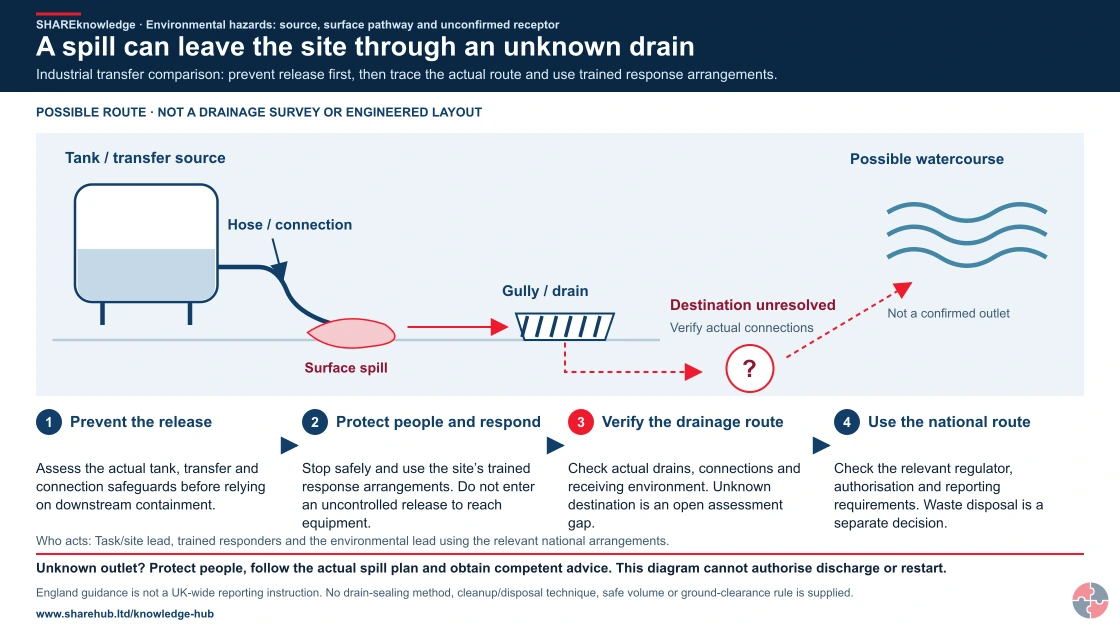
Full written explanation
A conceptual tank outlet and hose lead to a surface spill and gully. A dashed below-ground connection ends at an unresolved destination and a separately labelled possible watercourse receptor. The dashed route is a question to verify, not a surveyed connection. Source prevention, protection of people, drainage evidence and national response requirements are connected without supplying a drain-sealing or cleanup method.
Industrial transfer comparison: prevent release first, then trace the actual route and use trained response arrangements.
- Prevent the release. Assess the actual tank, transfer and connection safeguards before relying on downstream containment.
- Protect people and respond. Stop safely and use the site’s trained response arrangements. Do not enter an uncontrolled release to reach equipment.
- Verify the drainage route. Check actual drains, connections and receiving environment. Unknown destination is an open assessment gap.
- Use the national route. Check the relevant regulator, authorisation and reporting requirements. Waste disposal is a separate decision.
When the evidence does not fit: Unknown outlet? Protect people, follow the actual spill plan and obtain competent advice. This diagram cannot authorise discharge or restart.
Who acts: Task/site lead, trained responders and the environmental lead using the relevant national arrangements.
Changed workplace
Construction rainfall: Soil, changed ground/access and runoff need their own checks.
Industrial delivery: Prevent loss at source and resolve the drain and receiving environment.
Evidence check: England guidance is not a UK-wide reporting instruction. No drain-sealing method, cleanup/disposal technique, safe volume or ground-clearance rule is supplied.
Source, pathway, receptor and separate national response requirements
Primary references: Environment Agency: pollution prevention (England) · Source topic: national response routes and actual drainage
Open the complete HD image (new tab)Download image

Source, pathway, receptor and separate national response requirements
Primary references: Environment Agency: pollution prevention (England) · Source topic: national response routes and actual drainage
Use HSE’s hierarchy to eliminate or substitute a hazard where practicable, then apply engineering and administrative controls before relying on PPE. Check each chosen control against the actual task and stop when it fails.
Personal discipline matters, but it is not enough. A worker should not be the final barrier between a leaking oil drum and an unprotected surface-water drain.
How can the ERICPD hierarchy of controls prevent spills and worker exposure during a tank delivery?

| Control level | Control for this activity | Owner and verification | Stop / restart decision |
|---|---|---|---|
| Eliminate | Remove an unnecessary transfer or hazardous stock through a validated supply or process redesign. | Task owner verifies that the proposed change removes the named hazardous step, including foreseeable cleaning, maintenance and work transferred elsewhere. | If the hazardous step remains, keep it within the task assessment and select the stronger feasible remaining controls. |
| Reduce, including substitution | Evaluate a less hazardous stored material or suitable alternative supply arrangement through change review. | Competent task/process owner validates suitability, compatibility and new hazards against the actual operating requirements before the alternative is adopted. | Reject an alternative if its performance is unproved or its new hazards are unresolved. |
| Isolate | Separate delivery operations from people and incompatible plant; control the credible spill and escalation area. | Supervisor checks the actual boundary, affected people and connected work; verify separation or isolation before allowing access. | Hold or stop for uncertain ullage, leak, failed safeguard or loss of transfer communication. |
| Control: physical safeguards | Provide compatible connections, sound containment, appropriate drainage protection and the specified overfill safeguards; verify where a spill would actually travel. | Competent equipment/process owner checks product identity, tank capacity, connections and credited overfill safeguards. | Hold or stop for uncertain ullage, leak, failed safeguard or loss of transfer communication. |
| Control: work method and response | Confirm product, tank capacity and delivery limits, the authorised drain-protection arrangement and who stops the delivery. Keep spill response equipment accessible without approaching an uncontrolled release. | Supervisor confirms the work limits, competent cover, communication and stop/restart authority with the people doing this activity. | Hold work when the agreed limits, competent cover or effective communication cannot be maintained. |
| PPE | Select splash and other protection for the actual product; PPE is not protection against a major tank release. | Assessor confirms whether personal protection is needed and checks suitability, condition, compatibility and any required fit evidence. | Do not use unsuitable protection or rely on PPE to continue after an essential source control fails. |
| Discipline | Test credited safeguards, maintain delivery equipment and reconcile delivery quantities and abnormal events. | Release only after receiving operator approves capacity and functioning safeguards before delivery. Retain verification and unresolved restrictions at handover. | Keep the task on hold until required reinstatement evidence and unresolved defects are accepted by the responsible owner. |
How can the ISO 45001 hierarchy of controls prevent spills and worker exposure during a tank delivery?

| Control level | Control for this activity | Owner and verification | Stop / restart decision |
|---|---|---|---|
| Elimination | Remove an unnecessary transfer or hazardous stock through a validated supply or process redesign. | Task owner verifies that the proposed change removes the named hazardous step, including foreseeable cleaning, maintenance and work transferred elsewhere. | If the hazardous step remains, keep it within the task assessment and select the stronger feasible remaining controls. |
| Substitution | Evaluate a less hazardous stored material or suitable alternative supply arrangement through change review. | Competent task/process owner validates suitability, compatibility and new hazards against the actual operating requirements before the alternative is adopted. | Reject an alternative if its performance is unproved or its new hazards are unresolved. |
| Engineering controls | Separate delivery operations from people and incompatible plant; control the credible spill and escalation area. | Supervisor checks the actual boundary, affected people and connected work; verify separation or isolation before allowing access. | Hold or stop for uncertain ullage, leak, failed safeguard or loss of transfer communication. |
| Engineering controls | Provide compatible connections, sound containment, appropriate drainage protection and the specified overfill safeguards; verify where a spill would actually travel. | Competent equipment/process owner checks product identity, tank capacity, connections and credited overfill safeguards. | Hold or stop for uncertain ullage, leak, failed safeguard or loss of transfer communication. |
| Administrative controls | Confirm product, tank capacity and delivery limits, the authorised drain-protection arrangement and who stops the delivery. Keep spill response equipment accessible without approaching an uncontrolled release. | Supervisor confirms the work limits, competent cover, communication and stop/restart authority with the people doing this activity. | Hold work when the agreed limits, competent cover or effective communication cannot be maintained. |
| PPE | Select splash and other protection for the actual product; PPE is not protection against a major tank release. | Assessor confirms whether personal protection is needed and checks suitability, condition, compatibility and any required fit evidence. | Do not use unsuitable protection or rely on PPE to continue after an essential source control fails. |
| Administrative controls | Test credited safeguards, maintain delivery equipment and reconcile delivery quantities and abnormal events. | Release only after receiving operator approves capacity and functioning safeguards before delivery. Retain verification and unresolved restrictions at handover. | Keep the task on hold until required reinstatement evidence and unresolved defects are accepted by the responsible owner. |
Illustrative diesel-delivery scenario: a 1,000-litre tank stands near a surface-water drain. Check site rules, permit status and local oil-storage law before adopting these controls.
Which legal duties apply to environmental hazards?
Select the law by site nation, activity and duty. The Great Britain instruments in this table do not automatically apply in Northern Ireland.
| Where | Instrument | Practical boundary |
|---|---|---|
| England and Wales | Environmental Permitting (England and Wales) Regulations 2016 | Permits for specified activities and discharges |
| England | Control of Pollution (Oil Storage) (England) Regulations 2001 | England oil storage for in-scope containers |
| England and Wales | Waste (England and Wales) Regulations 2011 | Waste hierarchy and related duties |
| Great Britain | Health and Safety at Work etc. Act 1974 | GB general work-safety duties |
| Northern Ireland | Health and Safety at Work (Northern Ireland) Order 1978 | NI general work-safety duties |
| Northern Ireland | Pollution Prevention and Control (Industrial Emissions) Regulations (Northern Ireland) 2013 | NI industrial-emissions permitting for activities within scope. |
| Scotland | Environmental Authorisations (Scotland) Regulations 2018 | Scottish environmental authorisation framework as amended; check activity and transition. |
| Great Britain | Environmental Protection Act 1990 section 34 | Section 34 waste duty of care; read nation-specific amended text and the E/W or Scottish code. |
This page cannot decide whether a site needs a permit or notification. Check the activity, location and discharge with the relevant regulator and obtain specialist legal or environmental advice where the requirement is disputed.
How can environmental regulation differ across the UK?
Environmental regulation can differ because environmental protection is substantially devolved and the relevant regulator depends on location and activity.
A UK-facing page should not assume one regulator for every site. England, Wales, Scotland and Northern Ireland have different environmental regulators, guidance routes and, in some areas, different regulations or enforcement approaches. A business operating in more than one nation should maintain a legal register that identifies the specific requirements for each site.
Some health and safety duties remain GB-wide through HSE or local authorities, while environmental duties may sit with the Environment Agency, Natural Resources Wales, SEPA, NIEA or local authorities. The practical control standards can be similar, but the legal route, permit, reporting process or emergency contact may differ.
| Nation | Typical environmental regulator route | What to check |
|---|---|---|
| England | Environment Agency and local authorities. | Environmental permits, pollution reporting, waste duty, nuisance and oil storage rules. |
| Wales | Natural Resources Wales and local authorities. | Permits, waste controls, water protection, pollution reporting and Welsh guidance. |
| Scotland | Scottish Environment Protection Agency and local authorities. | CAR, PPC, waste, pollution prevention, controlled activities and incident reporting. |
| Northern Ireland | Northern Ireland Environment Agency and local councils. | Waste, water, pollution prevention, permits and incident reporting routes. |
| Multi-site organisations | Different regulators may apply to different sites. | Maintain a site-specific legal register and emergency contacts. |
The linked GOV.UK pollution-prevention and permit pages say they apply to England. Wales, Scotland and Northern Ireland have separate regulators and activity-specific rules; check the NRW, SEPA or NIEA source for the site instead of copying an England-only permit condition.
For industrial activities in Northern Ireland, check the NI 2013 PPC instrument; Scotland uses the Environmental Authorisations (Scotland) framework as amended, with activity-specific transition rules. These are examples of distinct regimes, not a blanket permit determination. NI PPC 2013 Scottish authorisations
What should be recorded in an environmental risk or aspects register?
An environmental register should record significant aspects, impacts, legal duties, controls, monitoring, responsibilities and improvement actions.
The register should be more than a list of environmental words. It should help managers make decisions: what matters most, what control prevents harm, who owns it, how often it is checked, what legal requirement applies and what would happen if the control failed.
A strong register includes normal operations, abnormal operations, start-up, shutdown, cleaning, deliveries, contractors, maintenance, emergencies and foreseeable changes.
| Register field | What to capture | Example |
|---|---|---|
| Activity | The task, area, equipment or process. | Diesel delivery to external tank. |
| Aspect | How it interacts with the environment. | Fuel transfer and storage. |
| Impact | Possible environmental harm. | Oil pollution to surface water. |
| Pathway and receptor | How harm could travel and what could be affected. | Yard drain to nearby stream. |
| Legal duties | Permits, consents, waste duty, nuisance or storage rules. | Oil storage rules and pollution prevention. |
| Controls | Prevention, containment, monitoring and emergency arrangements. | Bunded tank, supervised delivery, drain cover and spill kit. |
| Assurance | Inspection, maintenance, monitoring or audit evidence. | Weekly bund check and annual tank inspection. |
| Improvement | Actions to reduce risk or close gaps. | Install labelled drain marker and update delivery procedure. |
How could Riverside Leisure Ltd manage environmental hazards?

Riverside Leisure Ltd could manage environmental hazards by turning site activities into a live aspects register, routine inspections, training, contractor rules and incident learning.
A field decision from start to hand-back — part 1 of 3


Read the complete visual as text
- 1. Task and setting: A diesel hose leaks during delivery near a surface-water drain.
- 2. People and prerequisites: Driver, site lead and trained spill responder; know drain destination, tank controls and regulator contact.
- 3. Before the task: Check bund, hose, overfill protection, drain cover, spill kit and the local permit or oil-storage rule.
A field decision from start to hand-back — part 2 of 3


Read the complete visual as text
- 1. Check during work: Stop transfer, protect people, contain the source and pathway, and activate the site response plan.
- 2. Stop, hold or refer: No untrained entry or further delivery while containment, drainage or reporting decisions are uncertain.
A field decision from start to hand-back — part 3 of 3


Read the complete visual as text
- 1. Completion and hand-back: Inspect, recover and dispose of material appropriately; notify as required and retest failed controls.
- 2. Retained evidence: Delivery check, incident log, drainage map, waste record and corrective retest.
Riverside Leisure Ltd (worked example). a leisure and hospitality organisation with venues, kitchens, swimming pool plant, grounds maintenance, events, cleaning chemicals, waste areas, contractors and public-facing operations.
The business would start by mapping its activities: chemical stores, pool water treatment, fuel for grounds equipment, waste cooking oil, food waste, cleaning chemicals, event generators, noise from entertainment, drainage routes, landscaping waste, energy use, refrigeration and contractor works. Each activity would be assessed for source, pathway and receptor, then placed into an environmental aspects register with named owners and evidence checks.
The useful part is the operating rhythm. Venue managers would complete simple weekly checks on waste areas, drains, chemical stores and spill equipment. Facilities teams would manage plant, interceptors, energy, refrigeration and contractor works. The health, safety and environment lead would review permits, waste contractor evidence, incident trends, complaints and audit actions. Senior leaders would review significant risks, budget for improvements and check whether repeated issues are being fixed.
| Management element | How Riverside would apply it | Evidence produced |
|---|---|---|
| Assess and analyse | Create an aspects and impacts register covering venues, kitchens, pools, grounds, waste, events, contractors, plant rooms and emergencies. | Environmental aspects register and site drainage plans. |
| Implement controls | Label drains, store chemicals in trays or bunds, segregate waste, maintain spill kits, control event noise and set contractor environmental rules. | Inspection checklists, photos, contractor packs and defect actions. |
| Training | Give all workers awareness of spills, drains, waste segregation and reporting; train maintenance and supervisors in spill response and waste documentation. | Induction records, toolbox talks and practical drill sign-off. |
| Procurement | Specify authorised waste contractors, low-impact cleaning products, efficient equipment and competent refrigeration service providers. | Supplier checks, SDS review and contract conditions. |
| Contractor management | Require contractors to protect drains, manage waste, control noise, prevent spills and stop work if environmental controls fail. | RAMS review, permits, induction and site monitoring. |
| Active monitoring | Use venue checks, second-line HSSE inspections and periodic specialist reviews for drains, waste, plant and legal compliance. | Audit schedule, action tracker and leadership review. |
| Learning and improvement | Investigate spills, complaints, waste errors and near misses using source-pathway-receptor learning. | Incident reports, corrective actions and updated training. |
A field decision from start to hand-back
Task, material and setting: A diesel hose leaks during delivery near a surface-water drain.
People and prerequisites: Driver, site lead and trained spill responder; know drain destination, tank controls and regulator contact.
Before: Check bund, hose, overfill protection, drain cover, spill kit and the local permit or oil-storage rule.
During: Stop transfer, protect people, contain the source and pathway, and activate the site response plan.
Hold or stop: No untrained entry or further delivery while containment, drainage or reporting decisions are uncertain.
Completion and hand back: Inspect, recover and dispose of material appropriately; notify as required and retest failed controls.
Evidence: Delivery check, incident log, drainage map, waste record and corrective retest.
What training helps people manage environmental hazards?
Training should be layered from general awareness to task-specific and management-level competence.
Everyone should understand the basic environmental rules for the site: waste segregation, spill reporting, drain awareness, housekeeping and stop-work triggers. People who handle chemicals, fuels, waste, washdown, maintenance or contractor supervision need more detailed practical training.
Managers and specialists need to understand legal registers, environmental aspects, permit conditions, waste duty of care, incident reporting, audit evidence and how environmental controls connect to health and safety risk management.
| Role | Learning | Demonstration | Assessor | Record | Reassess when |
|---|---|---|---|---|---|
| All workers | Spot source and drain pathways | Locate drain map | Supervisor | Induction | Site change |
| Delivery lead | Stop transfer and contain safely | Demonstrate pre-use checks | Operations lead | Delivery record | Tank change |
| Facilities | Inspect bund and drainage | Test containment route | Engineering lead | Inspection log | Defect |
| Environment lead | Check permits and notification | Run spill exercise | Competent lead | Permit register | Rule change |
| Contractors | Follow site transfer rules | Observe delivery briefing | Site owner | Briefing record | New contract |
| Directors | Resource controls and review | Sample corrective retest | Independent reviewer | Assurance record | Repeat spill |
How does environmental hazards knowledge support NEBOSH-style study?
Environmental hazards knowledge supports study by linking aspects, impacts, legal duties, controls, emergency planning and management systems to realistic workplace scenarios.
For NEBOSH National General Certificate learners, the value is understanding how general health and safety management systems also need to control environmental and welfare-related conditions. For Diploma-level learners, the topic becomes more analytical: aspects and impacts, legal registers, management system assurance, contractor control, emergency planning and evidence-based review.
Scenario questions may describe a site with unlabelled drains, poor waste segregation, a fuel spill, dusty work, neighbour complaints, missing permits or weak contractor controls. A strong answer identifies the source of harm, the pathway, the receptor, immediate actions, legal duties and longer-term management improvements.
| Study area | What to understand | Scenario application |
|---|---|---|
| Environmental aspects and impacts | Difference between activity and consequence. | Explain how a task such as washdown or fuel transfer can pollute water. |
| Legal duties | Permits, waste duty, nuisance, oil storage and pollution prevention. | Identify which records or authorisations should be checked. |
| Control hierarchy | Prevent, reduce, contain, monitor and respond. | Recommend controls for a spill or dust release. |
| Emergency planning | Drain protection, spill response, reporting and learning. | Set out immediate actions after a chemical spill. |
| Management systems | Policy, roles, competence, monitoring, audit and review. | Explain how leaders know controls are working. |
How can management arrangements support this topic?
HSE’s Plan–Do–Check–Act guidance helps assign ownership, deliver controls, check evidence and improve weak arrangements. Apply the relevant legal duties and task-specific technical evidence separately.
Official management guidance: HSE Managing for health and safety (HSG65)
HSE’s Plan–Do–Check–Act guidance helps assign ownership, deliver controls, check evidence and improve weak arrangements. Apply the relevant legal duties and task-specific technical evidence separately.
What are the warning signs that environmental hazards are not being managed?
Warning signs usually appear as poor housekeeping, weak records, repeated small spills, unclear drains, waste errors, complaints or controls that exist on paper only.
These signs matter because environmental incidents often build from small normalised failures. A stained yard, missing spill-kit contents, unlabelled drains or repeated waste paperwork errors may look minor until a delivery failure, storm event, fire or contractor mistake turns them into a major pollution incident.
Managers should look for how failure would manifest: a spill reaching a drain, dust crossing the boundary, waste being rejected by a carrier, a neighbour complaint becoming an abatement notice, or a permit breach being identified during inspection.
| Warning sign | How harm can happen | Action |
|---|---|---|
| Unlabelled or misunderstood drains | Workers may wash pollutants into surface water or fail to protect the right drain during a spill. | Update drainage plans, label drains and brief teams. |
| Stained yards or damaged bunds | Leaks may already be reaching ground or drains. | Repair containment and investigate contamination risk. |
| Spill kits missing or unused | A small release may spread before response begins. | Restock kits and run practical spill drills. |
| Mixed or unlabelled waste | Hazardous waste may be mishandled, rejected, illegally transferred or create fire risk. | Classify waste and retrain teams. |
| Repeated dust, odour or noise complaints | Neighbours may be affected and regulator attention may increase. | Investigate, monitor and change controls. |
| Contractors working without environmental rules | Fuel, waste, washdown or excavation may create uncontrolled releases. | Strengthen induction, permits and supervision. |
| Permits or consents not reviewed | Operations may drift outside legal conditions. | Audit the legal register and compliance evidence. |
What do the acronyms and key terms mean?
Environmental management uses several technical terms that should be explained clearly for mixed-experience readers.
| Term | Full expansion | Meaning here |
|---|---|---|
| Aspect | Aspect | Part of an activity, product or service that can interact with the environment. |
| Impact | Impact | The resulting change or harm to the environment. |
| CAR | Controlled Activities Regulations (Scotland) | Controlled Activities Regulations, commonly associated with water environment controls in Scotland. |
| EMS | Environmental management system | Environmental Management System. |
| F-gas | F-gas | Fluorinated greenhouse gas used in some refrigeration, air conditioning and other equipment. |
| IBC | Intermediate bulk container | Intermediate Bulk Container. |
| NIEA | Northern Ireland Environment Agency | Northern Ireland Environment Agency. |
| NRW | Natural Resources Wales | Natural Resources Wales. |
| SECR | Streamlined Energy and Carbon Reporting | Streamlined Energy and Carbon Reporting. |
| SEPA | Scottish Environment Protection Agency | Scottish Environment Protection Agency. |
| SPR | Source–pathway–receptor | Source-pathway-receptor model. |
| VOC | Volatile organic compound | Volatile Organic Compound. |
| WEEE | Waste electrical and electronic equipment | Waste Electrical and Electronic Equipment. |
Which BuildOut documents support this topic?
Download individual editable BuildOut documents for this topic. Procedures and plans contain completed arrangements; forms, checklists, assessments, RAMS and permits are blank masters. Registers include separate worked examples.
| Document | Purpose and content | Editable download |
|---|---|---|
| Legal and other requirements register BOUK-REG-GOV-01 · Blank register with separate worked entries · v1.1 | A detailed GB construction legal baseline with 142 requirement entries, environmental permits and consents, national overlays and eight completed decisions, plus a blank live register. | Download XLSX Read preview |
Review and adapt the documents for your organisation, activities and jurisdiction before approval and issue. Open the SHAREms management-system hierarchy to find each document under its parent policy.
Which Crownway Fuels documents support this topic?
Open an editable document, read the preview, or find its place in the Crownway hierarchy. 14 resources relate to this page.
Fictional Crownway Fuels examples for English forecourts, with a separate illustrative bulk terminal. Check site applicability, permissions and actual controls before adapting any document for use.
Pollution prevention and environmental permits policy (8)
- Pollution prevention and environmental permits policy (CWF-POL-ENV · Completed fictional example)
Set company expectations, responsibilities and resources for pollution prevention and environmental permits.
Read preview · Download DOCX · Show in hierarchy - Pollution prevention and environmental permits procedure (CWF-PRO-ENV · Completed fictional example)
Explain who does what, in what sequence, the control rationale, evidence, escalation and safe restart conditions.
Read preview · Download DOCX · Show in hierarchy - Environmental aspects receptors and obligations register (CWF-REG-ENV-01 · Blank register with separate fictional worked entries)
Provide the site/task-specific environmental aspects receptors and obligations register and retain its controlled output.
Read preview · Download XLSX · Show in hierarchy - Permits certificates and conditions compliance register (CWF-REG-ENV-02 · Blank register with separate fictional worked entries)
Provide the site/task-specific permits certificates and conditions compliance register and retain its controlled output.
Read preview · Download XLSX · Show in hierarchy - Drainage interceptor and pollution prevention plan (CWF-PLN-ENV-01 · Completed fictional example)
Provide the site/task-specific drainage interceptor and pollution prevention plan and retain its controlled output.
Read preview · Download DOCX · Show in hierarchy - Vapour recovery and emissions condition check (CWF-CHK-ENV-01 · Blank editable master)
Provide the site/task-specific vapour recovery and emissions condition check and retain its controlled output.
Read preview · Download DOCX · Download PDF · Show in hierarchy - Environmental site inspection and authorised bund drainage (CWF-CHK-ENV-02 · Blank editable master)
Provide the site/task-specific environmental site inspection and authorised bund drainage and retain its controlled output.
Read preview · Download DOCX · Download PDF · Show in hierarchy - Environmental incident and regulator notification record (CWF-FRM-ENV-01 · Blank editable master)
Provide the site/task-specific environmental incident and regulator notification record and retain its controlled output.
Read preview · Download DOCX · Show in hierarchy
Waste fuel and contaminated materials policy (6)
- Waste fuel and contaminated materials policy (CWF-POL-WASTE · Completed fictional example)
Set company expectations, responsibilities and resources for waste fuel and contaminated materials.
Read preview · Download DOCX · Show in hierarchy - Waste fuel and contaminated materials procedure (CWF-PRO-WASTE · Completed fictional example)
Explain who does what, in what sequence, the control rationale, evidence, escalation and safe restart conditions.
Read preview · Download DOCX · Show in hierarchy - Waste classification and authorised disposal register (CWF-REG-WASTE-01 · Blank register with separate fictional worked entries)
Provide the site/task-specific waste classification and authorised disposal register and retain its controlled output.
Read preview · Download XLSX · Show in hierarchy - Waste storage and collection inspection (CWF-CHK-WASTE-01 · Blank editable master)
Provide the site/task-specific waste storage and collection inspection and retain its controlled output.
Read preview · Download DOCX · Download PDF · Show in hierarchy - Waste transfer and hazardous consignment control (CWF-FRM-WASTE-01 · Blank editable master)
Provide the site/task-specific waste transfer and hazardous consignment control and retain its controlled output.
Read preview · Download DOCX · Show in hierarchy - Tank cleaning residues and spill waste disposal plan (CWF-PLN-WASTE-01 · Completed fictional example)
Provide the site/task-specific tank cleaning residues and spill waste disposal plan and retain its controlled output.
Read preview · Download DOCX · Show in hierarchy