SHARE Knowledge Hub
Fire Growth, Smoke Movement and Heat Transfer
A small fire can make a route unsafe through smoke and heat long before flames reach it. Growth depends on fuel, oxygen, ventilation and enclosure; conduction, convection and radiation transfer heat, while openings and services can spread smoke. Prevent ignition, preserve barriers and warning, and withdraw on smoke. A changed door, duct or ceiling penetration needs a current risk decision and verified repair.
Understanding Fire Growth, Smoke Movement and Heat Transfer
A small fire can make a route unsafe through smoke and heat long before flames reach it. Growth depends on fuel, oxygen, ventilation and enclosure; conduction, convection and radiation transfer heat, while openings and services can spread smoke. Prevent ignition, preserve barriers and warning, and withdraw on smoke. A changed door, duct or ceiling penetration needs a current risk decision and verified repair.
Why this matters at work
Decision point: Clinical need; Evidence to retain: Emergency advice and factual exposure information; Failure to avoid: Wait for symptoms to appear Decision point: Rescue boundary; Evidence to retain: Authorised safe help and responder direction; Failure to avoid: Expose another worker to collect evidence Decision point: Return scope; Evidence to retain: Competent area system and task acceptance; Failure to avoid: Treat medical discharge as atmosphere clearance Decision point: Learning; Evidence to retain: Relevant facts welfare and verified corrections; Failure to avoid: Close because production has resumed.
Decision point: Exposure; Evidence to retain: Source target openings and occupancy; Failure to avoid: Assume an air gap removes radiation Decision point: Basis; Evidence to retain: Relevant material and engineering evidence; Failure to avoid: Use one temperature reading as universal clearance Decision point: Barrier; Evidence to retain: Assessed protection and accountable owner; Failure to avoid: Count a temporary screen as certified separation Decision point: Closure; Evidence to retain: Accepted arrangement and explicit limits; Failure to avoid: Use comfort or PPE as occupancy permission.
How organisations manage this in practice
Decision point: Purpose; Evidence to retain: Decision scenarios and competent review; Failure to avoid: Treat a colour plot as universal proof Decision point: Inputs; Evidence to retain: Actual geometry fuel and system basis; Failure to avoid: Transfer results to changed stock without review Decision point: Limits; Evidence to retain: Uncertainty variations and excluded conditions; Failure to avoid: Select only the favourable run Decision point: Control; Evidence to retain: Accepted scope and change triggers; Failure to avoid: Use report date or drill time as validation.
Decision point: Mechanisms; Evidence to retain: Solid heat path and separate opening; Failure to avoid: Assume one seal controls every effect Decision point: Interfaces; Evidence to retain: Both tenants and concealed route; Failure to avoid: Inspect only the convenient side Decision point: Authorisation; Evidence to retain: Assessed method and actual controls; Failure to avoid: Use a permit signature as physical proof Decision point: Handback; Evidence to retain: Competent scope and unresolved limits; Failure to avoid: Declare all barriers sound from one repair.
Fire development depends on the fuel and its arrangement as well as ventilation and enclosure. Growth can affect warning and escape before flames reach another room. A change that leaves the same floor footprint may still alter heat release, smoke and protection performance. Assessment should expose these dependencies rather than infer safety from a generic fire-growth description. Examine material properties, quantity, packaging, arrangement, height and ventilation rather than floor area alone. A denser or taller arrangement can change growth and the exposure of routes and protection. Review the assessment and any sprinkler or detection design assumptions before accepting the change. Record what the existing system is designed to protect and obtain competent advice where new conditions exceed that basis. No generic growth curve can demonstrate tenability in an unidentified building.
Map how a small ignition can remove a distant escape route
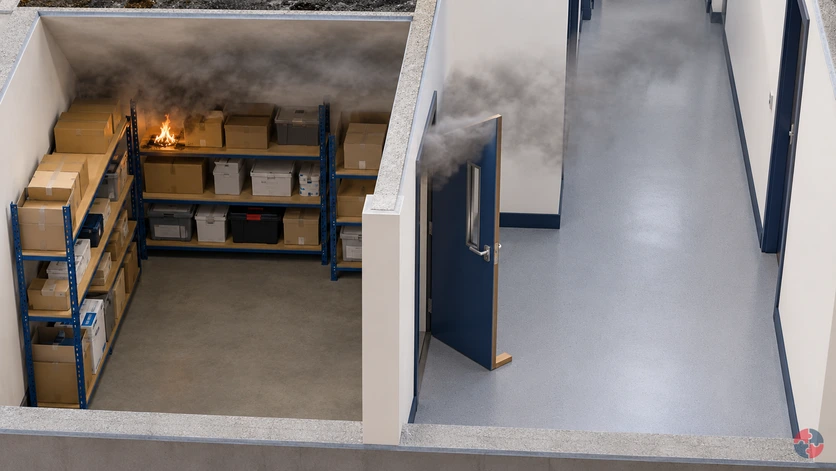
Follow the stockroom scenario as a pathway: an ignition involves packaging; an open fire door lets smoke leave the room; an unsealed service penetration provides another route above the ceiling; smoke reaches people and a credited escape corridor. Each link points to a prevention or barrier task, not simply an instruction to evacuate faster.
Best-practice guide: Fire Growth, Smoke Movement and Heat Transfer

Map how a small ignition can remove a distant escape route
Follow the stockroom scenario as a pathway: an ignition involves packaging; an open fire door lets smoke leave the room; an unsealed service penetration provides another route above the ceiling; smoke reaches people and a credited escape corridor. Each link points to a prevention or barrier task, not simply an instruction to evacuate faster. A small fire can make a route unsafe through smoke and heat long before flames reach it.
Turn fire growth, smoke movement and heat transfer knowledge into a decision
A small fire can make a route unsafe through smoke and heat long before flames reach it. Growth depends on fuel, oxygen, ventilation and enclosure; conduction, convection and radiation transfer heat, while openings and services can spread smoke. Self-closer maintained, door discipline checked and staff briefed.
Store-room smoke spread scenario
Fire door wedged open: Self-closer maintained, door discipline checked and staff briefed. High packaging load: Stock limits, waste removal and fire load review.
Where do fire growth and smoke controls fail in practice?
They fail when fuel, oxygen, openings, building defects and human behaviour are not managed as connected controls.
Choose controls for the actual task
Elimination: Remove unnecessary packaging or ignition work beside the corridor. Substitution: Choose less combustible storage or a safer process where feasible. Engineering: Maintain a fire-resisting enclosure, self-closing door and compatible sealed service opening. Administrative: Control storage, hot work and inspection with a named route owner. PPE: Use suitable PPE for repair workers only; it does not protect occupants from smoke. Read the full control table for qualifications, ownership and verification. Use the actual task and applicable jurisdiction; existing technical approval remains unchanged.
Use the full fire growth, smoke movement and heat transfer lesson
Use the full topic for the decision points, practical examples, detailed control tables and source scope. HSE guidance applies to Great Britain; use HSENI for the Northern Ireland route and the source’s stated jurisdiction. A simplified guide does not change the page’s technical-review or approval status.

Read all six steps as text
1. Map how a small ignition can remove a distant escape route
Follow the stockroom scenario as a pathway: an ignition involves packaging; an open fire door lets smoke leave the room; an unsealed service penetration provides another route above the ceiling; smoke reaches people and a credited escape corridor.
- Avoid / redesign: Remove unnecessary packaging or ignition work beside the corridor.
- Control the task: Maintain a fire-resisting enclosure, self-closing door and compatible sealed service opening.
- Verify before release: If the work still creates the credible smoke route, redesign before starting.
Follow the stockroom scenario as a pathway: an ignition involves packaging; an open fire door lets smoke leave the room; an unsealed service penetration provides another route above the ceiling; smoke reaches people and a credited escape corridor. Each link points to a prevention or barrier task, not simply an instruction to evacuate faster. A small fire can make a route unsafe through smoke and heat long before flames reach it.
Apply it: Which part of this plan would you check at the workface before authorising the task?
2. Turn fire growth, smoke movement and heat transfer knowledge into a decision
Use the evidence to improve the actual work arrangement.
- Change at source: Remove unnecessary packaging or ignition work beside the corridor.
- Make it observable: If the work still creates the credible smoke route, redesign before starting.
- Keep useful evidence: Self-closer maintained, door discipline checked and staff briefed.
A small fire can make a route unsafe through smoke and heat long before flames reach it. Growth depends on fuel, oxygen, ventilation and enclosure; conduction, convection and radiation transfer heat, while openings and services can spread smoke. Self-closer maintained, door discipline checked and staff briefed.
Apply it: What evidence would show that the change improves this task, rather than only completing a record?
3. Store-room smoke spread scenario
Example: a practical application of the existing topic lesson.
- Fire door wedged open: Self-closer maintained, door discipline checked and staff briefed.
- High packaging load: Stock limits, waste removal and fire load review.
- Fire-barrier penetration unsealed: Contractor permit, reinstatement check and defect close-out.
Fire door wedged open: Self-closer maintained, door discipline checked and staff briefed. High packaging load: Stock limits, waste removal and fire load review.
Apply it: At which point would you hold this example, and what evidence would allow it to proceed?
4. Where do fire growth and smoke controls fail in practice?
Connect the task, the route to the person and the control that can fail.
- Source / exposure: They fail when fuel, oxygen, openings, building defects and human behaviour are not managed as connected controls.
- Possible consequence: Many organisations inspect obvious fire equipment but miss the conditions that allow growth and spread: stored combustibles, open doors, contractor penetrations, poor waste control, blocked extraction, missing dampers, badly managed charging areas and unclear escalation when defects are found.
- Control failure: The test is whether a small foreseeable ignition can grow or spread before people escape.
They fail when fuel, oxygen, openings, building defects and human behaviour are not managed as connected controls.
Apply it: Who could be exposed, including other trades, cleaners, maintainers and people nearby?
5. Choose controls for the actual task
Control summary. Read the complete task-specific controls and checks in the linked topic.
- Elimination: Remove unnecessary packaging or ignition work beside the corridor.
- Substitution: Choose less combustible storage or a safer process where feasible.
- Engineering controls: Maintain a fire-resisting enclosure, self-closing door and compatible sealed service opening.
- Administrative controls: Control storage, hot work and inspection with a named route owner.
- PPE: Use suitable PPE for repair workers only; it does not protect occupants from smoke.
Elimination: Remove unnecessary packaging or ignition work beside the corridor. Substitution: Choose less combustible storage or a safer process where feasible. Engineering: Maintain a fire-resisting enclosure, self-closing door and compatible sealed service opening. Administrative: Control storage, hot work and inspection with a named route owner. PPE: Use suitable PPE for repair workers only; it does not protect occupants from smoke. Read the full control table for qualifications, ownership and verification. Use the actual task and applicable jurisdiction; existing technical approval remains unchanged.
Apply it: Which stronger option can be used here, and who will verify it before accepting the remaining risk?
6. Use the full fire growth, smoke movement and heat transfer lesson
Follow the official sources below and retain the task-specific evidence.
- Official guidance: official guidance
- Official guidance: HSE PPE guidance
- Task decision: An intact initial-room view is an initial state, not an image of developed smoke. Do not enter to test conditions or infer tenability from a timer.
Use the full topic for the decision points, practical examples, detailed control tables and source scope. HSE guidance applies to Great Britain; use HSENI for the Northern Ireland route and the source’s stated jurisdiction. A simplified guide does not change the page’s technical-review or approval status.
Apply it: Which official source and full-topic section will you use to resolve the next decision?
Have the competent team identify the actual fire-resisting line, the complete door and penetration details, affected warning and the people who depend on the corridor. Control occupied refurbishment while these are corrected and verify the installed assembly before hand-back. The learning timeline explains changing conditions; it cannot predict fixed minutes to flashover or guarantee an escape period from the visible size of the flame.
Riverside: a hidden route above the ceiling
Illustrative example. A stockroom ignition produces smoke that bypasses the visible door through an unsealed cable opening above the corridor.
Decision. Staff raise the alarm and follow escape arrangements; facilities restricts the affected area and obtains competent barrier correction.
Evidence to check. The actual wall/ceiling line, opening location, installed repair detail, warning and route condition.
Hold or escalation point. Do not investigate the room or assume a small flame means the corridor will remain safe.
Follow-up. Inspect the completed barrier and strengthen contractor controls so future service work cannot leave hidden openings.
Smoke can affect a route beyond the room of origin
A fire-development illustration is qualitative. Smoke movement, heat transfer and loss of escape conditions depend on the building and fire; the drawing does not predict a safe time.

Locate the source and route
Follow the storeroom, corridor and any connected ceiling void or service opening.
Distinguish mechanisms
Conduction, convection and radiation describe heat transfer; smoke may travel through openings and spaces beyond the visible flame.
Protect the enclosure
Verify the actual doors, barriers, service seals and relevant maintenance with competent people.
Keep states explicit
An intact initial-room view is an initial state, not an image of developed smoke. Do not enter to test conditions or infer tenability from a timer.
Read the complete task-specific control examples
ERICPD is a planning cross-map: Discipline verifies and sustains every control. ESEAP compares effectiveness. A label does not authorise the task; retain the owner, evidence and stop or change decision.
Fire Growth, Smoke Movement and Heat Transfer · ERICPD
- Eliminate
- Remove unnecessary packaging or ignition work beside the corridor.
- Reduce
- Choose less combustible storage or a safer process where feasible.
- Isolate
- Maintain a fire-resisting enclosure, self-closing door and compatible sealed service opening.
- Control
- Control storage, hot work and inspection with a named route owner.
- PPE
- Use suitable PPE for repair workers only; it does not protect occupants from smoke.
- Discipline
- Trace each penetration and door defect to field-verified repair and route review.
Fire Growth, Smoke Movement and Heat Transfer · ESEAP
- Elimination
- Remove unnecessary packaging or ignition work beside the corridor.
- Substitution
- Choose less combustible storage or a safer process where feasible.
- Engineering controls
- Maintain a fire-resisting enclosure, self-closing door and compatible sealed service opening.
- Administrative controls
- Control storage, hot work and inspection with a named route owner.
- PPE
- Use suitable PPE for repair workers only; it does not protect occupants from smoke.
How does a workplace fire grow?
A fire grows when heat, fuel and oxygen interact in a way that produces more heat faster than the surroundings can absorb or remove it.
Fire growth depends on the fuel surface, heat release, oxygen supply and enclosure. A small ignition in packaging can warm nearby fuel; smoke and hot gases collect and can travel ahead of the flame. People may lose a safe route before the room is fully involved. Prevention removes fuel or ignition; protection limits spread and provides warning and escape.
The early stage of a fire may be small: a waste bin, an electrical fault, a battery charger, a flammable liquid spill, a cooking pan, packaging near a heater or hot work igniting hidden material. Whether that small fire stays small depends on nearby fuel, ventilation, detection, human response, compartmentation and suppression.
Fire growth is not linear. A room may move from a developing fire to flashover when hot gases and radiant heat ignite most exposed combustible surfaces. Smoke can travel away from the fire through doors, corridors, ducts, voids, risers, ceiling spaces and stairways. People can be overcome by smoke and toxic gases before direct flame reaches them.
Understanding fire growth helps supervisors and managers see why housekeeping, fire doors, storage control, separation, detection, emergency lighting and escape route inspection are not admin tasks. They are barriers that slow fire development and protect the time people need to escape.
| Stage | What is happening | Workplace relevance |
|---|---|---|
| Ignition | A source of heat ignites fuel in the presence of oxygen. | Control ignition sources, fuel load and dangerous substances. |
| Growth | Fire spreads to nearby materials and hot smoke layer develops. | Early warning, extinguishers and housekeeping can still matter. |
| Flashover potential | Radiant heat and hot gases may ignite many surfaces at once. | Escape routes and compartment doors become critical. |
| Fully developed fire | Available fuel and oxygen support intense burning. | Structural protection, separation and fire service access matter. |
| Decay | Fuel or oxygen becomes limited, but hazards remain. | Backdraught, reignition, hot surfaces and toxic atmospheres can remain. |
| Smouldering | Incomplete combustion continues without obvious flames. | Hidden cavities, soft furnishings, waste and insulation may reignite. |
How do heat and smoke move through a workplace?
Heat moves by conduction, convection and radiation; smoke moves with buoyancy, air pressure, ventilation paths and building openings.
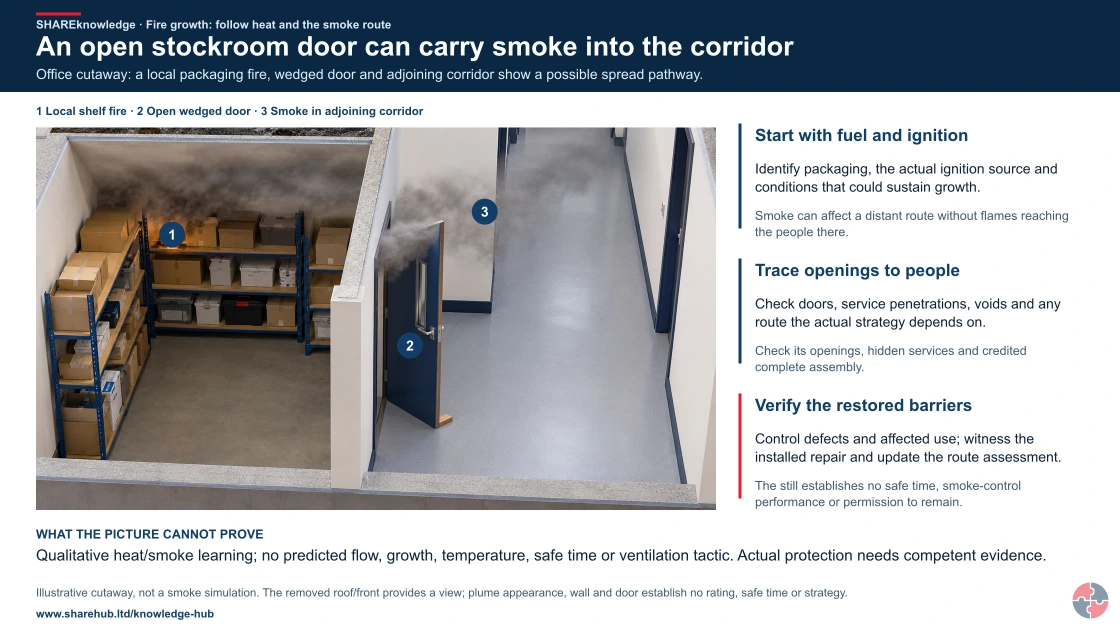
An open stockroom door can carry smoke into the corridor
Full written explanation
A new connected stockroom/corridor architectural cutaway marks the local shelf fire, physically open door with wedge and smoke entering the adjoining corridor. The doorway aligns with the dividing wall; smoke is shown at that opening rather than travelling through solid wall. The roof/front removal is a viewing cutaway, not a breach or measured ceiling layer. Three checks connect fuel and ignition, openings and the credited escape route to verified correction. This illustration predicts no smoke concentration, growth rate, travel time or tenability; the separate source example’s above-ceiling service breach still needs its own inspection. Picture key: 1 Local shelf fire · 2 Open wedged door · 3 Smoke in adjoining corridor. The separate process headings are unnumbered.
Office cutaway: a local packaging fire, wedged door and adjoining corridor show a possible spread pathway.
- Start with fuel and ignition. Identify packaging, the actual ignition source and conditions that could sustain growth.
- Trace openings to people. Check doors, service penetrations, voids and any route the actual strategy depends on.
- Verify the restored barriers. Control defects and affected use; witness the installed repair and update the route assessment.
Change the pathway
- A small flame is not a small risk. Smoke can affect a distant route without flames reaching the people there.
- A wall outline is not protection. Check its openings, hidden services and credited complete assembly.
- No fixed escape clock. The still establishes no safe time, smoke-control performance or permission to remain.
Evidence check: Qualitative heat/smoke learning; no predicted flow, growth, temperature, safe time or ventilation tactic. Actual protection needs competent evidence.
Distinguish heat transfer from the actual movement of smoke
Primary references: NIST: qualitative heat-transfer science — United States research · GOV.UK: offices and shops guidance — stated England scope
Open the complete HD image (new tab)Download image

Distinguish heat transfer from the actual movement of smoke
Primary references: NIST: qualitative heat-transfer science — United States research · GOV.UK: offices and shops guidance — stated England scope
Conduction carries heat through a solid, convection carries it with moving hot gas, and radiation can heat objects across an open space. Buoyancy, pressure differences, wind and mechanical ventilation move smoke through doors, shafts, ducts and gaps above ceilings. A changed fan or opened door can alter both smoke travel and oxygen supply, so only the designed fire strategy and emergency responders should control ventilation in an incident.
Conduction transfers heat through solids, such as steelwork, pipes, panels or structural members. Convection carries heat and smoke in moving gases, often upwards through stairs, shafts, ducts and open doors. Radiation transfers heat across open space and can ignite fuel without direct flame contact.
Smoke movement is strongly affected by openings and pressure. A door left open, a breached fire-resisting line above a suspended ceiling, a damaged fire damper, an unsealed service penetration, a lift shaft, a ventilation system or a poorly controlled construction opening can turn a local fire into a wider life-safety problem.
| Mechanism | Example | Control implication |
|---|---|---|
| Conduction | Heat travels through metal ductwork or structural steel. | Protect penetrations, inspect fire stopping and consider hot surfaces. |
| Convection | Hot smoke rises through stairs, atria, shafts or open doors. | Keep fire doors closed and protect vertical routes. |
| Radiation | Heat from a pool fire ignites adjacent packaging or damages tanks. | Control separation distances, shielding, bund layout and fire load. |
| Direct flame contact | Flame reaches stored waste, pallets or wall lining. | Control storage, housekeeping and internal linings. |
| Pressure and ventilation | Opening a door or window changes air supply and smoke movement. | Plan firefighting, evacuation and smoke control carefully. |
| Cavity spread | Fire travels through voids above ceilings or behind linings. | Maintain cavity barriers, dampers and fire stopping. |
How can smoke spread from a small store-room fire?
A store-room example shows how ordinary defects can make smoke movement a major evacuation issue.
A small electrical fire starts in a retail stockroom containing packaging, cardboard displays and cleaning products. The fire door is propped open because staff move stock through it during the morning. Cable work has left an unsealed penetration through the fire-resisting wall above a suspended ceiling. Smoke enters the sales floor and staff corridor before the alarm is acted on.
The investigation would not stop at the ignition source. It would ask why fuel load was high, why the door was propped, whether contractor work had breached the actual fire-resisting line above the ceiling, whether detection was suitable, whether the route remained tenable and whether staff understood that fire doors and designated fire-resisting barriers are part of the fire safety system.
| Weak condition | Effect on fire or smoke movement | Stronger control |
|---|---|---|
| Fire door wedged open | Smoke enters circulation space quickly. | Self-closer maintained, door discipline checked and staff briefed. |
| High packaging load | Faster growth and more smoke. | Stock limits, waste removal and fire load review. |
| Fire-barrier penetration unsealed | Smoke can enter void and bypass compartments. | Contractor permit, reinstatement check and defect close-out. |
| Delayed alarm response | People wait for confirmation while smoke spreads. | Clear alarm instructions and drill learning. |
| Poor route inspection | Escape route condition not challenged before the event. | Routine route checks with action tracking. |
What are flashover and backdraught?
Flashover and backdraught are different dangerous fire behaviours that show why ventilation and firefighting should be left to competent responders.
Flashover is rapid room-wide involvement after intense heating and radiation; backdraught is a violent ignition possibility when air reaches a hot, fuel-rich, under-ventilated compartment. They are distinct mechanisms, and no visible colour or single temperature is a safe field test. Staff should raise the alarm, withdraw and leave door opening and firefighting tactics to trained responders.
Flashover is associated with rapid transition to a fully developed room fire when heat and hot gases cause widespread ignition of exposed combustibles. It is relevant to escape because conditions can deteriorate very quickly once a space reaches this point.
Backdraught can occur where a fire has become ventilation-limited and then receives fresh oxygen, for example when a door or opening is made. Workplaces should not train ordinary staff to manage these conditions. The practical lesson is to evacuate, keep people away, provide information to the fire and rescue service and avoid unsafe intervention.
| Term | Plain-language explanation | Workplace lesson |
|---|---|---|
| Flashover | Most exposed combustible surfaces in a compartment ignite rapidly. | Do not assume a small developing fire will stay controllable. |
| Backdraught | Fresh oxygen enters a hot, oxygen-depleted fire and can cause violent ignition. | Do not open doors or disturb fire compartments without fire service control. |
| Smoke explosion risk | Unburnt gases can ignite where mixed with air. | Keep evacuation and firefighting boundaries clear. |
| Tenability failure | Heat, smoke or toxic gases make escape unsafe. | Protect routes and act early. |
For technical background, NIST fire-dynamics guidance explains compartment-fire growth and ventilation phenomena. It is US fire-science material, not a UK workplace legal source or a tactical instruction for workers.


How can heat feedback lead to flashover in a compartment fire?
Flashover is a rapid transition to widespread burning in a compartment when thermal conditions and available oxygen allow it. It is not inevitable in every fire. Follow how several exposed fuel surfaces heat up and become involved.
Read the complete lesson without the viewer
A room cutaway progresses from one burning object to increased thermal exposure, fuel heating and rapid broad involvement; radiation rays point toward exposed target fuels.
FS22 · Flashover and heat feedback
Flashover is a rapid transition to widespread burning in a compartment when thermal conditions and available oxygen allow it. It is not inevitable in every fire. Follow how several exposed fuel surfaces heat up and become involved.
Growing thermal exposure can heat target fuels, increase gaseous fuel release and increase fire involvement. Radiation from flames and hot surroundings is one important pathway; other heat transfer remains present. Arrangement, ventilation and enclosure conditions affect whether the transition occurs. This fixed sequence illustrates a mechanism and predicts no temperature, timing or escape tenability.
Eight named structures and concepts
FS22-H01 · Initial burning object
The fire begins visibly at one object. Other objects retain their identity so the growth in involvement can be followed.
FS22-H02 · Hot upper gases
Heated gases contribute to the thermal exposure. The region is gas, not a solid glowing lid or an automatic flashover switch.
FS22-H03 · Radiant heat transfer
Radiation carries energy toward exposed surfaces. The rays explain an energy pathway across space; they are not visible smoke streams.
FS22-H04 · Target fuel surface
An exposed combustible surface receives heat. Response depends on material and exposure, not distance alone.
FS22-H05 · Further fuel generation
Heated organic materials can release decomposition products. The illustrated fuel-release overlay is separate from the radiation and gas-motion arrows.
FS22-H06 · Increasing involvement
More fuel regions may begin to burn. Growing fire involvement can strengthen the thermal feedback; the animation is not a heat-release-rate curve.
FS22-H07 · Oxygen availability
Combustion also requires sufficient oxidiser. This observation provides no instruction to open, enter or ventilate the room.
FS22-H08 · Rapid broad involvement
The final state represents flashover. Extensive involvement develops rapidly without asserting that every surface ignites at one exact instant.
Four illustrative states
Localized fire
One burning furnishing and its plume are visible; most target objects remain unburned.
Increasing exposure
Show hot upper gases and radiation reaching exposed target surfaces.
Upper gases and exposed surfaces The upper gas layer grows. Radiation paths link it to exposed furnishings.
Feedback strengthens
Target fuels heat, release further gaseous fuel and become increasingly involved at different moments.
The first target becomes involved Watch the nearer target heat and become involved before the other objects.
Involvement spreads unevenly Other target fuels become involved at different moments as heat feedback increases.
Rapid broad involvement
Pause on extensive compartment involvement, labelled flashover. Follow the workplace alarm and evacuation arrangements; do not stay to observe.
Extensive compartment involvement Several objects are burning. Follow the alarm and evacuation arrangements; never stay to observe this stage.
Which description best matches compartment-fire flashover?
Any fireball seen at a doorway A doorway fireball alone does not define flashover. Follow the heating and broad involvement across the compartment.
A rapid transition to widespread burning under suitable thermal and oxygen conditions Correct. Flashover concerns rapid broad involvement, not a fixed countdown or any particular doorway flame.
An event that always happens at a fixed time after ignition No universal clock is shown. Whether the transition occurs depends on the fire and enclosure conditions.
HSE: Introduction to fire safety · HSE HSG168 Fire safety in construction
Sources, original geometry and review status
Original editable procedural geometry and illustrations. No third-party fire artwork, atlas, site model or incident footage is copied. Sources establish scientific context; the depiction requires competent scientific and editorial review. Three.js is supplied under its MIT licence.
FS22 HSE: Introduction to fire safety · HSE HSG168 Fire safety in construction
No material-specific values have been added. Missing product, method and conditions remain unverified. This library gives no site approval, prediction or practical certification.
Why does tenability matter for learners and managers?
Tenability means whether people can survive, see, breathe, move and make decisions long enough to escape.
A route can be physically open but practically unusable if smoke obscures vision, heat becomes intolerable, toxic gases affect breathing or panic and crowding slow movement. This is why fire safety decisions cannot rely only on counting exits.
Managers should treat smoke-control defects, open fire doors, missing emergency lighting, damaged fire stopping and poor housekeeping as time-critical because each can reduce the safe time available.
| Factor | How it affects escape | Evidence to check |
|---|---|---|
| Visibility | People slow down or choose wrong routes. | Emergency lighting, signage and smoke barrier checks. |
| Heat | People may not pass through or near affected areas. | Separation, doors and fuel load control. |
| Toxic gases | People can be overcome away from flames. | Detection, escape route protection and drill behaviour. |
| Crowding | Queues increase exposure time. | Occupancy review and drill observation. |
| Assistance needs | People needing help may require more time. | PEEPs and staffing levels. |
What does a fire growth timeline look like?
A timeline helps learners understand how a small ignition can become an untenable and spreading fire.
Fire development should be taught as a sequence of changing conditions. The early event may be a small ignition, but heat release, smoke production, ventilation and fuel arrangement decide how quickly conditions worsen. A workplace may have only minutes to detect, warn and evacuate before smoke or heat makes routes unsafe.
The timeline is also a management tool. Controls can be placed against each stage: prevent ignition, limit fuel, detect early, contain smoke, preserve escape routes, support evacuation, prevent spread and plan recovery.
| Timeline stage | What is happening | Control and assessor question |
|---|---|---|
| Ignition | A heat source ignites nearby fuel. | Are ignition sources controlled and separated from fuel? |
| Early growth | Flame spreads locally and smoke begins to form. | Would detection, housekeeping or first-response action limit the event safely? |
| Smoke layer development | Hot smoke accumulates and moves through openings. | Are doors, ceilings, ducts, voids and escape routes protected? |
| Flashover risk | Radiant heat and hot gases may ignite many exposed surfaces. | Is fire load controlled and are people already moving to safety? |
| Fully developed fire | The compartment or area is burning intensely. | Are structural fire resistance, separation and fire service access adequate? |
| Spread or decay | Fire spreads to new fuel, becomes ventilation-limited or decays with residual hazards. | Are re-entry, isolation, environmental and recovery controls managed? |
How should ASET and RSET be understood simply?
ASET is the time available before conditions become unsafe; RSET is the time people need to reach safety.
Available safe escape time and required safe escape time are engineering concepts, not fixed numbers. Detection delay, warning, recognition, assisted movement and route capacity affect required time; smoke, heat, toxic gases and visibility affect available time. A competent fire engineer assesses the particular building and scenario. If a smoke barrier, warning route or escape route fails, do not assume the original calculation still applies.
Learners do not need to start with complex modelling. The simple idea is that evacuation is safe only where the time available before untenable conditions is greater than the time people need to detect, respond and move. The gap between those two times is the safety margin.
In ordinary premises, this thinking supports practical judgement rather than calculation. If detection is late, alarms are unclear, people hesitate, routes are long, assistance is needed or smoke can enter routes, RSET increases or ASET decreases. The assessor then looks for stronger controls.
| Term | Plain English meaning | Workplace example |
|---|---|---|
| ASET | Available safe escape time before heat, smoke or toxic gases make conditions unsafe. | A corridor remains usable because the fire door closes and smoke is contained. |
| RSET | Required safe escape time for people to notice, decide, move and reach safety. | Visitors in a venue take longer because they wait for staff instruction. |
| Safety margin | The gap between available time and required time. | A drill showing confusion may reduce confidence in the margin. |
| ASET reduced | Conditions become unsafe sooner. | Door wedged open, unsealed fire-barrier penetration, high fuel load or fast-spreading material. |
| RSET increased | People take longer to escape. | Poor alarm audibility, mobility needs, crowding, route obstruction or delayed recognition. |
What should a fire-growth and smoke-path risk register connect?
Connect each credible ignition and fuel scenario to smoke and heat paths, people at risk, barriers, warning, escape and change triggers.
For a stockroom fire, record packaging quantity, hot-work or electrical ignition, nearby stair or ceiling void, fire-door and penetration condition, detection and the people who depend on the route. Include the owner of each barrier and evidence from inspections, maintenance and drills.
A newly opened service hole, propped fire door or changed ventilation can invalidate the previous assumptions. Treat the defect as a current occupancy and escape decision, with competent repair and field verification before hand-back.
How can the hierarchy of controls limit fire growth, smoke spread and heat exposure?
Control the actual fuel, ignition and smoke route before depending on instructions or PPE. A competent fire-risk decision must test the credited barrier and current escape assumptions.
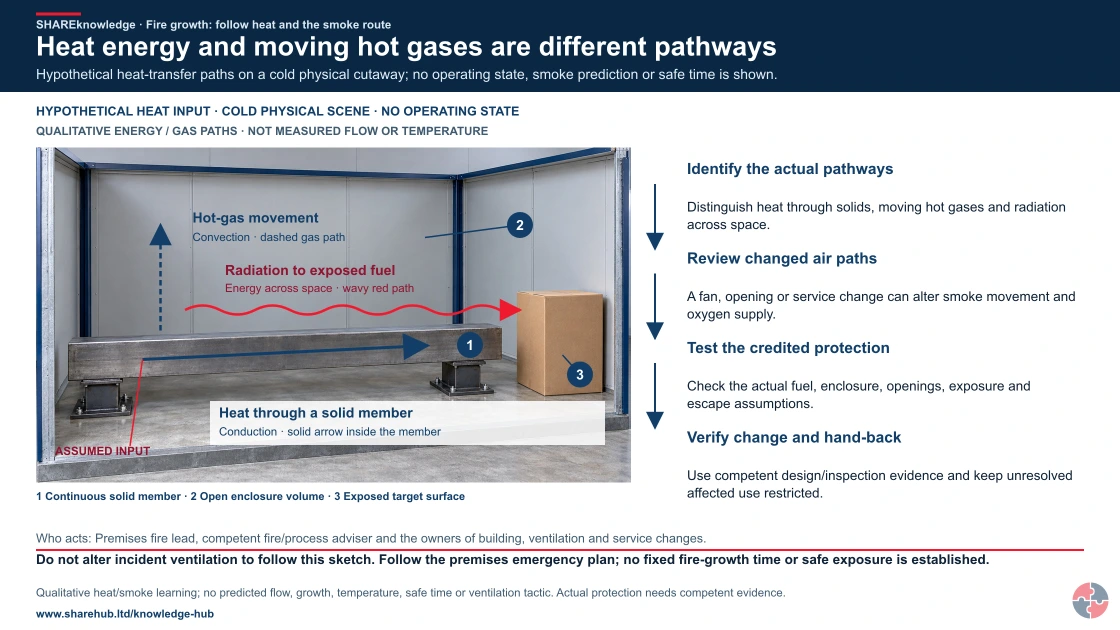
Heat energy and moving hot gases are different pathways
Full written explanation
A realistic inactive industrial-enclosure cutaway provides physical context for three explicitly hypothetical heat-transfer pathways. Picture key: 1 Continuous solid member · 2 Open enclosure volume · 3 Exposed target surface. An assumed heat-input label does not show an operating heat source. The solid conduction arrow stays within the continuous steel member, which rests visibly on two separate pedestal supports. A distinct dashed upward arrow models gas/convection movement in the open volume; it is not a smoke plume or a measured flow. The wavy red radiation path carries conceptual energy through unobstructed space to the separate target surface, not material or smoke. The carton stands independently across an air gap. The deliberately omitted front/roof is an educational view, not a breach or a credited fire barrier. The cold scene establishes no temperature, heat flux, growth, smoke spread, tenability, safe time, physical protection, device behaviour, operating state or design result. Four unnumbered checks identify the actual pathways, review changed air paths, test the credited protection and verify change/hand-back. No incident ventilation tactic, emergency action or operating permission is supplied.
Hypothetical heat-transfer paths on a cold physical cutaway; no operating state, smoke prediction or safe time is shown.
- Identify the actual pathways. Distinguish heat through solids, moving hot gases and radiation across space.
- Review changed air paths. A fan, opening or service change can alter smoke movement and oxygen supply.
- Test the credited protection. Check the actual fuel, enclosure, openings, exposure and escape assumptions.
- Verify change and hand-back. Use competent design/inspection evidence and keep unresolved affected use restricted.
When the evidence does not fit: Do not alter incident ventilation to follow this sketch. Follow the premises emergency plan; no fixed fire-growth time or safe exposure is established.
Who acts: Premises fire lead, competent fire/process adviser and the owners of building, ventilation and service changes.
Changed workplace
Office stockroom: Connect packaging ignition and the open door to the actual adjoining route.
Industrial enclosure: Distinguish heat pathways and assess changed ventilation without using flame size as the sole test.
Evidence check: Qualitative heat/smoke learning; no predicted flow, growth, temperature, safe time or ventilation tactic. Actual protection needs competent evidence.
Distinguish heat transfer from the actual movement of smoke
Primary references: NIST: qualitative heat-transfer science — United States research · GOV.UK: offices and shops guidance — stated England scope
Open the complete HD image (new tab)Download image

Distinguish heat transfer from the actual movement of smoke
Primary references: NIST: qualitative heat-transfer science — United States research · GOV.UK: offices and shops guidance — stated England scope
The control matrices are illustrations; premises-specific suitability, implementation and specialist design approval remain held for competent review.
The scenarios are reasoned task applications of the linked control principles, not a prescribed design or proof that each exact intervention appears in a source. A competent person must verify the method, local law and stop criteria.
Packaging ignition could push smoke through a service penetration into an occupied escape corridor.
A new duct or fan change could carry smoke to a stair or alter compartment fire growth.
How can the ERICPD hierarchy of controls limit fire growth, smoke spread and heat exposure?

| Hazard and harm route | ERICPD → five-level control | Task intervention and feasibility | Owner, test and evidence | Failure and stop decision |
|---|---|---|---|---|
| Stockroom smoke into a protected corridor | Eliminate → Elimination | Remove unnecessary packaging or ignition work beside the corridor. Source: official guidance. | Fire-risk lead documents the removed hazard and confirms the task no longer creates it. | If the work still creates the credible smoke route, redesign before starting. |
| Same scenario | Reduce → Substitution | Choose less combustible storage or a safer process where feasible. Source: official guidance. | Fire-risk lead compares the substitute and its new risks before release. | If the new method is unassessed, hold the change. |
| Same scenario | Isolate → Engineering | Maintain a fire-resisting enclosure, self-closing door and compatible sealed service opening. Source: official guidance. | Fire-risk lead inspects or tests the installed physical control at the workface. | If the physical barrier is missing or impaired, stop affected work. |
| Same scenario | Control → Administrative | Control storage, hot work and inspection with a named route owner. Source: official guidance. | Fire-risk lead observes the method and checks handover or permit evidence. | If the method or handover is unverified, pause and rebrief. |
| Same scenario | PPE → PPE | Use suitable PPE for repair workers only; it does not protect occupants from smoke. Source: official guidance. | Fire-risk lead checks compatibility, condition and user competence for residual work. | If PPE is the only credited barrier, revise the plan. |
| Same scenario | Discipline → Administrative assurance | Trace each penetration and door defect to field-verified repair and route review. Source: official guidance. | Fire-risk lead samples defects, actions and rechecks after change. | If the defect recurs or remains open, restrict use and escalate. |
| Ventilation alteration across fire zones | Eliminate → Elimination | Avoid an unnecessary opening through the designated fire-resisting line. Source: Home Office fire guide. | Competent fire engineer documents the removed hazard and confirms the task no longer creates it. | If the work still creates an unprotected smoke path, redesign before starting. |
| Same scenario | Reduce → Substitution | Reroute the service outside the protected route if practicable. Source: Home Office fire guide. | Competent fire engineer compares the substitute and its new risks before release. | If the new method is unassessed, hold the change. |
| Same scenario | Isolate → Engineering | Specify compatible dampers, seals and controls to the fire strategy. Source: Home Office fire guide. | Competent fire engineer inspects or tests the installed physical control at the workface. | If the physical barrier is missing or impaired, stop affected work. |
| Same scenario | Control → Administrative | Permit the change and update drawings, testing and emergency information. Source: Home Office fire guide. | Competent fire engineer observes the method and checks handover or permit evidence. | If the method or handover is unverified, pause and rebrief. |
| Same scenario | PPE → PPE | Use assessed maintenance PPE only for residual installation hazards. Source: HSE PPE guidance. | Competent fire engineer checks compatibility, condition and user competence for residual work. | If PPE is the only credited barrier, revise the plan. |
| Same scenario | Discipline → Administrative assurance | Commission, witness and record the as-built barrier and fan response. Source: Home Office fire guide. | Competent fire engineer samples defects, actions and rechecks after change. | If the defect recurs or remains open, restrict use and escalate. |
How can the ISO 45001 hierarchy of controls limit fire growth, smoke spread and heat exposure?

| Hazard and harm route | ERICPD → five-level control | Task intervention and feasibility | Owner, test and evidence | Failure and stop decision |
|---|---|---|---|---|
| Stockroom smoke into a protected corridor | Eliminate → Elimination | Remove unnecessary packaging or ignition work beside the corridor. Source: official guidance. | Fire-risk lead documents the removed hazard and confirms the task no longer creates it. | If the work still creates the credible smoke route, redesign before starting. |
| Same scenario | Reduce → Substitution | Choose less combustible storage or a safer process where feasible. Source: official guidance. | Fire-risk lead compares the substitute and its new risks before release. | If the new method is unassessed, hold the change. |
| Same scenario | Isolate → Engineering | Maintain a fire-resisting enclosure, self-closing door and compatible sealed service opening. Source: official guidance. | Fire-risk lead inspects or tests the installed physical control at the workface. | If the physical barrier is missing or impaired, stop affected work. |
| Same scenario | Control → Administrative | Control storage, hot work and inspection with a named route owner. Source: official guidance. | Fire-risk lead observes the method and checks handover or permit evidence. | If the method or handover is unverified, pause and rebrief. |
| Same scenario | PPE → PPE | Use suitable PPE for repair workers only; it does not protect occupants from smoke. Source: official guidance. | Fire-risk lead checks compatibility, condition and user competence for residual work. | If PPE is the only credited barrier, revise the plan. |
| Same scenario | Discipline → Administrative assurance | Trace each penetration and door defect to field-verified repair and route review. Source: official guidance. | Fire-risk lead samples defects, actions and rechecks after change. | If the defect recurs or remains open, restrict use and escalate. |
| Ventilation alteration across fire zones | Eliminate → Elimination | Avoid an unnecessary opening through the designated fire-resisting line. Source: Home Office fire guide. | Competent fire engineer documents the removed hazard and confirms the task no longer creates it. | If the work still creates an unprotected smoke path, redesign before starting. |
| Same scenario | Reduce → Substitution | Reroute the service outside the protected route if practicable. Source: Home Office fire guide. | Competent fire engineer compares the substitute and its new risks before release. | If the new method is unassessed, hold the change. |
| Same scenario | Isolate → Engineering | Specify compatible dampers, seals and controls to the fire strategy. Source: Home Office fire guide. | Competent fire engineer inspects or tests the installed physical control at the workface. | If the physical barrier is missing or impaired, stop affected work. |
| Same scenario | Control → Administrative | Permit the change and update drawings, testing and emergency information. Source: Home Office fire guide. | Competent fire engineer observes the method and checks handover or permit evidence. | If the method or handover is unverified, pause and rebrief. |
| Same scenario | PPE → PPE | Use assessed maintenance PPE only for residual installation hazards. Source: HSE PPE guidance. | Competent fire engineer checks compatibility, condition and user competence for residual work. | If PPE is the only credited barrier, revise the plan. |
| Same scenario | Discipline → Administrative assurance | Commission, witness and record the as-built barrier and fan response. Source: Home Office fire guide. | Competent fire engineer samples defects, actions and rechecks after change. | If the defect recurs or remains open, restrict use and escalate. |
When should fire growth or smoke movement concerns be escalated?
Escalate when a condition could allow faster fire growth, smoke spread into escape routes or loss of compartment protection.
Seemingly small issues can be critical. A damaged door seal, blocked vent, unsealed fire-barrier penetration, changed stock layout or wedged fire door may alter how smoke and heat move.
Escalation should be practical: secure the area if needed, apply temporary controls, stop work that creates the defect, involve competent advice and update the fire risk assessment where the building or activity has changed.
| Trigger or question | Immediate action | Evidence before normal operation |
|---|---|---|
| Has the building, process or occupancy changed? | Review the fire risk assessment and confirm whether controls still match the risk. | Updated assessment, action plan and communication record. |
| Is a key fire precaution impaired? | Apply temporary controls, inform relevant people and escalate to the responsible person. | Impairment log, compensatory measures and close-out evidence. |
| Could people be trapped, delayed or confused? | Review escape, warning, signage, assistance and drill findings. | Drill record, PEEP review, route inspection and action tracker. |
| Is specialist design or technical judgement needed? | Seek competent advice before relying on assumptions. | Competent report, design note, certificate or reviewed fire strategy. |
| Has a near miss, false alarm or drill failure occurred? | Investigate the learning point and update arrangements. | Investigation note, corrective action and communication record. |
Where do fire growth and smoke controls fail in practice?
They fail when fuel, oxygen, openings, building defects and human behaviour are not managed as connected controls.
Many organisations inspect obvious fire equipment but miss the conditions that allow growth and spread: stored combustibles, open doors, contractor penetrations, poor waste control, blocked extraction, missing dampers, badly managed charging areas and unclear escalation when defects are found.
The test is whether a small foreseeable ignition can grow or spread before people escape. If the answer is yes, the issue belongs in the fire risk assessment and action plan.
| Failure or weak practice | How it develops | What good looks like |
|---|---|---|
| Assumption without evidence | The organisation assumes fire growth and smoke movement is adequate because it has existed for years. | Review the fire risk assessment, inspect the real condition and test the arrangement. |
| Unmanaged change | Refurbishment, new stock, changed hours, altered routes or different users undermine the original arrangement. | Add fire safety review to change control and contractor handover. |
| Open defects | Defects are recorded but not risk-ranked, resourced or closed. | Escalate overdue critical actions and use interim controls. |
| Poor communication | Workers, visitors, contractors or night staff do not understand what to do. | Update briefings, notices, inductions and drills. |
| Competence gap | A non-specialist makes design assumptions about complex premises, smoke spread, evacuation or fire resistance. | Use competent advice and record the decision basis. |
| Fuel load creep | Stock, waste, pallets or displays accumulate near routes or ignition sources. | Set storage limits and inspect them. |
| Hidden spread route | Voids, ducts, risers or penetrations bypass compartment lines. | Use competent inspection and contractor control. |
What evidence shows fire growth, smoke movement and heat transfer is controlled?
Evidence should show that fire precautions are suitable, available, maintained, tested, understood and reviewed.
Fire evidence should connect the fire risk assessment to real controls. A log book alone is not enough if defects remain open, staff do not know the procedure or equipment cannot be reached during normal work.
Good records show what was checked, what failed, who owned the action, when it was closed and how the responsible person knows the arrangement still protects relevant persons.
| Evidence item | What it should show | Assurance question |
|---|---|---|
| Compartment and fire door checks | Doors, seals, closers, glazing, walls, ceilings, risers and dampers are intact. | Photographic defect records and repair close-out. |
| Fuel load reviews | Combustible materials are limited and separated from ignition sources. | Housekeeping inspections and storage-zone records. |
| Contractor fire stopping evidence | Penetrations are identified, reinstated and checked after work. | Permit records, photos, product details and handover. |
| Fire risk assessment | Current hazards, people at risk, existing controls, further actions and review triggers are recorded. | Check after change, incident, refurbishment, occupancy change or drill learning. |
| Action tracker | Actions show owner, due date, priority, interim control and close-out evidence. | High-risk defects should not drift without escalation. |
| Testing and inspection records | Alarms, emergency lighting, extinguishers, doors, escape routes and relevant systems are checked at suitable intervals. | Records should show defects and corrective action, not just ticks. |
| Training and drill records | Workers, wardens and relevant contractors know what to do and how to report defects. | Drill observations should lead to improvement. |
How should fire growth, smoke movement and heat transfer be assured?
Assurance should test whether the fire arrangement works in the building, at the time, with the people who may need it.
First-line assurance comes from daily checks, weekly tests, warden observations and immediate defect reporting. Second-line assurance reviews fire risk assessment actions, drills, maintenance, contractor records and repeat findings. Specialist assurance may include competent fire risk assessor review, fire alarm contractor reports, extinguisher servicing, emergency lighting testing and enforcement feedback.
The test is practical: if the alarm operates today, can everyone hear, understand, move, escape, account for vulnerable people and keep routes safe without relying on luck?
| Assurance layer | What to check | What good looks like |
|---|---|---|
| Frontline checks | Supervisors and wardens check that fire growth and smoke movement controls are available before and during normal work. | Defects are reported, prioritised and corrected before people rely on failed controls. |
| Manager review | Managers review fire risk assessment actions, contractor changes, drills, inspections and repeat defects. | Resources, ownership and close-out dates match the risk. |
| Competent review | A competent fire risk assessor, engineer or specialist reviews complex design, strategy or technical uncertainty. | Recommendations are understood, risk-ranked and turned into practical actions. |
| Leadership assurance | Senior leaders review overdue critical actions, enforcement feedback, recurring impairments and high-risk premises. | Important fire risks are visible in governance rather than buried in a log book. |
Which fire duties apply across the UK jurisdictions?
England and Wales, Scotland and Northern Ireland have separate non-domestic premises fire routes; work and dangerous-substance duties must also be checked for the actual location and activity.
The Fire Safety Order is the England and Wales premises route. Scottish and Northern Irish instruments are separate. GB work-health rules and DSEAR do not silently apply in NI; use the corresponding NI rules where in scope. This table identifies routes, not legal approval for a site-specific strategy.
| Jurisdiction | Duty or guidance | What it means | How to apply it |
|---|---|---|---|
| E&W | Regulatory Reform (Fire Safety) Order 2005 | Requires the responsible person to assess fire risk and maintain suitable fire precautions in non-domestic premises. | Use as the main fire safety legal framework for England and Wales. |
| GB | Health and Safety at Work etc. Act 1974 | Requires employers to protect employees and others affected by work so far as reasonably practicable. | Use for work activities that create fire, emergency or firefighting risk. |
| GB | Management of Health and Safety at Work Regulations 1999 | Requires suitable and sufficient risk assessment, preventive arrangements, competent help, emergency arrangements and review. | Use for management arrangements, competence and emergency procedures. |
| GB | Dangerous Substances and Explosive Atmospheres Regulations 2002 | Requires fire and explosion risk from dangerous substances to be assessed and controlled. | Use where flammable substances, gases, vapours, dusts or oxygen enrichment affect the fire arrangements. |
| Scotland | Fire (Scotland) Act 2005 | Scottish non-domestic premises fire framework. | Assess people and fire precautions in the actual premises. |
| Scotland | Fire Safety (Scotland) Regulations 2006 | Scottish detailed premises precautions. | Warning, escape, maintenance and coordination. |
| NI | Fire and Rescue Services (NI) Order 2006 | NI non-domestic premises fire framework. | Identify the appropriate person and affected premises. |
| NI | Fire Safety Regulations (NI) 2010 | NI detailed premises precautions. | Warning, escape, maintenance and review. |
| NI | Health and Safety at Work (NI) Order 1978 | NI general work-health and safety route. | Control work-created fire and emergency risks. |
| NI | Management Regulations (NI) 2000 | NI risk-assessment and emergency arrangements. | Coordinate workers, contractors, competence and emergency action. |
| NI | DSEAR (NI) 2003 | NI dangerous-substance work-risk route where relevant. | Plan release, ignition and emergency controls. |
In England and Wales, Article 14 of the Fire Safety Order addresses emergency routes and exits; Article 15 addresses procedures for serious and imminent danger, including appropriate drills. The Workplace Regulations 1992 address ordinary traffic routes, not emergency escape routes.
Where can a voluntary management standard help?
A voluntary occupational health and safety system can assign owners for fuel control, smoke-route inspections, fire-barrier maintenance, worker competence and corrective action; technical fire and escape decisions need competent premises evidence.
Exact ISO clause mapping requires an authorised licensed copy and specialist review; no licensed clause text is reproduced. A competent reviewer should use an authorised copy if clause-level mapping is required.
Who needs competence, and how should it be demonstrated?
Test the decisions and actions each role must make in a realistic fire scenario, including faults, absent staff and hand-back.
| Role | Learning to test | Competence demonstration | Assessor and record | Reassessment trigger |
|---|---|---|---|---|
| All workers and contractors | Recognise smoke and changed fuel or openings; raise alarm and withdraw. | Explain why a new ceiling opening or propped door matters. | Supervisor observes site exercise. | Change in storage or route. |
| Supervisors and managers | Link growth, smoke paths and escape; restrict affected use. | Decide on occupancy after a failed fire door or shaft seal. | Fire lead samples risk decision. | Defect, incident or work change. |
| Designers and fire specialists | Assess scenario, ventilation and tenability without generic values. | Trace stockroom smoke route and challenge model assumptions. | Competent technical authority records basis. | Building or strategy change. |
| Maintenance and contractors | Preserve barriers and control penetrations or ventilation work. | Show full repair and hand-back of a breached route. | Technical lead witnesses work. | New service or failed inspection. |
| Dutyholders and assurance leads | Resource controls and verify trend learning. | Review combined storage, door and ventilation drill. | Leadership records action effectiveness. | Near miss or repeated defect. |
How could Riverside Leisure Ltd manage this in practice?

At Riverside Leisure Ltd, a small stockroom fire starts beside packaged supplies. Hot smoke moves above a suspended ceiling and reaches a protected corridor through an unsealed cable opening. A staff member notices the smoke, raises the alarm and directs visitors away; nobody opens the stockroom door to investigate. The manager closes the affected area, gives responders the fire and building layout, and later has a competent contractor reinstate and document the penetration seal before the corridor returns to use.
A retail stockroom example shows how fire growth knowledge turns into storage limits, door checks, contractor controls and drill learning.
Riverside Leisure Ltd reviews its cafe, plant room, storage areas and contractor works because each can influence fire growth and smoke spread.
| Management element | How the business would manage it | Evidence to review |
|---|---|---|
| Fuel control | Packaging and waste limits are set for stores and corridors. | Weekly inspection and waste contractor records. |
| Door control | Fire doors are checked for closure, damage and unauthorised wedging. | Door inspection log and defect photos. |
| Contractor works | Cable or duct penetrations require reinstatement evidence. | Permit handback and fire stopping record. |
| Learning | Drill observations check whether smoke-prone routes are avoided. | Updated evacuation instructions. |
What do the acronyms and key terms mean?
Acronyms should be understood before they are used in assessments, briefings, audits or learning answers.
Acronyms can exclude newer readers if they are not explained. This section keeps the main terms available at the end of the page so the article stays readable while still supporting learners and audit users.
| Acronym | Meaning | Plain-English use |
|---|---|---|
| ACOP | Approved Code of Practice | Practical guidance with special legal status; following it is not compulsory, but it can be used as evidence of compliance. |
| FRA | Fire Risk Assessment | A structured assessment of fire hazards, people at risk, controls, emergency arrangements and review needs. |
| FRS | Fire and Rescue Service | The emergency service and enforcing authority for many fire safety matters in England and Wales. |
| HSE | Health and Safety Executive | Great Britain workplace health and safety regulator. |
| HSWA | Health and Safety at Work etc. Act 1974 | Great Britain general work-health and safety statute; Northern Ireland has a separate 1978 Order. |
| MHSWR | Management of Health and Safety at Work Regulations 1999 | Regulations requiring suitable and sufficient risk assessment and management arrangements. |
| PEEP | Personal Emergency Evacuation Plan | A person-specific plan for someone who may need assistance to evacuate safely. |
| ASET | Available Safe Escape Time | The time available before conditions become unsafe for escape. |
| RSET | Required Safe Escape Time | The time needed for people to recognise, respond and reach safety. |
Unlock another resource
You have used this month’s two free downloads. Publish a post in your own words to unlock one more resource, or choose SHARE Individual for 10 downloads per month.
You decide whether to share. If you do, use the relevant platform disclosure tools and do not make claims you do not genuinely hold.