SHARE Knowledge Hub
Fire safety law in Scotland
Fire safety law in Scotland requires employers and people who control relevant premises to assess fire risks, take the necessary precautions and keep those precautions working. Part 3 of the Fire (Scotland) Act 2005 and the Fire Safety (Scotland) Regulations 2006 protect people, not just buildings. Responsibilities depend on employment, premises control and contractual obligations; an assessment only helps when its findings lead to action.
Understanding Fire safety law in Scotland
Fire safety law in Scotland requires employers and people who control relevant premises to assess fire risks, take the necessary precautions and keep those precautions working. Part 3 of the Fire (Scotland) Act 2005 and the Fire Safety (Scotland) Regulations 2006 protect people, not just buildings. Responsibilities depend on employment, premises control and contractual obligations; an assessment only helps when its findings lead to action.
Why this matters at work
Under section 72, the specified breaches of sections 53–55, employee duties under section 56, or requirements under regulations made under sections 57–58 are offences when the stated failure puts a relevant person at risk of death or serious injury in a fire. Actual injury is not required for that risk-based test. Other listed offences include ignoring notices, specified obstruction or failure to assist an officer, impersonating an officer, charging employees contrary to section 68, and knowingly false records or knowingly/recklessly false information in the defined circumstances.
For the specified serious duty/notice offences, conviction on indictment can carry up to two years’ imprisonment, a fine or both; section 72 distinguishes offences, procedure and penalties. Do not present one maximum as applying to every paperwork defect. The reasonable-precautions/due-diligence defence in section 72(9) has express exclusions, including the section 53 employer-duty offence and specified reasonably-practicable regulatory duties. The section also places defined practicability burdens on the accused.
How organisations manage this in practice
Scotland — reviewed 10 November 2026. Before work starts, identify whether it affects escape, warning, smoke control, suppression, compartmentation, external walls, electrical supplies or occupied areas. Establish the building-control and specialist requirements for the proposed work. Coordinate the construction and operational fire arrangements so that each phase has a workable strategy; the final completed design is not the strategy for an occupied building while systems are disconnected.
Scottish fire duties are set out through Part 3 of the 2005 Act and detailed regulations. Section 53 concerns employers and section 54 other control-based responsibilities, with duties depending on the actual facts. Several persons can be involved. Delegation and assistance should make precautions effective without substituting an English title for the Scottish statutory analysis. Read Part 3 of the Fire Scotland Act 2005 with the Fire Safety Scotland Regulations 2006. Map the employer’s employee duties and the responsibilities of people with control, including relevant contractual obligations. Coordinate shared measures and identify who implements and verifies them. Do not assume the English Responsible Person label is the Scottish statutory test. A nominated manager or assessor needs authority and information, while the actual dutyholders retain the obligations applicable to them.
Scotland — reviewed 10 November 2026. The Electricity at Work Regulations 1989 apply to electrical systems and work within their defined scope. Address construction, maintenance, use and competence needed to prevent danger. The workplace route and a housing-specific electrical-inspection duty are related but distinct. Good practice: maintain installations and equipment according to the risk, equipment, use and competent advice; deal with damage and dangerous conditions promptly. Do not describe annual portable-appliance testing as a universal statutory rule for every item or use a test label as proof that equipment remains safe after damage or modification. Audit a sample through the whole chain. Select a door defect and confirm the location, risk decision, interim response, competent repair, verification and communication. Select a training record and ask the person to describe the local arrangements. Select a tenant fit-out and follow the information into the latest assessment and plans. Compare the written procedure with conditions on the night or weekend shift as well as the normal working day.
Where should I start when checking fire safety duties?
This page explains fire-safety duties in Scotland. Start with your situation, then open only the detail you need. The practical examples help you act on the law; they are not an approval for a particular building.
If there is a fire or immediate danger, raise the alarm, follow the emergency arrangements and contact the emergency services when needed. Do not delay action to finish reading this guide.
A few useful terms in plain English
Dutyholder or Responsible Person: the person or organisation with a legal responsibility. The name and the precise duty differ between nations.
Fire risk assessment: working out how a fire could start, who could be harmed and which precautions are needed.
Compartmentation: walls, floors, doors and sealed openings that help limit fire and smoke spreading.
Competent person: someone with the skills, knowledge and experience needed for the particular task.
Fire strategy: how the building’s prevention, protection and evacuation arrangements are intended to work together.
Premises: the building, part of a building or place covered by the rule being discussed.
How can I make people safe and keep the fire arrangements working?
Identify who controls the premises, assess the fire risks, put the necessary precautions in place, and keep checking that they work.
A fire risk assessment is a practical examination of your building, activities and the people who use it. It asks how a fire might start, how smoke or flames could reach people, whether everyone could escape, and what needs to change. Buying an extinguisher or filing a generic assessment does not answer those questions. The duties in section 53 and section 54 require action as well as assessment.
- Know who is responsible. Identify the employer and everyone with control or fire-safety obligations. Agree who does what, including shared stairs, alarms and maintenance.
- Assess the actual premises. Consider ignition, combustible material, fire spread, occupants and escape. Obtain competent help where the risks exceed your knowledge.
- Fix the risks. Remove avoidable hazards and provide the protection the assessment identifies. Give improvements an owner, priority and completion date.
- Prepare people. Explain how to prevent fire, raise the alarm, call for help and leave safely. Include visitors, contractors and people needing assistance.
- Check and maintain. Keep escape routes usable, check precautions in everyday work, arrange competent servicing, and act on defects.
- Record, review and improve. Keep the required records, revisit the assessment when things change, and check that completed actions actually solved the problem.
These are practical headings, not six additional legal tests. The detailed requirements come from Part 3 of the Act and the Fire Safety (Scotland) Regulations 2006. The right precautions depend on the premises, their use and the people at risk.
Does this apply to my premises?
Part 3 applies to most non-domestic premises in Scotland, including workplaces and many buildings used by the public. It is not limited to employers or large businesses.
Shops, offices, warehouses, workshops and community premises are familiar examples. A charity or volunteer-run hall can have duties even without paid staff. The legal term is relevant premises; it can include places and structures other than conventional buildings. Different rules apply outside Scotland: do not substitute England and Wales' Fire Safety Order for the Scottish Act.
Workplaces and public premises
For an existing office, shop, factory, warehouse or hall without overnight accommodation, start with the Scottish Government's non-domestic guidance routes. Choose the guidance matching the actual activity and building.
People sleep or receive care here
Use the separate sleeping-accommodation guidance for relevant hotels, guest houses, holiday lets and houses in multiple occupation. Care homes have their own guidance. Do not assess sleeping occupants as though they were awake office staff.
Homes, flats or mixed use
Private dwellings and their common areas are generally excluded from Part 3's definition of relevant premises, but there are important exceptions and other housing duties. Regulation 24 also addresses maintenance of measures protecting firefighters in common areas. Use the Scottish home-fire-safety guidance and get advice for mixed-use or uncertain cases.
Childminding, specialised housing and complex industrial premises need the appropriate specific route. New buildings, alterations and changes of use may also require building standards approval; a fire risk assessment does not replace that process. The Scottish Government guidance hub separates these routes.
Who is responsible? Sections 53 and 54 in plain English
An employer has duties to employees under section 53. People who control relevant premises have duties under section 54 to the extent of that control or their contractual obligations. One organisation can have both sets of duties.
A dutyholder is a person or organisation with a legal responsibility. It is not simply whoever has been given the title “fire warden”. A company can be the employer and dutyholder; a manager coordinates work on its behalf. Appointing a manager, warden or consultant does not make the employer's responsibilities disappear.
Section 54(3) can also place duties on the owner where the controller is neither acting in connection with an undertaking nor owning the premises. Section 54(4) addresses maintenance, repair and fire-safety obligations in a contract or tenancy. Identify the legal person and the extent of control or obligation for each interface. Signing a contract cannot simply remove a duty that the legislation places on you.
| Legal starting point | What it means | What this looks like |
|---|---|---|
| Section 53: employer | Ensure employees' safety from fire in the workplace so far as is reasonably practicable. Assess the workplace, take necessary measures and review the assessment. | A shop employer assesses stock storage, staff work areas and escape, implements precautions and trains its team. Having fewer than five employees does not remove the assessment duty. |
| Section 54: control of premises | Assess risks to relevant persons and take the measures it is reasonable for someone in that position to take. Duties follow control and can also follow maintenance, repair or fire-safety obligations in a contract or tenancy. | A tenant controls activities inside its unit; a landlord may control a shared stair and alarm. Each must address their own responsibilities and the interfaces between them. |
“Relevant persons” broadly includes people lawfully in the premises and people nearby who could be put at risk by a fire. Employees protected through section 53 are not counted again under section 54 where the same employer has both assessment duties. This is a legal distinction, not permission to omit anyone from the overall fire-safety arrangements. See section 79.
Check the lease, service contracts and actual control rather than assuming “the landlord does everything”. Where responsibilities overlap, regulation 21 requires cooperation, coordination and sharing relevant risk information. Record who tests the common alarm, keeps the shared exit clear, deals with defects and tells other occupiers about changes.
Employees have responsibilities too. Under section 56 they must take reasonable care and cooperate with their employer. Regulation 22 requires reporting serious fire dangers and shortcomings in protection arrangements. Staff should report a wedged fire door or blocked exit; they should not improvise repairs beyond their competence.
What do the fire safety regulations require in practice?
Use this map to connect the legal provision, the person with the duty and the action needed on site.
The summaries retain each provision’s scope and conditions. Read the linked amended law for the complete requirement. The evidence examples help organise compliance; they are not extra statutory forms. Section 53 applies to the employer, which may be a company. A senior manager can coordinate the work but is not automatically the statutory employer.
| Provision | Who has the duty | Requirement and practical meaning |
|---|---|---|
| Regulation 1: Citation and commencement | Anyone using the Regulations | Identifies the instrument and when it started. It creates no separate routine inspection task. In practice: Use the current amended instrument, not an unamended 2006 printout. |
| Regulation 2: Interpretation and extent | Each person applying the Regulations | Defines competence, dangerous substances, explosive atmospheres and young persons. Duties on section 53 or 54 dutyholders extend only as far as their duties under those sections. In practice: Confirm the activity, people and extent of control before choosing precautions. |
| Regulation 3: Review | Section 53 or 54 dutyholder | Review regularly to keep the assessment up to date, and after a significant change or reason to suspect it is no longer valid. In practice: Record changed occupancy, processes, protection, incidents and completed review actions; no universal annual expiry is specified. |
| Regulation 4: Before employing a young person | Employer | Carry out or review the assessment for risks to a young person before employing them. In practice: Do this before an under-18 starts, including an apprentice. |
| Regulation 5: What the young-person assessment covers | Employer | Consider inexperience, limited risk awareness, maturity, layout, exposure, equipment, work organisation and training, including the specified hazardous work. In practice: Check induction, supervision and task limits for the actual young person and work. |
| Regulation 6: Dangerous-substance assessment | Section 53 or 54 dutyholder | Consider properties, supplier information, quantities and combinations, safe storage and waste, maintenance, possible explosive atmospheres, ignition including static, likely effects and connected spaces. In practice: Keep substance and activity information, including a suitable safety data sheet, with the assessment. A data sheet alone is not the assessment. |
| Regulation 7: New dangerous-substance work | Section 53 or 54 dutyholder | Do not start a new work activity involving dangerous substances until the applicable Chapter 1 duties for those substances are fulfilled. In practice: Confirm assessment and necessary controls before authorising the changed activity. |
| Regulation 8: When assessment information must be recorded | Section 53 or 54 dutyholder | Record regulation 9 information as soon as practicable after assessment or review if the dutyholder employs five or more people, the premises require a statutory licence or registration, or a qualifying alterations notice requires it. In practice: Count the employer’s employees across the undertaking, not only the staff on one shift or at one branch. Check the licence and notice triggers separately. |
| Regulation 9: What assessment information must be recorded | Dutyholder meeting a regulation 8 trigger | Record significant findings, including measures taken or planned, and people or groups identified as especially at risk. In practice: Include an action owner, priority and evidence of completion as useful management practice. |
| Regulation 10: Management arrangements and their records | Dutyholder taking the specified section 53 or 54 measures | Make effective arrangements for planning, organisation, control, monitoring and review. Record them if there are five or more employees, required statutory licensing or registration, or a notice requiring arrangements to be recorded. In practice: Keep a responsibility map, maintenance and defect process, training arrangements and management review. The licence and notice triggers apply here too. |
| Regulation 11: Dangerous-substance precautions | Section 53 or 54 dutyholder | Eliminate or reduce the fire risk so far as reasonably practicable. Prefer a less dangerous substance or process where reasonably practicable; otherwise control the risk and mitigate its effects using the Schedule. In practice: Manage quantities, releases, ignition, waste, handling, storage and transport and maintain the conditions on which safe use depends. |
| Regulation 12: Firefighting and warning | Section 53 or 54 dutyholder | Where necessary, provide appropriate warning and firefighting means, accessible signed non-automatic equipment, adequate competent nominated people and emergency-service contacts. In practice: Select measures for the building, people and hazards. Staff must not delay escape or enter danger to fight a fire. |
| Regulation 13: Means of escape | Section 53 or 54 dutyholder | Where necessary for safety, keep escape routes and exits unobstructed and meet the requirements for adequate routes, doors, signs and emergency lighting leading to safety. In practice: Check that people can readily open the necessary exits and reach safety during actual occupation, including shifts and temporary works. |
| Regulation 14: Serious and imminent danger | Section 53 or 54 dutyholder | Establish appropriate emergency procedures including drills, nominate sufficient competent evacuation assistants and restrict unsafe areas to people with adequate safety instruction. In practice: Provide for stopping work, leaving danger and preventing premature return. Plan usable assistance and shift cover before occupation. |
| Regulation 15: Dangerous-substance emergencies | Section 53 or 54 dutyholder | Provide the emergency information, warning, communication and escape measures required for dangerous-substance incidents; share relevant information with emergency services and control access during recovery. The stated slight-risk exception has both conditions. In practice: Prepare a task-specific response. Only essential people with suitable protection and equipment enter the affected area for necessary recovery work. |
| Regulation 16: Maintenance for people’s safety | Section 53 or 54 dutyholder | Where necessary, provide a suitable maintenance system and keep fire-safety premises, facilities, equipment and devices efficient, in working order and in good repair. In practice: Include alarms, doors, lighting and other relevant safeguards. Coordinate shared systems even where connected premises are domestic. |
| Regulation 17: Competent safety assistance | Section 53 or 54 dutyholder, subject to the stated exceptions | Nominate adequate competent assistance with enough time, resources, information and cooperation. Prefer a competent employee where available. Limited exceptions cover suitably competent sole traders and partnerships. In practice: Check competence for the actual task and building. Assistance does not transfer the dutyholder’s legal responsibility. |
| Regulation 18: Information for employees | Employer | Give understandable and relevant risk, precaution, emergency and nominated-person information. Give the required information to a child’s parent before employment; additional dangerous-substance information applies. In practice: Use language and formats people understand and verify understanding, including temporary workers. |
| Regulation 19: Outside employers and workers | Section 53 or 54 dutyholder | Give outside employers and self-employed people relevant risks and precaution information; give visiting workers appropriate instructions and identify evacuation assistance relevant to them. In practice: Brief contractors on the local alarm, exits, work restrictions and how their work could affect others. |
| Regulation 20: Employee training | Employer under section 53 | Provide adequate training on first employment and new or increased risks. Adapt it, repeat periodically where appropriate and provide it during working hours. In practice: Demonstrate local actions, practice assigned roles and check learning; a generic certificate alone is insufficient. |
| Regulation 20A: Capabilities | Employer under section 53 | Take the employee’s relevant health-and-safety capabilities into account when entrusting tasks. In practice: Confirm a person can safely perform an assigned evacuation or fire-related role. This is the capability rule, not the shared-premises coordination rule. |
| Regulation 21: Cooperation and coordination | Two or more section 53 or 54 dutyholders sharing or having duties for the premises | Cooperate, take reasonable steps to coordinate measures and share relevant fire risks. Where an explosive atmosphere may occur, the overall responsible dutyholder coordinates the required protective measures. In practice: Agree who maintains common protection, communicates impairments and coordinates emergency plans, including temporary occupiers. |
| Regulation 22: Employee reporting | Employee while at work | Report a serious and immediate fire danger or shortcoming in protection which their training would reasonably identify, within the regulation’s scope and where not already reported. In practice: Report a blocked exit, damaged fire door or failed alarm promptly; section 56 separately covers reasonable care and cooperation. |
| Regulation 23: Firefighter-protection maintenance | Section 53 or 54 dutyholder | Where necessary for firefighter safety, keep the relevant facilities, equipment and devices subject to suitable maintenance and in efficient working order and good repair. In practice: Include installed firefighter-use systems and access arrangements; coordinate with adjoining occupiers and owners where appropriate. |
| Regulation 24: Domestic common areas | Persons controlling the common areas and, in the circumstances specified, their owners | Extends regulation 23 firefighter-protection maintenance to common areas of private dwellings, with specific modifications. It does not import every Part 3 workplace duty into ordinary flats. In practice: Identify and maintain applicable firefighter-protection measures. Consider separate housing, licensing and building duties. |
| Regulation 25: Office of Rail and Road | Relevant enforcing authorities | Prescribes the Office of Rail and Road for section 61(8) enforcement arrangements. In practice: This is an authority-facing provision, not an extra routine task for every business. |
| Regulation 26: Nominated persons and an employer’s defence | Employer and the specified nominated competent people | For section 75, identifies nominees under regulations 12, 14 and 17. Their act or omission alone does not afford the employer a defence. In practice: Appoint, support and check competent assistance rather than treating the appointment as a release from responsibility. |
| Regulation 27: Service of documents | Dutyholders and enforcing authorities | Sets additional arrangements for serving statutory documents, including electronic service when its conditions are met. In practice: Ensure notices reach the right decision-maker and are acted on within their terms; record receipt and escalation. |
| Regulation 28: Defined disapplications | People in the specific listed circumstances | Disapplies only listed provisions in defined cases involving certain young-person work, regulated transport or custody. Remaining duties continue; custodial safety must still be ensured so far as possible. In practice: Do not infer a general transport, family-business or prison exemption. Check the precise provision and conditions. |
The dangerous-substance Schedule
The Schedule supporting regulation 11 sets out control and mitigation measures. These include limiting quantities, preventing or controlling releases, avoiding ignition and adverse conditions, separating incompatible substances, limiting the people exposed and preventing fire or explosion spread. Specialist measures may include suitable pressure relief, suppression or resistant plant. Required protection must remain effective during power failure, shutdown and maintenance. Hazardous work requires appropriate written instructions and permit arrangements. Selection and design need competent assessment; a permit or PPE does not make an uncontrolled process safe.
What should a fire risk assessment actually cover?
It must relate to your premises, your activities and the people who could be harmed, not just a template for your type of business.
A Scottish shop and shared stair need coordinated working precautions
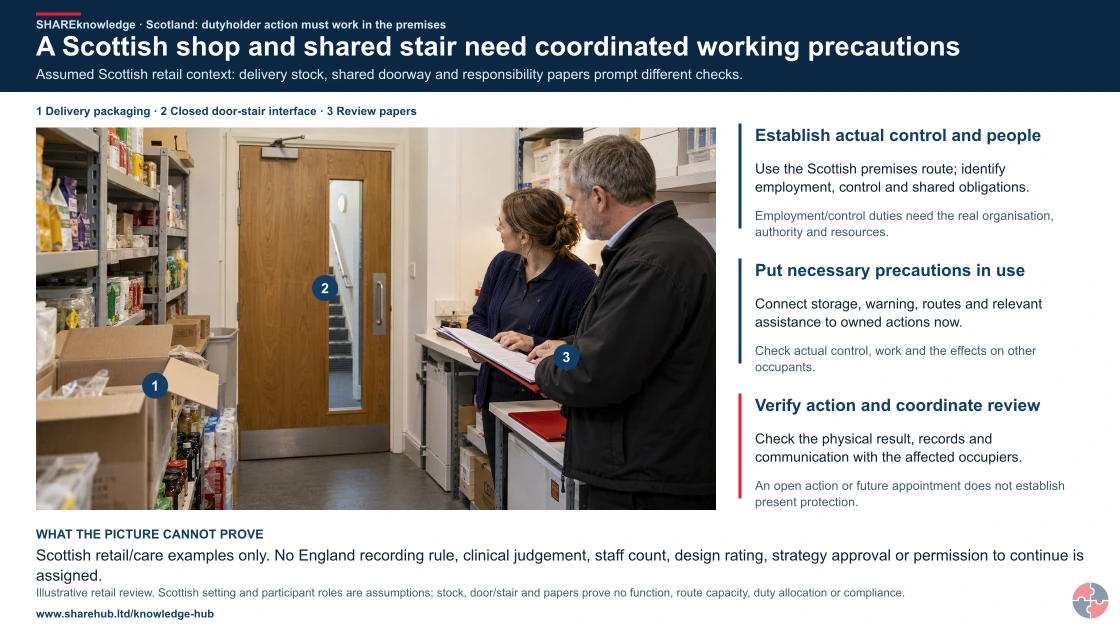
Full written explanation
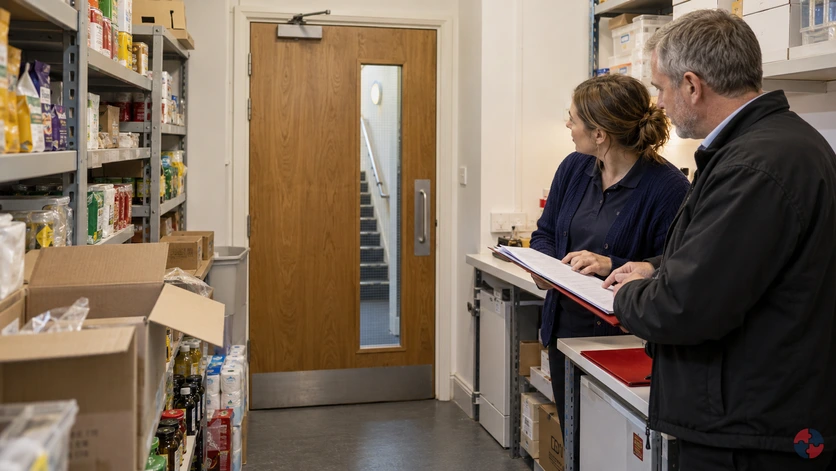
A new shop-back-room scene marks delivery packaging, the complete closed door towards a stair and inert review papers. The shop operator/building-representative roles and Scottish location are illustrative assumptions, not legal facts proven by a photograph. Three checks establish actual employment/control and the people protected, turn assessment findings into present precautions and verify action with coordinated review. The image proves no door performance, route width, allocation of duties or implemented action. The separate care-service comparison uses its own premises guidance and actual people/resources. Picture key: 1 Delivery packaging · 2 Closed door-stair interface · 3 Review papers. The separate process headings are unnumbered.
Assumed Scottish retail context: delivery stock, shared doorway and responsibility papers prompt different checks.
- Establish actual control and people. Use the Scottish premises route; identify employment, control and shared obligations.
- Put necessary precautions in use. Connect storage, warning, routes and relevant assistance to owned actions now.
- Verify action and coordinate review. Check the physical result, records and communication with the affected occupiers.
Change the pathway
- A warden or consultant is not a transfer. Employment/control duties need the real organisation, authority and resources.
- A shared door is not someone else’s whole problem. Check actual control, work and the effects on other occupants.
- Filed is not implemented. An open action or future appointment does not establish present protection.
Evidence check: Scottish retail/care examples only. No England recording rule, clinical judgement, staff count, design rating, strategy approval or permission to continue is assigned.
Connect Scottish assessment findings to implemented and verified precautions
Primary references: Scottish Government: current non-domestic framework · Scottish Government: 2022 non-residential guidance · Scottish Government: 2022 existing care-home scope
Open the complete HD image (new tab)Download image

Connect Scottish assessment findings to implemented and verified precautions
Primary references: Scottish Government: current non-domestic framework · Scottish Government: 2022 non-residential guidance · Scottish Government: 2022 existing care-home scope
Walk the premises and talk to the people using them. Consider heat and ignition sources, things that burn, the ways smoke and fire could spread, existing protection and the route to safety. Include occasional work, deliveries, cleaners, contractors, out-of-hours use and anyone who might not hear, understand or act on the warning without support.
The result should explain what is already adequate and what needs improvement. Give each action a named owner, a risk-based priority and a realistic deadline. A serious risk needs protection now; putting it on a long-term action list is not an interim safeguard. The Scottish assessment guidance explains the assessment and review process.
Can I do it myself?
Only if you have the knowledge and ability for the actual premises and risks. A small, straightforward workplace is different from a hotel, care home, complicated shared building or process with flammable substances. Regulation 17 addresses competent assistance, including limited exceptions for competent sole traders and partnerships. Provide suitable time, information and resources to those assisting you.
When appointing an assessor, check competence for your building type, the scope of the work and how uncertainties will be resolved. Registration or third-party certification can help you judge competence; the Scottish Government explains the recommended approach. You must still act on the findings. The fire service's enforcement or advice role does not mean it will perform your assessment for you.
For a deeper explanation, read Fire risk assessment principles and practice and Choosing competent assessment support.
What needs to be in place?
You need a working combination of prevention, protection, escape arrangements, trained people and maintenance appropriate to the assessed risks.
The Act's Schedule 2 sets out the broad categories of fire-safety measures. The Regulations add practical requirements. They do not prescribe one identical alarm, extinguisher package or evacuation method for every building.
Prevent fire and limit its spread
Start with the cause: remove avoidable ignition sources, keep combustible waste under control, and separate fuel from heat. Preserve fire-resisting construction and doors where the fire strategy requires them. Section 55 gives priority to avoiding risk, dealing with it at source and protecting people collectively. Dangerous substances need additional assessment and controls under regulation 6 and regulation 11; a general fire checklist does not replace them.
Warn people and give them a usable way out
Provide the warning and firefighting arrangements necessary for the premises under regulation 12. Under regulation 13, the necessary escape routes and exits must be adequate, unobstructed and usable. Check the whole journey to safety, including doors, signs and emergency lighting where needed. Do not infer safe occupancy or an acceptable travel distance from this introductory guide.
Have an emergency plan people can carry out
Regulation 14 requires appropriate emergency procedures, including drills, and enough competent people to implement evacuation procedures. Set out how to raise the alarm, call 999, leave, account for people and pass information to firefighters. Include arrangements for people needing assistance; the plan must not depend on firefighters arriving to make evacuation possible. Use the Scottish disabled-evacuation guidance for the relevant needs and building arrangements.
Maintain precautions and manage defects
Regulation 16 requires a suitable maintenance system where necessary. Allocate checks and competent servicing for the protection you actually have. Record defects, the immediate safeguard, who will fix them and how restoration will be confirmed. Use the premises' assessment, relevant guidance and equipment instructions to set the programme; do not assume that every check has the same statutory interval.
People should escape, not be expected to fight a developing fire. Any staff firefighting role must have appropriate competence, equipment and safe limits. Extinguishers are not a substitute for warning, escape or calling the fire service.
What must I record, and when must I review it?
Everyone with the relevant assessment duty must assess and review risk. The specific written-record triggers in Scotland are five or more employees, a required licence or registration, or a relevant alterations notice.
Under regulation 8, record the information specified by regulation 9 as soon as practicable after assessment or review when one of those triggers applies. That includes significant findings, measures taken or planned, and people or groups especially at risk. The employee count is the employer's total, not just the people working at that particular site. Regulation 10 separately requires appropriate management arrangements and their recording under the corresponding triggers.
Fewer than five employees is not an exemption from fire safety. A licence or registration requirement may trigger recording anyway. Even where those particular statutory recording triggers do not apply, keeping a clear written assessment, action list and maintenance/training evidence is sensible good practice. Do not confuse that recommendation with a claim that Scotland has England's recording rules.
Regulation 3 requires regular review and a review when there is reason to suspect the assessment is no longer valid or a significant change occurs. Set a review programme suitable for the premises, but do not wait for its next scheduled date after a layout change, changed occupants, a failed control, fire, near miss or drill revealing a problem. There is no single annual assessment expiry date imposed by that regulation.
A useful fire-safety record connects the assessment to the action owner, deadline, completed work and evidence of effectiveness. Store personal evacuation information securely and share it only with those who need it to make the arrangements work.
What should people know, and how do I check it?
Teach people the actions needed for their role, then check that they can carry them out in these premises.
Regulation 18 covers employee information; regulation 19 covers outside undertakings. Under regulation 20, employees need adequate fire training when first employed and when exposed to new or increased risks, with periodic repetition where appropriate, during working hours. Regulation 20A also requires employers to consider capabilities when assigning fire-related tasks.
| Role | What to teach and demonstrate | Evidence and reassessment |
|---|---|---|
| Staff and contractors | Recognise local fire risks, raise the alarm, use the correct exit and report defects. The supervisor checks understanding in the workplace. | Induction and observed understanding. Repeat after changes, gaps in knowledge or changed duties. |
| Wardens and evacuation assistants | Demonstrate their assigned role and limits, communication and any evacuation equipment. A competent person checks the practical arrangements. | Role allocation, practice and drill findings, including shift and absence cover. Reassess if the people, plan or equipment change. |
| Managers and dutyholder representatives | Understand ownership, assessment findings, maintenance, contractors, action priorities and when to restrict use or obtain advice. | Challenge a real defect and check its closure. Review after changes, overdue serious actions or unsuccessful drills. |
| Assessors, maintainers and auditors | Demonstrate competence for the building, system or review scope. An informed appointing manager checks experience and proposed method. | Scope-specific competence, inspection or service results and justified findings. Obtain specialist support outside that scope. |
No universal external “fire warden certificate” or fixed course-renewal period is created by these provisions. Training must suit the duties and risks; a certificate cannot compensate for blocked exits or an ineffective alarm.
First-line checks, then audit and review
A supervisor's routine check asks whether precautions are working today: exits clear, doors working, faults reported and temporary work controlled. A more detailed audit samples whether the system reliably assesses, maintains, trains and closes actions. Management then resolves gaps and verifies improvements. An external review can add independent challenge; none of these replaces the dutyholder's assessment or the enforcing authority's role.
Use the fire-readiness routine checklist for first-line monitoring and the detailed audit library for assurance. Apply Scottish criteria to the actual premises; completing a checklist does not establish legal compliance.
How can fire safety duties be turned into practical decisions?
A useful assessment leads to a clear decision, a responsible owner and a check that the risk has been controlled.
A filed care assessment needs action, function and people evidence
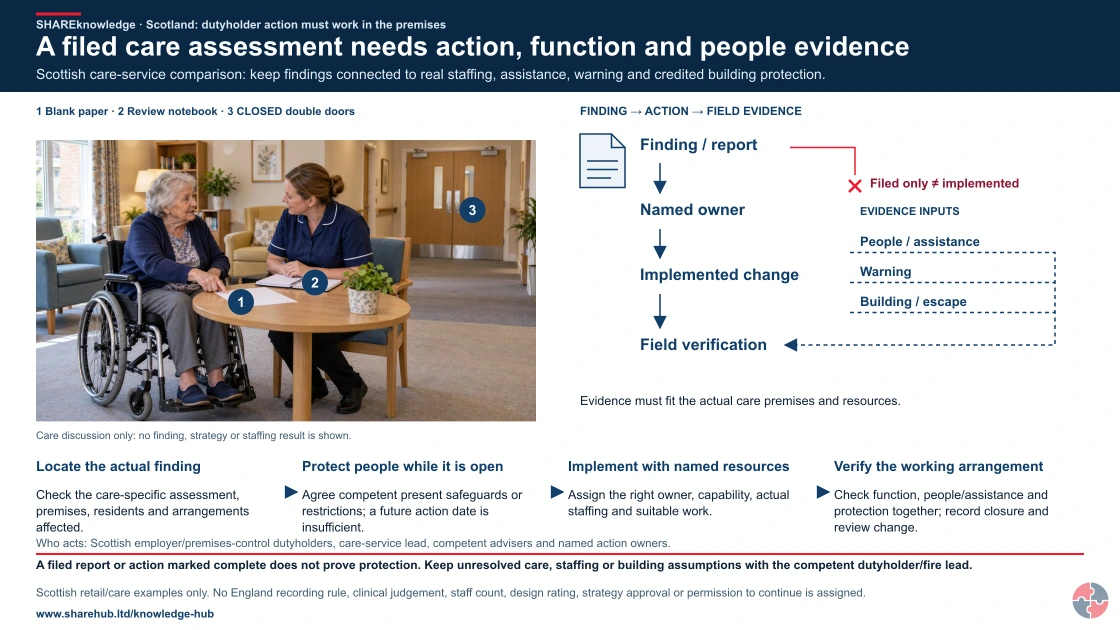
Full written explanation
An illustrative person-led care discussion supports questions about the actual arrangement, alongside a separate conceptual action route. Picture key: 1 Blank paper · 2 Review notebook · 3 CLOSED double doors. The complete finding/report→named owner→implemented change→field verification chain has three forward relationships; a separate crossed branch shows Filed only ≠ implemented. People/assistance, Warning and Building/escape are three distinct evidence inputs to final field verification. Evidence must fit the actual care premises and resources. Four checks locate the actual finding, protect people while it remains open, implement action with named resources, and verify the working arrangement. The independent process headings are unnumbered. The scene shows no actual assessment finding, filed report, defect, completed action, Scottish address, clinical dependency, staffing number or capability, door/warning performance, selected strategy, design rating or permission to continue. The care-specific assessment and qualified Scottish source routes require actual evidence.
Scottish care-service comparison: keep findings connected to real staffing, assistance, warning and credited building protection.
- Locate the actual finding. Check the care-specific assessment, premises, residents and arrangements affected.
- Protect people while it is open. Agree competent present safeguards or restrictions; a future action date is insufficient.
- Implement with named resources. Assign the right owner, capability, actual staffing and suitable work.
- Verify the working arrangement. Check function, people/assistance and protection together; record closure and review change.
When the evidence does not fit: A filed report or action marked complete does not prove protection. Keep unresolved care, staffing or building assumptions with the competent dutyholder/fire lead.
Who acts: Scottish employer/premises-control dutyholders, care-service lead, competent advisers and named action owners.
Changed workplace
Shared-stair shop: Clarify control and verify delivery/route precautions in ordinary use.
Care-service action: Use the care-specific source and check implementation with actual people/resources.
Evidence check: Scottish retail/care examples only. No England recording rule, clinical judgement, staff count, design rating, strategy approval or permission to continue is assigned.
Connect Scottish assessment findings to implemented and verified precautions
Primary references: Scottish Government: current non-domestic framework · Scottish Government: 2022 non-residential guidance · Scottish Government: 2022 existing care-home scope
Open the complete HD image (new tab)Download image

Connect Scottish assessment findings to implemented and verified precautions
Primary references: Scottish Government: current non-domestic framework · Scottish Government: 2022 non-residential guidance · Scottish Government: 2022 existing care-home scope
A shop with a shared stair
Task material and setting: A fictional Scottish shop has three employees and uses a stair shared with another business. Delivery cartons are being left beside the final exit.
People and prerequisites: The shop employer identifies staff, customers and contractors, checks the current assessment, and asks the landlord who controls the stair, alarm and door maintenance. The example assumes ordinary non-sleeping premises; it is not a building design.
Before: The manager and landlord agree responsibilities and a delivery/storage arrangement that keeps the escape route usable. The employer checks whether any licence, registration or notice triggers written recording despite the small team.
During: Deliveries are received into the designated storage area. The supervisor checks the route and door operation, briefs staff and shares material changes with the neighbouring occupier.
Hold or stop: A locked or obstructed necessary exit is addressed immediately. If safe escape cannot be maintained, the affected occupation does not continue while someone merely emails a complaint.
Completion and hand back: The manager verifies a clear route and correct door operation; competent help resolves any defect beyond simple safe housekeeping. Relevant staff and occupiers are told when normal use can resume.
Evidence: Keep the responsibility agreement, assessment/review, action owner and closure evidence, together with check and maintenance records. These original example arrangements illustrate escape duties and coordination duties; they are not prescribed forms.
A workshop proposes hot work near stored packaging
Task material and setting: A fictional Scottish workshop proposes welding a removable bracket beside stored cartons. Sparks could ignite packaging; smoke could spread to an occupied escape corridor.
People and prerequisites: The workshop manager, competent welder and fire-safety adviser consider staff, contractors and neighbouring occupants. They review the work, combustible storage, fire separation and alarm arrangements before authorising it.
Before: First avoid on-site hot work by using a suitable cold method or taking the removable item to an appropriate controlled location. This removes the ignition activity from the occupied storage area. Competent engineering judgement must confirm the alternative still produces a suitable repair.
During: Reduce exposed combustible material; use suitable physical separation and spark containment; preserve required fire doors and protection; then apply task-specific authorisation, supervision and fire-watch arrangements. The appointed owner checks the area, hidden spread routes and protection before release. This follows section 55's prevention principles.
How the control hierarchies fit: Eliminate the unnecessary hot work; Reduce/substitute through an appropriate cold method; Isolate with engineered separation; Control the remaining work through a planned method; use task-selected Personal Protective Equipment (PPE) for the welder; sustain the precautions through Discipline, meaning supervision and verification. This ERICPD teaching aid maps to the five-level workplace hierarchy: elimination, substitution, engineering, administrative controls and PPE. It is not the wording of the Act. PPE does not protect everyone in the building from smoke or replace safe escape.
Hold or stop: Do not start or continue if combustible material cannot be controlled, the fire separation or warning arrangements are impaired, or the work's spread risk is uncertain. Obtain competent advice rather than treating a permit as permission to accept an uncontrolled risk.
Completion and hand back: The authorised owner verifies the work area and any affected protection, follows the task-specific post-work monitoring arrangements, and confirms restoration before normal storage and occupation resume. No universal watch duration is asserted here.
Evidence: Record the alternative-method decision, agreed controls, checks, authorisation, defects and verified hand-back. Additional dangerous-substance/process duties may apply: regulation 11 and the dangerous-substances guidance require their own consideration.
How do housing and building work follow their applicable fire safety routes?
A private home, a holiday let and a workplace can have different legal routes. A new building or conversion also needs the correct building-standard checks.
Scotland’s home alarm standard applies to all homes through the housing route. It includes interlinked smoke alarms in the most frequently used daytime room and circulation spaces on each storey, and a heat alarm in every kitchen. Carbon-monoxide detection is a separate requirement where the relevant appliance or flue conditions apply; CO alarms do not need to link to the fire alarms. Follow the Scottish Government homeowner guidance for siting, power supplies, specialist needs and the exact conditions. This domestic specification is not a universal alarm design for hotels, workplaces or care premises.
The Building (Scotland) Amendment Regulations 2025 came into force on 6 April 2026, including changes concerning automatic fire suppression on specified conversions. Check the exact building-work trigger and transitional arrangements using the current Technical Handbooks. This does not mean every existing building must retrospectively receive a sprinkler system merely because the calendar date changed.
For a mixed-use building, licensed HMO, short-term let, care home or supported setting, choose the relevant Scottish guidance and confirm the actual use, licence and occupation. Part 3 assessment, housing standards, licensing and the building-warrant route can operate together.
Scottish common property also has a specific duty: occupiers must keep it free of dangerously combustible material and items that could obstruct escape or fire-service access. Deal with obstructions promptly through safe arrangements; unresolved dangerous conditions can be raised with SFRS. Do not assume the general domestic exclusion means that common stairs have no fire-safety duties. Read section 93 for the precise duty and enforcement powers.
Who checks compliance, and when should I get help?
The Scottish Fire and Rescue Service (SFRS) enforces fire-safety law for most relevant premises, but responsibility for compliance remains with dutyholders.
Inspectors can examine premises and evidence, and formal action can include enforcement, prohibition or alterations notices and referral for prosecution. Some premises have a different enforcing authority, including certain construction sites, nuclear installations, defence premises and major sports grounds. The Scottish Government explains those boundaries.
Seek competent help promptly if escape is uncertain, essential protection is unavailable, people cannot evacuate using the plan, or the premises or activity are outside your competence. For non-emergency questions about Scottish fire-safety responsibilities, use SFRS's fire-safety contact route. Do not wait for an inspection to correct a known serious problem.
Which guidance applies to my type of building?
Choose the closest description of your premises in Scotland. Mixed-use buildings may need more than one profile. Each profile explains the legal route, the people at risk, practical checks and the records to keep.
Offices and administrative workplaces
Check that everyone can hear the warning and leave by a usable route, including visitors and people who need help.
Which rules apply. Scotland. Apply sections 53/54 and the 2006 regulations to relevant premises. Assess and review regardless of employee numbers; use the Scottish recording triggers rather than England's all-premises recording amendment.
Who could be at risk. Employees, visitors, contractors, people working alone and people attending meetings may have different familiarity with the layout. Consider hot-desking, remote or lone working, meeting-room occupancy and reduced staffing outside normal hours.
What you need to check. Assess warning, exits, stairs and door operation for the actual occupation. Keep routes usable during deliveries and furniture moves. Address electrical installations, portable equipment, kitchens, heaters, charging and combustible storage. Coordinate shared stairs, reception, alarm and plant with the building controller.
How to manage it in practice. Use induction with a short local route walk, a maintained defect-reporting process and changes recorded when partitions or occupancy alter. Test a sample of out-of-hours access and the escape function of security doors. A desk-based plan should be checked against the actual fitted layout.
What to record and when to get help. Keep the assessment, shared-responsibility record, relevant maintenance evidence, training and exercise findings. Escalate unconfirmed protected-route construction or a reduction in usable exits; do not assume an office label makes an unfamiliar layout low risk.
Official sources: Fire (Scotland) Act 2005, section 53 · Non-domestic fire safety: Scottish guidance routes · Building (Scotland) Regulations 2004
Shops, retail units and shopping centres
Plan for customers who do not know the building. Keep stock and deliveries out of escape routes.
Which rules apply. Scotland. Use the Scottish non-residential guidance, coordinate occupiers and maintain shared routes/protection. Applicable premises licences can add requirements and can independently trigger written assessment/arrangement records.
Who could be at risk. Customers may be unfamiliar with the premises, distracted, accompanied by children or unable to follow staff instructions quickly. Stock levels, seasonal displays, queues and back-of-house activities can change the fire and escape conditions.
What you need to check. Assess both trading and non-trading periods. Maintain exit availability through shutters, stockrooms and service areas. Address cooking concessions, batteries, packaging and deliberate ignition risks. In a centre, coordinate the individual unit with common malls, stairs, service yards and management arrangements.
How to manage it in practice. Check routes before opening, after major deliveries and when displays change. Give staff clear roles for alerting customers, managing a queue and reporting a protection fault. Agree how the centre and tenant communicate an alarm, a disabled system and an alteration.
What to record and when to get help. Retain approved layout/capacity decisions, tenancy interfaces, installation and maintenance evidence, waste controls and staff briefing records. A tenant fit-out or new concession should trigger review before it opens.
Official sources: Fire (Scotland) Act 2005, section 53 · Non-domestic fire safety: Scottish guidance routes · Building (Scotland) Regulations 2004
Factories, workshops and production buildings
Start with the process: heat, machinery, fuels and dangerous substances can need specialist precautions.
Which rules apply. Scotland. Apply Part 3 and the 2006 regulations, alongside DSEAR 2002 and process/work-equipment duties where relevant. Use the Scottish statutory prevention principles and distinguish general fire precautions from specialist process controls.
Who could be at risk. Machinery, heat, dust, flammable liquids, gas, hot work and electrical equipment may introduce process risks as well as ordinary building fire risks. Contractors, maintenance staff and shift patterns affect control and escape.
What you need to check. Apply the general fire duties together with the relevant dangerous-substances, work-equipment and construction requirements. Consider how fuel is released, ignited and transported, and whether a fire or explosion could disable escape or essential services. A general premises assessment does not replace the process assessment.
How to manage it in practice. Keep extraction and housekeeping effective, separate ignition from fuel, manage abnormal operation and plan maintenance and shutdown. Verify isolations and the controlled condition of hot-work areas. Review how a process change affects alarms, suppression, compartmentation and neighbouring occupancies.
What to record and when to get help. Retain process and premises assessments, substance information, engineering design/inspection records, training, authorisations and change decisions. Specialist process or fire engineering is needed where hazards, release mechanisms or protection performance are not established.
Official sources: Fire (Scotland) Act 2005, section 53 · Non-domestic fire safety: Scottish guidance routes · Building (Scotland) Regulations 2004 · Dangerous Substances and Explosive Atmospheres Regulations 2002
Warehouses, logistics centres and high-bay storage
Changing the goods, packaging or storage height can change the fire risk and whether protection remains suitable.
Which rules apply. Scotland. Apply the Scottish non-residential route and appropriate storage/process assessment. Confirm the actual commodity, height and protection design before accepting a change; a building-warrant approval does not authorise any later storage arrangement.
Who could be at risk. The type, quantity, height and arrangement of stored goods influence fire growth, spread and the effectiveness of protection. Charging, loading, packaging, mezzanines and changes in racking can affect ignition and escape.
What you need to check. Assess the actual storage commodity and arrangement against the building strategy and any suppression design. Maintain clear escape routes and relevant firefighting access. Include contractors, drivers, visitors, night work and occupied offices or mezzanines within the building.
How to manage it in practice. Control changes in stock, racking height, storage under or near protective systems and charging locations. Agree acceptance criteria with competent designers rather than assuming that existing sprinklers protect any new commodity. Keep waste and external storage from threatening exits or the building envelope.
What to record and when to get help. Record storage/design limits, floor and racking layouts, changes, system impairments, loading/charging arrangements and inspection evidence. A change to aerosols, lithium batteries or other hazardous stock needs specific review; this guide does not supply a universal storage separation distance.
Official sources: Fire (Scotland) Act 2005, section 53 · Non-domestic fire safety: Scottish guidance routes · Building (Scotland) Regulations 2004
Hotels, guest houses, hostels and holiday accommodation
Sleeping guests may not know the escape route. Warning, protected routes and staff arrangements need to work at night.
Which rules apply. Scotland. Use Part 3 and Scottish sleeping-accommodation guidance for relevant premises. Short-term-let licensing may introduce additional mandatory conditions where in scope. Ordinary domestic guidance is not a substitute for assessing paid sleeping accommodation.
Who could be at risk. People may be asleep, unfamiliar with the building, affected by alcohol or medication, or unable to understand an alarm. Staffing and assistance at night may be very different from daytime arrangements.
What you need to check. Use the applicable sleeping-accommodation guidance and consider the whole escape strategy, bedroom and route protection, warning, emergency lighting and information to guests. Assess staffing, fire doors, kitchens, laundries, charging and contractor work. Small accommodation is not exempt simply because it resembles a private house.
How to manage it in practice. Give guests clear, accessible instructions and staff a usable response plan. Verify what happens when the reception desk is unstaffed, a person needs assistance or the preferred staircase is unavailable. Keep doors, signs and warning arrangements consistent after room or use changes.
What to record and when to get help. Keep the assessment, room/route plans, guest and staff information, door and system records and night-staff exercises. Use the correct national licensing route. Do not infer sprinkler duties, high-rise status or exemption from a booking platform's description.
Official sources: Fire (Scotland) Act 2005, section 53 · Non-domestic fire safety: Scottish guidance routes · Building (Scotland) Regulations 2004 · Existing premises with sleeping accommodation (2022)
Single private homes occupied by their household
A home has a different legal route from a workplace. Check the national housing and alarm rules before using this workplace guidance.
Which rules apply. Scotland. Use the Scottish domestic housing route and the tolerable standard. Since February 2022 the national standard includes appropriate interlinked smoke/heat alarms in homes; check the official locations and equipment requirements rather than importing English rented-only rules.
Who could be at risk. An ordinary owner-occupied home generally follows the domestic-housing route, not the same operational fire regime as a workplace, hotel or licensed HMO. The position can change where premises are used for business, paid sleeping accommodation, care or shared occupation.
What you need to check. Apply the national housing and building requirements that actually cover the home. Do not tell an ordinary homeowner that every workplace fire-risk-assessment record or communal-system requirement automatically applies. Work carried out by an employer or contractor still needs its applicable safety controls.
How to manage it in practice. Keep suitable domestic warning arrangements in working order, plan escape and consider charging, cooking, smoking, heating and people needing help. Seek a home-fire-safety visit or official advice where appropriate. A domestic alarm is not a substitute for assessing a change to commercial sleeping use.
What to record and when to get help. Keep installation, testing, maintenance and building-work information relevant to the systems provided. Reclassify the premises before a change to letting, holiday accommodation, an HMO or a care use; do not rely on the former domestic description.
Official sources: Fire (Scotland) Act 2005, section 53 · Non-domestic fire safety: Scottish guidance routes · Building (Scotland) Regulations 2004 · Housing (Scotland) Act 1987 (Tolerable Standard) (Extension of Criteria) Order 2019
Single rented dwellings and social housing
Landlords need to check the housing, alarm and electrical rules that apply to the particular tenancy.
Which rules apply. Scotland. Apply the Scottish tolerable and repairing standards and the actual landlord/HMO/licensing duties. Housing alarm, electrical and repair requirements are separate from the question whether a premises falls within Part 3.
Who could be at risk. The landlord's statutory housing duties, the tenant's occupation and the building's common parts must be distinguished. Fire, electrical, gas, furniture, repair and fitness obligations may operate through different legal routes.
What you need to check. Apply the nation-specific smoke, heat and carbon-monoxide provisions, electrical safety and housing standards where in scope. Keep supplied equipment and the installation safe, address known faults and provide the information or reports required by that route. A managing-agent contract does not remove the landlord's applicable duties.
How to manage it in practice. Use a property-specific record showing alarms and other provided protection, test/repair history, access attempts, tenant information and how concerns are acted on. Consider vulnerable residents' functional needs while avoiding unnecessary medical-data collection. Keep housing and any communal fire-management duties connected.
What to record and when to get help. Retain compliance reports, evidence of remedial work, required tenancy information and notifications. Check whether the building is an HMO, a block of flats, specialised housing or guest accommodation before applying the single-dwelling route.
Official sources: Fire (Scotland) Act 2005, section 53 · Non-domestic fire safety: Scottish guidance routes · Building (Scotland) Regulations 2004 · Housing (Scotland) Act 1987 (Tolerable Standard) (Extension of Criteria) Order 2019
Houses in multiple occupation and shared student houses
Shared housing can need a licence and extra precautions. The definition and licensing rules depend on the nation.
Which rules apply. Scotland. Check Housing (Scotland) Act 2006 Part 5 and the national HMO licensing definition, generally three or more persons from three or more families using the accommodation as their only/main residence, subject to statutory rules/exemptions. In-scope HMOs are not treated simply as ordinary domestic premises for Part 3.
Who could be at risk. Unrelated households may cook and sleep independently, lock individual rooms and share stairs or kitchens. Occupancy and licensing definitions differ between nations and from an ordinary family tenancy.
What you need to check. Check the statutory HMO definition, any specific exemption, the local authority licence and its conditions, housing-management duties and the operational fire-law route. Every HMO within Part 5 requires a licence unless a statutory exemption applies; do not assume a smaller HMO is outside licensing. Assess warning, protected routes, door locking, kitchens, common spaces and the actual number and needs of occupants. Accommodation outside the HMO definition can still have applicable housing and fire-safety duties.
How to manage it in practice. Keep resident information understandable, maintain common protection, manage waste and electrical charging and arrange repairs without waiting for a licence renewal. Review the premises when room use, occupancy or escape changes. Do not apply England's licensing threshold to a Welsh, Scottish or Northern Irish property.
What to record and when to get help. Retain the licence where required, classification evidence, layout and occupancy conditions, assessments, checks, repair/access records and resident communications. Seek local-authority and fire-authority advice when the classification or a licence condition is uncertain.
Official sources: Fire (Scotland) Act 2005, section 53 · Non-domestic fire safety: Scottish guidance routes · Building (Scotland) Regulations 2004 · Housing (Scotland) Act 2006
Purpose-built blocks, converted buildings and common parts of flats
Look at the flats and shared building together. Confirm who controls the common areas, doors and other shared protection.
Which rules apply. Scotland. Do not assert that an ordinary domestic block's common parts automatically have the full English Fire Safety Order assessment duty. Check Part 3 scope, regulation 24 firefighter-facility maintenance, housing/building obligations and the Scottish high-rise guidance. A broader risk assessment can be important good practice.
Who could be at risk. The safety of a flat, common routes and other occupancies are connected, but the general fire-law treatment of domestic common parts differs substantially between nations. Converted buildings may have different protection and uncertainty from a purpose-built block.
What you need to check. Establish the legally applicable route for the common parts, external walls, doors, shared systems and any commercial area. Verify the evacuation strategy and its protection assumptions. Do not add a communal evacuation alarm or change stay-put instructions without competent review of the building and occupants.
How to manage it in practice. Keep compartmentation and flat/common doors effective, control storage and charging in routes, manage resident alterations and maintain fire-service facilities. Provide accessible information appropriate to the building. In nations where a broad domestic-common-area assessment is good practice rather than a general fire-law requirement, describe it accurately.
What to record and when to get help. Keep strategy and construction information, relevant assessments, resident/owner responsibilities, door and system records, repairs and change decisions. Missing evidence of the boundary between a shop and flats, or uncertainty about external walls, needs escalation rather than an assumed safe condition.
Official sources: Fire (Scotland) Act 2005, section 53 · Non-domestic fire safety: Scottish guidance routes · Building (Scotland) Regulations 2004
Tall and higher-risk multi-residential buildings
Height, use and the exact legal definition matter. A label such as “high rise” does not identify every duty.
Which rules apply. Scotland. Use Scottish domestic/high-rise and cladding/remediation guidance, housing duties and applicable building rules. Scotland does not use England's BSR occupation regime or England's 2022/2025 residential regulations. Do not introduce communal evacuation alarms without reviewing the actual strategy.
Who could be at risk. Height, storeys, number/type of residential units and building use determine which additional regime applies. Design-and-construction definitions and occupation-stage definitions are not necessarily the same.
What you need to check. Apply the precise national definition, measurement method, exclusions and commencement. Check the additional information, resident engagement, doors, firefighting facilities and safety-management duties that are actually in force. Do not transplant England's Building Safety Regulator arrangements to Wales, Scotland or Northern Ireland.
How to manage it in practice. Use a controlled information set linking the building strategy, actual construction, resident information, system status and outstanding risks. Test the handover between the operational fire dutyholder, landlord and any separate building-safety dutyholder. Maintain the information as use and protection change.
What to record and when to get help. Retain classification and scope decisions, registration/approval information where required, plans, safety-management and maintenance records, resident engagement and required notifications. A height label is not a complete legal assessment; check the particular provision before using a threshold.
Official sources: Fire (Scotland) Act 2005, section 53 · Non-domestic fire safety: Scottish guidance routes · Building (Scotland) Regulations 2004 · Fire (Scotland) Act 2005, section 78
Residential care homes and nursing homes
People may need staff help to move. The fire plan must work with the staffing and support actually available, including at night.
Which rules apply. Scotland. Care homes are covered by the Scottish fire-law route and relevant care-service regulation. Use Scottish care-home guidance, person-centred planning, compartmentation and the actual night-staffing response.
Who could be at risk. Residents may need assistance, be unable to recognise a warning or have limited ability to move. Staffing, dependency, medication, sleeping occupancy and clinical equipment affect the practical response.
What you need to check. Use care-premises guidance, applicable care-regulation requirements and the national fire and building route. Assess the evacuation strategy, compartments, detection/warning, staffing and equipment needed for the actual resident population. A generic office drill does not demonstrate that night staff can implement a care evacuation plan.
How to manage it in practice. Use person-centred planning and realistic, safe exercises. Check minimum available staff, backup arrangements, specialist equipment, oxygen use, charging and the effect of doors or compartments being impaired. Plans should protect residents without relying on an unsafe improvised lift or on firefighters supplying the ordinary planned assistance.
What to record and when to get help. Keep the premises assessment and care/evacuation interface, staffing and training evidence, equipment checks, protection records and decisions after a resident or building change. Protect sensitive individual information; a general fire register need not contain unrestricted clinical histories.
Official sources: Fire (Scotland) Act 2005, section 53 · Non-domestic fire safety: Scottish guidance routes · Building (Scotland) Regulations 2004
Sheltered housing, extra-care and supported living
Establish whether this is a home, a care service or a mixed arrangement. Plan around the people living there.
Which rules apply. Scotland. Use Scottish specialised-housing guidance to distinguish domestic housing, HMOs requiring a licence, care-home services and other relevant supported premises. A housing-support label alone does not settle the legal category or the assistance needed.
Who could be at risk. The service name does not establish the legal category. A tenancy with support, shared accommodation, a staffed scheme and a registered care-home service can fall under different arrangements.
What you need to check. Establish the actual tenure, care/support provided, control of common areas and applicable housing, care, fire and licensing duties. Consider both the building strategy and the person-centred risks associated with mobility, cognition, smoking, cooking, oxygen and assistive equipment where relevant.
How to manage it in practice. Keep the landlord, support provider, resident and care team's responsibilities clear. Plan how changing support needs are identified and how the alarm and assistance arrangements remain workable overnight. Do not assume that a telecare connection replaces required building protection or a local response.
What to record and when to get help. Retain classification, responsibility and information-sharing decisions, premises and individual planning where appropriate, system records and review triggers. Seek competent help where increasing dependency means the current premises or staffing can no longer support the adopted strategy.
Official sources: Fire (Scotland) Act 2005, section 53 · Non-domestic fire safety: Scottish guidance routes · Building (Scotland) Regulations 2004
Hospitals, treatment centres, GP and dental premises
Treatment and patient needs affect evacuation. Use the appropriate healthcare guidance and specialist advice.
Which rules apply. Scotland. Use the Scottish fire-law route and healthcare guidance adopted by NHS Scotland/provider, including relevant Scottish Health Technical Memoranda. Keep clinical/estates responsibilities and protection/evacuation assumptions coordinated.
Who could be at risk. A hospital with dependent inpatients is different from a small daytime clinic. Surgery, treatment, medical gases, electrical equipment, laboratories and limited patient mobility can change the risks and evacuation options.
What you need to check. Use the national fire-law route and the healthcare fire guidance adopted by the responsible health service or provider. Check the building's fire strategy, clinical activity, compartmentation, warning, staffing and patient movement. Do not treat an English Health Technical Memorandum as legislation for every UK nation.
How to manage it in practice. Establish clinical and estates responsibilities, coordinated impairment controls and arrangements for medical gases and equipment. Plan progressive or other evacuation only where justified by the building and clinical strategy. Use safe exercises and confirm the staffing/equipment assumptions; do not make generic claims about how many patients a team can move.
What to record and when to get help. Retain the healthcare fire policy and strategy, local assessments, system/door records, impairment decisions and training/exercise evidence. Include operating theatres, outpatient areas, laboratories, plant and contractors according to their actual risks, with specialist advice where necessary.
Official sources: Fire (Scotland) Act 2005, section 53 · Non-domestic fire safety: Scottish guidance routes · Building (Scotland) Regulations 2004
Schools, colleges, universities and childcare
Plan for children, unfamiliar visitors and people who need help, as well as normal staff and students.
Which rules apply. Scotland. Apply the Scottish fire duties to relevant education premises and separate any residential or care use. Include childcare/supervision, laboratories, workshops, community occupation and people needing assistance in the assessment.
Who could be at risk. Age, familiarity, additional needs, supervision and the use of rooms outside normal hours affect evacuation. A university site may contain teaching, laboratories, workshops, accommodation, entertainment and public events with different risks.
What you need to check. Apply the national fire duties, education/childcare and building requirements relevant to each use. Consider warning, supervision, escape, arrival/departure, laboratories, practical workshops, kitchens and shared facilities. Apply sleeping-accommodation requirements separately to boarding or residential areas.
How to manage it in practice. Plan for visitors, contractors, community use, exams, temporary classrooms and children or learners needing assistance. Teach the local arrangements and test them safely across different occupancies. Keep emergency access and escape usable during events and the school run.
What to record and when to get help. Retain assessments and use classifications, drills and corrective actions, staff induction, visitor/event plans, protection maintenance and change records. A classroom assessment cannot be used automatically as the fire assessment for a boarding house, science store or public performance.
Official sources: Fire (Scotland) Act 2005, section 53 · Non-domestic fire safety: Scottish guidance routes · Building (Scotland) Regulations 2004
Restaurants, pubs, places of worship and assembly halls
Numbers, seating, queues and unfamiliar visitors affect escape. Keep the permitted use and capacity under control.
Which rules apply. Scotland. Use the Scottish non-residential/assembly guidance and applicable licensing or event conditions. Assess capacity and routes for the actual use, furniture and staffing.
Who could be at risk. Crowding, unfamiliar visitors, seating, queues, alcohol, catering and variable lighting/noise can affect warning and escape. Religious, community or volunteer operation does not itself remove safety duties.
What you need to check. Determine the safe occupancy and layout using the actual exits, route widths, travel and building strategy with the appropriate guidance. Address kitchens, extraction, portable heating, candles or other ignition sources and temporary decorations. Check licensing conditions separately from the underlying fire duties.
How to manage it in practice. Use an opening check and an event-specific change process for seating, stages, stalls and locked doors. Train enough people to implement the response, including volunteers. Ensure an alarm can be recognised in noisy settings and that persons needing assistance are included.
What to record and when to get help. Retain capacity/layout decisions, booking and event conditions, staff/volunteer briefings, cooking-system and fire-protection records and action follow-up. A licence or a previous event attendance figure does not establish the capacity of a changed layout.
Official sources: Fire (Scotland) Act 2005, section 53 · Non-domestic fire safety: Scottish guidance routes · Building (Scotland) Regulations 2004
Theatres, cinemas, performance venues and indoor arenas
Scenery, stage work, crowds and low lighting create risks that a generic office plan may miss.
Which rules apply. Scotland. Apply Part 3/2006 regulations, relevant performance guidance and licence conditions. Check backstage and production interfaces as well as audience escape.
Who could be at risk. Darkness, crowd movement, temporary scenery, backstage storage, production equipment and effects may create risks that are not apparent from the audience seating plan alone.
What you need to check. Use the appropriate entertainment/assembly guidance and applicable licence or safety conditions. Consider evacuation from seating and backstage, separation of stage/production risks, warning and communication, accessibility, temporary electrical systems and any proposed special effects.
How to manage it in practice. Require production-specific approval of scenery, drapes, storage, charging and ignition sources by competent people. Coordinate venue and production management and verify that protective systems and clear routes are maintained through fit-up, rehearsal, performance and strike.
What to record and when to get help. Keep layouts, capacity decisions, technical/production risk information, briefings, protection testing, impairment controls and changes. Specialist assessment is required for pyrotechnics or other significant effects; an artistic requirement does not justify overriding the fire strategy.
Official sources: Fire (Scotland) Act 2005, section 53 · Non-domestic fire safety: Scottish guidance routes · Building (Scotland) Regulations 2004
Sports grounds, open-air events, markets and temporary structures
Temporary layouts and changing crowds need a plan suited to the actual event and any licensing conditions.
Which rules apply. Scotland. Check the Scottish fire-law, local licensing, sports-ground and temporary-use routes for the event. Any fireworks or pyrotechnic activity needs its own applicable permissions and specialist assessment; the event licence is not a generic fire approval.
Who could be at risk. Open air does not remove fire risk. Marquees, stalls, temporary sleeping, catering fuel, vehicles, generators, fencing, crowd density and changing weather can create restricted routes or rapid spread.
What you need to check. Check the premises/event classification, applicable fire duties, licensing, sports-ground certification and temporary-structure/building requirements. Establish safe arrangements for warning, exits, emergency access, fuel and cooking, temporary power, crowd management and people needing assistance.
How to manage it in practice. Coordinate all operators through a site plan and clear control arrangements. Check that changes by traders, caterers or contractors do not reduce escape or emergency access. Include build-up and breakdown as well as the public event, with competent planning for fuel, special effects and overnight occupation.
What to record and when to get help. Retain permissions and conditions, site/capacity plans, contractor information, briefings, inspections and exercise/incident lessons. A temporary structure or short event duration is not an automatic exemption; ask the relevant authority where scope is uncertain.
Official sources: Fire (Scotland) Act 2005, section 53 · Non-domestic fire safety: Scottish guidance routes · Building (Scotland) Regulations 2004
Construction, demolition and refurbishment in occupied premises
Building work can remove protection or create ignition sources. Recheck arrangements before and during the work.
Which rules apply. Scotland. Apply CDM 2015, Scottish building standards and any continuing Part 3 duties. Coordinate the changing site and occupied premises rather than waiting for final warrant completion.
Who could be at risk. Changing escape routes, exposed voids, temporary electrics, flammable materials, waste and hot work can undermine the original protection. Residents, staff or the public may remain in adjacent parts.
What you need to check. Apply the national construction safety requirements together with any continuing operational fire duties and building-control requirements. Assess each work phase, separation between work and occupation, temporary warning and firefighting, escape and emergency access.
How to manage it in practice. Use a coordinated fire plan before each material change. Prefer cold methods, control hot work, keep combustible waste manageable and verify temporary/partly completed compartmentation. Reassess whether continued occupation is appropriate when essential safeguards are removed.
What to record and when to get help. Keep construction and operational risk assessments, sequencing, permits/authorisations, temporary protection, inspections and hand-back evidence. Do not wait for final completion to resolve an unsafe interim arrangement.
Official sources: Fire (Scotland) Act 2005, section 53 · Non-domestic fire safety: Scottish guidance routes · Building (Scotland) Regulations 2004 · Construction (Design and Management) Regulations 2015
Historic buildings, museums, archives and libraries
Historic fabric does not remove the need to protect people. Seek a solution that considers both fire safety and conservation.
Which rules apply. Scotland. Apply the Scottish fire and building/heritage routes together. Seek a suitable competent solution where protected fabric constrains standard measures; conservation does not remove the need to protect occupants.
Who could be at risk. Complex layouts, combustible historic fabric, concealed voids, valuable collections and restrictions on alteration can complicate protection. Heritage importance does not itself establish that existing precautions are adequate.
What you need to check. Apply the relevant fire, building, heritage and planning routes together. Obtain competent advice where fire measures affect protected fabric or require an alternative design. Distinguish life-safety requirements from separate property and collection-protection objectives.
How to manage it in practice. Use suitable, discreet measures supported by the assessment and required permissions, and manage temporary work, public events, storage and contractors. Prepare a salvage plan only after life safety and safe emergency arrangements; staff must not re-enter to rescue objects.
What to record and when to get help. Retain survey/design reasoning, consents, strategy, concealed-space limitations, maintenance and change evidence. Do not claim a heritage exemption from suppression or other duties without checking the precise statutory conditions and applicable work.
Official sources: Fire (Scotland) Act 2005, section 53 · Non-domestic fire safety: Scottish guidance routes · Building (Scotland) Regulations 2004
Agricultural buildings, animal premises and stables
Think about stored fuels, hay, machinery and sleeping accommodation separately. Do not assume the whole site has one legal status.
Which rules apply. Scotland. Apply Scottish fire/workplace duties to relevant farm, stable, public and accommodation uses. Use suitable non-residential or sleeping guidance, not a blanket agricultural exemption.
Who could be at risk. Hay, straw, bedding, dust, fuels, heating, workshops and remote locations can create significant fire and escape risks. People may work alone or be unfamiliar visitors, and animals can complicate movement.
What you need to check. Apply the relevant workplace/premises and dangerous-substances duties to the actual activities, together with building or licensing requirements where applicable. Address human warning and escape, ignition control, electrical condition, storage and emergency access.
How to manage it in practice. Separate high-risk maintenance and charging from combustible storage, control heaters and temporary electrics, and plan how emergency services receive location and hazard information. Consider animal welfare and rescue arrangements without instructing staff to enter a hazardous building.
What to record and when to get help. Retain activity-specific assessments, storage and equipment decisions, training, checks and emergency information. Include public riding schools, events or accommodation under the additional occupancy routes; a farm setting is not a blanket exemption.
Official sources: Fire (Scotland) Act 2005, section 53 · Non-domestic fire safety: Scottish guidance routes · Building (Scotland) Regulations 2004
Mixed-use buildings and connected sites
A fire in one part can affect another. The people responsible must agree how shared risks and protection will be managed.
Which rules apply. Scotland. Assess commercial/relevant premises and their interfaces with domestic areas. The different legal treatment of domestic common parts does not eliminate shared fire/smoke-spread or maintenance risks.
Who could be at risk. A fire can cross a tenancy or use boundary through shared routes, structure, services or smoke movement. Separate assessments that never examine the interface can leave a critical gap.
What you need to check. Classify each use and then assess the whole-building interfaces. Identify the statutory duties applying to commercial, residential, care, parking, plant, storage and construction areas. Consider external-wall and structural information where relevant and reconcile conflicting evacuation instructions.
How to manage it in practice. Use a shared responsibilities and change register, coordinated system/impairment arrangements and a way for occupiers and residents to raise concerns. Test a scenario in which the originating area is closed or unstaffed while another area is occupied.
What to record and when to get help. Retain boundary and strategy evidence, relevant linked assessments, contacts, joint decisions and actions. Resolve unknown separation or incompatible escape arrangements through competent assessment before treating each individual area as independently safe.
Official sources: Fire (Scotland) Act 2005, section 53 · Non-domestic fire safety: Scottish guidance routes · Building (Scotland) Regulations 2004
Transport, offshore, mines, defence and secure premises
Some sites have special legal rules or enforcing authorities. Establish the correct route before applying a general checklist.
Which rules apply. Scotland. Check the exact Scottish statutory exclusions, sector rules and enforcing authority. Do not substitute the Fire Safety Order simply because a generic UK template uses that terminology.
Who could be at risk. Some premises or means of transport have statutory exclusions, modified enforcement arrangements or specialist regimes. A general introductory document cannot determine those boundaries from a short name alone.
What you need to check. Check the exact exclusion and the actual activity. Distinguish a vehicle or vessel from a terminal, station, depot, workshop or office. Identify the responsible regulator, operational fire requirements, construction/design rules and emergency organisation applying to that specific setting.
How to manage it in practice. Use sector-competent advice and a documented interface assessment where the specialist and ordinary premises regimes meet. In secure premises, reconcile security and controlled movement with the adopted fire strategy. Never infer that exclusion from a general fire order means there are no duties.
What to record and when to get help. Keep the legal scope decision, regulator contact, sector fire strategy, interfaces, training and assurance evidence. Treat uncertain scope as a matter to resolve, not as permission to apply a convenient generic template.
Official sources: Fire (Scotland) Act 2005, section 53 · Non-domestic fire safety: Scottish guidance routes · Building (Scotland) Regulations 2004
How can I put the fire safety duties into practice?
These practical steps explain what a useful fire-safety arrangement looks like. They support the legal duties above; an example or suggested record is not automatically a separate statutory requirement.
Start with the building and its use
Write down what each part is used for, who is there and who needs help. That tells you which rules and precautions to check.
Begin with the actual building and its use rather than the title on a previous report. Record the nation, address, use of every floor, sleeping accommodation, principal and occasional occupancies, building height and storeys using the relevant legal measurement method, connections to adjoining buildings, basements and roof spaces. Record whether people are familiar with the layout, asleep, working alone, receiving care, detained or dependent on assistance. A daytime office used for a public evening event needs a different assessment of warning, supervision and escape during that event.
Separate four questions: which operational fire duties apply; which housing or licensing duties apply; which building-work requirements apply; and whether a specialist sector regime applies. The answer can involve several duties at once. An exclusion from one fire statute does not remove housing, building, employment or contractual obligations. A property advertised as a home may operate as guest accommodation; a supported-living flat is not automatically a care home. Establish the facts before selecting the route.
Keep a premises classification record with the evidence used, the person who checked it, unresolved questions and the conditions under which the conclusion must be revisited. Do not let a generic occupancy label hide commercial premises beneath flats, a care activity inside domestic accommodation or a substantial change in use.
Official sources: Fire (Scotland) Act 2005, section 53 · Building (Scotland) Regulations 2004 · Non-domestic fire safety: Scottish guidance routes
Agree who does what
Name who controls each area, who maintains shared equipment and who will deal with a defect. A contract does not automatically remove legal responsibility.
Use a plan to show who controls each area, system and decision. Distinguish the employer, owner, landlord, tenant, managing agent, facilities contractor, building-work client and any separate housing or building-safety dutyholder. The national legislation determines their legal responsibilities; an appointment letter cannot simply transfer every statutory duty to a consultant. Record who can authorise repairs, suspend an activity, close a route, order replacement equipment and communicate with residents or other occupiers.
Test interfaces through realistic changes. Who knows when a tenant removes a door closer? Who approves a contractor opening a service riser? Who receives an alarm fault outside normal hours? Who informs another occupier when a protected staircase is impaired? Record shared actions with a named lead, an agreed response and evidence of completion. An unanswered email is not coordination.
Good practice is a short, maintained responsibility matrix linked to actual contracts and practical authority. Record disagreement as an unresolved risk, rather than marking the matter complete because it sits outside one team's budget. Give incoming managers the current assessment, system information, outstanding defects, emergency arrangements and relevant contacts before operational responsibility changes.
Official sources: Fire (Scotland) Act 2005, section 53 · Fire Safety (Scotland) Regulations 2006, as amended
Make the fire risk assessment useful
Explain how a fire could start, how people would be warned and how they could reach safety. Record anything the assessor could not verify.
A useful assessment explains how a credible fire could start and develop, how warning will reach everyone affected and how people can reach or remain in a place of safety under the adopted strategy. It addresses the actual premises, not an idealised drawing. Examine ignition and fuel, deliberate fire-setting, housekeeping, electrical and charging arrangements, cooking, heating, maintenance work, dangerous substances and credible external fire exposure. Consider concealed spread, doors, penetrations, shafts, ventilation, roof voids and the interface with adjacent premises.
State what was inspected, which information was relied upon and what could not be confirmed. A non-intrusive visit does not prove hidden compartmentation or external-wall performance. Treat inaccessible areas, inconsistent plans and missing fire-stopping evidence as limitations requiring a decision. Specify the additional survey or specialist assessment needed and how the uncertainty will be managed meanwhile.
Record the reasoning behind priorities and precautions. A list of low, medium and high scores is not a substitute for an explanation of exposure, consequence and urgency. Identify who must act, the completion criterion and how effectiveness will be checked. Revisit findings after changes, defects, incidents or evidence that the assessment is no longer valid; do not assume a particular review interval is universal law.
Official sources: Existing non-residential premises (2022): assessment of fire risk · Fire (Scotland) Act 2005, section 53 · Non-domestic fire safety: Scottish guidance routes
Check that the escape plan can work
Match the routes and evacuation plan to the number of people, their needs and how the building is actually used.
Follow the complete route from the most remote occupied point to the final place of safety. Consider alternative routes, dead ends, stairs, changes of level, door operation, exit discharge, outside gates, emergency lighting and the consequences of smoke entering a route. Determine capacity and travel distances using the correct national guidance, premises category and building-specific fire strategy. This document deliberately does not turn a single travel-distance or floor-area figure into a rule for all buildings.
Check the arrangement during the conditions that create the greatest challenge: busy trading, a public event, overnight operation, reduced staffing, deliveries, cleaning or work by contractors. A route that works with the building empty may fail when displays, furniture, equipment or queues are present. An access-controlled door must provide the required escape function; security arrangements need to be considered alongside fire safety rather than assessed in isolation.
Do not impose simultaneous evacuation or stay-put arrangements by preference. Establish which strategy is justified by the building, people and protection, and how it will be communicated and maintained. Where essential assumptions are not met, competent review and a proportionate interim decision are required. A refuge or evacuation chair is only one part of an assistance arrangement, not evidence that a person can actually reach safety.
Official sources: Fire Safety (Scotland) Regulations 2006, as amended · Building (Scotland) Regulations 2004 · Non-domestic fire safety: Scottish guidance routes
Keep doors and fire-resisting barriers working
A damaged door or an unsealed hole can let fire and smoke spread. Record the defect and arrange a suitable repair.
Compartmentation limits the spread of heat and smoke so that the evacuation or protection strategy has time to work. Review walls, floors, doors, glazing, dampers, service penetrations, risers and concealed spaces as a connected system. A fire door is an assembly: the leaf, frame, glazing, seals, hardware, closer, gaps, installation and surrounding construction all matter. A label on one component does not prove that the installed assembly performs as required.
Create a controlled process for any work that can disturb protection. Before a penetration is formed, identify the construction and required performance, select a suitable tested arrangement and allocate responsibility for installation and inspection. Retain location-specific evidence and arrange competent verification before concealment. Do not accept photographs that cannot be matched to a location or product system. Do not specify a universal foam or sealant as a remedy for every opening.
Good practice includes a door and fire-stopping register with defects, temporary measures, repair evidence and reinspection. Keep self-closing doors effective and approved hold-open arrangements maintained. Avoid giving permission to wedge doors open or silence smoke controls to reduce inconvenience. Escalate a defect immediately where it undermines the safety strategy; a future service visit does not by itself make continued use acceptable.
Official sources: Fire Safety (Scotland) Regulations 2006, as amended · Building (Scotland) Regulations 2004 · Non-domestic fire safety: Scottish guidance routes
Look after alarms and protective systems
Having equipment is only the start. It must suit the building, work when needed and be maintained by people with the right skills.
Establish what each system is intended to do, who it protects and the conditions on which it depends. Fire detection, occupant warning, voice alarm, smoke control, emergency lighting, suppression, firefighting water supplies, fire-service facilities and access-controlled doors may interact. Keep a cause-and-effect description that the competent maintenance provider and responsible management understand. Domestic smoke alarms, a communal warning system and detectors that operate smoke control have different purposes and are not interchangeable.
Provide arrangements for routine user checks, specialist inspection and maintenance, defect response and restoration. Use the applicable legislation, current national guidance, design information, relevant standards and manufacturer's instructions to establish the schedule. Distinguish legally specified intervals from standards-based or risk-based maintenance. A service certificate should identify the system, scope, defects and limitations, not simply say that the building is fire safe.
When a system is impaired, record the affected area, duration, operational consequences, interim arrangements and person authorised to decide whether the use can continue. Consider whether planned activities, staffing or occupancy must change. Verify restoration through an appropriate functional check and communication to affected people. Repeated false alarms need investigation and management; disabling protection without an assessed, authorised arrangement is not a solution.
Official sources: Fire Safety (Scotland) Regulations 2006, as amended · Building (Scotland) Regulations 2004 · Non-domestic fire safety: Scottish guidance routes
Plan for people who need help
Agree practical assistance and make sure it is available. Focus on what the person needs to leave safely, rather than collecting unnecessary medical detail.
Start with what a person needs to hear or understand the warning, move along the route, operate doors, use stairs and reach a place of safety. Relevant needs may be permanent, temporary or situational. A person's diagnosis alone does not define an evacuation solution. Discuss practical needs respectfully, arrange an accessible planning process and involve competent assistance where the solution depends on equipment, staffing or specialist building features.
Check that the plan can operate during ordinary foreseeable circumstances: staff absence, night shifts, a failed lift, more than one person needing assistance, visitors and a blocked preferred route. Identify equipment, training, communication, supervision and backup arrangements. Avoid a plan that depends on an untrained colleague improvising a carry or on the fire service arriving to provide the building's ordinary evacuation arrangement.
Workplace personal emergency evacuation planning and the specific English residential-evacuation regulations have different legal scopes. Apply the correct national section in this document. Store personal planning information securely with restricted, purposeful access. Share only information necessary for the agreed safety function and under an appropriate legal basis; a fire-risk assessment should not become an unrestricted medical record. Revisit the arrangement when the person, activity or building changes.
Official sources: Fire Safety (Scotland) Regulations 2006, as amended · Non-domestic fire safety: Scottish guidance routes
Prevent a fire before relying on escape
Remove avoidable fuels and ignition sources. Warning and emergency equipment do not make an avoidable fire risk acceptable.
Start by removing unnecessary ignition and fuel combinations: eliminate avoidable hot work, reduce combustible storage, substitute a less hazardous process where technically suitable and prevent waste accumulation. Use physical separation, suitable equipment, containment and engineering precautions before relying only on instructions. Consider fire spread from outside storage, vehicles, charging areas or adjoining operations, especially where it can affect exits or occupied rooms.
Management controls support those physical measures. They include delivery and waste arrangements, equipment inspection, controlled maintenance, contractor coordination, safe storage, authorisation of exceptional work and supervision. Confirm that the controls actually operate under production pressure. A permit records an authorised control process; it does not make a hazardous task safe merely by being signed. Protective clothing for a worker does not provide an escape route or protect sleeping occupants from smoke.
Keep prevention, mitigation and emergency response distinct. Extinguishers and sprinklers do not justify allowing uncontrolled ignition hazards. Detection cannot compensate automatically for missing compartmentation. Use the statutory prevention principles applicable in the nation and the relevant specialist regulations. The SHARE ERICPD hierarchy is a practical teaching aid: explain its mapping to elimination, substitution, engineering, administrative controls and PPE, without presenting the mnemonic as the wording of legislation.
Official sources: Fire (Scotland) Act 2005, section 53 · Dangerous Substances and Explosive Atmospheres Regulations 2002 · Non-domestic fire safety: Scottish guidance routes
Make sure people know what to do
Explain the plan in a way people understand, then practise it and use what you learn to improve it.
Provide information and training appropriate to the role, hazards and evacuation strategy. Induction should explain how to raise the alarm, the routes and actions to take, assistance arrangements, any restrictions on firefighting and how to report a defect. Contractors, temporary workers, agency staff and people working at unusual hours need relevant information too. A general online awareness certificate does not prove that a person knows the building or can use specialist equipment safely.
Use drills and exercises to test the arrangement rather than to obtain a quick evacuation time at any cost. Plan for the relevant shifts, occupancy patterns and people who may need assistance. Avoid unsafe realism, obstructing actual escape routes or exposing people to smoke. Where a full exercise is unsuitable, use a competent, documented alternative to test the important assumptions. Do not invent a universal legal six-monthly drill requirement; use the correct national guidance and risk assessment.
Record what was tested, which areas or shifts were represented, the problems identified and the corrective actions. Follow up with a repeat check where necessary. Training records should identify content and practical limitations. A marshal's course does not transfer the employer's or dutyholder's responsibility, and a marshal should not be instructed to enter a hazardous area to complete a checklist.
Official sources: Fire Safety (Scotland) Regulations 2006, as amended · Non-domestic fire safety: Scottish guidance routes
Review the risk when work changes
Hot work, refurbishment and disabled alarms can change the risk immediately. Agree precautions and responsibilities before work starts.
Before work starts, identify whether it affects escape, warning, smoke control, suppression, compartmentation, external walls, electrical supplies or occupied areas. Establish the building-control and specialist requirements for the proposed work. Coordinate the construction and operational fire arrangements so that each phase has a workable strategy; the final completed design is not the strategy for an occupied building while systems are disconnected.
Prefer a process that avoids hot work. Where it is justified, plan the task, adjacent and concealed spaces, combustible removal or protection, isolation, monitoring, competent supervision and emergency response. Decide the scope and duration of any fire watch from the actual risk and relevant official guidance rather than using a universal figure from a template. Consider heat travelling through metalwork, particles entering hidden spaces and combustible material on the other side of a surface.
Use a hand-back process. Verify that disturbed protection is restored, alarm and suppression impairments are closed, temporary materials are removed and the operator has updated information. Retain evidence with the location and work record. Inform residents and other occupiers when their safety arrangements are affected. A contractor's completion note is one piece of evidence, not a substitute for the operator's acceptance checks.
Official sources: Building (Scotland) Regulations 2004 · Fire (Scotland) Act 2005, section 53 · Dangerous Substances and Explosive Atmospheres Regulations 2002
Turn findings into completed actions
Give each action an owner and a date. Check that the repair or change works before closing the action.
An assurance file connects the current assessment to actions and the precautions present on site. Useful records include premises and system plans, the adopted strategy, dutyholder boundaries, inspection and maintenance results, impairments, training, drills, resident or occupier information, contractor work, repairs and decisions about continued use. Keep records readable, current and retrievable; more documents do not necessarily mean better control.
Audit a sample through the whole chain. Select a door defect and confirm the location, risk decision, interim response, competent repair, verification and communication. Select a training record and ask the person to describe the local arrangements. Select a tenant fit-out and follow the information into the latest assessment and plans. Compare the written procedure with conditions on the night or weekend shift as well as the normal working day.
An action closes when the defined control is in place and its effectiveness has been checked. Ordering a part or sending a reminder is progress, not closure. Escalate overdue life-safety actions to someone with the authority and resources to act. Keep a record of why a temporary decision was accepted and when it expires. The file supports accountability; it is not a self-issued fire certificate.
Official sources: Fire Safety (Scotland) Regulations 2006, as amended · Existing non-residential premises (2022): assessment of fire risk
Know when to ask for specialist help
Unclear legal scope, hidden fire barriers or complex systems may need a competent specialist. Record the uncertainty and manage the risk meanwhile.
Match the competence required to the question. Complex sleeping accommodation, vulnerable people, disputed evacuation strategies, uncertain external-wall or compartmentation performance, engineered smoke control, dangerous substances and significant changes of use may require expertise beyond a routine assessment. Check experience, scope, resources and the quality of the proposed deliverable. An assessor's general certificate does not establish competence in every building or engineering discipline.
Set a clear brief: the premises and uses included, exclusions, inspection depth, evidence expected, treatment of uncertainty and the decisions the report must support. Require the assessor to distinguish observations, assumptions and recommendations. Ask how a significant unknown will be investigated. Do not convert an absence of evidence into an assumed compliant condition.
Where an escape route is unavailable, warning is ineffective, essential fire protection is seriously impaired or occupants cannot follow the current strategy, management must make a prompt, competent decision about risk and continued use. Consider restrictions or suspension proportionate to the circumstances and applicable legal requirements. Seek the relevant enforcing authority's advice about notices or unresolved duties. A successful historical inspection does not approve a later alteration or remove ongoing responsibilities.
Official sources: Existing non-residential premises (2022): assessment of fire risk · Fire (Scotland) Act 2005, section 53 · Non-domestic fire safety: Scottish guidance routes
Which other duties or special situations should I consider?
Fire law works alongside housing, building, licensing and other safety rules. Open the subject that matches your work. Check the nation, the type of premises and whether a particular provision has started before treating it as a duty.
Workplace and employer duties alongside fire law
The Health and Safety at Work etc. Act 1974 and applicable GB management/workplace regulations remain relevant to safe activities, information, instruction, training and supervision. The general premises fire route is not a substitute for controlling the work that can start a fire or endanger people.
Good practice: connect the fire assessment with task/process assessments, equipment condition, contractor management and changes. Identify which regulator and duty applies to a particular finding rather than placing every issue under one generic fire heading.
Official sources: Health and Safety at Work etc. Act 1974
Dangerous substances and explosive atmospheres
The Dangerous Substances and Explosive Atmospheres Regulations 2002 can require assessment and prevention/protection for dangerous substances and explosive atmospheres in work activities. Consider the actual properties, release mechanisms, ignition, quantities, handling/storage and foreseeable abnormal conditions. Do not assume that a general fire assessment establishes hazardous-area classification, engineering protection or explosion safety.
Good practice: link the substance/process information to practical controls, change approval, inspection, competence and emergency arrangements. Use competent specialist analysis where the assessment depends on release rates, ventilation, protective-system performance or other engineering inputs. Do not invent a universal safe quantity, zone or separation distance.
Official sources: Dangerous Substances and Explosive Atmospheres Regulations 2002
Construction and temporary conditions
The Construction (Design and Management) Regulations 2015 introduce the construction dutyholder framework and site requirements relevant to fire, emergencies and escape. Apply them to the actual project and phases, with the separate national building-control and continuing operational fire duties.
Good practice: the operator, client and contractor agree who controls temporary warning, exits, hot work, combustible materials, system impairments and hand-back. Record the strategy for occupied phases and how critical protection is verified before continued use.
Official sources: Construction (Design and Management) Regulations 2015
Care-service regulation and fire protection
The care route includes Public Services Reform (Scotland) Act 2010 and the relevant Scottish care-service regulations/registration conditions. Establish the service actually provided, registration and regulator requirements. This route can operate alongside the national fire duties; a care inspection does not replace the premises fire assessment or specialist protection/evacuation decisions.
Good practice: connect resident dependency, staffing and training with the building strategy and protection. Evidence should show workable arrangements and action on defects, rather than only a policy. Keep clinical/individual support information restricted and separate from general premises and topic records.
Official sources: Public Services Reform (Scotland) Act 2010 · Existing care homes: practical fire-safety guidance (2022)
Healthcare technical guidance and its status
NHSScotland SHTM 80 addresses governance/competence, SHTM 81 supports healthcare design and SHTM 86 addresses risk assessment. The official SHTM 86 page identifies its use as mandated by the NHS Scotland Fire Safety Policy; that is distinct from a universal statutory requirement for every UK premises.
These documents must be applied to the clinical and building context by competent people. Distinguish statutory duties, organisational mandatory policy and technical guidance. Establish the local fire strategy, patient movement/assistance, staffing, medical-gas and equipment controls and coordination of clinical and estates decisions. Check the official catalogue for updates, withdrawn documents and locally adopted arrangements.
Official sources: SHTM 80: Fire safety model management structure · SHTM 81: Fire safety precautions and engineering · SHTM 86: Fire risk assessment
Entertainment, public use and licensing
Scottish licensed alcohol premises and public entertainment can engage the Licensing (Scotland) Act 2005 and Civic Government (Scotland) Act 1982 routes.
Check the specific activity, exemptions, local authority and actual licence conditions. Do not treat a licence as a substitute for the premises fire duties. Good practice is to connect the licence/approved layout and capacity to bookings, changes, staff/volunteer readiness and checks before opening.
Official sources: Licensing (Scotland) Act 2005 · Civic Government (Scotland) Act 1982
Sports grounds and stands
The Safety of Sports Grounds Act 1975 and Fire Safety and Safety of Places of Sport Act 1987 can introduce sports-ground/stand certification requirements in Great Britain.
Check whether the ground or stand is designated or otherwise within the relevant certification provision and comply with its actual safety certificate/conditions. Do not infer the permitted crowd from a previous event or a general assembly guide. Coordinate event layout, warning, crowd and emergency access with all relevant fire and licensing duties.
Official sources: Safety of Sports Grounds Act 1975 · Fire Safety and Safety of Places of Sport Act 1987
Furniture supply and fire performance
The Furniture and Furnishings (Fire) (Safety) Regulations 1988, as amended, are relevant to the supply of specified furniture/furnishings in their defined scope. Check current product, supply, exemption and evidence requirements where furnished letting, replacement furniture or commercial supply is involved.
Product compliance does not show that a room layout, quantity of combustible material, upholstery condition or evacuation arrangement is acceptable. Keep relevant supplier/product evidence and review changes within the premises assessment. Do not treat an informal flame test or a photograph of a label as a complete technical assessment.
Official sources: Furniture and Furnishings (Fire) (Safety) Regulations 1988
Disability, access and equality interfaces
The Equality Act 2010 applies in Great Britain and can be relevant to access and reasonable adjustments in work/services. Its operation must be considered with, not instead of, safe fire arrangements.
Good practice: identify functional assistance needs, agree a workable accessible planning process and maintain the equipment, competence and staffing needed. Avoid a plan that merely says wait for the fire service or records a diagnosis without establishing how the person can be protected.
Official sources: Equality Act 2010
Gas installations, appliances and landlord duties
The Gas Safety (Installation and Use) Regulations 1998 apply within their defined scope to gas fittings, work, use and relevant landlord obligations. Use appropriately competent and authorised gas professionals; an awareness course or premises fire assessment does not authorise gas work. Check the actual installation, appliances, flues, ventilation, maintenance and applicable safety-check/report requirements.
Good practice: keep a clear installation/appliance record, competent maintenance and check evidence, access/remedial actions and safe arrangements when a defect is found. Include gas/LPG and catering interfaces in the fire assessment where relevant. A carbon-monoxide alarm does not replace safe installation, maintenance or the applicable checks.
Official sources: Gas Safety (Installation and Use) Regulations 1998
Electrical installations, equipment and work
The Electricity at Work Regulations 1989 apply to electrical systems and work within their defined scope. Address construction, maintenance, use and competence needed to prevent danger. The workplace route and a housing-specific electrical-inspection duty are related but distinct.
Good practice: maintain installations and equipment according to the risk, equipment, use and competent advice; deal with damage and dangerous conditions promptly. Do not describe annual portable-appliance testing as a universal statutory rule for every item or use a test label as proof that equipment remains safe after damage or modification.
Official sources: Electricity at Work Regulations 1989
Scottish cladding-remediation assessment route
The Housing (Cladding Remediation) (Scotland) Act 2024 provides a separate Scottish route for qualifying buildings and assessments/remediation. The official Single Building Assessment standards define the relevant assessment process. This is not England’s higher-risk occupation regime.
Good practice: establish whether the building and work fall within the Scottish route, use the current official assessment standard and competent specialists, and connect findings to the building strategy and interim risk-management decisions. A general non-intrusive premises visit does not establish external-wall construction or performance.
Official sources: Housing (Cladding Remediation) (Scotland) Act 2024 · Cladding remediation: Single Building Assessment standards
Specific requirements — Assessment versus recording
Assessment/review duties and the recording triggers are distinct. Regulations 8–10 must be read with the relevant licence/registration or alterations-notice conditions; do not count only staff on the inspected shift.
The five-employee trigger refers to employees employed by the dutyholder, including employees at other premises; it is not only the number on this site or shift. Licensing/registration and the specified alterations-notice requirements are alternative triggers. Regulations 8 and 9 cover the significant findings, measures and people especially at risk; regulation 10 separately addresses management arrangements and their recording. The assessment duty remains even when a recording trigger is absent.
Official sources: Fire Safety (Scotland) Regulations 2006, as amended
Specific requirements — Domestic smoke/heat detection
The tolerable standard introduced from 1 February 2022 applies to homes across tenures. Official guidance addresses the main living room, circulation on each storey, kitchen heat detection and interlinking, with separate carbon-monoxide provisions where applicable.
Official sources: Housing (Scotland) Act 1987 (Tolerable Standard) (Extension of Criteria) Order 2019 · Home fire safety: Scottish guidance routes
Specific requirements — Ordinary domestic common parts
Check Part 3 exclusions and the regulation 24 firefighter-protection maintenance duty. Housing/building rules and Scottish good-practice guidance remain relevant; England's general communal-part regime must not be imported.
Separately, section 93 of the Civic Government (Scotland) Act 1982 requires occupiers to keep common property free of substances that are dangerously combustible in normal conditions and items that could obstruct escape from, or access to, the property in a fire. This is a Scottish statutory duty, not merely a voluntary extension of Part 3. Deal with such items promptly through safe, agreed removal arrangements. SFRS has inspection, notice and specified immediate-risk powers under section 93; report unresolved dangerous storage or obstruction to its local fire-safety team. Do not enter a dangerous area or attempt an unsafe removal.
Official sources: Fire (Scotland) Act 2005, section 78 · Fire (Scotland) Act 2005, section 79 · Fire Safety (Scotland) Regulations 2006, as amended · Civic Government (Scotland) Act 1982
Specific requirements — New work and fire suppression
Apply the relevant Scottish building regulation/Technical Handbook requirements to the actual new building, conversion or alteration and application date. New domestic/special-occupancy requirements do not create an automatic universal retrofit rule.
Official sources: Building (Scotland) Regulations 2004
Specific requirements — HMO and short-term-let licensing
Use the actual HMO definition or applicable short-term-let licensing order and local conditions. These are separate classification and licensing questions, not interchangeable terms for every rented property.
Official sources: Housing (Scotland) Act 2006 · Civic Government (Scotland) Act 1982 (Licensing of Short-term Lets) Order 2022
Scottish home alarm standard and HMO scope
For a Scottish home under the tolerable standard, the official guidance calls for a smoke alarm in the room most frequently used during the day, smoke alarms in circulation spaces on each storey, and a heat alarm in every kitchen. The smoke and heat alarms are ceiling-mounted and interlinked, using the permitted mains or tamper-proof long-life battery arrangements. This standard applies across tenures; it is not limited to privately rented homes.
Carbon monoxide detection is a separate requirement where the applicable fixed carbon-fuelled appliance/flue conditions arise. Appliances used solely for cooking are excluded from that Scottish combustion-appliance condition. CO detection is not a substitute for maintaining the appliance and flue, and the fire/smoke interlinking requirement does not automatically mean every CO alarm must be interlinked.
For Scottish fire-law classification, the HMO exception concerns premises within the statutory HMO licensing scope. A premises requiring a licence does not escape Part 3 merely because its operator has failed to obtain the licence. Confirm the Housing Scotland Act 2006 definition and exclusions rather than treating the word licensed as the whole test.
Ordinary domestic common parts, care services, short-term paid guest accommodation and HMOs can have different legal routes. Classify the actual use, main-residence facts, services and control, then apply the correct operational, housing, licensing and building standards. English residential door-check/high-rise regulations do not become Scottish law.
Official sources: Scottish tolerable standard guidance for fire and carbon monoxide detection · Fire (Scotland) Act 2005, section 78 · Housing (Scotland) Act 2006 · Fire Safety (Scotland) Regulations 2006, as amended
Applying inspection intervals and specialist requirements
Territory: Scotland. Start with the actual occupancy profile and legal scope in this document. A maintenance or exercise interval can come from legislation, a licence, an adopted technical standard, manufacturer guidance or a competent risk-based plan. Record which source creates each interval and whether it is a legal duty or a selected benchmark.
Do not apply a universal annual fire-risk-assessment expiry, a universal six-month drill rule, an annual PAT rule, or a generic travel-distance/door-width/occupancy formula to every premises. Specific residential, housing, building and equipment duties stated elsewhere in this document remain applicable when their conditions are met.
For care, healthcare, boarding, supported living or other assisted evacuation, check actual resident/patient dependency, compartmentation, alarm/communication, equipment, staff numbers and skills on the least-resourced shift. A refuge, evacuation chair or stay-put label does not establish a complete safe plan. Check credible actions and the agreed building strategy with competent people.
For a premises-specific decision, obtain the current fire strategy and assessment, actual use/occupancy, relevant layout/construction evidence, system condition and the controlling project/licence conditions. Missing evidence is an unresolved assessment input. General text cannot certify a particular building or retrospectively validate an unobserved control.
Official sources: Existing non-residential premises (2022): assessment of fire risk · Fire (Scotland) Act 2005, section 53 · Non-domestic fire safety: Scottish guidance routes
Formal notices, appeals and practical audit preparation
Formal notices have different legal purposes and effects. Read the notice, the applicable statutory provision and the focused questions in the question bank. Keep the underlying protective arrangements effective; a challenge is not a remote approval of premises.
In Scotland, section 63 permits restriction or prohibition for sufficiently serious fire risk. Immediate effect requires the authority’s finding of imminent serious personal-injury risk. Follow the actual notice; a repair booking does not lift it.
Escalate the notice to the dutyholder promptly, protect affected people, record its restrictions and obtain competent advice. Do not resume prohibited use on your own assumption that the problem has been solved.
Section 64 specifies a compliance period of at least 28 days. Read the exact action and deadline in the notice. That period is not permission to leave an immediate danger uncontrolled.
Identify each required action, its responsible person and the evidence that will show completion. Resolve uncertainty with the enforcing authority and competent advisers; keep the underlying fire precautions effective.
Under section 65, the notice requires advance notification of specified changes that would create serious risk. It may also require recorded assessment/arrangements and assessment or precaution-change information.
Check changes to the premises, services, equipment, dangerous-substance quantities and use against the actual notice. Tell contractors and decision-makers about the restriction before work begins; retain the notice and communications.
Section 66 requires a summary application to the sheriff before the 21-day period beginning with service expires. An enforcement or alterations notice is suspended during the appeal. A prohibition notice needs a sheriff’s suspension order; an appeal alone does not suspend it.
Get legal advice promptly on the actual notice, service date and court procedure. An informal discussion is not an appeal or permission to ignore a prohibition. Keep protecting people while any challenge is considered.
No. Section 68 prohibits charging employees for anything provided or done to fulfil Chapter 1 duties. Regulation 20 requires employee fire training during working hours.
Budget for the training, equipment and arrangements needed for the assigned role. Do not turn a statutory employer precaution into a fee the worker must pay.
Have the current assessment, action plan, management arrangements, emergency plan, training/drill records, maintenance evidence and relevant fire or false-alarm history available. SFRS may compare these with actual conditions and ask staff about local procedures.
Arrange a knowledgeable person who can explain the records and give safe access. Show unresolved defects and interim decisions honestly. A tidy file or a satisfactory previous visit does not prove that today’s precautions work.
Official sources: Fire (Scotland) Act 2005, section 63 · Fire (Scotland) Act 2005, section 64 · Fire (Scotland) Act 2005, section 65 · Fire (Scotland) Act 2005, section 66 · Fire (Scotland) Act 2005, section 68 · SFRS: Fire safety audits
What can I do if I disagree with SFRS about the fire precautions needed?
Section 67 concerns a disagreement about what action is needed where the enforcing authority considers a Chapter 1 duty has not been met. The dutyholder and authority may refer the matter for determination. Where the authority is SFRS, either it or the dutyholder may refer it. The decision-maker is the person appointed under section 43A(1)(a), currently the Chief Inspector under the HMFSI process; do not import Northern Ireland’s different reference procedure.
HMFSI explains that this is a technical fire-safety-measures route, not a way to decide whether the law applies. Its current process normally expects full discussion and SFRS internal review first and assesses whether accepting the case is reasonable and appropriate. Present the disputed precaution, risk reasoning, alternatives and supporting evidence clearly.
A determination prevents a conflicting enforcement notice or direction, subject to the section 67(5) exception where later premises/use change significantly increases risk. It is not a suspension of a prohibition or an extension of the section 66 court-appeal deadline. Read any actual notice, keep protective arrangements effective and obtain timely legal or competent technical advice for the particular decision.
Official sources: Fire (Scotland) Act 2005, section 67 · Fire (Scotland) Act 2005, section 66 · HM Fire Service Inspectorate: Dispute Determination
Which Scottish fire failures can be offences, and is a policy or appointed warden a defence?
Under section 72, the specified breaches of sections 53–55, employee duties under section 56, or requirements under regulations made under sections 57–58 are offences when the stated failure puts a relevant person at risk of death or serious injury in a fire. Actual injury is not required for that risk-based test. Other listed offences include ignoring notices, specified obstruction or failure to assist an officer, impersonating an officer, charging employees contrary to section 68, and knowingly false records or knowingly/recklessly false information in the defined circumstances.
For the specified serious duty/notice offences, conviction on indictment can carry up to two years’ imprisonment, a fine or both; section 72 distinguishes offences, procedure and penalties. Do not present one maximum as applying to every paperwork defect. The reasonable-precautions/due-diligence defence in section 72(9) has express exclusions, including the section 53 employer-duty offence and specified reasonably-practicable regulatory duties. The section also places defined practicability burdens on the accused.
Section 75 prevents an employer relying only on an employee’s or specified nominee’s act or omission as a defence. Regulation 26 identifies the relevant nominated people. A policy, contractor appointment or training certificate is not automatic immunity: maintain actual controls, supervision, defect escalation and honest evidence. A particular charge or defence needs legal advice.
Official sources: Fire (Scotland) Act 2005, section 72 · Fire (Scotland) Act 2005, section 75 · Fire Safety (Scotland) Regulations 2006, regulation 26 · Fire (Scotland) Act 2005, section 68
Can directors, partners or contractors be liable for a Scottish fire offence as well as the organisation?
Section 73 can make a relevant officer personally liable as well as a body corporate where its offence is proved to involve that officer’s consent, connivance or neglect. The defined officers include directors, managers, secretaries and similar officers, including people purporting to act in those roles. There is a corresponding rule for members managing a body corporate and for partners in a partnership. Liability is not automatic merely because a person has a management title: the statutory offence and connection must be established.
Section 74 provides for another person whose act or default caused an offence to be guilty of that offence; that person can be charged and convicted whether or not proceedings are taken against the first person. A contractor or adviser therefore cannot assume that only the building operator could face consequences. Conversely, hiring a contractor does not erase the employer’s or controller’s own duties.
In practice, record who has actual control and authority, what information and instructions were given, the limits of competence, and how significant defects are acted on. Escalate an unresolved life-safety risk to someone able to authorise protection or restrict use. These provisions describe potential liability; they do not decide guilt in a particular case.
Official sources: Fire (Scotland) Act 2005, section 73 · Fire (Scotland) Act 2005, section 74 · Fire (Scotland) Act 2005, section 75
Does Scottish fire law give an injured employee a civil claim?
Section 69 does not create a general civil right of action under Part 3. Its express exception is a breach of a duty imposed on an employer by Part 3 which causes damage to an employee: to that extent the employee has a right of action in civil proceedings. The employer duty, breach, employee damage and causal connection matter; the provision is not a promise of compensation whenever a defect is observed.
This specific statutory position is separate from criminal enforcement under section 72 and from any other legal basis that may apply to a particular loss or injury. A general fire guide cannot determine liability, compensation, limitation periods or the evidence in an individual case. Seek appropriate legal advice for an actual claim.
For premises management, prevention remains the priority. Preserve accurate assessment, maintenance, training and incident evidence; make prompt decisions to protect people and remedy defects; and do not treat an absence of an injury or compensation claim as proof that the duties have been met. Records should describe what happened and what controls actually worked, without retrospective invention.
Official sources: Fire (Scotland) Act 2005, section 69 · Fire (Scotland) Act 2005, section 72
Does Scottish fire law replace every workplace rule or fire condition on a licence?
Section 70 defines the overlap with Part I of the Health and Safety at Work etc. Act 1974 and instruments under it. Its fire-safety disapplication is subject to the reserved fire-safety matters and the stated enforcing-authority exception. It does not remove general work/process safety duties. Establish the actual hazard and statutory route rather than assuming that a premises fire assessment replaces dangerous-substance, equipment or other work controls.
Section 71 makes a qualifying licence term, condition or restriction ineffective only so far as it concerns a matter for which Part 3 requirements or prohibitions are or could be imposed. It covers the specified certification/registration and renewal, transfer or variation situations. The section has an exception where the licensing authority is also the enforcing authority within its terms. It is not permission to abandon a licence, an occupancy restriction or unrelated licensing conditions.
Check the actual authority, provision and condition where overlap is disputed. Keep complying with applicable operational fire duties and other safety obligations while the legal position is clarified. Share the assessment, approved use, layout, material changes and unresolved questions with the appropriate competent advisers and authorities. A licence is not a substitute for maintaining real precautions.
Official sources: Fire (Scotland) Act 2005, section 70 · Fire (Scotland) Act 2005, section 71
Do police or armed-forces operational activities have a blanket exemption from Scottish fire duties?
No. Section 60 applies only where applying a particular Chapter 1 duty in relevant premises would prevent a qualifying person from carrying out operational duties. The listed people are members of the armed forces of the Crown or a visiting force, constables, and any further description prescribed by regulation. The affected duty is treated as inapplicable only during the period of those operational duties. The Act defines operational duties by the person being at work in that capacity and required to do the activity by virtue of it.
The person normally subject to the duty must nevertheless ensure relevant persons’ fire safety so far as possible during that period. This is not a general exemption for an entire police, defence or secure estate, nor permission to apply the exception because an ordinary precaution is inconvenient. Separately, regulation 28’s lawful-custody provision removes only its specified emergency-door fastening rule and retains safety so far as possible.
For an actual operational or secure setting, establish the precise activity, affected duty, duration and authority, and plan the protection that remains possible. Use the responsible specialist organisation and applicable guidance; a general premises guide cannot approve locking, staffing or operational tactics.
Official sources: Fire (Scotland) Act 2005, section 60 · Fire Safety (Scotland) Regulations 2006, regulation 28
Does Part 3 apply to Scottish Crown or defence premises?
Section 77 generally binds the Crown and applies Part 3 to people in Crown public service as to others. A Crown contravention does not create Crown criminal liability; an enforcing authority can seek a Court of Session declaration that a Crown act or omission is unlawful. The Part does not itself authorise entry to Crown-occupied premises. The statutory position is therefore different from simply calling Crown premises exempt.
There are specific limits where the enforcing authority is the Secretary of State for Defence’s fire service: sections 62 and 63 bind the Crown only for premises it owns but does not occupy; sections 64–67 and 72–75 do not bind it, and the section 77(2) declaration provision does not apply. Section 77 also addresses Parliamentary corporation premises. Confirm the actual ownership, occupation and enforcement route, rather than borrowing England’s Crown inspection arrangements.
Ordinary practical protection still depends on competent assessment, usable escape, functioning precautions, information and management within the applicable duties. Direct an uncertain Crown or defence case to the responsible specialist authority. This summary is a legal boundary guide, not permission to enter restricted premises or disregard operational safety arrangements.
Official sources: Fire (Scotland) Act 2005, section 77 · Fire (Scotland) Act 2005, section 61
Do sections 57–59 themselves specify a separate inspection interval or every fire precaution?
Sections 57 and 58 empower Scottish Ministers to make regulations about assessments, reviews and fire safety in relevant premises. Their listed subjects include assessment factors, young people, records, precautions, escape, warning, firefighting, construction, equipment, training and arrangements with other occupiers. They are enabling provisions; they do not themselves create one universal annual assessment expiry, drill interval or identical equipment specification for every building.
Section 59 permits regulations to apply specified firefighter-protection maintenance provisions to common areas of private dwellings with modifications. Regulations 23 and 24 use that route. This is distinct from imposing every general Part 3 workplace requirement on ordinary domestic common parts. The separate common-property duty in section 93 of the Civic Government (Scotland) Act 1982 also remains relevant.
For a practical decision, identify the operative regulation, the premises and people in scope, and its conditions. Then select suitable technical guidance and actual maintenance arrangements. Keep a clear distinction between legal requirements, an official guidance benchmark and a locally chosen management schedule; a reference to an enabling power is not a premises-specific approval.
Official sources: Fire (Scotland) Act 2005, section 57 · Fire (Scotland) Act 2005, section 58 · Fire (Scotland) Act 2005, section 59 · Fire Safety (Scotland) Regulations 2006, regulation 23 · Fire Safety (Scotland) Regulations 2006, regulation 24 · Civic Government (Scotland) Act 1982, section 93
What can I learn from the examples and common mistakes?
These fictional examples show how the same principles apply when conditions change. They do not give permission to continue unsafe work or replace a premises-specific decision.
Night-time impairment in care premises
A fictional care premises identifies that a door protecting an evacuation compartment will not close. The manager first considers the people affected, the adopted strategy and actual night staffing. The defect is escalated promptly to someone authorised to make a competent decision on temporary protection, restrictions and continued use. An engineer's appointment is not treated as repair. The action record identifies the location, protection function, interim decision and review point. After competent repair, the door is checked and relevant staff are told that the impairment is closed. The learning point is the connected chain from observation through a justified risk decision to verified restoration; this example does not prescribe a safe staffing number or a universal temporary solution.
Official sources: Fire (Scotland) Act 2005, section 53 · Existing non-residential premises (2022): assessment of fire risk · Fire Safety (Scotland) Regulations 2006, as amended · Building (Scotland) Regulations 2004
Warehouse commodity change
A fictional warehouse proposes changing a storage bay from ordinary packaged goods to a materially different battery product. The operator pauses the change while the actual product, quantities, packaging, charging and protection assumptions are checked. The storage, process/dangerous-substances, fire-system and escape implications are reviewed with competent specialists as necessary. The action is not closed because the old building report mentions sprinklers. A decision records the accepted arrangement and its limits, the revised information and staff instructions, and the checks needed to keep the arrangement within those limits. The learning point is that a new commodity is a management-of-change question, not simply an update to a stock list.
Official sources: Fire (Scotland) Act 2005, section 53 · Existing non-residential premises (2022): assessment of fire risk · Fire Safety (Scotland) Regulations 2006, as amended · Building (Scotland) Regulations 2004
Refurbishment while guests remain
A fictional hotel plans work beside an occupied stair. Before work begins, the operator and contractor establish the route, protection, warning and night-response arrangements for each phase and check relevant permissions. A colder or remote method is considered before hot work. Temporary materials and openings are controlled and guests/staff receive relevant accessible information. If a phase removes an essential safeguard without a workable alternative, the affected use is restricted or suspended under a competent decision. At hand-back, disturbed protection and system status are verified and the plans/assessment are updated. The learning point is that the finished design does not protect guests during an unsafe intermediate phase.
Official sources: Fire (Scotland) Act 2005, section 53 · Existing non-residential premises (2022): assessment of fire risk · Fire Safety (Scotland) Regulations 2006, as amended · Building (Scotland) Regulations 2004
A shop and flats share a building interface
In a fictional mixed-use building, a shop proposes a new extraction route through a separation serving flats above. The parties establish the applicable commercial, housing and building routes for Scotland and who controls the affected construction and system. They obtain competent design/approval advice, agree installation and verification evidence, and consider how work and future maintenance affect both occupancies. Each relevant assessment is updated and occupants receive appropriate information. The legal position of ordinary domestic common parts is taken from this nation's scope section, not copied from England. The learning point is to examine the interface and protection assumptions rather than treating the two uses as disconnected.
Official sources: Fire (Scotland) Act 2005, section 53 · Existing non-residential premises (2022): assessment of fire risk · Fire Safety (Scotland) Regulations 2006, as amended · Building (Scotland) Regulations 2004
Decision checks and common legal mistakes
A certificate of servicing is not a statutory certificate that every aspect of the premises is safe.
A statutory record trigger is not the same as an exemption from the underlying assessment/precaution duty.
A building-work requirement does not automatically require the same retrofit in every existing building.
A consultation, draft regulation or enacted but uncommenced duty is not a current operational obligation.
A specialist premises category, local licence or engineered design can require more than a general introductory guide.
An alarm, extinguisher or evacuation chair is not a substitute for the whole strategy, maintenance, staffing and competence needed to use it.
A numerical fire-risk score cannot by itself establish compliance, tenability, safe occupancy or permission to continue use.
A statement from another UK nation is not automatically an applicable legal duty here.
Official sources: Fire (Scotland) Act 2005, section 53 · Non-domestic fire safety: Scottish guidance routes
Search more fire questions
Find a practical answer for Scotland. These source-linked questions cover legal duties, building types, common problems and what to do next. Check the conditions in the answer before applying it to your premises.
This is a broad reference, not a guarantee that every situation is covered. If the evidence does not answer your question, establish the missing facts and seek competent advice. A search result is not approval of a building.
120 questions
No questions match. Try fewer words, a different phrase or All subjects.
Which Scottish fire laws apply, and how are workplace, housing and building duties different?
Scotland — reviewed 10 November 2026. Fire safety law in Scotland — a detailed reference for premises managers, employers, building controllers, assessors, training authors and SHAREhub knowledge tools. The reference date is 10 November 2026. It combines the maintained SHARE topic with the expanded legal-duty register and twenty-two building/occupancy profiles.
Core legal route: Part 3 of the Fire (Scotland) Act 2005 and the Fire Safety (Scotland) Regulations 2006, using their definitions, exclusions and Scottish enforcement arrangements. Dutyholders: employer under section 53 and persons with control under section 54 of the Fire (Scotland) Act 2005, as applicable. Usually Scottish Fire and Rescue Service for Part 3 duties, with local authorities acting through housing/licensing/building-standard routes and sector bodies having their separate functions.
Recording position: The relevant assessment/review duty is not limited to employers with five employees. Regulations 8–10 set recording/arrangements requirements with triggers including five or more employees, a required licence/registration or a relevant alterations notice. A proportionate written file is good practice even where a particular recording trigger is absent.
Residential scope: Ordinary domestic premises and common areas generally have a different Part 3 position from England/Wales. HMOs requiring a licence, care homes and particular supported uses may be relevant premises. Regulation 24 preserves specified firefighter-protection maintenance duties in domestic common areas; housing and building duties also remain.
Building-work route: Building (Scotland) Act 2003, Building (Scotland) Regulations 2004 and the appropriate Scottish Technical Handbook Section 2, including the project's edition and transitional rules. Warrant/completion matters do not replace operational assessment and maintenance.
Housing route: Housing (Scotland) Act 1987 tolerable standard, including the interlinked fire/smoke-alarm requirements introduced in 2022; Housing (Scotland) Act 2006 repairing-standard/HMO provisions and applicable short-term-let licensing conditions.
How to read this document: statutory duties, official guidance and SHARE good-practice recommendations are identified separately. Applicability depends on the actual building, work, people, activity and date. Standards/guidance benchmarks are not automatically universal statutory limits. No text here is a premises-specific approval, engineering design or evidence of an implemented control.
Official sources: Fire (Scotland) Act 2005, section 53 · Building (Scotland) Regulations 2004 · Non-domestic fire safety: Scottish guidance routes
Must I review my Scottish fire risk assessment after a change, or only once a year?
Scotland — reviewed 10 November 2026. Regulation 3 Review. Who has the duty: Section 53 or 54 dutyholder.
Legal requirement: Review regularly to keep the assessment up to date, and after a significant change or reason to suspect it is no longer valid.
Good practice and evidence: Record changed occupancy, processes, protection, incidents and completed review actions; no universal annual expiry is specified.
Regulation 3 requires regular review and a review when there is reason to suspect the assessment is no longer valid or a significant change occurs. Set a review programme suitable for the premises, but do not wait for its next scheduled date after a layout change, changed occupants, a failed control, fire, near miss or drill revealing a problem. There is no single annual assessment expiry date imposed by that regulation.
A useful fire-safety record connects the assessment to the action owner, deadline, completed work and evidence of effectiveness. Store personal evacuation information securely and share it only with those who need it to make the arrangements work.
Official sources: Fire Safety (Scotland) Regulations 2006, regulation 3 · Fire Safety (Scotland) Regulations 2006, as amended · Existing non-residential premises (2022): assessment of fire risk
What must happen before a 17-year-old apprentice starts work in Scotland?
Scotland — reviewed 10 November 2026. Regulation 4 Before employing a young person. Who has the duty: Employer.
Legal requirement: Carry out or review the assessment for risks to a young person before employing them.
Good practice and evidence: Do this before an under-18 starts, including an apprentice.
Regulation 5 What the young-person assessment covers. Who has the duty: Employer.
Legal requirement: Consider inexperience, limited risk awareness, maturity, layout, exposure, equipment, work organisation and training, including the specified hazardous work.
Good practice and evidence: Check induction, supervision and task limits for the actual young person and work.
Provide information and training appropriate to the role, hazards and evacuation strategy. Induction should explain how to raise the alarm, the routes and actions to take, assistance arrangements, any restrictions on firefighting and how to report a defect. Contractors, temporary workers, agency staff and people working at unusual hours need relevant information too. A general online awareness certificate does not prove that a person knows the building or can use specialist equipment safely.
Record what was tested, which areas or shifts were represented, the problems identified and the corrective actions. Follow up with a repeat check where necessary. Training records should identify content and practical limitations. A marshal's course does not transfer the employer's or dutyholder's responsibility, and a marshal should not be instructed to enter a hazardous area to complete a checklist.
Official sources: Fire Safety (Scotland) Regulations 2006, regulation 4 · Fire Safety (Scotland) Regulations 2006, regulation 5 · Fire Safety (Scotland) Regulations 2006, as amended · Non-domestic fire safety: Scottish guidance routes
What must I assess before introducing new work involving flammable or dangerous substances?
Scotland — reviewed 10 November 2026. Regulation 6 Dangerous-substance assessment. Who has the duty: Section 53 or 54 dutyholder.
Legal requirement: Consider properties, supplier information, quantities and combinations, safe storage and waste, maintenance, possible explosive atmospheres, ignition including static, likely effects and connected spaces.
Good practice and evidence: Keep substance and activity information, including a suitable safety data sheet, with the assessment. A data sheet alone is not the assessment.
Regulation 7 New dangerous-substance work. Who has the duty: Section 53 or 54 dutyholder.
Legal requirement: Do not start a new work activity involving dangerous substances until the applicable Chapter 1 duties for those substances are fulfilled.
Good practice and evidence: Confirm assessment and necessary controls before authorising the changed activity.
Before work starts, identify whether it affects escape, warning, smoke control, suppression, compartmentation, external walls, electrical supplies or occupied areas. Establish the building-control and specialist requirements for the proposed work. Coordinate the construction and operational fire arrangements so that each phase has a workable strategy; the final completed design is not the strategy for an occupied building while systems are disconnected.
Official sources: Fire Safety (Scotland) Regulations 2006, regulation 6 · Fire Safety (Scotland) Regulations 2006, regulation 7 · Building (Scotland) Regulations 2004 · Fire (Scotland) Act 2005, section 53 · Dangerous Substances and Explosive Atmospheres Regulations 2002
Do I count all company employees or only this branch when deciding whether to record fire findings?
Scotland — reviewed 10 November 2026. Regulation 8 When assessment information must be recorded. Who has the duty: Section 53 or 54 dutyholder.
Legal requirement: Record regulation 9 information as soon as practicable after assessment or review if the dutyholder employs five or more people, the premises require a statutory licence or registration, or a qualifying alterations notice requires it.
Good practice and evidence: Count the employer’s employees across the undertaking, not only the staff on one shift or at one branch. Check the licence and notice triggers separately.
Regulation 9 What assessment information must be recorded. Who has the duty: Dutyholder meeting a regulation 8 trigger.
Legal requirement: Record significant findings, including measures taken or planned, and people or groups identified as especially at risk.
Good practice and evidence: Include an action owner, priority and evidence of completion as useful management practice.
Fewer than five employees is not an exemption from fire safety. A licence or registration requirement may trigger recording anyway. Even where those particular statutory recording triggers do not apply, keeping a clear written assessment, action list and maintenance/training evidence is sensible good practice. Do not confuse that recommendation with a claim that Scotland has England's recording rules.
A useful fire-safety record connects the assessment to the action owner, deadline, completed work and evidence of effectiveness. Store personal evacuation information securely and share it only with those who need it to make the arrangements work.
Official sources: Fire Safety (Scotland) Regulations 2006, regulation 8 · Fire Safety (Scotland) Regulations 2006, regulation 9 · Fire Safety (Scotland) Regulations 2006, as amended · Existing non-residential premises (2022): assessment of fire risk
What fire-management arrangements must be made, put into effect and recorded?
Scotland — reviewed 10 November 2026. Regulation 10 Management arrangements and their records. Who has the duty: Dutyholder taking the specified section 53 or 54 measures.
Legal requirement: Make effective arrangements for planning, organisation, control, monitoring and review. Record them if there are five or more employees, required statutory licensing or registration, or a notice requiring arrangements to be recorded.
Good practice and evidence: Keep a responsibility map, maintenance and defect process, training arrangements and management review. The licence and notice triggers apply here too.
An assurance file connects the current assessment to actions and the precautions present on site. Useful records include premises and system plans, the adopted strategy, dutyholder boundaries, inspection and maintenance results, impairments, training, drills, resident or occupier information, contractor work, repairs and decisions about continued use. Keep records readable, current and retrievable; more documents do not necessarily mean better control.
An action closes when the defined control is in place and its effectiveness has been checked. Ordering a part or sending a reminder is progress, not closure. Escalate overdue life-safety actions to someone with the authority and resources to act. Keep a record of why a temporary decision was accepted and when it expires. The file supports accountability; it is not a self-issued fire certificate.
Official sources: Fire Safety (Scotland) Regulations 2006, regulation 10 · Fire Safety (Scotland) Regulations 2006, as amended · Existing non-residential premises (2022): assessment of fire risk
Can I rely on extinguishers instead of eliminating or reducing dangerous-substance fire risks?
Scotland — reviewed 10 November 2026. Regulation 11 Dangerous-substance precautions. Who has the duty: Section 53 or 54 dutyholder.
Legal requirement: Eliminate or reduce the fire risk so far as reasonably practicable. Prefer a less dangerous substance or process where reasonably practicable; otherwise control the risk and mitigate its effects using the Schedule.
Good practice and evidence: Manage quantities, releases, ignition, waste, handling, storage and transport and maintain the conditions on which safe use depends.
Start by removing unnecessary ignition and fuel combinations: eliminate avoidable hot work, reduce combustible storage, substitute a less hazardous process where technically suitable and prevent waste accumulation. Use physical separation, suitable equipment, containment and engineering precautions before relying only on instructions. Consider fire spread from outside storage, vehicles, charging areas or adjoining operations, especially where it can affect exits or occupied rooms.
Keep prevention, mitigation and emergency response distinct. Extinguishers and sprinklers do not justify allowing uncontrolled ignition hazards. Detection cannot compensate automatically for missing compartmentation. Use the statutory prevention principles applicable in the nation and the relevant specialist regulations. The SHARE ERICPD hierarchy is a practical teaching aid: explain its mapping to elimination, substitution, engineering, administrative controls and PPE, without presenting the mnemonic as the wording of legislation.
Official sources: Fire Safety (Scotland) Regulations 2006, regulation 11 · Fire (Scotland) Act 2005, section 53 · Dangerous Substances and Explosive Atmospheres Regulations 2002 · Non-domestic fire safety: Scottish guidance routes
What warning and firefighting equipment must be provided, and who may use it?
Scotland — reviewed 10 November 2026. Regulation 12 Firefighting and warning. Who has the duty: Section 53 or 54 dutyholder.
Legal requirement: Where necessary, provide appropriate warning and firefighting means, accessible signed non-automatic equipment, adequate competent nominated people and emergency-service contacts.
Good practice and evidence: Select measures for the building, people and hazards. Staff must not delay escape or enter danger to fight a fire.
Establish what each system is intended to do, who it protects and the conditions on which it depends. Fire detection, occupant warning, voice alarm, smoke control, emergency lighting, suppression, firefighting water supplies, fire-service facilities and access-controlled doors may interact. Keep a cause-and-effect description that the competent maintenance provider and responsible management understand. Domestic smoke alarms, a communal warning system and detectors that operate smoke control have different purposes and are not interchangeable.
When a system is impaired, record the affected area, duration, operational consequences, interim arrangements and person authorised to decide whether the use can continue. Consider whether planned activities, staffing or occupancy must change. Verify restoration through an appropriate functional check and communication to affected people. Repeated false alarms need investigation and management; disabling protection without an assessed, authorised arrangement is not a solution.
Official sources: Fire Safety (Scotland) Regulations 2006, regulation 12 · Fire Safety (Scotland) Regulations 2006, as amended · Building (Scotland) Regulations 2004 · Non-domestic fire safety: Scottish guidance routes
Can an escape door be locked for security or an escape route used for storage?
Scotland — reviewed 10 November 2026. Regulation 13 Means of escape. Who has the duty: Section 53 or 54 dutyholder.
Legal requirement: Where necessary for safety, keep escape routes and exits unobstructed and meet the requirements for adequate routes, doors, signs and emergency lighting leading to safety.
Good practice and evidence: Check that people can readily open the necessary exits and reach safety during actual occupation, including shifts and temporary works.
Where necessary for fire safety, regulation 13 requires escape routes and exits to remain unobstructed at all times and lead as directly as possible beyond the premises to safety. Route numbers, distribution and dimensions must account for the use, equipment, building size and maximum number of people present. Doors on the emergency route must open in the escape direction; sliding or revolving doors must not serve exits specifically intended as emergency exits.
An emergency-route door must not be locked or fastened so that a person needing it cannot open it easily and immediately. Signs and adequate emergency lighting on loss of normal lighting are required where necessary. Security must preserve the required escape function during occupation. Regulation 28(3) removes only the door-fastening rule in its specified lawful-custody premises; regulation 28(4) still requires fire safety so far as possible. It is not a general exemption for a locked workplace.
Official sources: Fire Safety (Scotland) Regulations 2006, regulation 13 · Fire Safety (Scotland) Regulations 2006, regulation 28
What procedures and trained people are needed for serious and imminent fire danger?
Scotland — reviewed 10 November 2026. Regulation 14 Serious and imminent danger. Who has the duty: Section 53 or 54 dutyholder.
Legal requirement: Establish appropriate emergency procedures including drills, nominate sufficient competent evacuation assistants and restrict unsafe areas to people with adequate safety instruction.
Good practice and evidence: Provide for stopping work, leaving danger and preventing premature return. Plan usable assistance and shift cover before occupation.
Check that the plan can operate during ordinary foreseeable circumstances: staff absence, night shifts, a failed lift, more than one person needing assistance, visitors and a blocked preferred route. Identify equipment, training, communication, supervision and backup arrangements. Avoid a plan that depends on an untrained colleague improvising a carry or on the fire service arriving to provide the building's ordinary evacuation arrangement.
Workplace personal emergency evacuation planning and the specific English residential-evacuation regulations have different legal scopes. Apply the correct national section in this document. Store personal planning information securely with restricted, purposeful access. Share only information necessary for the agreed safety function and under an appropriate legal basis; a fire-risk assessment should not become an unrestricted medical record. Revisit the arrangement when the person, activity or building changes.
Official sources: Fire Safety (Scotland) Regulations 2006, regulation 14 · Fire Safety (Scotland) Regulations 2006, as amended · Non-domestic fire safety: Scottish guidance routes
What additional emergency arrangements apply when dangerous substances are present?
Scotland — reviewed 10 November 2026. Regulation 15 Dangerous-substance emergencies. Who has the duty: Section 53 or 54 dutyholder.
Legal requirement: Provide the emergency information, warning, communication and escape measures required for dangerous-substance incidents; share relevant information with emergency services and control access during recovery. The stated slight-risk exception has both conditions.
Good practice and evidence: Prepare a task-specific response. Only essential people with suitable protection and equipment enter the affected area for necessary recovery work.
The regulation 15(4) exception needs both findings: the quantity of each dangerous substance creates only a slight risk, and regulation 11 precautions sufficiently control it. A small business or a small container does not by itself establish either condition.
Provide and, unless the assessment makes it unnecessary, display the dangerous-substance emergency information and make relevant hazard, response, contact and foreseeable-event information available to emergency services. Unless the slight-risk exception is established, warning, communications and escape arrangements must permit immediate withdrawal before explosive conditions are reached. Necessary recovery work in the affected area is limited to essential people with appropriate protection and specialised equipment; others are excluded. Neither a drill nor a real incident authorises unprotected re-entry.
Official sources: Fire Safety (Scotland) Regulations 2006, regulation 15
Who must maintain fire precautions, and is booking a repair enough?
Scotland — reviewed 10 November 2026. Regulation 16 Maintenance for people’s safety. Who has the duty: Section 53 or 54 dutyholder.
Legal requirement: Where necessary, provide a suitable maintenance system and keep fire-safety premises, facilities, equipment and devices efficient, in working order and in good repair.
Good practice and evidence: Include alarms, doors, lighting and other relevant safeguards. Coordinate shared systems even where connected premises are domestic.
A fictional care premises identifies that a door protecting an evacuation compartment will not close. The manager first considers the people affected, the adopted strategy and actual night staffing. The defect is escalated promptly to someone authorised to make a competent decision on temporary protection, restrictions and continued use. An engineer's appointment is not treated as repair. The action record identifies the location, protection function, interim decision and review point. After competent repair, the door is checked and relevant staff are told that the impairment is closed. The learning point is the connected chain from observation through a justified risk decision to verified restoration; this example does not prescribe a safe staffing number or a universal temporary solution.
Official sources: Fire Safety (Scotland) Regulations 2006, regulation 16 · Fire (Scotland) Act 2005, section 53 · Existing non-residential premises (2022): assessment of fire risk · Fire Safety (Scotland) Regulations 2006, as amended · Building (Scotland) Regulations 2004
When must I appoint competent fire-safety assistance, and what support must they receive?
Scotland — reviewed 10 November 2026. Regulation 17 Competent safety assistance. Who has the duty: Section 53 or 54 dutyholder, subject to the stated exceptions.
Legal requirement: Nominate adequate competent assistance with enough time, resources, information and cooperation. Prefer a competent employee where available. Limited exceptions cover suitably competent sole traders and partnerships.
Good practice and evidence: Check competence for the actual task and building. Assistance does not transfer the dutyholder’s legal responsibility.
The nomination exception in regulation 17(5) applies to a self-employed person who is not in partnership and has sufficient training and experience or knowledge and other qualities properly to undertake the fire-safety measures. For a partnership, regulation 17(6) requires at least one partner with those qualities both to undertake the measures properly and to assist the other partners properly. These are competence-dependent exceptions to nomination, not exceptions to the underlying precautions.
Where assistance is nominated, arrange cooperation and enough people, time and resources for the premises and risks. Give outside assistants the relevant known or suspected risk information and access to applicable dangerous-substance information, and provide necessary information about fixed-term and agency workers. A competent employee must be preferred to a competent external person. Check the actual task and competence; appointing help does not remove the dutyholder’s responsibility.
Official sources: Fire Safety (Scotland) Regulations 2006, regulation 17
What fire-safety information must employees, contractors and outside employers receive?
Scotland — reviewed 10 November 2026. Regulation 18 Information for employees. Who has the duty: Employer.
Legal requirement: Give understandable and relevant risk, precaution, emergency and nominated-person information. Give the required information to a child’s parent before employment; additional dangerous-substance information applies.
Good practice and evidence: Use language and formats people understand and verify understanding, including temporary workers.
Regulation 19 Outside employers and workers. Who has the duty: Section 53 or 54 dutyholder.
Legal requirement: Give outside employers and self-employed people relevant risks and precaution information; give visiting workers appropriate instructions and identify evacuation assistance relevant to them.
Good practice and evidence: Brief contractors on the local alarm, exits, work restrictions and how their work could affect others.
Provide information and training appropriate to the role, hazards and evacuation strategy. Induction should explain how to raise the alarm, the routes and actions to take, assistance arrangements, any restrictions on firefighting and how to report a defect. Contractors, temporary workers, agency staff and people working at unusual hours need relevant information too. A general online awareness certificate does not prove that a person knows the building or can use specialist equipment safely.
Record what was tested, which areas or shifts were represented, the problems identified and the corrective actions. Follow up with a repeat check where necessary. Training records should identify content and practical limitations. A marshal's course does not transfer the employer's or dutyholder's responsibility, and a marshal should not be instructed to enter a hazardous area to complete a checklist.
Official sources: Fire Safety (Scotland) Regulations 2006, regulation 18 · Fire Safety (Scotland) Regulations 2006, regulation 19 · Fire Safety (Scotland) Regulations 2006, as amended · Non-domestic fire safety: Scottish guidance routes
Who needs fire training, when should it happen, and must it be in working hours?
Scotland — reviewed 10 November 2026. Regulation 20 Employee training. Who has the duty: Employer under section 53.
Legal requirement: Provide adequate training on first employment and new or increased risks. Adapt it, repeat periodically where appropriate and provide it during working hours.
Good practice and evidence: Demonstrate local actions, practice assigned roles and check learning; a generic certificate alone is insufficient.
Provide information and training appropriate to the role, hazards and evacuation strategy. Induction should explain how to raise the alarm, the routes and actions to take, assistance arrangements, any restrictions on firefighting and how to report a defect. Contractors, temporary workers, agency staff and people working at unusual hours need relevant information too. A general online awareness certificate does not prove that a person knows the building or can use specialist equipment safely.
Record what was tested, which areas or shifts were represented, the problems identified and the corrective actions. Follow up with a repeat check where necessary. Training records should identify content and practical limitations. A marshal's course does not transfer the employer's or dutyholder's responsibility, and a marshal should not be instructed to enter a hazardous area to complete a checklist.
Official sources: Fire Safety (Scotland) Regulations 2006, regulation 20 · Fire Safety (Scotland) Regulations 2006, as amended · Non-domestic fire safety: Scottish guidance routes
How must landlords, tenants and employers cooperate over shared stairs and alarms?
Scotland — reviewed 10 November 2026. Regulation 21 Cooperation and coordination. Who has the duty: Two or more section 53 or 54 dutyholders sharing or having duties for the premises.
Legal requirement: Cooperate, take reasonable steps to coordinate measures and share relevant fire risks. Where an explosive atmosphere may occur, the overall responsible dutyholder coordinates the required protective measures.
Good practice and evidence: Agree who maintains common protection, communicates impairments and coordinates emergency plans, including temporary occupiers.
Test interfaces through realistic changes. Who knows when a tenant removes a door closer? Who approves a contractor opening a service riser? Who receives an alarm fault outside normal hours? Who informs another occupier when a protected staircase is impaired? Record shared actions with a named lead, an agreed response and evidence of completion. An unanswered email is not coordination.
Good practice is a short, maintained responsibility matrix linked to actual contracts and practical authority. Record disagreement as an unresolved risk, rather than marking the matter complete because it sits outside one team's budget. Give incoming managers the current assessment, system information, outstanding defects, emergency arrangements and relevant contacts before operational responsibility changes.
Official sources: Fire Safety (Scotland) Regulations 2006, regulation 21 · Fire (Scotland) Act 2005, section 53 · Fire Safety (Scotland) Regulations 2006, as amended
What fire-safety duties do employees themselves have?
Scotland — reviewed 10 November 2026. Regulation 22 Employee reporting. Who has the duty: Employee while at work.
Legal requirement: Report a serious and immediate fire danger or shortcoming in protection which their training would reasonably identify, within the regulation’s scope and where not already reported.
Good practice and evidence: Report a blocked exit, damaged fire door or failed alarm promptly; section 56 separately covers reasonable care and cooperation.
Section 56 separately requires employees at work to take reasonable care for their own and other relevant persons’ fire safety and cooperate as necessary for the employer to comply. Regulation 22 requires reporting, to the employer or a person with specific safety responsibility, serious and immediate danger and protective shortcomings that training and instruction would reasonably identify, subject to its already-reported condition. Report and follow safe instructions; do not enter danger or attempt a repair beyond competence merely to demonstrate cooperation.
Record what was tested, which areas or shifts were represented, the problems identified and the corrective actions. Follow up with a repeat check where necessary. Training records should identify content and practical limitations. A marshal's course does not transfer the employer's or dutyholder's responsibility, and a marshal should not be instructed to enter a hazardous area to complete a checklist.
Official sources: Fire Safety (Scotland) Regulations 2006, regulation 22 · Fire (Scotland) Act 2005, section 56 · Fire Safety (Scotland) Regulations 2006, as amended · Non-domestic fire safety: Scottish guidance routes
What maintenance is required for equipment that protects firefighters?
Scotland — reviewed 10 November 2026. Regulation 23 Firefighter-protection maintenance. Who has the duty: Section 53 or 54 dutyholder.
Legal requirement: Where necessary for firefighter safety, keep the relevant facilities, equipment and devices subject to suitable maintenance and in efficient working order and good repair.
Good practice and evidence: Include installed firefighter-use systems and access arrangements; coordinate with adjoining occupiers and owners where appropriate.
Provide arrangements for routine user checks, specialist inspection and maintenance, defect response and restoration. Use the applicable legislation, current national guidance, design information, relevant standards and manufacturer's instructions to establish the schedule. Distinguish legally specified intervals from standards-based or risk-based maintenance. A service certificate should identify the system, scope, defects and limitations, not simply say that the building is fire safe.
When a system is impaired, record the affected area, duration, operational consequences, interim arrangements and person authorised to decide whether the use can continue. Consider whether planned activities, staffing or occupancy must change. Verify restoration through an appropriate functional check and communication to affected people. Repeated false alarms need investigation and management; disabling protection without an assessed, authorised arrangement is not a solution.
Official sources: Fire Safety (Scotland) Regulations 2006, regulation 23 · Fire Safety (Scotland) Regulations 2006, as amended · Building (Scotland) Regulations 2004 · Non-domestic fire safety: Scottish guidance routes
Do Scottish domestic common areas have any fire-safety maintenance duties?
Scotland — reviewed 10 November 2026. Regulation 24 Domestic common areas. Who has the duty: Persons controlling the common areas and, in the circumstances specified, their owners.
Legal requirement: Extends regulation 23 firefighter-protection maintenance to common areas of private dwellings, with specific modifications. It does not import every Part 3 workplace duty into ordinary flats.
Good practice and evidence: Identify and maintain applicable firefighter-protection measures. Consider separate housing, licensing and building duties.
Separately, section 93 of the Civic Government (Scotland) Act 1982 requires occupiers to keep common property free of substances that are dangerously combustible in normal conditions and items that could obstruct escape from, or access to, the property in a fire. This is a Scottish statutory duty, not merely a voluntary extension of Part 3. Deal with such items promptly through safe, agreed removal arrangements. SFRS has inspection, notice and specified immediate-risk powers under section 93; report unresolved dangerous storage or obstruction to its local fire-safety team. Do not enter a dangerous area or attempt an unsafe removal.
Official sources: Fire Safety (Scotland) Regulations 2006, regulation 24 · Fire (Scotland) Act 2005, section 78 · Fire (Scotland) Act 2005, section 79 · Fire Safety (Scotland) Regulations 2006, as amended · Civic Government (Scotland) Act 1982
When did the Scottish Fire Safety Regulations begin, and which version should I use?
Scotland — reviewed 10 November 2026. Who has the duty: Anyone using the Regulations
Legal requirement: Identifies the instrument and when it started. It creates no separate routine inspection task.
Good practice and evidence: Use the current amended instrument, not an unamended 2006 printout.
The Regulations commenced on 1 October 2006. Use the current amended text for the date and circumstances of the decision.
Core legal route: Part 3 of the Fire (Scotland) Act 2005 and the Fire Safety (Scotland) Regulations 2006, using their definitions, exclusions and Scottish enforcement arrangements. Dutyholders: employer under section 53 and persons with control under section 54 of the Fire (Scotland) Act 2005, as applicable. Usually Scottish Fire and Rescue Service for Part 3 duties, with local authorities acting through housing/licensing/building-standard routes and sector bodies having their separate functions.
How to read this document: statutory duties, official guidance and SHARE good-practice recommendations are identified separately. Applicability depends on the actual building, work, people, activity and date. Standards/guidance benchmarks are not automatically universal statutory limits. No text here is a premises-specific approval, engineering design or evidence of an implemented control.
Official sources: Fire Safety (Scotland) Regulations 2006, regulation 1 · Fire (Scotland) Act 2005, section 53 · Building (Scotland) Regulations 2004 · Non-domestic fire safety: Scottish guidance routes
Who counts as a young person or competent person under Scottish fire regulations?
Scotland — reviewed 10 November 2026. Who has the duty: Each person applying the Regulations
Legal requirement: Defines competence, dangerous substances, explosive atmospheres and young persons. Duties on section 53 or 54 dutyholders extend only as far as their duties under those sections.
Good practice and evidence: Confirm the activity, people and extent of control before choosing precautions.
A young person is under 18. Competence means sufficient training and experience or knowledge and other qualities for the particular nominated firefighting, evacuation or safety-assistance function; a job title alone is insufficient.
A child is a person not over school age as construed under section 31 of the Education (Scotland) Act 1980; do not substitute the Northern Ireland fixed under-16 definition. The current dangerous-substance definition includes the specified CLP physical hazard classes except corrosive-to-metals and gases-under-pressure classes, but separately includes substances or mixtures whose properties and use/presence create fire risk, and dust capable of forming an explosive mixture or atmosphere. An excluded classification label alone therefore does not settle the actual fire-risk assessment.
Official sources: Fire Safety (Scotland) Regulations 2006, regulation 2
Must I consider a worker’s capabilities before giving them a fire-related task?
Scotland — reviewed 10 November 2026. Who has the duty: Employer under section 53
Legal requirement: Take the employee’s relevant health-and-safety capabilities into account when entrusting tasks.
Good practice and evidence: Confirm a person can safely perform an assigned evacuation or fire-related role. This is the capability rule, not the shared-premises coordination rule.
Start with what a person needs to hear or understand the warning, move along the route, operate doors, use stairs and reach a place of safety. Relevant needs may be permanent, temporary or situational. A person's diagnosis alone does not define an evacuation solution. Discuss practical needs respectfully, arrange an accessible planning process and involve competent assistance where the solution depends on equipment, staffing or specialist building features.
Check that the plan can operate during ordinary foreseeable circumstances: staff absence, night shifts, a failed lift, more than one person needing assistance, visitors and a blocked preferred route. Identify equipment, training, communication, supervision and backup arrangements. Avoid a plan that depends on an untrained colleague improvising a carry or on the fire service arriving to provide the building's ordinary evacuation arrangement.
Official sources: Fire Safety (Scotland) Regulations 2006, regulation 20A · Fire Safety (Scotland) Regulations 2006, as amended · Non-domestic fire safety: Scottish guidance routes
What is the Office of Rail and Road interface in Scottish fire-safety enforcement?
Scotland — reviewed 10 November 2026. Who has the duty: Relevant enforcing authorities
Legal requirement: Prescribes the Office of Rail and Road for section 61(8) enforcement arrangements.
Good practice and evidence: This is an authority-facing provision, not an extra routine task for every business.
The Scottish Fire and Rescue Service (SFRS) enforces fire-safety law for most relevant premises, but responsibility for compliance remains with dutyholders.
Sections 61 and 62 govern enforcement and inspection. SFRS is the usual enforcing authority, but section 61 has specific routes for qualifying construction/ship-work premises through HSE, nuclear premises and specified sites through ONR, defence premises through the defence fire service, and specified sports grounds or regulated stands through the local authority. Confirm the statutory category; neither a business label nor the identity of a general health-and-safety inspector alone decides it.
Official sources: Fire Safety (Scotland) Regulations 2006, regulation 25 · Existing non-residential premises (2022): scope, assistance and enforcement · Fire-safety concerns, queries and local contacts · Fire (Scotland) Act 2005, section 61 · Fire (Scotland) Act 2005, section 62 · SFRS: Fire safety audits
Does nominating a fire warden or assistant remove the employer’s responsibility?
Scotland — reviewed 10 November 2026. Who has the duty: Employer and the specified nominated competent people
Legal requirement: For section 75, identifies nominees under regulations 12, 14 and 17. Their act or omission alone does not afford the employer a defence.
Good practice and evidence: Appoint, support and check competent assistance rather than treating the appointment as a release from responsibility.
Use a plan to show who controls each area, system and decision. Distinguish the employer, owner, landlord, tenant, managing agent, facilities contractor, building-work client and any separate housing or building-safety dutyholder. The national legislation determines their legal responsibilities; an appointment letter cannot simply transfer every statutory duty to a consultant. Record who can authorise repairs, suspend an activity, close a route, order replacement equipment and communicate with residents or other occupiers.
Good practice is a short, maintained responsibility matrix linked to actual contracts and practical authority. Record disagreement as an unresolved risk, rather than marking the matter complete because it sits outside one team's budget. Give incoming managers the current assessment, system information, outstanding defects, emergency arrangements and relevant contacts before operational responsibility changes.
Official sources: Fire Safety (Scotland) Regulations 2006, regulation 26 · Fire (Scotland) Act 2005, section 53 · Fire Safety (Scotland) Regulations 2006, as amended
How are formal Scottish fire-safety documents served?
Scotland — reviewed 10 November 2026. Who has the duty: Dutyholders and enforcing authorities
Legal requirement: Sets additional arrangements for serving statutory documents, including electronic service when its conditions are met.
Good practice and evidence: Ensure notices reach the right decision-maker and are acted on within their terms; record receipt and escalation.
Section 76 permits personal delivery, leaving a document at the proper address or posting it there, with specific routes for companies and partnerships and rules for the proper or nominated UK address. Regulation 27 additionally permits posting to the dutyholder at the relevant premises or named delivery to an apparently responsible resident or employee there. After reasonable inquiry cannot establish the name or address, its described-dutyholder route permits delivery to a responsible resident or, if none is available, conspicuous affixing at the premises.
Electronic transmission counts as delivery to the dutyholder only if the dutyholder has indicated to the enforcing authority a willingness to receive that form and manner of transmission. The indication specifies the address and other required information; it may be general or document-specific and may be changed or withdrawn in the required manner. Corresponding willingness is required for electronic delivery to the enforcing authority. Its computer record creates the stated rebuttable presumptions about recipient, delivery time and content. Escalate actual notices immediately and retain service evidence; do not assume an email was invalid or that an unopened notice stops time running.
Official sources: Fire Safety (Scotland) Regulations 2006, regulation 27 · Fire (Scotland) Act 2005, section 76
Are there defined disapplications in the Scottish fire regulations, and can I assume an exemption?
Scotland — reviewed 10 November 2026. Who has the duty: People in the specific listed circumstances
Legal requirement: Disapplies only listed provisions in defined cases involving certain young-person work, regulated transport or custody. Remaining duties continue; custodial safety must still be ensured so far as possible.
Good practice and evidence: Do not infer a general transport, family-business or prison exemption. Check the precise provision and conditions.
Regulation 28(1) concerns only occasional or short-term, legally non-harmful work by young people in a family undertaking. Regulation 28(2) concerns listed dangerous-substance duties for transport meeting its international-agreement and Directive conditions, except transport intended for potentially explosive atmospheres. The custody exception removes only regulation 13(2)(f); fire safety must still be secured so far as possible.
The precise provisions disapplied by regulation 28(1) are regulations 4, 5 and 18(2), and only for occasional or short-term family-undertaking work regulated as not harmful, damaging or dangerous to young people. Regulation 28(2) concerns only regulations 6, 11, 15, 18(3) and 21(2), where transport is regulated by the specified international agreements and implementing directives and falls within Directive 1999/92/EC article 1.2(e). Transport intended for a potentially explosive atmosphere is excepted from that disapplication. Other duties remain.
Official sources: Fire Safety (Scotland) Regulations 2006, regulation 28
How do general workplace health and safety duties sit alongside Scottish fire duties?
Scotland — reviewed 10 November 2026. The Health and Safety at Work etc. Act 1974 and applicable GB management/workplace regulations remain relevant to safe activities, information, instruction, training and supervision. The general premises fire route is not a substitute for controlling the work that can start a fire or endanger people.
Good practice: connect the fire assessment with task/process assessments, equipment condition, contractor management and changes. Identify which regulator and duty applies to a particular finding rather than placing every issue under one generic fire heading.
Management controls support those physical measures. They include delivery and waste arrangements, equipment inspection, controlled maintenance, contractor coordination, safe storage, authorisation of exceptional work and supervision. Confirm that the controls actually operate under production pressure. A permit records an authorised control process; it does not make a hazardous task safe merely by being signed. Protective clothing for a worker does not provide an escape route or protect sleeping occupants from smoke.
Keep prevention, mitigation and emergency response distinct. Extinguishers and sprinklers do not justify allowing uncontrolled ignition hazards. Detection cannot compensate automatically for missing compartmentation. Use the statutory prevention principles applicable in the nation and the relevant specialist regulations. The SHARE ERICPD hierarchy is a practical teaching aid: explain its mapping to elimination, substitution, engineering, administrative controls and PPE, without presenting the mnemonic as the wording of legislation.
Official sources: Health and Safety at Work etc. Act 1974 · Fire (Scotland) Act 2005, section 53 · Dangerous Substances and Explosive Atmospheres Regulations 2002 · Non-domestic fire safety: Scottish guidance routes
How does DSEAR relate to the assessment of dangerous substances and explosive atmospheres?
Scotland — reviewed 10 November 2026. The Dangerous Substances and Explosive Atmospheres Regulations 2002 can require assessment and prevention/protection for dangerous substances and explosive atmospheres in work activities. Consider the actual properties, release mechanisms, ignition, quantities, handling/storage and foreseeable abnormal conditions. Do not assume that a general fire assessment establishes hazardous-area classification, engineering protection or explosion safety.
Good practice: link the substance/process information to practical controls, change approval, inspection, competence and emergency arrangements. Use competent specialist analysis where the assessment depends on release rates, ventilation, protective-system performance or other engineering inputs. Do not invent a universal safe quantity, zone or separation distance.
Start by removing unnecessary ignition and fuel combinations: eliminate avoidable hot work, reduce combustible storage, substitute a less hazardous process where technically suitable and prevent waste accumulation. Use physical separation, suitable equipment, containment and engineering precautions before relying only on instructions. Consider fire spread from outside storage, vehicles, charging areas or adjoining operations, especially where it can affect exits or occupied rooms.
Keep prevention, mitigation and emergency response distinct. Extinguishers and sprinklers do not justify allowing uncontrolled ignition hazards. Detection cannot compensate automatically for missing compartmentation. Use the statutory prevention principles applicable in the nation and the relevant specialist regulations. The SHARE ERICPD hierarchy is a practical teaching aid: explain its mapping to elimination, substitution, engineering, administrative controls and PPE, without presenting the mnemonic as the wording of legislation.
Official sources: Dangerous Substances and Explosive Atmospheres Regulations 2002 · Fire (Scotland) Act 2005, section 53 · Non-domestic fire safety: Scottish guidance routes
What fire arrangements must change during construction or refurbishment?
Scotland — reviewed 10 November 2026. The Construction (Design and Management) Regulations 2015 introduce the construction dutyholder framework and site requirements relevant to fire, emergencies and escape. Apply them to the actual project and phases, with the separate national building-control and continuing operational fire duties.
Good practice: the operator, client and contractor agree who controls temporary warning, exits, hot work, combustible materials, system impairments and hand-back. Record the strategy for occupied phases and how critical protection is verified before continued use.
Before work starts, identify whether it affects escape, warning, smoke control, suppression, compartmentation, external walls, electrical supplies or occupied areas. Establish the building-control and specialist requirements for the proposed work. Coordinate the construction and operational fire arrangements so that each phase has a workable strategy; the final completed design is not the strategy for an occupied building while systems are disconnected.
Use a hand-back process. Verify that disturbed protection is restored, alarm and suppression impairments are closed, temporary materials are removed and the operator has updated information. Retain evidence with the location and work record. Inform residents and other occupiers when their safety arrangements are affected. A contractor's completion note is one piece of evidence, not a substitute for the operator's acceptance checks.
Official sources: Construction (Design and Management) Regulations 2015 · Building (Scotland) Regulations 2004 · Fire (Scotland) Act 2005, section 53 · Dangerous Substances and Explosive Atmospheres Regulations 2002
How do care-service requirements interact with Scottish fire-safety duties?
Scotland — reviewed 10 November 2026. The care route includes Public Services Reform (Scotland) Act 2010 and the relevant Scottish care-service regulations/registration conditions. Establish the service actually provided, registration and regulator requirements. This route can operate alongside the national fire duties; a care inspection does not replace the premises fire assessment or specialist protection/evacuation decisions.
Good practice: connect resident dependency, staffing and training with the building strategy and protection. Evidence should show workable arrangements and action on defects, rather than only a policy. Keep clinical/individual support information restricted and separate from general premises and topic records.
Who could be at risk. Residents may need assistance, be unable to recognise a warning or have limited ability to move. Staffing, dependency, medication, sleeping occupancy and clinical equipment affect the practical response.
What you need to check. Use care-premises guidance, applicable care-regulation requirements and the national fire and building route. Assess the evacuation strategy, compartments, detection/warning, staffing and equipment needed for the actual resident population. A generic office drill does not demonstrate that night staff can implement a care evacuation plan.
Official sources: Public Services Reform (Scotland) Act 2010 · Existing care homes: practical fire-safety guidance (2022) · Fire (Scotland) Act 2005, section 53 · Non-domestic fire safety: Scottish guidance routes · Building (Scotland) Regulations 2004
Is a healthcare technical memorandum itself a universal Scottish legal requirement?
Scotland — reviewed 10 November 2026. NHSScotland SHTM 80 addresses governance/competence, SHTM 81 supports healthcare design and SHTM 86 addresses risk assessment. The official SHTM 86 page identifies its use as mandated by the NHS Scotland Fire Safety Policy; that is distinct from a universal statutory requirement for every UK premises.
These documents must be applied to the clinical and building context by competent people. Distinguish statutory duties, organisational mandatory policy and technical guidance. Establish the local fire strategy, patient movement/assistance, staffing, medical-gas and equipment controls and coordination of clinical and estates decisions. Check the official catalogue for updates, withdrawn documents and locally adopted arrangements.
Who could be at risk. A hospital with dependent inpatients is different from a small daytime clinic. Surgery, treatment, medical gases, electrical equipment, laboratories and limited patient mobility can change the risks and evacuation options.
What you need to check. Use the national fire-law route and the healthcare fire guidance adopted by the responsible health service or provider. Check the building's fire strategy, clinical activity, compartmentation, warning, staffing and patient movement. Do not treat an English Health Technical Memorandum as legislation for every UK nation.
Official sources: SHTM 80: Fire safety model management structure · SHTM 81: Fire safety precautions and engineering · SHTM 86: Fire risk assessment · Fire (Scotland) Act 2005, section 53 · Non-domestic fire safety: Scottish guidance routes · Building (Scotland) Regulations 2004
Does a public-entertainment or premises licence replace the fire risk assessment?
Scotland — reviewed 10 November 2026. Scottish licensed alcohol premises and public entertainment can engage the Licensing (Scotland) Act 2005 and Civic Government (Scotland) Act 1982 routes.
Check the specific activity, exemptions, local authority and actual licence conditions. Do not treat a licence as a substitute for the premises fire duties. Good practice is to connect the licence/approved layout and capacity to bookings, changes, staff/volunteer readiness and checks before opening.
Who could be at risk. Crowding, unfamiliar visitors, seating, queues, alcohol, catering and variable lighting/noise can affect warning and escape. Religious, community or volunteer operation does not itself remove safety duties.
What you need to check. Determine the safe occupancy and layout using the actual exits, route widths, travel and building strategy with the appropriate guidance. Address kitchens, extraction, portable heating, candles or other ignition sources and temporary decorations. Check licensing conditions separately from the underlying fire duties.
Official sources: Licensing (Scotland) Act 2005 · Civic Government (Scotland) Act 1982 · Fire (Scotland) Act 2005, section 53 · Non-domestic fire safety: Scottish guidance routes · Building (Scotland) Regulations 2004
Which additional fire-safety and certification routes matter at sports grounds and stands?
Scotland — reviewed 10 November 2026. The Safety of Sports Grounds Act 1975 and Fire Safety and Safety of Places of Sport Act 1987 can introduce sports-ground/stand certification requirements in Great Britain.
Check whether the ground or stand is designated or otherwise within the relevant certification provision and comply with its actual safety certificate/conditions. Do not infer the permitted crowd from a previous event or a general assembly guide. Coordinate event layout, warning, crowd and emergency access with all relevant fire and licensing duties.
Who could be at risk. Open air does not remove fire risk. Marquees, stalls, temporary sleeping, catering fuel, vehicles, generators, fencing, crowd density and changing weather can create restricted routes or rapid spread.
What you need to check. Check the premises/event classification, applicable fire duties, licensing, sports-ground certification and temporary-structure/building requirements. Establish safe arrangements for warning, exits, emergency access, fuel and cooking, temporary power, crowd management and people needing assistance.
Official sources: Safety of Sports Grounds Act 1975 · Fire Safety and Safety of Places of Sport Act 1987 · Fire (Scotland) Act 2005, section 53 · Non-domestic fire safety: Scottish guidance routes · Building (Scotland) Regulations 2004
What should I check about supplied furniture and its fire performance?
Scotland — reviewed 10 November 2026. The Furniture and Furnishings (Fire) (Safety) Regulations 1988, as amended, are relevant to the supply of specified furniture/furnishings in their defined scope. Check current product, supply, exemption and evidence requirements where furnished letting, replacement furniture or commercial supply is involved.
Product compliance does not show that a room layout, quantity of combustible material, upholstery condition or evacuation arrangement is acceptable. Keep relevant supplier/product evidence and review changes within the premises assessment. Do not treat an informal flame test or a photograph of a label as a complete technical assessment.
Start by removing unnecessary ignition and fuel combinations: eliminate avoidable hot work, reduce combustible storage, substitute a less hazardous process where technically suitable and prevent waste accumulation. Use physical separation, suitable equipment, containment and engineering precautions before relying only on instructions. Consider fire spread from outside storage, vehicles, charging areas or adjoining operations, especially where it can affect exits or occupied rooms.
Official sources: Furniture and Furnishings (Fire) (Safety) Regulations 1988 · Fire (Scotland) Act 2005, section 53 · Dangerous Substances and Explosive Atmospheres Regulations 2002 · Non-domestic fire safety: Scottish guidance routes
How should disability and equality considerations be reflected in evacuation planning?
Scotland — reviewed 10 November 2026. The Equality Act 2010 applies in Great Britain and can be relevant to access and reasonable adjustments in work/services. Its operation must be considered with, not instead of, safe fire arrangements.
Good practice: identify functional assistance needs, agree a workable accessible planning process and maintain the equipment, competence and staffing needed. Avoid a plan that merely says wait for the fire service or records a diagnosis without establishing how the person can be protected.
Start with what a person needs to hear or understand the warning, move along the route, operate doors, use stairs and reach a place of safety. Relevant needs may be permanent, temporary or situational. A person's diagnosis alone does not define an evacuation solution. Discuss practical needs respectfully, arrange an accessible planning process and involve competent assistance where the solution depends on equipment, staffing or specialist building features.
Check that the plan can operate during ordinary foreseeable circumstances: staff absence, night shifts, a failed lift, more than one person needing assistance, visitors and a blocked preferred route. Identify equipment, training, communication, supervision and backup arrangements. Avoid a plan that depends on an untrained colleague improvising a carry or on the fire service arriving to provide the building's ordinary evacuation arrangement.
Official sources: Equality Act 2010 · Fire Safety (Scotland) Regulations 2006, as amended · Non-domestic fire safety: Scottish guidance routes
What gas-installation and landlord responsibilities must be considered alongside fire safety?
Scotland — reviewed 10 November 2026. The Gas Safety (Installation and Use) Regulations 1998 apply within their defined scope to gas fittings, work, use and relevant landlord obligations. Use appropriately competent and authorised gas professionals; an awareness course or premises fire assessment does not authorise gas work. Check the actual installation, appliances, flues, ventilation, maintenance and applicable safety-check/report requirements.
Good practice: keep a clear installation/appliance record, competent maintenance and check evidence, access/remedial actions and safe arrangements when a defect is found. Include gas/LPG and catering interfaces in the fire assessment where relevant. A carbon-monoxide alarm does not replace safe installation, maintenance or the applicable checks.
Management controls support those physical measures. They include delivery and waste arrangements, equipment inspection, controlled maintenance, contractor coordination, safe storage, authorisation of exceptional work and supervision. Confirm that the controls actually operate under production pressure. A permit records an authorised control process; it does not make a hazardous task safe merely by being signed. Protective clothing for a worker does not provide an escape route or protect sleeping occupants from smoke.
Official sources: Gas Safety (Installation and Use) Regulations 1998 · Fire (Scotland) Act 2005, section 53 · Dangerous Substances and Explosive Atmospheres Regulations 2002 · Non-domestic fire safety: Scottish guidance routes
Does a PAT sticker prove that the building’s electrical installation is safe?
Scotland — reviewed 10 November 2026. The Electricity at Work Regulations 1989 apply to electrical systems and work within their defined scope. Address construction, maintenance, use and competence needed to prevent danger. The workplace route and a housing-specific electrical-inspection duty are related but distinct.
Good practice: maintain installations and equipment according to the risk, equipment, use and competent advice; deal with damage and dangerous conditions promptly. Do not describe annual portable-appliance testing as a universal statutory rule for every item or use a test label as proof that equipment remains safe after damage or modification.
Audit a sample through the whole chain. Select a door defect and confirm the location, risk decision, interim response, competent repair, verification and communication. Select a training record and ask the person to describe the local arrangements. Select a tenant fit-out and follow the information into the latest assessment and plans. Compare the written procedure with conditions on the night or weekend shift as well as the normal working day.
Official sources: Electricity at Work Regulations 1989 · Fire Safety (Scotland) Regulations 2006, as amended · Existing non-residential premises (2022): assessment of fire risk
How does Scottish cladding remediation relate to the building’s present fire-safety arrangements?
Scotland — reviewed 10 November 2026. The Housing (Cladding Remediation) (Scotland) Act 2024 provides a separate Scottish route for qualifying buildings and assessments/remediation. The official Single Building Assessment standards define the relevant assessment process. This is not England’s higher-risk occupation regime.
Good practice: establish whether the building and work fall within the Scottish route, use the current official assessment standard and competent specialists, and connect findings to the building strategy and interim risk-management decisions. A general non-intrusive premises visit does not establish external-wall construction or performance.
Who could be at risk. Height, storeys, number/type of residential units and building use determine which additional regime applies. Design-and-construction definitions and occupation-stage definitions are not necessarily the same.
What you need to check. Apply the precise national definition, measurement method, exclusions and commencement. Check the additional information, resident engagement, doors, firefighting facilities and safety-management duties that are actually in force. Do not transplant England's Building Safety Regulator arrangements to Wales, Scotland or Northern Ireland.
Official sources: Housing (Cladding Remediation) (Scotland) Act 2024 · Cladding remediation: Single Building Assessment standards · Fire (Scotland) Act 2005, section 53 · Non-domestic fire safety: Scottish guidance routes · Building (Scotland) Regulations 2004 · Fire (Scotland) Act 2005, section 78
What should I do first if a fire precaution is missing or unsafe?
Scotland — reviewed 10 November 2026. Identify who controls the premises, assess the fire risks, put the necessary precautions in place, and keep checking that they work.
A fire risk assessment is a practical examination of your building, activities and the people who use it. It asks how a fire might start, how smoke or flames could reach people, whether everyone could escape, and what needs to change. Buying an extinguisher or filing a generic assessment does not answer those questions. The duties in section 53 and section 54 require action as well as assessment.
Know who is responsible. Identify the employer and everyone with control or fire-safety obligations. Agree who does what, including shared stairs, alarms and maintenance.
Assess the actual premises. Consider ignition, combustible material, fire spread, occupants and escape. Obtain competent help where the risks exceed your knowledge.
Fix the risks. Remove avoidable hazards and provide the protection the assessment identifies. Give improvements an owner, priority and completion date.
Prepare people. Explain how to prevent fire, raise the alarm, call for help and leave safely. Include visitors, contractors and people needing assistance.
Check and maintain. Keep escape routes usable, check precautions in everyday work, arrange competent servicing, and act on defects.
Record, review and improve. Keep the required records, revisit the assessment when things change, and check that completed actions actually solved the problem.
These are practical headings, not six additional legal tests. The detailed requirements come from Part 3 of the Act and the Fire Safety (Scotland) Regulations 2006. The right precautions depend on the premises, their use and the people at risk.
Official sources: Fire (Scotland) Act 2005, section 53 · Fire (Scotland) Act 2005, section 54 · Fire Safety (Scotland) Regulations 2006, as amended
Does Scottish fire law apply to my business, rented accommodation or mixed-use building?
Scotland — reviewed 10 November 2026. Part 3 applies to most non-domestic premises in Scotland, including workplaces and many buildings used by the public. It is not limited to employers or large businesses.
Shops, offices, warehouses, workshops and community premises are familiar examples. A charity or volunteer-run hall can have duties even without paid staff. The legal term is relevant premises; it can include places and structures other than conventional buildings. Different rules apply outside Scotland: do not substitute England and Wales' Fire Safety Order for the Scottish Act.
Workplaces and public premises
For an existing office, shop, factory, warehouse or hall without overnight accommodation, start with the Scottish Government's non-domestic guidance routes. Choose the guidance matching the actual activity and building.
People sleep or receive care here
Use the separate sleeping-accommodation guidance for relevant hotels, guest houses, holiday lets and houses in multiple occupation. Care homes have their own guidance. Do not assess sleeping occupants as though they were awake office staff.
Homes, flats or mixed use
Private dwellings and their common areas are generally excluded from Part 3's definition of relevant premises, but there are important exceptions and other housing duties. Regulation 24 also addresses maintenance of measures protecting firefighters in common areas. Use the Scottish home-fire-safety guidance and get advice for mixed-use or uncertain cases.
Childminding, specialised housing and complex industrial premises need the appropriate specific route. New buildings, alterations and changes of use may also require building standards approval; a fire risk assessment does not replace that process. The Scottish Government guidance hub separates these routes.
Official sources: Fire (Scotland) Act 2005, section 78 · Non-domestic fire safety: Scottish guidance routes · Existing premises with sleeping accommodation (2022) · Existing care homes: practical fire-safety guidance (2022) · Home fire safety: Scottish guidance routes · Fire Safety (Scotland) Regulations 2006, as amended
Can I assess fire risk myself, and how do I recognise the limits of my competence?
Scotland — reviewed 10 November 2026. It must relate to your premises, your activities and the people who could be harmed, not just a template for your type of business.
Walk the premises and talk to the people using them. Consider heat and ignition sources, things that burn, the ways smoke and fire could spread, existing protection and the route to safety. Include occasional work, deliveries, cleaners, contractors, out-of-hours use and anyone who might not hear, understand or act on the warning without support.
The result should explain what is already adequate and what needs improvement. Give each action a named owner, a risk-based priority and a realistic deadline. A serious risk needs protection now; putting it on a long-term action list is not an interim safeguard. The Scottish assessment guidance explains the assessment and review process.
Can I do it myself?
Only if you have the knowledge and ability for the actual premises and risks. A small, straightforward workplace is different from a hotel, care home, complicated shared building or process with flammable substances. Regulation 17 addresses competent assistance, including limited exceptions for competent sole traders and partnerships. Provide suitable time, information and resources to those assisting you.
When appointing an assessor, check competence for your building type, the scope of the work and how uncertainties will be resolved. Registration or third-party certification can help you judge competence; the Scottish Government explains the recommended approach. You must still act on the findings. The fire service's enforcement or advice role does not mean it will perform your assessment for you.
For a deeper explanation, read Fire risk assessment principles and practice and Choosing competent assessment support.
Official sources: Fire (Scotland) Act 2005, section 53 · Fire (Scotland) Act 2005, section 54 · Existing non-residential premises (2022): scope, assistance and enforcement · Existing non-residential premises (2022): assessment of fire risk · Fire Safety (Scotland) Regulations 2006, as amended
What practical fire precautions and management arrangements should I put in place?
Scotland — reviewed 10 November 2026. You need a working combination of prevention, protection, escape arrangements, trained people and maintenance appropriate to the assessed risks.
The Act's Schedule 2 sets out the broad categories of fire-safety measures. The Regulations add practical requirements. They do not prescribe one identical alarm, extinguisher package or evacuation method for every building.
Prevent fire and limit its spread
Start with the cause: remove avoidable ignition sources, keep combustible waste under control, and separate fuel from heat. Preserve fire-resisting construction and doors where the fire strategy requires them. Section 55 gives priority to avoiding risk, dealing with it at source and protecting people collectively. Dangerous substances need additional assessment and controls under regulation 6 and regulation 11; a general fire checklist does not replace them.
Warn people and give them a usable way out
Provide the warning and firefighting arrangements necessary for the premises under regulation 12. Under regulation 13, the necessary escape routes and exits must be adequate, unobstructed and usable. Check the whole journey to safety, including doors, signs and emergency lighting where needed. Do not infer safe occupancy or an acceptable travel distance from this introductory guide.
Have an emergency plan people can carry out
Regulation 14 requires appropriate emergency procedures, including drills, and enough competent people to implement evacuation procedures. Set out how to raise the alarm, call 999, leave, account for people and pass information to firefighters. Include arrangements for people needing assistance; the plan must not depend on firefighters arriving to make evacuation possible. Use the Scottish disabled-evacuation guidance for the relevant needs and building arrangements.
Maintain precautions and manage defects
Regulation 16 requires a suitable maintenance system where necessary. Allocate checks and competent servicing for the protection you actually have. Record defects, the immediate safeguard, who will fix them and how restoration will be confirmed. Use the premises' assessment, relevant guidance and equipment instructions to set the programme; do not assume that every check has the same statutory interval.
People should escape, not be expected to fight a developing fire. Any staff firefighting role must have appropriate competence, equipment and safe limits. Extinguishers are not a substitute for warning, escape or calling the fire service.
Official sources: Fire (Scotland) Act 2005, section 55 · Fire (Scotland) Act 2005, Schedule 2 · Fire Safety (Scotland) Regulations 2006, as amended · Evacuating disabled people from buildings
What should a usable Scottish fire-safety file contain and when should it be reviewed?
Scotland — reviewed 10 November 2026. Everyone with the relevant assessment duty must assess and review risk. The specific written-record triggers in Scotland are five or more employees, a required licence or registration, or a relevant alterations notice.
Under regulation 8, record the information specified by regulation 9 as soon as practicable after assessment or review when one of those triggers applies. That includes significant findings, measures taken or planned, and people or groups especially at risk. The employee count is the employer's total, not just the people working at that particular site. Regulation 10 separately requires appropriate management arrangements and their recording under the corresponding triggers.
Fewer than five employees is not an exemption from fire safety. A licence or registration requirement may trigger recording anyway. Even where those particular statutory recording triggers do not apply, keeping a clear written assessment, action list and maintenance/training evidence is sensible good practice. Do not confuse that recommendation with a claim that Scotland has England's recording rules.
Regulation 3 requires regular review and a review when there is reason to suspect the assessment is no longer valid or a significant change occurs. Set a review programme suitable for the premises, but do not wait for its next scheduled date after a layout change, changed occupants, a failed control, fire, near miss or drill revealing a problem. There is no single annual assessment expiry date imposed by that regulation.
A useful fire-safety record connects the assessment to the action owner, deadline, completed work and evidence of effectiveness. Store personal evacuation information securely and share it only with those who need it to make the arrangements work.
Official sources: Fire Safety (Scotland) Regulations 2006, as amended · Existing non-residential premises (2022): assessment of fire risk
What should workers know and what routine checks should managers arrange?
Scotland — reviewed 10 November 2026. Teach people the actions needed for their role, then check that they can carry them out in these premises.
Regulation 18 covers employee information; regulation 19 covers outside undertakings. Under regulation 20, employees need adequate fire training when first employed and when exposed to new or increased risks, with periodic repetition where appropriate, during working hours. Regulation 20A also requires employers to consider capabilities when assigning fire-related tasks.
Role: Staff and contractors | What to teach and demonstrate: Recognise local fire risks, raise the alarm, use the correct exit and report defects. The supervisor checks understanding in the workplace. | Evidence and reassessment: Induction and observed understanding. Repeat after changes, gaps in knowledge or changed duties.
Role: Wardens and evacuation assistants | What to teach and demonstrate: Demonstrate their assigned role and limits, communication and any evacuation equipment. A competent person checks the practical arrangements. | Evidence and reassessment: Role allocation, practice and drill findings, including shift and absence cover. Reassess if the people, plan or equipment change.
Role: Managers and dutyholder representatives | What to teach and demonstrate: Understand ownership, assessment findings, maintenance, contractors, action priorities and when to restrict use or obtain advice. | Evidence and reassessment: Challenge a real defect and check its closure. Review after changes, overdue serious actions or unsuccessful drills.
Role: Assessors, maintainers and auditors | What to teach and demonstrate: Demonstrate competence for the building, system or review scope. An informed appointing manager checks experience and proposed method. | Evidence and reassessment: Scope-specific competence, inspection or service results and justified findings. Obtain specialist support outside that scope.
No universal external “fire warden certificate” or fixed course-renewal period is created by these provisions. Training must suit the duties and risks; a certificate cannot compensate for blocked exits or an ineffective alarm.
First-line checks, then audit and review
A supervisor's routine check asks whether precautions are working today: exits clear, doors working, faults reported and temporary work controlled. A more detailed audit samples whether the system reliably assesses, maintains, trains and closes actions. Management then resolves gaps and verifies improvements. An external review can add independent challenge; none of these replaces the dutyholder's assessment or the enforcing authority's role.
Official sources: Fire Safety (Scotland) Regulations 2006, as amended · Existing non-residential premises (2022): managing fire safety
How do I keep housing, licensing and building work on the correct Scottish legal routes?
Scotland — reviewed 10 November 2026. A private home, a holiday let and a workplace can have different legal routes. A new building or conversion also needs the correct building-standard checks.
Scotland’s home alarm standard applies to all homes through the housing route. It includes interlinked smoke alarms in the most frequently used daytime room and circulation spaces on each storey, and a heat alarm in every kitchen. Carbon-monoxide detection is a separate requirement where the relevant appliance or flue conditions apply; CO alarms do not need to link to the fire alarms. Follow the Scottish Government homeowner guidance for siting, power supplies, specialist needs and the exact conditions. This domestic specification is not a universal alarm design for hotels, workplaces or care premises.
The Building (Scotland) Amendment Regulations 2025 came into force on 6 April 2026, including changes concerning automatic fire suppression on specified conversions. Check the exact building-work trigger and transitional arrangements using the current Technical Handbooks. This does not mean every existing building must retrospectively receive a sprinkler system merely because the calendar date changed.
For a mixed-use building, licensed HMO, short-term let, care home or supported setting, choose the relevant Scottish guidance and confirm the actual use, licence and occupation. Part 3 assessment, housing standards, licensing and the building-warrant route can operate together.
Scottish common property also has a specific duty: occupiers must keep it free of dangerously combustible material and items that could obstruct escape or fire-service access. Deal with obstructions promptly through safe arrangements; unresolved dangerous conditions can be raised with SFRS. Do not assume the general domestic exclusion means that common stairs have no fire-safety duties. Read section 93 for the precise duty and enforcement powers.
Official sources: Fire (Scotland) Act 2005, section 78 · Fire Safety (Scotland) Regulations 2006, as amended · Home fire safety: Scottish guidance routes · Fire and smoke alarms in Scottish homes · Building (Scotland) Amendment Regulations 2025 · Current Scottish building regulations and technical handbooks · Scottish fire-safety guidance collection · Civic Government (Scotland) Act 1982, section 93
Who enforces Scottish fire law and when should I ask for help?
Scotland — reviewed 10 November 2026. The Scottish Fire and Rescue Service (SFRS) enforces fire-safety law for most relevant premises, but responsibility for compliance remains with dutyholders.
Inspectors can examine premises and evidence, and formal action can include enforcement, prohibition or alterations notices and referral for prosecution. Some premises have a different enforcing authority, including certain construction sites, nuclear installations, defence premises and major sports grounds. The Scottish Government explains those boundaries.
Seek competent help promptly if escape is uncertain, essential protection is unavailable, people cannot evacuate using the plan, or the premises or activity are outside your competence. For non-emergency questions about Scottish fire-safety responsibilities, use SFRS's fire-safety contact route. Do not wait for an inspection to correct a known serious problem.
An enforcement officer can enter at a reasonable time, or at any time where the officer considers circumstances dangerous or potentially dangerous; inspect premises and articles; reasonably require duty-related facilities, information, records and assistance; copy or remove documents; and exercise the specified testing, sampling or article-retention powers. Evidence of authority must be produced if required. Particular safeguards apply to sampling, dismantling and taking possession. Premises entered while unoccupied or the occupier is absent must be left as effectively secured as found.
Official sources: Existing non-residential premises (2022): scope, assistance and enforcement · Fire-safety concerns, queries and local contacts · Fire (Scotland) Act 2005, section 61 · Fire (Scotland) Act 2005, section 62 · SFRS: Fire safety audits
What do FRA, SFRS, PEEP and other common fire-safety terms mean?
Scotland — reviewed 10 November 2026. These are the main terms used in the explanation.
Term: Dutyholder | Meaning: A person or organisation with duties under the applicable fire-safety law.
Term: Relevant premises | Meaning: Premises within Part 3's scope; section 78 sets the definition and exclusions.
Term: Relevant persons | Meaning: The people protected as defined in section 79, including people lawfully present and certain people nearby.
Term: Reasonably practicable | Meaning: A legal risk-reduction test, not simply what is convenient or what the organisation would prefer to spend.
Term: Significant findings | Meaning: The important assessment conclusions, precautions and people especially at risk that inform action.
Term: SFRS | Meaning: Scottish Fire and Rescue Service: the enforcing authority for most relevant premises.
Term: HMO | Meaning: House in multiple occupation: a housing category with specific legal and licensing requirements.
Term: PPE | Meaning: Personal Protective Equipment: task-specific protection worn or held by an individual.
Term: ERICPD | Meaning: Eliminate, Reduce, Isolate, Control, PPE and Discipline: a teaching aid for selecting and sustaining controls, not a separate Scottish statute.
Term: ISO | Meaning: International Organization for Standardization: publisher of voluntary standards; certification does not replace the law.
Term: FRA | Meaning: Fire risk assessment.
Term: PEEP | Meaning: Personal emergency evacuation plan: an individual plan for the arrangements and any assistance a person needs to evacuate safely.
Official sources: Fire (Scotland) Act 2005, section 53 · Evacuating disabled people from buildings
What building and occupancy facts must I establish before choosing fire precautions?
Scotland — reviewed 10 November 2026. Begin with the actual building and its use rather than the title on a previous report. Record the nation, address, use of every floor, sleeping accommodation, principal and occasional occupancies, building height and storeys using the relevant legal measurement method, connections to adjoining buildings, basements and roof spaces. Record whether people are familiar with the layout, asleep, working alone, receiving care, detained or dependent on assistance. A daytime office used for a public evening event needs a different assessment of warning, supervision and escape during that event.
Separate four questions: which operational fire duties apply; which housing or licensing duties apply; which building-work requirements apply; and whether a specialist sector regime applies. The answer can involve several duties at once. An exclusion from one fire statute does not remove housing, building, employment or contractual obligations. A property advertised as a home may operate as guest accommodation; a supported-living flat is not automatically a care home. Establish the facts before selecting the route.
Keep a premises classification record with the evidence used, the person who checked it, unresolved questions and the conditions under which the conclusion must be revisited. Do not let a generic occupancy label hide commercial premises beneath flats, a care activity inside domestic accommodation or a substantial change in use.
Official sources: Fire (Scotland) Act 2005, section 53 · Building (Scotland) Regulations 2004 · Non-domestic fire safety: Scottish guidance routes
How can I make a usable responsibility map for a multi-occupied Scottish building?
Scotland — reviewed 10 November 2026. Use a plan to show who controls each area, system and decision. Distinguish the employer, owner, landlord, tenant, managing agent, facilities contractor, building-work client and any separate housing or building-safety dutyholder. The national legislation determines their legal responsibilities; an appointment letter cannot simply transfer every statutory duty to a consultant. Record who can authorise repairs, suspend an activity, close a route, order replacement equipment and communicate with residents or other occupiers.
Test interfaces through realistic changes. Who knows when a tenant removes a door closer? Who approves a contractor opening a service riser? Who receives an alarm fault outside normal hours? Who informs another occupier when a protected staircase is impaired? Record shared actions with a named lead, an agreed response and evidence of completion. An unanswered email is not coordination.
Good practice is a short, maintained responsibility matrix linked to actual contracts and practical authority. Record disagreement as an unresolved risk, rather than marking the matter complete because it sits outside one team's budget. Give incoming managers the current assessment, system information, outstanding defects, emergency arrangements and relevant contacts before operational responsibility changes.
Official sources: Fire (Scotland) Act 2005, section 53 · Fire Safety (Scotland) Regulations 2006, as amended
What should a suitable fire risk assessment investigate beyond a checklist score?
Scotland — reviewed 10 November 2026. A useful assessment explains how a credible fire could start and develop, how warning will reach everyone affected and how people can reach or remain in a place of safety under the adopted strategy. It addresses the actual premises, not an idealised drawing. Examine ignition and fuel, deliberate fire-setting, housekeeping, electrical and charging arrangements, cooking, heating, maintenance work, dangerous substances and credible external fire exposure. Consider concealed spread, doors, penetrations, shafts, ventilation, roof voids and the interface with adjacent premises.
State what was inspected, which information was relied upon and what could not be confirmed. A non-intrusive visit does not prove hidden compartmentation or external-wall performance. Treat inaccessible areas, inconsistent plans and missing fire-stopping evidence as limitations requiring a decision. Specify the additional survey or specialist assessment needed and how the uncertainty will be managed meanwhile.
Record the reasoning behind priorities and precautions. A list of low, medium and high scores is not a substitute for an explanation of exposure, consequence and urgency. Identify who must act, the completion criterion and how effectiveness will be checked. Revisit findings after changes, defects, incidents or evidence that the assessment is no longer valid; do not assume a particular review interval is universal law.
Official sources: Existing non-residential premises (2022): assessment of fire risk · Fire (Scotland) Act 2005, section 53 · Non-domestic fire safety: Scottish guidance routes
How should occupant numbers, escape routes and the evacuation strategy be considered together?
Scotland — reviewed 10 November 2026. Follow the complete route from the most remote occupied point to the final place of safety. Consider alternative routes, dead ends, stairs, changes of level, door operation, exit discharge, outside gates, emergency lighting and the consequences of smoke entering a route. Determine capacity and travel distances using the correct national guidance, premises category and building-specific fire strategy. This document deliberately does not turn a single travel-distance or floor-area figure into a rule for all buildings.
Check the arrangement during the conditions that create the greatest challenge: busy trading, a public event, overnight operation, reduced staffing, deliveries, cleaning or work by contractors. A route that works with the building empty may fail when displays, furniture, equipment or queues are present. An access-controlled door must provide the required escape function; security arrangements need to be considered alongside fire safety rather than assessed in isolation.
Do not impose simultaneous evacuation or stay-put arrangements by preference. Establish which strategy is justified by the building, people and protection, and how it will be communicated and maintained. Where essential assumptions are not met, competent review and a proportionate interim decision are required. A refuge or evacuation chair is only one part of an assistance arrangement, not evidence that a person can actually reach safety.
Official sources: Fire Safety (Scotland) Regulations 2006, as amended · Building (Scotland) Regulations 2004 · Non-domestic fire safety: Scottish guidance routes
What should be checked when fire doors, seals, walls or service penetrations are damaged?
Scotland — reviewed 10 November 2026. Compartmentation limits the spread of heat and smoke so that the evacuation or protection strategy has time to work. Review walls, floors, doors, glazing, dampers, service penetrations, risers and concealed spaces as a connected system. A fire door is an assembly: the leaf, frame, glazing, seals, hardware, closer, gaps, installation and surrounding construction all matter. A label on one component does not prove that the installed assembly performs as required.
Create a controlled process for any work that can disturb protection. Before a penetration is formed, identify the construction and required performance, select a suitable tested arrangement and allocate responsibility for installation and inspection. Retain location-specific evidence and arrange competent verification before concealment. Do not accept photographs that cannot be matched to a location or product system. Do not specify a universal foam or sealant as a remedy for every opening.
Good practice includes a door and fire-stopping register with defects, temporary measures, repair evidence and reinspection. Keep self-closing doors effective and approved hold-open arrangements maintained. Avoid giving permission to wedge doors open or silence smoke controls to reduce inconvenience. Escalate a defect immediately where it undermines the safety strategy; a future service visit does not by itself make continued use acceptable.
Official sources: Fire Safety (Scotland) Regulations 2006, as amended · Building (Scotland) Regulations 2004 · Non-domestic fire safety: Scottish guidance routes
How should alarms, emergency lighting and suppression be managed as working systems?
Scotland — reviewed 10 November 2026. Establish what each system is intended to do, who it protects and the conditions on which it depends. Fire detection, occupant warning, voice alarm, smoke control, emergency lighting, suppression, firefighting water supplies, fire-service facilities and access-controlled doors may interact. Keep a cause-and-effect description that the competent maintenance provider and responsible management understand. Domestic smoke alarms, a communal warning system and detectors that operate smoke control have different purposes and are not interchangeable.
Provide arrangements for routine user checks, specialist inspection and maintenance, defect response and restoration. Use the applicable legislation, current national guidance, design information, relevant standards and manufacturer's instructions to establish the schedule. Distinguish legally specified intervals from standards-based or risk-based maintenance. A service certificate should identify the system, scope, defects and limitations, not simply say that the building is fire safe.
When a system is impaired, record the affected area, duration, operational consequences, interim arrangements and person authorised to decide whether the use can continue. Consider whether planned activities, staffing or occupancy must change. Verify restoration through an appropriate functional check and communication to affected people. Repeated false alarms need investigation and management; disabling protection without an assessed, authorised arrangement is not a solution.
Official sources: Fire Safety (Scotland) Regulations 2006, as amended · Building (Scotland) Regulations 2004 · Non-domestic fire safety: Scottish guidance routes
How do I plan evacuation assistance for someone who cannot use the stairs independently?
Scotland — reviewed 10 November 2026. Start with what a person needs to hear or understand the warning, move along the route, operate doors, use stairs and reach a place of safety. Relevant needs may be permanent, temporary or situational. A person's diagnosis alone does not define an evacuation solution. Discuss practical needs respectfully, arrange an accessible planning process and involve competent assistance where the solution depends on equipment, staffing or specialist building features.
Check that the plan can operate during ordinary foreseeable circumstances: staff absence, night shifts, a failed lift, more than one person needing assistance, visitors and a blocked preferred route. Identify equipment, training, communication, supervision and backup arrangements. Avoid a plan that depends on an untrained colleague improvising a carry or on the fire service arriving to provide the building's ordinary evacuation arrangement.
Workplace personal emergency evacuation planning and the specific English residential-evacuation regulations have different legal scopes. Apply the correct national section in this document. Store personal planning information securely with restricted, purposeful access. Share only information necessary for the agreed safety function and under an appropriate legal basis; a fire-risk assessment should not become an unrestricted medical record. Revisit the arrangement when the person, activity or building changes.
Official sources: Fire Safety (Scotland) Regulations 2006, as amended · Non-domestic fire safety: Scottish guidance routes
What is a practical hierarchy for preventing fire and reducing harm?
Scotland — reviewed 10 November 2026. Start by removing unnecessary ignition and fuel combinations: eliminate avoidable hot work, reduce combustible storage, substitute a less hazardous process where technically suitable and prevent waste accumulation. Use physical separation, suitable equipment, containment and engineering precautions before relying only on instructions. Consider fire spread from outside storage, vehicles, charging areas or adjoining operations, especially where it can affect exits or occupied rooms.
Management controls support those physical measures. They include delivery and waste arrangements, equipment inspection, controlled maintenance, contractor coordination, safe storage, authorisation of exceptional work and supervision. Confirm that the controls actually operate under production pressure. A permit records an authorised control process; it does not make a hazardous task safe merely by being signed. Protective clothing for a worker does not provide an escape route or protect sleeping occupants from smoke.
Keep prevention, mitigation and emergency response distinct. Extinguishers and sprinklers do not justify allowing uncontrolled ignition hazards. Detection cannot compensate automatically for missing compartmentation. Use the statutory prevention principles applicable in the nation and the relevant specialist regulations. The SHARE ERICPD hierarchy is a practical teaching aid: explain its mapping to elimination, substitution, engineering, administrative controls and PPE, without presenting the mnemonic as the wording of legislation.
Official sources: Fire (Scotland) Act 2005, section 53 · Dangerous Substances and Explosive Atmospheres Regulations 2002 · Non-domestic fire safety: Scottish guidance routes
How do I demonstrate that staff can actually perform the fire arrangements?
Scotland — reviewed 10 November 2026. Provide information and training appropriate to the role, hazards and evacuation strategy. Induction should explain how to raise the alarm, the routes and actions to take, assistance arrangements, any restrictions on firefighting and how to report a defect. Contractors, temporary workers, agency staff and people working at unusual hours need relevant information too. A general online awareness certificate does not prove that a person knows the building or can use specialist equipment safely.
Use drills and exercises to test the arrangement rather than to obtain a quick evacuation time at any cost. Plan for the relevant shifts, occupancy patterns and people who may need assistance. Avoid unsafe realism, obstructing actual escape routes or exposing people to smoke. Where a full exercise is unsuitable, use a competent, documented alternative to test the important assumptions. Do not invent a universal legal six-monthly drill requirement; use the correct national guidance and risk assessment.
Record what was tested, which areas or shifts were represented, the problems identified and the corrective actions. Follow up with a repeat check where necessary. Training records should identify content and practical limitations. A marshal's course does not transfer the employer's or dutyholder's responsibility, and a marshal should not be instructed to enter a hazardous area to complete a checklist.
Official sources: Fire Safety (Scotland) Regulations 2006, as amended · Non-domestic fire safety: Scottish guidance routes
How should hot work, building alterations and temporary fire-system isolation be controlled?
Scotland — reviewed 10 November 2026. Before work starts, identify whether it affects escape, warning, smoke control, suppression, compartmentation, external walls, electrical supplies or occupied areas. Establish the building-control and specialist requirements for the proposed work. Coordinate the construction and operational fire arrangements so that each phase has a workable strategy; the final completed design is not the strategy for an occupied building while systems are disconnected.
Prefer a process that avoids hot work. Where it is justified, plan the task, adjacent and concealed spaces, combustible removal or protection, isolation, monitoring, competent supervision and emergency response. Decide the scope and duration of any fire watch from the actual risk and relevant official guidance rather than using a universal figure from a template. Consider heat travelling through metalwork, particles entering hidden spaces and combustible material on the other side of a surface.
Use a hand-back process. Verify that disturbed protection is restored, alarm and suppression impairments are closed, temporary materials are removed and the operator has updated information. Retain evidence with the location and work record. Inform residents and other occupiers when their safety arrangements are affected. A contractor's completion note is one piece of evidence, not a substitute for the operator's acceptance checks.
Official sources: Building (Scotland) Regulations 2004 · Fire (Scotland) Act 2005, section 53 · Dangerous Substances and Explosive Atmospheres Regulations 2002
What records demonstrate that fire defects and improvement actions have actually been closed?
Scotland — reviewed 10 November 2026. An assurance file connects the current assessment to actions and the precautions present on site. Useful records include premises and system plans, the adopted strategy, dutyholder boundaries, inspection and maintenance results, impairments, training, drills, resident or occupier information, contractor work, repairs and decisions about continued use. Keep records readable, current and retrievable; more documents do not necessarily mean better control.
Audit a sample through the whole chain. Select a door defect and confirm the location, risk decision, interim response, competent repair, verification and communication. Select a training record and ask the person to describe the local arrangements. Select a tenant fit-out and follow the information into the latest assessment and plans. Compare the written procedure with conditions on the night or weekend shift as well as the normal working day.
An action closes when the defined control is in place and its effectiveness has been checked. Ordering a part or sending a reminder is progress, not closure. Escalate overdue life-safety actions to someone with the authority and resources to act. Keep a record of why a temporary decision was accepted and when it expires. The file supports accountability; it is not a self-issued fire certificate.
Official sources: Fire Safety (Scotland) Regulations 2006, as amended · Existing non-residential premises (2022): assessment of fire risk
When do I need specialist fire advice rather than relying on a generic assessor or course?
Scotland — reviewed 10 November 2026. Match the competence required to the question. Complex sleeping accommodation, vulnerable people, disputed evacuation strategies, uncertain external-wall or compartmentation performance, engineered smoke control, dangerous substances and significant changes of use may require expertise beyond a routine assessment. Check experience, scope, resources and the quality of the proposed deliverable. An assessor's general certificate does not establish competence in every building or engineering discipline.
Set a clear brief: the premises and uses included, exclusions, inspection depth, evidence expected, treatment of uncertainty and the decisions the report must support. Require the assessor to distinguish observations, assumptions and recommendations. Ask how a significant unknown will be investigated. Do not convert an absence of evidence into an assumed compliant condition.
Where an escape route is unavailable, warning is ineffective, essential fire protection is seriously impaired or occupants cannot follow the current strategy, management must make a prompt, competent decision about risk and continued use. Consider restrictions or suspension proportionate to the circumstances and applicable legal requirements. Seek the relevant enforcing authority's advice about notices or unresolved duties. A successful historical inspection does not approve a later alteration or remove ongoing responsibilities.
Official sources: Existing non-residential premises (2022): assessment of fire risk · Fire (Scotland) Act 2005, section 53 · Non-domestic fire safety: Scottish guidance routes
What fire-safety duties, risks, practical checks and records apply to offices and administrative workplaces in Scotland?
Scotland — reviewed 10 November 2026. Nation and legal classification: Scotland. Apply sections 53/54 and the 2006 regulations to relevant premises. Assess and review regardless of employee numbers; use the Scottish recording triggers rather than England's all-premises recording amendment.
Who could be at risk. Employees, visitors, contractors, people working alone and people attending meetings may have different familiarity with the layout. Consider hot-desking, remote or lone working, meeting-room occupancy and reduced staffing outside normal hours.
What you need to check. Assess warning, exits, stairs and door operation for the actual occupation. Keep routes usable during deliveries and furniture moves. Address electrical installations, portable equipment, kitchens, heaters, charging and combustible storage. Coordinate shared stairs, reception, alarm and plant with the building controller.
How to manage it in practice. Use induction with a short local route walk, a maintained defect-reporting process and changes recorded when partitions or occupancy alter. Test a sample of out-of-hours access and the escape function of security doors. A desk-based plan should be checked against the actual fitted layout.
What to record and when to get help. Keep the assessment, shared-responsibility record, relevant maintenance evidence, training and exercise findings. Escalate unconfirmed protected-route construction or a reduction in usable exits; do not assume an office label makes an unfamiliar layout low risk.
Official sources: Fire (Scotland) Act 2005, section 53 · Non-domestic fire safety: Scottish guidance routes · Building (Scotland) Regulations 2004
What fire-safety duties, risks, practical checks and records apply to shops, retail units and shopping centres in Scotland?
Scotland — reviewed 10 November 2026. Nation and legal classification: Scotland. Use the Scottish non-residential guidance, coordinate occupiers and maintain shared routes/protection. Applicable premises licences can add requirements and can independently trigger written assessment/arrangement records.
Who could be at risk. Customers may be unfamiliar with the premises, distracted, accompanied by children or unable to follow staff instructions quickly. Stock levels, seasonal displays, queues and back-of-house activities can change the fire and escape conditions.
What you need to check. Assess both trading and non-trading periods. Maintain exit availability through shutters, stockrooms and service areas. Address cooking concessions, batteries, packaging and deliberate ignition risks. In a centre, coordinate the individual unit with common malls, stairs, service yards and management arrangements.
How to manage it in practice. Check routes before opening, after major deliveries and when displays change. Give staff clear roles for alerting customers, managing a queue and reporting a protection fault. Agree how the centre and tenant communicate an alarm, a disabled system and an alteration.
What to record and when to get help. Retain approved layout/capacity decisions, tenancy interfaces, installation and maintenance evidence, waste controls and staff briefing records. A tenant fit-out or new concession should trigger review before it opens.
Official sources: Fire (Scotland) Act 2005, section 53 · Non-domestic fire safety: Scottish guidance routes · Building (Scotland) Regulations 2004
What fire-safety duties, risks, practical checks and records apply to factories, workshops and production buildings in Scotland?
Scotland — reviewed 10 November 2026. Nation and legal classification: Scotland. Apply Part 3 and the 2006 regulations, alongside DSEAR 2002 and process/work-equipment duties where relevant. Use the Scottish statutory prevention principles and distinguish general fire precautions from specialist process controls.
Who could be at risk. Machinery, heat, dust, flammable liquids, gas, hot work and electrical equipment may introduce process risks as well as ordinary building fire risks. Contractors, maintenance staff and shift patterns affect control and escape.
What you need to check. Apply the general fire duties together with the relevant dangerous-substances, work-equipment and construction requirements. Consider how fuel is released, ignited and transported, and whether a fire or explosion could disable escape or essential services. A general premises assessment does not replace the process assessment.
How to manage it in practice. Keep extraction and housekeeping effective, separate ignition from fuel, manage abnormal operation and plan maintenance and shutdown. Verify isolations and the controlled condition of hot-work areas. Review how a process change affects alarms, suppression, compartmentation and neighbouring occupancies.
What to record and when to get help. Retain process and premises assessments, substance information, engineering design/inspection records, training, authorisations and change decisions. Specialist process or fire engineering is needed where hazards, release mechanisms or protection performance are not established.
Official sources: Fire (Scotland) Act 2005, section 53 · Non-domestic fire safety: Scottish guidance routes · Building (Scotland) Regulations 2004 · Dangerous Substances and Explosive Atmospheres Regulations 2002
What fire-safety duties, risks, practical checks and records apply to warehouses, logistics centres and high-bay storage in Scotland?
Scotland — reviewed 10 November 2026. Nation and legal classification: Scotland. Apply the Scottish non-residential route and appropriate storage/process assessment. Confirm the actual commodity, height and protection design before accepting a change; a building-warrant approval does not authorise any later storage arrangement.
Who could be at risk. The type, quantity, height and arrangement of stored goods influence fire growth, spread and the effectiveness of protection. Charging, loading, packaging, mezzanines and changes in racking can affect ignition and escape.
What you need to check. Assess the actual storage commodity and arrangement against the building strategy and any suppression design. Maintain clear escape routes and relevant firefighting access. Include contractors, drivers, visitors, night work and occupied offices or mezzanines within the building.
How to manage it in practice. Control changes in stock, racking height, storage under or near protective systems and charging locations. Agree acceptance criteria with competent designers rather than assuming that existing sprinklers protect any new commodity. Keep waste and external storage from threatening exits or the building envelope.
What to record and when to get help. Record storage/design limits, floor and racking layouts, changes, system impairments, loading/charging arrangements and inspection evidence. A change to aerosols, lithium batteries or other hazardous stock needs specific review; this guide does not supply a universal storage separation distance.
Official sources: Fire (Scotland) Act 2005, section 53 · Non-domestic fire safety: Scottish guidance routes · Building (Scotland) Regulations 2004
What fire-safety duties, risks, practical checks and records apply to hotels, guest houses, hostels and holiday accommodation in Scotland?
Scotland — reviewed 10 November 2026. Nation and legal classification: Scotland. Use Part 3 and Scottish sleeping-accommodation guidance for relevant premises. Short-term-let licensing may introduce additional mandatory conditions where in scope. Ordinary domestic guidance is not a substitute for assessing paid sleeping accommodation.
Who could be at risk. People may be asleep, unfamiliar with the building, affected by alcohol or medication, or unable to understand an alarm. Staffing and assistance at night may be very different from daytime arrangements.
What you need to check. Use the applicable sleeping-accommodation guidance and consider the whole escape strategy, bedroom and route protection, warning, emergency lighting and information to guests. Assess staffing, fire doors, kitchens, laundries, charging and contractor work. Small accommodation is not exempt simply because it resembles a private house.
How to manage it in practice. Give guests clear, accessible instructions and staff a usable response plan. Verify what happens when the reception desk is unstaffed, a person needs assistance or the preferred staircase is unavailable. Keep doors, signs and warning arrangements consistent after room or use changes.
What to record and when to get help. Keep the assessment, room/route plans, guest and staff information, door and system records and night-staff exercises. Use the correct national licensing route. Do not infer sprinkler duties, high-rise status or exemption from a booking platform's description.
Official sources: Fire (Scotland) Act 2005, section 53 · Non-domestic fire safety: Scottish guidance routes · Building (Scotland) Regulations 2004 · Existing premises with sleeping accommodation (2022)
What fire-safety duties, risks, practical checks and records apply to single private homes occupied by their household in Scotland?
Scotland — reviewed 10 November 2026. Nation and legal classification: Scotland. Use the Scottish domestic housing route and the tolerable standard. Since February 2022 the national standard includes appropriate interlinked smoke/heat alarms in homes; check the official locations and equipment requirements rather than importing English rented-only rules.
Who could be at risk. An ordinary owner-occupied home generally follows the domestic-housing route, not the same operational fire regime as a workplace, hotel or licensed HMO. The position can change where premises are used for business, paid sleeping accommodation, care or shared occupation.
What you need to check. Apply the national housing and building requirements that actually cover the home. Do not tell an ordinary homeowner that every workplace fire-risk-assessment record or communal-system requirement automatically applies. Work carried out by an employer or contractor still needs its applicable safety controls.
How to manage it in practice. Keep suitable domestic warning arrangements in working order, plan escape and consider charging, cooking, smoking, heating and people needing help. Seek a home-fire-safety visit or official advice where appropriate. A domestic alarm is not a substitute for assessing a change to commercial sleeping use.
What to record and when to get help. Keep installation, testing, maintenance and building-work information relevant to the systems provided. Reclassify the premises before a change to letting, holiday accommodation, an HMO or a care use; do not rely on the former domestic description.
Official sources: Fire (Scotland) Act 2005, section 53 · Non-domestic fire safety: Scottish guidance routes · Building (Scotland) Regulations 2004 · Housing (Scotland) Act 1987 (Tolerable Standard) (Extension of Criteria) Order 2019
What fire-safety duties, risks, practical checks and records apply to single rented dwellings and social housing in Scotland?
Scotland — reviewed 10 November 2026. Nation and legal classification: Scotland. Apply the Scottish tolerable and repairing standards and the actual landlord/HMO/licensing duties. Housing alarm, electrical and repair requirements are separate from the question whether a premises falls within Part 3.
Who could be at risk. The landlord's statutory housing duties, the tenant's occupation and the building's common parts must be distinguished. Fire, electrical, gas, furniture, repair and fitness obligations may operate through different legal routes.
What you need to check. Apply the nation-specific smoke, heat and carbon-monoxide provisions, electrical safety and housing standards where in scope. Keep supplied equipment and the installation safe, address known faults and provide the information or reports required by that route. A managing-agent contract does not remove the landlord's applicable duties.
How to manage it in practice. Use a property-specific record showing alarms and other provided protection, test/repair history, access attempts, tenant information and how concerns are acted on. Consider vulnerable residents' functional needs while avoiding unnecessary medical-data collection. Keep housing and any communal fire-management duties connected.
What to record and when to get help. Retain compliance reports, evidence of remedial work, required tenancy information and notifications. Check whether the building is an HMO, a block of flats, specialised housing or guest accommodation before applying the single-dwelling route.
Official sources: Fire (Scotland) Act 2005, section 53 · Non-domestic fire safety: Scottish guidance routes · Building (Scotland) Regulations 2004 · Housing (Scotland) Act 1987 (Tolerable Standard) (Extension of Criteria) Order 2019
What fire-safety duties, risks, practical checks and records apply to houses in multiple occupation and shared student houses in Scotland?
Scotland — reviewed 10 November 2026. Nation and legal classification: Scotland. Check Housing (Scotland) Act 2006 Part 5 and the national HMO licensing definition, generally three or more persons from three or more families using the accommodation as their only/main residence, subject to statutory rules/exemptions. In-scope HMOs are not treated simply as ordinary domestic premises for Part 3.
Who could be at risk. Unrelated households may cook and sleep independently, lock individual rooms and share stairs or kitchens. Occupancy and licensing definitions differ between nations and from an ordinary family tenancy.
What you need to check. Check the statutory HMO definition, any specific exemption, the local authority licence and its conditions, housing-management duties and the operational fire-law route. Every HMO within Part 5 requires a licence unless a statutory exemption applies; do not assume a smaller HMO is outside licensing. Assess warning, protected routes, door locking, kitchens, common spaces and the actual number and needs of occupants. Accommodation outside the HMO definition can still have applicable housing and fire-safety duties.
How to manage it in practice. Keep resident information understandable, maintain common protection, manage waste and electrical charging and arrange repairs without waiting for a licence renewal. Review the premises when room use, occupancy or escape changes. Do not apply England's licensing threshold to a Welsh, Scottish or Northern Irish property.
What to record and when to get help. Retain the licence where required, classification evidence, layout and occupancy conditions, assessments, checks, repair/access records and resident communications. Seek local-authority and fire-authority advice when the classification or a licence condition is uncertain.
Official sources: Fire (Scotland) Act 2005, section 53 · Non-domestic fire safety: Scottish guidance routes · Building (Scotland) Regulations 2004 · Housing (Scotland) Act 2006
What fire-safety duties, risks, practical checks and records apply to purpose-built blocks, converted buildings and common parts of flats in Scotland?
Scotland — reviewed 10 November 2026. Nation and legal classification: Scotland. Do not assert that an ordinary domestic block's common parts automatically have the full English Fire Safety Order assessment duty. Check Part 3 scope, regulation 24 firefighter-facility maintenance, housing/building obligations and the Scottish high-rise guidance. A broader risk assessment can be important good practice.
Who could be at risk. The safety of a flat, common routes and other occupancies are connected, but the general fire-law treatment of domestic common parts differs substantially between nations. Converted buildings may have different protection and uncertainty from a purpose-built block.
What you need to check. Establish the legally applicable route for the common parts, external walls, doors, shared systems and any commercial area. Verify the evacuation strategy and its protection assumptions. Do not add a communal evacuation alarm or change stay-put instructions without competent review of the building and occupants.
How to manage it in practice. Keep compartmentation and flat/common doors effective, control storage and charging in routes, manage resident alterations and maintain fire-service facilities. Provide accessible information appropriate to the building. In nations where a broad domestic-common-area assessment is good practice rather than a general fire-law requirement, describe it accurately.
What to record and when to get help. Keep strategy and construction information, relevant assessments, resident/owner responsibilities, door and system records, repairs and change decisions. Missing evidence of the boundary between a shop and flats, or uncertainty about external walls, needs escalation rather than an assumed safe condition.
Official sources: Fire (Scotland) Act 2005, section 53 · Non-domestic fire safety: Scottish guidance routes · Building (Scotland) Regulations 2004
What fire-safety duties, risks, practical checks and records apply to tall and higher-risk multi-residential buildings in Scotland?
Scotland — reviewed 10 November 2026. Nation and legal classification: Scotland. Use Scottish domestic/high-rise and cladding/remediation guidance, housing duties and applicable building rules. Scotland does not use England's BSR occupation regime or England's 2022/2025 residential regulations. Do not introduce communal evacuation alarms without reviewing the actual strategy.
Who could be at risk. Height, storeys, number/type of residential units and building use determine which additional regime applies. Design-and-construction definitions and occupation-stage definitions are not necessarily the same.
What you need to check. Apply the precise national definition, measurement method, exclusions and commencement. Check the additional information, resident engagement, doors, firefighting facilities and safety-management duties that are actually in force. Do not transplant England's Building Safety Regulator arrangements to Wales, Scotland or Northern Ireland.
How to manage it in practice. Use a controlled information set linking the building strategy, actual construction, resident information, system status and outstanding risks. Test the handover between the operational fire dutyholder, landlord and any separate building-safety dutyholder. Maintain the information as use and protection change.
What to record and when to get help. Retain classification and scope decisions, registration/approval information where required, plans, safety-management and maintenance records, resident engagement and required notifications. A height label is not a complete legal assessment; check the particular provision before using a threshold.
Official sources: Fire (Scotland) Act 2005, section 53 · Non-domestic fire safety: Scottish guidance routes · Building (Scotland) Regulations 2004 · Fire (Scotland) Act 2005, section 78
What fire-safety duties, risks, practical checks and records apply to residential care homes and nursing homes in Scotland?
Scotland — reviewed 10 November 2026. Nation and legal classification: Scotland. Care homes are covered by the Scottish fire-law route and relevant care-service regulation. Use Scottish care-home guidance, person-centred planning, compartmentation and the actual night-staffing response.
Who could be at risk. Residents may need assistance, be unable to recognise a warning or have limited ability to move. Staffing, dependency, medication, sleeping occupancy and clinical equipment affect the practical response.
What you need to check. Use care-premises guidance, applicable care-regulation requirements and the national fire and building route. Assess the evacuation strategy, compartments, detection/warning, staffing and equipment needed for the actual resident population. A generic office drill does not demonstrate that night staff can implement a care evacuation plan.
How to manage it in practice. Use person-centred planning and realistic, safe exercises. Check minimum available staff, backup arrangements, specialist equipment, oxygen use, charging and the effect of doors or compartments being impaired. Plans should protect residents without relying on an unsafe improvised lift or on firefighters supplying the ordinary planned assistance.
What to record and when to get help. Keep the premises assessment and care/evacuation interface, staffing and training evidence, equipment checks, protection records and decisions after a resident or building change. Protect sensitive individual information; a general fire register need not contain unrestricted clinical histories.
Official sources: Fire (Scotland) Act 2005, section 53 · Non-domestic fire safety: Scottish guidance routes · Building (Scotland) Regulations 2004
What fire-safety duties, risks, practical checks and records apply to sheltered housing, extra-care and supported living in Scotland?
Scotland — reviewed 10 November 2026. Nation and legal classification: Scotland. Use Scottish specialised-housing guidance to distinguish domestic housing, HMOs requiring a licence, care-home services and other relevant supported premises. A housing-support label alone does not settle the legal category or the assistance needed.
Who could be at risk. The service name does not establish the legal category. A tenancy with support, shared accommodation, a staffed scheme and a registered care-home service can fall under different arrangements.
What you need to check. Establish the actual tenure, care/support provided, control of common areas and applicable housing, care, fire and licensing duties. Consider both the building strategy and the person-centred risks associated with mobility, cognition, smoking, cooking, oxygen and assistive equipment where relevant.
How to manage it in practice. Keep the landlord, support provider, resident and care team's responsibilities clear. Plan how changing support needs are identified and how the alarm and assistance arrangements remain workable overnight. Do not assume that a telecare connection replaces required building protection or a local response.
What to record and when to get help. Retain classification, responsibility and information-sharing decisions, premises and individual planning where appropriate, system records and review triggers. Seek competent help where increasing dependency means the current premises or staffing can no longer support the adopted strategy.
Official sources: Fire (Scotland) Act 2005, section 53 · Non-domestic fire safety: Scottish guidance routes · Building (Scotland) Regulations 2004
What fire-safety duties, risks, practical checks and records apply to hospitals, treatment centres, gp and dental premises in Scotland?
Scotland — reviewed 10 November 2026. Nation and legal classification: Scotland. Use the Scottish fire-law route and healthcare guidance adopted by NHS Scotland/provider, including relevant Scottish Health Technical Memoranda. Keep clinical/estates responsibilities and protection/evacuation assumptions coordinated.
Who could be at risk. A hospital with dependent inpatients is different from a small daytime clinic. Surgery, treatment, medical gases, electrical equipment, laboratories and limited patient mobility can change the risks and evacuation options.
What you need to check. Use the national fire-law route and the healthcare fire guidance adopted by the responsible health service or provider. Check the building's fire strategy, clinical activity, compartmentation, warning, staffing and patient movement. Do not treat an English Health Technical Memorandum as legislation for every UK nation.
How to manage it in practice. Establish clinical and estates responsibilities, coordinated impairment controls and arrangements for medical gases and equipment. Plan progressive or other evacuation only where justified by the building and clinical strategy. Use safe exercises and confirm the staffing/equipment assumptions; do not make generic claims about how many patients a team can move.
What to record and when to get help. Retain the healthcare fire policy and strategy, local assessments, system/door records, impairment decisions and training/exercise evidence. Include operating theatres, outpatient areas, laboratories, plant and contractors according to their actual risks, with specialist advice where necessary.
Official sources: Fire (Scotland) Act 2005, section 53 · Non-domestic fire safety: Scottish guidance routes · Building (Scotland) Regulations 2004
What fire-safety duties, risks, practical checks and records apply to schools, colleges, universities and childcare in Scotland?
Scotland — reviewed 10 November 2026. Nation and legal classification: Scotland. Apply the Scottish fire duties to relevant education premises and separate any residential or care use. Include childcare/supervision, laboratories, workshops, community occupation and people needing assistance in the assessment.
Who could be at risk. Age, familiarity, additional needs, supervision and the use of rooms outside normal hours affect evacuation. A university site may contain teaching, laboratories, workshops, accommodation, entertainment and public events with different risks.
What you need to check. Apply the national fire duties, education/childcare and building requirements relevant to each use. Consider warning, supervision, escape, arrival/departure, laboratories, practical workshops, kitchens and shared facilities. Apply sleeping-accommodation requirements separately to boarding or residential areas.
How to manage it in practice. Plan for visitors, contractors, community use, exams, temporary classrooms and children or learners needing assistance. Teach the local arrangements and test them safely across different occupancies. Keep emergency access and escape usable during events and the school run.
What to record and when to get help. Retain assessments and use classifications, drills and corrective actions, staff induction, visitor/event plans, protection maintenance and change records. A classroom assessment cannot be used automatically as the fire assessment for a boarding house, science store or public performance.
Official sources: Fire (Scotland) Act 2005, section 53 · Non-domestic fire safety: Scottish guidance routes · Building (Scotland) Regulations 2004
What fire-safety duties, risks, practical checks and records apply to restaurants, pubs, places of worship and assembly halls in Scotland?
Scotland — reviewed 10 November 2026. Nation and legal classification: Scotland. Use the Scottish non-residential/assembly guidance and applicable licensing or event conditions. Assess capacity and routes for the actual use, furniture and staffing.
Who could be at risk. Crowding, unfamiliar visitors, seating, queues, alcohol, catering and variable lighting/noise can affect warning and escape. Religious, community or volunteer operation does not itself remove safety duties.
What you need to check. Determine the safe occupancy and layout using the actual exits, route widths, travel and building strategy with the appropriate guidance. Address kitchens, extraction, portable heating, candles or other ignition sources and temporary decorations. Check licensing conditions separately from the underlying fire duties.
How to manage it in practice. Use an opening check and an event-specific change process for seating, stages, stalls and locked doors. Train enough people to implement the response, including volunteers. Ensure an alarm can be recognised in noisy settings and that persons needing assistance are included.
What to record and when to get help. Retain capacity/layout decisions, booking and event conditions, staff/volunteer briefings, cooking-system and fire-protection records and action follow-up. A licence or a previous event attendance figure does not establish the capacity of a changed layout.
Official sources: Fire (Scotland) Act 2005, section 53 · Non-domestic fire safety: Scottish guidance routes · Building (Scotland) Regulations 2004
What fire-safety duties, risks, practical checks and records apply to theatres, cinemas, performance venues and indoor arenas in Scotland?
Scotland — reviewed 10 November 2026. Nation and legal classification: Scotland. Apply Part 3/2006 regulations, relevant performance guidance and licence conditions. Check backstage and production interfaces as well as audience escape.
Who could be at risk. Darkness, crowd movement, temporary scenery, backstage storage, production equipment and effects may create risks that are not apparent from the audience seating plan alone.
What you need to check. Use the appropriate entertainment/assembly guidance and applicable licence or safety conditions. Consider evacuation from seating and backstage, separation of stage/production risks, warning and communication, accessibility, temporary electrical systems and any proposed special effects.
How to manage it in practice. Require production-specific approval of scenery, drapes, storage, charging and ignition sources by competent people. Coordinate venue and production management and verify that protective systems and clear routes are maintained through fit-up, rehearsal, performance and strike.
What to record and when to get help. Keep layouts, capacity decisions, technical/production risk information, briefings, protection testing, impairment controls and changes. Specialist assessment is required for pyrotechnics or other significant effects; an artistic requirement does not justify overriding the fire strategy.
Official sources: Fire (Scotland) Act 2005, section 53 · Non-domestic fire safety: Scottish guidance routes · Building (Scotland) Regulations 2004
What fire-safety duties, risks, practical checks and records apply to sports grounds, open-air events, markets and temporary structures in Scotland?
Scotland — reviewed 10 November 2026. Nation and legal classification: Scotland. Check the Scottish fire-law, local licensing, sports-ground and temporary-use routes for the event. Any fireworks or pyrotechnic activity needs its own applicable permissions and specialist assessment; the event licence is not a generic fire approval.
Who could be at risk. Open air does not remove fire risk. Marquees, stalls, temporary sleeping, catering fuel, vehicles, generators, fencing, crowd density and changing weather can create restricted routes or rapid spread.
What you need to check. Check the premises/event classification, applicable fire duties, licensing, sports-ground certification and temporary-structure/building requirements. Establish safe arrangements for warning, exits, emergency access, fuel and cooking, temporary power, crowd management and people needing assistance.
How to manage it in practice. Coordinate all operators through a site plan and clear control arrangements. Check that changes by traders, caterers or contractors do not reduce escape or emergency access. Include build-up and breakdown as well as the public event, with competent planning for fuel, special effects and overnight occupation.
What to record and when to get help. Retain permissions and conditions, site/capacity plans, contractor information, briefings, inspections and exercise/incident lessons. A temporary structure or short event duration is not an automatic exemption; ask the relevant authority where scope is uncertain.
Official sources: Fire (Scotland) Act 2005, section 53 · Non-domestic fire safety: Scottish guidance routes · Building (Scotland) Regulations 2004
What fire-safety duties, risks, practical checks and records apply to construction, demolition and refurbishment in occupied premises in Scotland?
Scotland — reviewed 10 November 2026. Nation and legal classification: Scotland. Apply CDM 2015, Scottish building standards and any continuing Part 3 duties. Coordinate the changing site and occupied premises rather than waiting for final warrant completion.
Who could be at risk. Changing escape routes, exposed voids, temporary electrics, flammable materials, waste and hot work can undermine the original protection. Residents, staff or the public may remain in adjacent parts.
What you need to check. Apply the national construction safety requirements together with any continuing operational fire duties and building-control requirements. Assess each work phase, separation between work and occupation, temporary warning and firefighting, escape and emergency access.
How to manage it in practice. Use a coordinated fire plan before each material change. Prefer cold methods, control hot work, keep combustible waste manageable and verify temporary/partly completed compartmentation. Reassess whether continued occupation is appropriate when essential safeguards are removed.
What to record and when to get help. Keep construction and operational risk assessments, sequencing, permits/authorisations, temporary protection, inspections and hand-back evidence. Do not wait for final completion to resolve an unsafe interim arrangement.
Official sources: Fire (Scotland) Act 2005, section 53 · Non-domestic fire safety: Scottish guidance routes · Building (Scotland) Regulations 2004 · Construction (Design and Management) Regulations 2015
What fire-safety duties, risks, practical checks and records apply to historic buildings, museums, archives and libraries in Scotland?
Scotland — reviewed 10 November 2026. Nation and legal classification: Scotland. Apply the Scottish fire and building/heritage routes together. Seek a suitable competent solution where protected fabric constrains standard measures; conservation does not remove the need to protect occupants.
Who could be at risk. Complex layouts, combustible historic fabric, concealed voids, valuable collections and restrictions on alteration can complicate protection. Heritage importance does not itself establish that existing precautions are adequate.
What you need to check. Apply the relevant fire, building, heritage and planning routes together. Obtain competent advice where fire measures affect protected fabric or require an alternative design. Distinguish life-safety requirements from separate property and collection-protection objectives.
How to manage it in practice. Use suitable, discreet measures supported by the assessment and required permissions, and manage temporary work, public events, storage and contractors. Prepare a salvage plan only after life safety and safe emergency arrangements; staff must not re-enter to rescue objects.
What to record and when to get help. Retain survey/design reasoning, consents, strategy, concealed-space limitations, maintenance and change evidence. Do not claim a heritage exemption from suppression or other duties without checking the precise statutory conditions and applicable work.
Official sources: Fire (Scotland) Act 2005, section 53 · Non-domestic fire safety: Scottish guidance routes · Building (Scotland) Regulations 2004
What fire-safety duties, risks, practical checks and records apply to agricultural buildings, animal premises and stables in Scotland?
Scotland — reviewed 10 November 2026. Nation and legal classification: Scotland. Apply Scottish fire/workplace duties to relevant farm, stable, public and accommodation uses. Use suitable non-residential or sleeping guidance, not a blanket agricultural exemption.
Who could be at risk. Hay, straw, bedding, dust, fuels, heating, workshops and remote locations can create significant fire and escape risks. People may work alone or be unfamiliar visitors, and animals can complicate movement.
What you need to check. Apply the relevant workplace/premises and dangerous-substances duties to the actual activities, together with building or licensing requirements where applicable. Address human warning and escape, ignition control, electrical condition, storage and emergency access.
How to manage it in practice. Separate high-risk maintenance and charging from combustible storage, control heaters and temporary electrics, and plan how emergency services receive location and hazard information. Consider animal welfare and rescue arrangements without instructing staff to enter a hazardous building.
What to record and when to get help. Retain activity-specific assessments, storage and equipment decisions, training, checks and emergency information. Include public riding schools, events or accommodation under the additional occupancy routes; a farm setting is not a blanket exemption.
Official sources: Fire (Scotland) Act 2005, section 53 · Non-domestic fire safety: Scottish guidance routes · Building (Scotland) Regulations 2004
What fire-safety duties, risks, practical checks and records apply to mixed-use buildings and connected sites in Scotland?
Scotland — reviewed 10 November 2026. Nation and legal classification: Scotland. Assess commercial/relevant premises and their interfaces with domestic areas. The different legal treatment of domestic common parts does not eliminate shared fire/smoke-spread or maintenance risks.
Who could be at risk. A fire can cross a tenancy or use boundary through shared routes, structure, services or smoke movement. Separate assessments that never examine the interface can leave a critical gap.
What you need to check. Classify each use and then assess the whole-building interfaces. Identify the statutory duties applying to commercial, residential, care, parking, plant, storage and construction areas. Consider external-wall and structural information where relevant and reconcile conflicting evacuation instructions.
How to manage it in practice. Use a shared responsibilities and change register, coordinated system/impairment arrangements and a way for occupiers and residents to raise concerns. Test a scenario in which the originating area is closed or unstaffed while another area is occupied.
What to record and when to get help. Retain boundary and strategy evidence, relevant linked assessments, contacts, joint decisions and actions. Resolve unknown separation or incompatible escape arrangements through competent assessment before treating each individual area as independently safe.
Official sources: Fire (Scotland) Act 2005, section 53 · Non-domestic fire safety: Scottish guidance routes · Building (Scotland) Regulations 2004
What fire-safety duties, risks, practical checks and records apply to transport, offshore, mines, defence and secure premises in Scotland?
Scotland — reviewed 10 November 2026. Nation and legal classification: Scotland. Check the exact Scottish statutory exclusions, sector rules and enforcing authority. Do not substitute the Fire Safety Order simply because a generic UK template uses that terminology.
Who could be at risk. Some premises or means of transport have statutory exclusions, modified enforcement arrangements or specialist regimes. A general introductory document cannot determine those boundaries from a short name alone.
What you need to check. Check the exact exclusion and the actual activity. Distinguish a vehicle or vessel from a terminal, station, depot, workshop or office. Identify the responsible regulator, operational fire requirements, construction/design rules and emergency organisation applying to that specific setting.
How to manage it in practice. Use sector-competent advice and a documented interface assessment where the specialist and ordinary premises regimes meet. In secure premises, reconcile security and controlled movement with the adopted fire strategy. Never infer that exclusion from a general fire order means there are no duties.
What to record and when to get help. Keep the legal scope decision, regulator contact, sector fire strategy, interfaces, training and assurance evidence. Treat uncertain scope as a matter to resolve, not as permission to apply a convenient generic template.
Official sources: Fire (Scotland) Act 2005, section 53 · Non-domestic fire safety: Scottish guidance routes · Building (Scotland) Regulations 2004
Is having fewer than five employees an exemption from a Scottish fire risk assessment?
Scotland — reviewed 10 November 2026. Assessment/review duties and the recording triggers are distinct. Regulations 8–10 must be read with the relevant licence/registration or alterations-notice conditions; do not count only staff on the inspected shift.
The five-employee trigger refers to employees employed by the dutyholder, including employees at other premises; it is not only the number on this site or shift. Licensing/registration and the specified alterations-notice requirements are alternative triggers. Regulations 8 and 9 cover the significant findings, measures and people especially at risk; regulation 10 separately addresses management arrangements and their recording. The assessment duty remains even when a recording trigger is absent.
A useful fire-safety record connects the assessment to the action owner, deadline, completed work and evidence of effectiveness. Store personal evacuation information securely and share it only with those who need it to make the arrangements work.
Official sources: Fire Safety (Scotland) Regulations 2006, as amended · Existing non-residential premises (2022): assessment of fire risk
Where are smoke and heat alarms required in an ordinary Scottish home?
Scotland — reviewed 10 November 2026. The tolerable standard introduced from 1 February 2022 applies to homes across tenures. Official guidance addresses the main living room, circulation on each storey, kitchen heat detection and interlinking, with separate carbon-monoxide provisions where applicable.
For a Scottish home under the tolerable standard, the official guidance calls for a smoke alarm in the room most frequently used during the day, smoke alarms in circulation spaces on each storey, and a heat alarm in every kitchen. The smoke and heat alarms are ceiling-mounted and interlinked, using the permitted mains or tamper-proof long-life battery arrangements. This standard applies across tenures; it is not limited to privately rented homes.
Carbon monoxide detection is a separate requirement where the applicable fixed carbon-fuelled appliance/flue conditions arise. Appliances used solely for cooking are excluded from that Scottish combustion-appliance condition. CO detection is not a substitute for maintaining the appliance and flue, and the fire/smoke interlinking requirement does not automatically mean every CO alarm must be interlinked.
Official sources: Housing (Scotland) Act 1987 (Tolerable Standard) (Extension of Criteria) Order 2019 · Home fire safety: Scottish guidance routes · Scottish tolerable standard guidance for fire and carbon monoxide detection · Fire (Scotland) Act 2005, section 78 · Housing (Scotland) Act 2006 · Fire Safety (Scotland) Regulations 2006, as amended
Must boxes and combustible furniture be removed from a Scottish common stair?
Scotland — reviewed 10 November 2026. Check Part 3 exclusions and the regulation 24 firefighter-protection maintenance duty. Housing/building rules and Scottish good-practice guidance remain relevant; England's general communal-part regime must not be imported.
Separately, section 93 of the Civic Government (Scotland) Act 1982 requires occupiers to keep common property free of substances that are dangerously combustible in normal conditions and items that could obstruct escape from, or access to, the property in a fire. This is a Scottish statutory duty, not merely a voluntary extension of Part 3. Deal with such items promptly through safe, agreed removal arrangements. SFRS has inspection, notice and specified immediate-risk powers under section 93; report unresolved dangerous storage or obstruction to its local fire-safety team. Do not enter a dangerous area or attempt an unsafe removal.
How to manage it in practice. Keep compartmentation and flat/common doors effective, control storage and charging in routes, manage resident alterations and maintain fire-service facilities. Provide accessible information appropriate to the building. In nations where a broad domestic-common-area assessment is good practice rather than a general fire-law requirement, describe it accurately.
Official sources: Fire (Scotland) Act 2005, section 78 · Fire (Scotland) Act 2005, section 79 · Fire Safety (Scotland) Regulations 2006, as amended · Civic Government (Scotland) Act 1982 · Fire (Scotland) Act 2005, section 53 · Non-domestic fire safety: Scottish guidance routes · Building (Scotland) Regulations 2004
Do new Scottish suppression requirements automatically require every existing building to be retrofitted?
Scotland — reviewed 10 November 2026. Apply the relevant Scottish building regulation/Technical Handbook requirements to the actual new building, conversion or alteration and application date. New domestic/special-occupancy requirements do not create an automatic universal retrofit rule.
The Building (Scotland) Amendment Regulations 2025 came into force on 6 April 2026, including changes concerning automatic fire suppression on specified conversions. Check the exact building-work trigger and transitional arrangements using the current Technical Handbooks. This does not mean every existing building must retrospectively receive a sprinkler system merely because the calendar date changed.
Before work starts, identify whether it affects escape, warning, smoke control, suppression, compartmentation, external walls, electrical supplies or occupied areas. Establish the building-control and specialist requirements for the proposed work. Coordinate the construction and operational fire arrangements so that each phase has a workable strategy; the final completed design is not the strategy for an occupied building while systems are disconnected.
Official sources: Building (Scotland) Regulations 2004 · Fire (Scotland) Act 2005, section 78 · Fire Safety (Scotland) Regulations 2006, as amended · Home fire safety: Scottish guidance routes · Fire and smoke alarms in Scottish homes · Building (Scotland) Amendment Regulations 2025 · Current Scottish building regulations and technical handbooks · Scottish fire-safety guidance collection · Civic Government (Scotland) Act 1982, section 93 · Fire (Scotland) Act 2005, section 53 · Dangerous Substances and Explosive Atmospheres Regulations 2002
Do small Scottish HMOs and short-term lets escape licensing requirements?
Scotland — reviewed 10 November 2026. Use the actual HMO definition or applicable short-term-let licensing order and local conditions. These are separate classification and licensing questions, not interchangeable terms for every rented property.
Which rules apply. Scotland. Check Housing (Scotland) Act 2006 Part 5 and the national HMO licensing definition, generally three or more persons from three or more families using the accommodation as their only/main residence, subject to statutory rules/exemptions. In-scope HMOs are not treated simply as ordinary domestic premises for Part 3.
What you need to check. Check the statutory HMO definition, any specific exemption, the local authority licence and its conditions, housing-management duties and the operational fire-law route. Every HMO within Part 5 requires a licence unless a statutory exemption applies; do not assume a smaller HMO is outside licensing. Assess warning, protected routes, door locking, kitchens, common spaces and the actual number and needs of occupants. Accommodation outside the HMO definition can still have applicable housing and fire-safety duties.
Applies to: Defined short-term lets.
Requirement and scope: Introduces a licensing route with mandatory conditions, including applicable safety matters.
Official sources: Housing (Scotland) Act 2006 · Civic Government (Scotland) Act 1982 (Licensing of Short-term Lets) Order 2022 · Fire (Scotland) Act 2005, section 53 · Non-domestic fire safety: Scottish guidance routes · Building (Scotland) Regulations 2004
What alarm types, interlinking and carbon-monoxide provision matter in Scottish homes?
Scotland — reviewed 10 November 2026. For a Scottish home under the tolerable standard, the official guidance calls for a smoke alarm in the room most frequently used during the day, smoke alarms in circulation spaces on each storey, and a heat alarm in every kitchen. The smoke and heat alarms are ceiling-mounted and interlinked, using the permitted mains or tamper-proof long-life battery arrangements. This standard applies across tenures; it is not limited to privately rented homes.
Carbon monoxide detection is a separate requirement where the applicable fixed carbon-fuelled appliance/flue conditions arise. Appliances used solely for cooking are excluded from that Scottish combustion-appliance condition. CO detection is not a substitute for maintaining the appliance and flue, and the fire/smoke interlinking requirement does not automatically mean every CO alarm must be interlinked.
For Scottish fire-law classification, the HMO exception concerns premises within the statutory HMO licensing scope. A premises requiring a licence does not escape Part 3 merely because its operator has failed to obtain the licence. Confirm the Housing Scotland Act 2006 definition and exclusions rather than treating the word licensed as the whole test.
Ordinary domestic common parts, care services, short-term paid guest accommodation and HMOs can have different legal routes. Classify the actual use, main-residence facts, services and control, then apply the correct operational, housing, licensing and building standards. English residential door-check/high-rise regulations do not become Scottish law.
Official sources: Scottish tolerable standard guidance for fire and carbon monoxide detection · Fire (Scotland) Act 2005, section 78 · Housing (Scotland) Act 2006 · Fire Safety (Scotland) Regulations 2006, as amended
Are annual assessments, six-month drills or annual PAT universal legal intervals?
Scotland — reviewed 10 November 2026. Territory: Scotland. Start with the actual occupancy profile and legal scope in this document. A maintenance or exercise interval can come from legislation, a licence, an adopted technical standard, manufacturer guidance or a competent risk-based plan. Record which source creates each interval and whether it is a legal duty or a selected benchmark.
Do not apply a universal annual fire-risk-assessment expiry, a universal six-month drill rule, an annual PAT rule, or a generic travel-distance/door-width/occupancy formula to every premises. Specific residential, housing, building and equipment duties stated elsewhere in this document remain applicable when their conditions are met.
For care, healthcare, boarding, supported living or other assisted evacuation, check actual resident/patient dependency, compartmentation, alarm/communication, equipment, staff numbers and skills on the least-resourced shift. A refuge, evacuation chair or stay-put label does not establish a complete safe plan. Check credible actions and the agreed building strategy with competent people.
For a premises-specific decision, obtain the current fire strategy and assessment, actual use/occupancy, relevant layout/construction evidence, system condition and the controlling project/licence conditions. Missing evidence is an unresolved assessment input. General text cannot certify a particular building or retrospectively validate an unobserved control.
Official sources: Existing non-residential premises (2022): assessment of fire risk · Fire (Scotland) Act 2005, section 53 · Non-domestic fire safety: Scottish guidance routes
A care-home compartment door will not close tonight: can occupancy continue until the engineer arrives?
Scotland — reviewed 10 November 2026. A fictional care premises identifies that a door protecting an evacuation compartment will not close. The manager first considers the people affected, the adopted strategy and actual night staffing. The defect is escalated promptly to someone authorised to make a competent decision on temporary protection, restrictions and continued use. An engineer's appointment is not treated as repair. The action record identifies the location, protection function, interim decision and review point. After competent repair, the door is checked and relevant staff are told that the impairment is closed. The learning point is the connected chain from observation through a justified risk decision to verified restoration; this example does not prescribe a safe staffing number or a universal temporary solution.
Where an escape route is unavailable, warning is ineffective, essential fire protection is seriously impaired or occupants cannot follow the current strategy, management must make a prompt, competent decision about risk and continued use. Consider restrictions or suspension proportionate to the circumstances and applicable legal requirements. Seek the relevant enforcing authority's advice about notices or unresolved duties. A successful historical inspection does not approve a later alteration or remove ongoing responsibilities.
Official sources: Fire (Scotland) Act 2005, section 53 · Existing non-residential premises (2022): assessment of fire risk · Fire Safety (Scotland) Regulations 2006, as amended · Building (Scotland) Regulations 2004 · Non-domestic fire safety: Scottish guidance routes
We have changed warehouse goods and storage height: is the previous fire strategy still enough?
Scotland — reviewed 10 November 2026. A fictional warehouse proposes changing a storage bay from ordinary packaged goods to a materially different battery product. The operator pauses the change while the actual product, quantities, packaging, charging and protection assumptions are checked. The storage, process/dangerous-substances, fire-system and escape implications are reviewed with competent specialists as necessary. The action is not closed because the old building report mentions sprinklers. A decision records the accepted arrangement and its limits, the revised information and staff instructions, and the checks needed to keep the arrangement within those limits. The learning point is that a new commodity is a management-of-change question, not simply an update to a stock list.
What you need to check. Assess the actual storage commodity and arrangement against the building strategy and any suppression design. Maintain clear escape routes and relevant firefighting access. Include contractors, drivers, visitors, night work and occupied offices or mezzanines within the building.
Official sources: Fire (Scotland) Act 2005, section 53 · Existing non-residential premises (2022): assessment of fire risk · Fire Safety (Scotland) Regulations 2006, as amended · Building (Scotland) Regulations 2004 · Non-domestic fire safety: Scottish guidance routes
Can hotel refurbishment continue while guests use the affected corridors and rooms?
Scotland — reviewed 10 November 2026. A fictional hotel plans work beside an occupied stair. Before work begins, the operator and contractor establish the route, protection, warning and night-response arrangements for each phase and check relevant permissions. A colder or remote method is considered before hot work. Temporary materials and openings are controlled and guests/staff receive relevant accessible information. If a phase removes an essential safeguard without a workable alternative, the affected use is restricted or suspended under a competent decision. At hand-back, disturbed protection and system status are verified and the plans/assessment are updated. The learning point is that the finished design does not protect guests during an unsafe intermediate phase.
Use a hand-back process. Verify that disturbed protection is restored, alarm and suppression impairments are closed, temporary materials are removed and the operator has updated information. Retain evidence with the location and work record. Inform residents and other occupiers when their safety arrangements are affected. A contractor's completion note is one piece of evidence, not a substitute for the operator's acceptance checks.
Official sources: Fire (Scotland) Act 2005, section 53 · Existing non-residential premises (2022): assessment of fire risk · Fire Safety (Scotland) Regulations 2006, as amended · Building (Scotland) Regulations 2004 · Dangerous Substances and Explosive Atmospheres Regulations 2002
What should a shop and flats sharing a building establish about their fire-safety interface?
Scotland — reviewed 10 November 2026. In a fictional mixed-use building, a shop proposes a new extraction route through a separation serving flats above. The parties establish the applicable commercial, housing and building routes for Scotland and who controls the affected construction and system. They obtain competent design/approval advice, agree installation and verification evidence, and consider how work and future maintenance affect both occupancies. Each relevant assessment is updated and occupants receive appropriate information. The legal position of ordinary domestic common parts is taken from this nation's scope section, not copied from England. The learning point is to examine the interface and protection assumptions rather than treating the two uses as disconnected.
Test interfaces through realistic changes. Who knows when a tenant removes a door closer? Who approves a contractor opening a service riser? Who receives an alarm fault outside normal hours? Who informs another occupier when a protected staircase is impaired? Record shared actions with a named lead, an agreed response and evidence of completion. An unanswered email is not coordination.
Official sources: Fire (Scotland) Act 2005, section 53 · Existing non-residential premises (2022): assessment of fire risk · Fire Safety (Scotland) Regulations 2006, as amended · Building (Scotland) Regulations 2004
Can a servicing certificate or fire-marshal certificate certify my whole building as safe?
Scotland — reviewed 10 November 2026. A certificate of servicing is not a statutory certificate that every aspect of the premises is safe.
Match the competence required to the question. Complex sleeping accommodation, vulnerable people, disputed evacuation strategies, uncertain external-wall or compartmentation performance, engineered smoke control, dangerous substances and significant changes of use may require expertise beyond a routine assessment. Check experience, scope, resources and the quality of the proposed deliverable. An assessor's general certificate does not establish competence in every building or engineering discipline.
Where an escape route is unavailable, warning is ineffective, essential fire protection is seriously impaired or occupants cannot follow the current strategy, management must make a prompt, competent decision about risk and continued use. Consider restrictions or suspension proportionate to the circumstances and applicable legal requirements. Seek the relevant enforcing authority's advice about notices or unresolved duties. A successful historical inspection does not approve a later alteration or remove ongoing responsibilities.
An assurance file connects the current assessment to actions and the precautions present on site. Useful records include premises and system plans, the adopted strategy, dutyholder boundaries, inspection and maintenance results, impairments, training, drills, resident or occupier information, contractor work, repairs and decisions about continued use. Keep records readable, current and retrievable; more documents do not necessarily mean better control.
Audit a sample through the whole chain. Select a door defect and confirm the location, risk decision, interim response, competent repair, verification and communication. Select a training record and ask the person to describe the local arrangements. Select a tenant fit-out and follow the information into the latest assessment and plans. Compare the written procedure with conditions on the night or weekend shift as well as the normal working day.
An action closes when the defined control is in place and its effectiveness has been checked. Ordering a part or sending a reminder is progress, not closure. Escalate overdue life-safety actions to someone with the authority and resources to act. Keep a record of why a temporary decision was accepted and when it expires. The file supports accountability; it is not a self-issued fire certificate.
Official sources: Fire (Scotland) Act 2005, section 53 · Non-domestic fire safety: Scottish guidance routes · Existing non-residential premises (2022): assessment of fire risk · Fire Safety (Scotland) Regulations 2006, as amended
Can I treat a low numerical fire-risk score as permission to continue operating?
Scotland — reviewed 10 November 2026. A numerical fire-risk score cannot by itself establish compliance, tenability, safe occupancy or permission to continue use.
A useful assessment explains how a credible fire could start and develop, how warning will reach everyone affected and how people can reach or remain in a place of safety under the adopted strategy. It addresses the actual premises, not an idealised drawing. Examine ignition and fuel, deliberate fire-setting, housekeeping, electrical and charging arrangements, cooking, heating, maintenance work, dangerous substances and credible external fire exposure. Consider concealed spread, doors, penetrations, shafts, ventilation, roof voids and the interface with adjacent premises.
State what was inspected, which information was relied upon and what could not be confirmed. A non-intrusive visit does not prove hidden compartmentation or external-wall performance. Treat inaccessible areas, inconsistent plans and missing fire-stopping evidence as limitations requiring a decision. Specify the additional survey or specialist assessment needed and how the uncertainty will be managed meanwhile.
Record the reasoning behind priorities and precautions. A list of low, medium and high scores is not a substitute for an explanation of exposure, consequence and urgency. Identify who must act, the completion criterion and how effectiveness will be checked. Revisit findings after changes, defects, incidents or evidence that the assessment is no longer valid; do not assume a particular review interval is universal law.
Official sources: Fire (Scotland) Act 2005, section 53 · Non-domestic fire safety: Scottish guidance routes · Existing non-residential premises (2022): assessment of fire risk
Can I copy the English statutory fire-door inspection schedule into a Scottish block of flats?
Scotland — reviewed 10 November 2026. Check Part 3 exclusions and the regulation 24 firefighter-protection maintenance duty. Housing/building rules and Scottish good-practice guidance remain relevant; England's general communal-part regime must not be imported.
Separately, section 93 of the Civic Government (Scotland) Act 1982 requires occupiers to keep common property free of substances that are dangerously combustible in normal conditions and items that could obstruct escape from, or access to, the property in a fire. This is a Scottish statutory duty, not merely a voluntary extension of Part 3. Deal with such items promptly through safe, agreed removal arrangements. SFRS has inspection, notice and specified immediate-risk powers under section 93; report unresolved dangerous storage or obstruction to its local fire-safety team. Do not enter a dangerous area or attempt an unsafe removal.
Which rules apply. Scotland. Do not assert that an ordinary domestic block's common parts automatically have the full English Fire Safety Order assessment duty. Check Part 3 scope, regulation 24 firefighter-facility maintenance, housing/building obligations and the Scottish high-rise guidance. A broader risk assessment can be important good practice.
Who could be at risk. The safety of a flat, common routes and other occupancies are connected, but the general fire-law treatment of domestic common parts differs substantially between nations. Converted buildings may have different protection and uncertainty from a purpose-built block.
What you need to check. Establish the legally applicable route for the common parts, external walls, doors, shared systems and any commercial area. Verify the evacuation strategy and its protection assumptions. Do not add a communal evacuation alarm or change stay-put instructions without competent review of the building and occupants.
How to manage it in practice. Keep compartmentation and flat/common doors effective, control storage and charging in routes, manage resident alterations and maintain fire-service facilities. Provide accessible information appropriate to the building. In nations where a broad domestic-common-area assessment is good practice rather than a general fire-law requirement, describe it accurately.
What to record and when to get help. Keep strategy and construction information, relevant assessments, resident/owner responsibilities, door and system records, repairs and change decisions. Missing evidence of the boundary between a shop and flats, or uncertainty about external walls, needs escalation rather than an assumed safe condition.
Official sources: Fire (Scotland) Act 2005, section 78 · Fire (Scotland) Act 2005, section 79 · Fire Safety (Scotland) Regulations 2006, as amended · Civic Government (Scotland) Act 1982 · Fire (Scotland) Act 2005, section 53 · Non-domestic fire safety: Scottish guidance routes · Building (Scotland) Regulations 2004
Is an evacuation chair or refuge enough if staff plan to wait for firefighters?
Scotland — reviewed 10 November 2026. Start with what a person needs to hear or understand the warning, move along the route, operate doors, use stairs and reach a place of safety. Relevant needs may be permanent, temporary or situational. A person's diagnosis alone does not define an evacuation solution. Discuss practical needs respectfully, arrange an accessible planning process and involve competent assistance where the solution depends on equipment, staffing or specialist building features.
Check that the plan can operate during ordinary foreseeable circumstances: staff absence, night shifts, a failed lift, more than one person needing assistance, visitors and a blocked preferred route. Identify equipment, training, communication, supervision and backup arrangements. Avoid a plan that depends on an untrained colleague improvising a carry or on the fire service arriving to provide the building's ordinary evacuation arrangement.
Workplace personal emergency evacuation planning and the specific English residential-evacuation regulations have different legal scopes. Apply the correct national section in this document. Store personal planning information securely with restricted, purposeful access. Share only information necessary for the agreed safety function and under an appropriate legal basis; a fire-risk assessment should not become an unrestricted medical record. Revisit the arrangement when the person, activity or building changes.
Territory: Scotland. Start with the actual occupancy profile and legal scope in this document. A maintenance or exercise interval can come from legislation, a licence, an adopted technical standard, manufacturer guidance or a competent risk-based plan. Record which source creates each interval and whether it is a legal duty or a selected benchmark.
For care, healthcare, boarding, supported living or other assisted evacuation, check actual resident/patient dependency, compartmentation, alarm/communication, equipment, staff numbers and skills on the least-resourced shift. A refuge, evacuation chair or stay-put label does not establish a complete safe plan. Check credible actions and the agreed building strategy with competent people.
For a premises-specific decision, obtain the current fire strategy and assessment, actual use/occupancy, relevant layout/construction evidence, system condition and the controlling project/licence conditions. Missing evidence is an unresolved assessment input. General text cannot certify a particular building or retrospectively validate an unobserved control.
Official sources: Fire Safety (Scotland) Regulations 2006, as amended · Non-domestic fire safety: Scottish guidance routes · Existing non-residential premises (2022): assessment of fire risk · Fire (Scotland) Act 2005, section 53
Can a consultation or future legal change be treated as a current fire duty?
Scotland — reviewed 10 November 2026. A consultation, draft regulation or enacted but uncommenced duty is not a current operational obligation.
Territory: Scotland. Start with the actual occupancy profile and legal scope in this document. A maintenance or exercise interval can come from legislation, a licence, an adopted technical standard, manufacturer guidance or a competent risk-based plan. Record which source creates each interval and whether it is a legal duty or a selected benchmark.
Do not apply a universal annual fire-risk-assessment expiry, a universal six-month drill rule, an annual PAT rule, or a generic travel-distance/door-width/occupancy formula to every premises. Specific residential, housing, building and equipment duties stated elsewhere in this document remain applicable when their conditions are met.
For care, healthcare, boarding, supported living or other assisted evacuation, check actual resident/patient dependency, compartmentation, alarm/communication, equipment, staff numbers and skills on the least-resourced shift. A refuge, evacuation chair or stay-put label does not establish a complete safe plan. Check credible actions and the agreed building strategy with competent people.
For a premises-specific decision, obtain the current fire strategy and assessment, actual use/occupancy, relevant layout/construction evidence, system condition and the controlling project/licence conditions. Missing evidence is an unresolved assessment input. General text cannot certify a particular building or retrospectively validate an unobserved control.
Official sources: Fire (Scotland) Act 2005, section 53 · Non-domestic fire safety: Scottish guidance routes · Existing non-residential premises (2022): assessment of fire risk
Can a Scottish prohibition notice stop or restrict use immediately?
In Scotland, section 63 permits restriction or prohibition for sufficiently serious fire risk. Immediate effect requires the authority’s finding of imminent serious personal-injury risk. Follow the actual notice; a repair booking does not lift it.
Escalate the notice to the dutyholder promptly, protect affected people, record its restrictions and obtain competent advice. Do not resume prohibited use on your own assumption that the problem has been solved.
An action closes when the defined control is in place and its effectiveness has been checked. Ordering a part or sending a reminder is progress, not closure. Escalate overdue life-safety actions to someone with the authority and resources to act. Keep a record of why a temporary decision was accepted and when it expires. The file supports accountability; it is not a self-issued fire certificate.
An assurance file connects the current assessment to actions and the precautions present on site. Useful records include premises and system plans, the adopted strategy, dutyholder boundaries, inspection and maintenance results, impairments, training, drills, resident or occupier information, contractor work, repairs and decisions about continued use. Keep records readable, current and retrievable; more documents do not necessarily mean better control.
Official sources: Fire (Scotland) Act 2005, section 63 · SFRS: Fire safety audits · Fire Safety (Scotland) Regulations 2006, as amended · Existing non-residential premises (2022): assessment of fire risk
How long does a Scottish enforcement notice give to remedy a breach?
Section 64 specifies a compliance period of at least 28 days. Read the exact action and deadline in the notice. That period is not permission to leave an immediate danger uncontrolled.
Identify each required action, its responsible person and the evidence that will show completion. Resolve uncertainty with the enforcing authority and competent advisers; keep the underlying fire precautions effective.
An action closes when the defined control is in place and its effectiveness has been checked. Ordering a part or sending a reminder is progress, not closure. Escalate overdue life-safety actions to someone with the authority and resources to act. Keep a record of why a temporary decision was accepted and when it expires. The file supports accountability; it is not a self-issued fire certificate.
An assurance file connects the current assessment to actions and the precautions present on site. Useful records include premises and system plans, the adopted strategy, dutyholder boundaries, inspection and maintenance results, impairments, training, drills, resident or occupier information, contractor work, repairs and decisions about continued use. Keep records readable, current and retrievable; more documents do not necessarily mean better control.
Official sources: Fire (Scotland) Act 2005, section 64 · SFRS: Fire safety audits · Fire Safety (Scotland) Regulations 2006, as amended · Existing non-residential premises (2022): assessment of fire risk
What does a Scottish alterations notice require before changing the building or its use?
Under section 65, the notice requires advance notification of specified changes that would create serious risk. It may also require recorded assessment/arrangements and assessment or precaution-change information.
Check changes to the premises, services, equipment, dangerous-substance quantities and use against the actual notice. Tell contractors and decision-makers about the restriction before work begins; retain the notice and communications.
An action closes when the defined control is in place and its effectiveness has been checked. Ordering a part or sending a reminder is progress, not closure. Escalate overdue life-safety actions to someone with the authority and resources to act. Keep a record of why a temporary decision was accepted and when it expires. The file supports accountability; it is not a self-issued fire certificate.
An assurance file connects the current assessment to actions and the precautions present on site. Useful records include premises and system plans, the adopted strategy, dutyholder boundaries, inspection and maintenance results, impairments, training, drills, resident or occupier information, contractor work, repairs and decisions about continued use. Keep records readable, current and retrievable; more documents do not necessarily mean better control.
Official sources: Fire (Scotland) Act 2005, section 65 · SFRS: Fire safety audits · Fire Safety (Scotland) Regulations 2006, as amended · Existing non-residential premises (2022): assessment of fire risk
Can I appeal a Scottish fire notice, and does an appeal let me reopen?
Section 66 requires a summary application to the sheriff before the 21-day period beginning with service expires. An enforcement or alterations notice is suspended during the appeal. A prohibition notice needs a sheriff’s suspension order; an appeal alone does not suspend it.
Get legal advice promptly on the actual notice, service date and court procedure. An informal discussion is not an appeal or permission to ignore a prohibition. Keep protecting people while any challenge is considered.
An action closes when the defined control is in place and its effectiveness has been checked. Ordering a part or sending a reminder is progress, not closure. Escalate overdue life-safety actions to someone with the authority and resources to act. Keep a record of why a temporary decision was accepted and when it expires. The file supports accountability; it is not a self-issued fire certificate.
An assurance file connects the current assessment to actions and the precautions present on site. Useful records include premises and system plans, the adopted strategy, dutyholder boundaries, inspection and maintenance results, impairments, training, drills, resident or occupier information, contractor work, repairs and decisions about continued use. Keep records readable, current and retrievable; more documents do not necessarily mean better control.
Official sources: Fire (Scotland) Act 2005, section 66 · SFRS: Fire safety audits · Fire Safety (Scotland) Regulations 2006, as amended · Existing non-residential premises (2022): assessment of fire risk
Can a Scottish employer charge staff for required fire training or precautions?
No. Section 68 prohibits charging employees for anything provided or done to fulfil Chapter 1 duties. Regulation 20 requires employee fire training during working hours.
Budget for the training, equipment and arrangements needed for the assigned role. Do not turn a statutory employer precaution into a fee the worker must pay.
Provide information and training appropriate to the role, hazards and evacuation strategy. Induction should explain how to raise the alarm, the routes and actions to take, assistance arrangements, any restrictions on firefighting and how to report a defect. Contractors, temporary workers, agency staff and people working at unusual hours need relevant information too. A general online awareness certificate does not prove that a person knows the building or can use specialist equipment safely.
Record what was tested, which areas or shifts were represented, the problems identified and the corrective actions. Follow up with a repeat check where necessary. Training records should identify content and practical limitations. A marshal's course does not transfer the employer's or dutyholder's responsibility, and a marshal should not be instructed to enter a hazardous area to complete a checklist.
Official sources: Fire (Scotland) Act 2005, section 68 · Fire Safety (Scotland) Regulations 2006, regulation 20 · Fire Safety (Scotland) Regulations 2006, as amended · Non-domestic fire safety: Scottish guidance routes
What should I prepare for a Scottish Fire and Rescue Service audit?
Have the current assessment, action plan, management arrangements, emergency plan, training/drill records, maintenance evidence and relevant fire or false-alarm history available. SFRS may compare these with actual conditions and ask staff about local procedures.
Arrange a knowledgeable person who can explain the records and give safe access. Show unresolved defects and interim decisions honestly. A tidy file or a satisfactory previous visit does not prove that today’s precautions work.
An action closes when the defined control is in place and its effectiveness has been checked. Ordering a part or sending a reminder is progress, not closure. Escalate overdue life-safety actions to someone with the authority and resources to act. Keep a record of why a temporary decision was accepted and when it expires. The file supports accountability; it is not a self-issued fire certificate.
An assurance file connects the current assessment to actions and the precautions present on site. Useful records include premises and system plans, the adopted strategy, dutyholder boundaries, inspection and maintenance results, impairments, training, drills, resident or occupier information, contractor work, repairs and decisions about continued use. Keep records readable, current and retrievable; more documents do not necessarily mean better control.
Official sources: SFRS: Fire safety audits · Fire (Scotland) Act 2005, section 53 · Fire Safety (Scotland) Regulations 2006, as amended · Existing non-residential premises (2022): assessment of fire risk
What can I do if I disagree with SFRS about the fire precautions needed?
Scotland — reviewed 10 November 2026. Section 67 concerns a disagreement about what action is needed where the enforcing authority considers a Chapter 1 duty has not been met. The dutyholder and authority may refer the matter for determination. Where the authority is SFRS, either it or the dutyholder may refer it. The decision-maker is the person appointed under section 43A(1)(a), currently the Chief Inspector under the HMFSI process; do not import Northern Ireland’s different reference procedure.
HMFSI explains that this is a technical fire-safety-measures route, not a way to decide whether the law applies. Its current process normally expects full discussion and SFRS internal review first and assesses whether accepting the case is reasonable and appropriate. Present the disputed precaution, risk reasoning, alternatives and supporting evidence clearly.
A determination prevents a conflicting enforcement notice or direction, subject to the section 67(5) exception where later premises/use change significantly increases risk. It is not a suspension of a prohibition or an extension of the section 66 court-appeal deadline. Read any actual notice, keep protective arrangements effective and obtain timely legal or competent technical advice for the particular decision.
Official sources: Fire (Scotland) Act 2005, section 67 · Fire (Scotland) Act 2005, section 66 · HM Fire Service Inspectorate: Dispute Determination
Which Scottish fire failures can be offences, and is a policy or appointed warden a defence?
Scotland — reviewed 10 November 2026. Under section 72, the specified breaches of sections 53–55, employee duties under section 56, or requirements under regulations made under sections 57–58 are offences when the stated failure puts a relevant person at risk of death or serious injury in a fire. Actual injury is not required for that risk-based test. Other listed offences include ignoring notices, specified obstruction or failure to assist an officer, impersonating an officer, charging employees contrary to section 68, and knowingly false records or knowingly/recklessly false information in the defined circumstances.
For the specified serious duty/notice offences, conviction on indictment can carry up to two years’ imprisonment, a fine or both; section 72 distinguishes offences, procedure and penalties. Do not present one maximum as applying to every paperwork defect. The reasonable-precautions/due-diligence defence in section 72(9) has express exclusions, including the section 53 employer-duty offence and specified reasonably-practicable regulatory duties. The section also places defined practicability burdens on the accused.
Section 75 prevents an employer relying only on an employee’s or specified nominee’s act or omission as a defence. Regulation 26 identifies the relevant nominated people. A policy, contractor appointment or training certificate is not automatic immunity: maintain actual controls, supervision, defect escalation and honest evidence. A particular charge or defence needs legal advice.
Official sources: Fire (Scotland) Act 2005, section 72 · Fire (Scotland) Act 2005, section 75 · Fire Safety (Scotland) Regulations 2006, regulation 26 · Fire (Scotland) Act 2005, section 68
Can directors, partners or contractors be liable for a Scottish fire offence as well as the organisation?
Scotland — reviewed 10 November 2026. Section 73 can make a relevant officer personally liable as well as a body corporate where its offence is proved to involve that officer’s consent, connivance or neglect. The defined officers include directors, managers, secretaries and similar officers, including people purporting to act in those roles. There is a corresponding rule for members managing a body corporate and for partners in a partnership. Liability is not automatic merely because a person has a management title: the statutory offence and connection must be established.
Section 74 provides for another person whose act or default caused an offence to be guilty of that offence; that person can be charged and convicted whether or not proceedings are taken against the first person. A contractor or adviser therefore cannot assume that only the building operator could face consequences. Conversely, hiring a contractor does not erase the employer’s or controller’s own duties.
In practice, record who has actual control and authority, what information and instructions were given, the limits of competence, and how significant defects are acted on. Escalate an unresolved life-safety risk to someone able to authorise protection or restrict use. These provisions describe potential liability; they do not decide guilt in a particular case.
Official sources: Fire (Scotland) Act 2005, section 73 · Fire (Scotland) Act 2005, section 74 · Fire (Scotland) Act 2005, section 75
Does Scottish fire law give an injured employee a civil claim?
Scotland — reviewed 10 November 2026. Section 69 does not create a general civil right of action under Part 3. Its express exception is a breach of a duty imposed on an employer by Part 3 which causes damage to an employee: to that extent the employee has a right of action in civil proceedings. The employer duty, breach, employee damage and causal connection matter; the provision is not a promise of compensation whenever a defect is observed.
This specific statutory position is separate from criminal enforcement under section 72 and from any other legal basis that may apply to a particular loss or injury. A general fire guide cannot determine liability, compensation, limitation periods or the evidence in an individual case. Seek appropriate legal advice for an actual claim.
For premises management, prevention remains the priority. Preserve accurate assessment, maintenance, training and incident evidence; make prompt decisions to protect people and remedy defects; and do not treat an absence of an injury or compensation claim as proof that the duties have been met. Records should describe what happened and what controls actually worked, without retrospective invention.
Official sources: Fire (Scotland) Act 2005, section 69 · Fire (Scotland) Act 2005, section 72
Does Scottish fire law replace every workplace rule or fire condition on a licence?
Scotland — reviewed 10 November 2026. Section 70 defines the overlap with Part I of the Health and Safety at Work etc. Act 1974 and instruments under it. Its fire-safety disapplication is subject to the reserved fire-safety matters and the stated enforcing-authority exception. It does not remove general work/process safety duties. Establish the actual hazard and statutory route rather than assuming that a premises fire assessment replaces dangerous-substance, equipment or other work controls.
Section 71 makes a qualifying licence term, condition or restriction ineffective only so far as it concerns a matter for which Part 3 requirements or prohibitions are or could be imposed. It covers the specified certification/registration and renewal, transfer or variation situations. The section has an exception where the licensing authority is also the enforcing authority within its terms. It is not permission to abandon a licence, an occupancy restriction or unrelated licensing conditions.
Check the actual authority, provision and condition where overlap is disputed. Keep complying with applicable operational fire duties and other safety obligations while the legal position is clarified. Share the assessment, approved use, layout, material changes and unresolved questions with the appropriate competent advisers and authorities. A licence is not a substitute for maintaining real precautions.
Official sources: Fire (Scotland) Act 2005, section 70 · Fire (Scotland) Act 2005, section 71
Do police or armed-forces operational activities have a blanket exemption from Scottish fire duties?
Scotland — reviewed 10 November 2026. No. Section 60 applies only where applying a particular Chapter 1 duty in relevant premises would prevent a qualifying person from carrying out operational duties. The listed people are members of the armed forces of the Crown or a visiting force, constables, and any further description prescribed by regulation. The affected duty is treated as inapplicable only during the period of those operational duties. The Act defines operational duties by the person being at work in that capacity and required to do the activity by virtue of it.
The person normally subject to the duty must nevertheless ensure relevant persons’ fire safety so far as possible during that period. This is not a general exemption for an entire police, defence or secure estate, nor permission to apply the exception because an ordinary precaution is inconvenient. Separately, regulation 28’s lawful-custody provision removes only its specified emergency-door fastening rule and retains safety so far as possible.
For an actual operational or secure setting, establish the precise activity, affected duty, duration and authority, and plan the protection that remains possible. Use the responsible specialist organisation and applicable guidance; a general premises guide cannot approve locking, staffing or operational tactics.
Official sources: Fire (Scotland) Act 2005, section 60 · Fire Safety (Scotland) Regulations 2006, regulation 28
Does Part 3 apply to Scottish Crown or defence premises?
Scotland — reviewed 10 November 2026. Section 77 generally binds the Crown and applies Part 3 to people in Crown public service as to others. A Crown contravention does not create Crown criminal liability; an enforcing authority can seek a Court of Session declaration that a Crown act or omission is unlawful. The Part does not itself authorise entry to Crown-occupied premises. The statutory position is therefore different from simply calling Crown premises exempt.
There are specific limits where the enforcing authority is the Secretary of State for Defence’s fire service: sections 62 and 63 bind the Crown only for premises it owns but does not occupy; sections 64–67 and 72–75 do not bind it, and the section 77(2) declaration provision does not apply. Section 77 also addresses Parliamentary corporation premises. Confirm the actual ownership, occupation and enforcement route, rather than borrowing England’s Crown inspection arrangements.
Ordinary practical protection still depends on competent assessment, usable escape, functioning precautions, information and management within the applicable duties. Direct an uncertain Crown or defence case to the responsible specialist authority. This summary is a legal boundary guide, not permission to enter restricted premises or disregard operational safety arrangements.
Official sources: Fire (Scotland) Act 2005, section 77 · Fire (Scotland) Act 2005, section 61
Do sections 57–59 themselves specify a separate inspection interval or every fire precaution?
Scotland — reviewed 10 November 2026. Sections 57 and 58 empower Scottish Ministers to make regulations about assessments, reviews and fire safety in relevant premises. Their listed subjects include assessment factors, young people, records, precautions, escape, warning, firefighting, construction, equipment, training and arrangements with other occupiers. They are enabling provisions; they do not themselves create one universal annual assessment expiry, drill interval or identical equipment specification for every building.
Section 59 permits regulations to apply specified firefighter-protection maintenance provisions to common areas of private dwellings with modifications. Regulations 23 and 24 use that route. This is distinct from imposing every general Part 3 workplace requirement on ordinary domestic common parts. The separate common-property duty in section 93 of the Civic Government (Scotland) Act 1982 also remains relevant.
For a practical decision, identify the operative regulation, the premises and people in scope, and its conditions. Then select suitable technical guidance and actual maintenance arrangements. Keep a clear distinction between legal requirements, an official guidance benchmark and a locally chosen management schedule; a reference to an enabling power is not a premises-specific approval.
Official sources: Fire (Scotland) Act 2005, section 57 · Fire (Scotland) Act 2005, section 58 · Fire (Scotland) Act 2005, section 59 · Fire Safety (Scotland) Regulations 2006, regulation 23 · Fire Safety (Scotland) Regulations 2006, regulation 24 · Civic Government (Scotland) Act 1982, section 93
Fast FAQs
Start with your actual duties and risks, not the size of the paperwork file.
I only employ two people. Do I need an assessment?
Yes, the employer's section 53 assessment duty is not limited to employers with five or more employees. The five-employee threshold relates to specific recording duties; licensing, registration or a relevant alterations notice can trigger recording too.
My landlord says fire safety is my responsibility. Is that enough?
No. Check both actual control and the tenancy or contractual obligations under section 54. Landlord and tenant may each have duties. Coordinate shared protection and escape rather than leaving a gap between agreements.
Does the law say my assessment expires every year?
Regulation 3 requires regular review and review after significant change or reason to doubt validity. It does not set one universal annual expiry. Set a suitable programme and bring the review forward when circumstances require it.
Can I pay an assessor and consider it finished?
No. Competent assistance can support the assessment, but the dutyholder still needs to implement, maintain and review the necessary precautions and follow up findings.
Is the most senior manager always the legal dutyholder?
No. Section 53 places duties on the employer, which may be the company. Managers can act for it, and section 54 duties may also arise from actual control or contractual obligations. Identify the relevant legal person and role rather than relying only on a job title.
When must a small business write down its fire-safety arrangements?
Regulation 10 requires records if there are five or more employees, required statutory premises licensing or registration, or an alterations notice requiring this. Regulation 8 has corresponding assessment-record triggers. Even below those triggers, assessment and effective precautions remain required; proportionate written records are useful evidence.
Does an ordinary block of flats follow the English common-parts rules?
No. Scotland generally excludes domestic premises and their common areas from Part 3, subject to its specific exceptions. Regulation 24 extends firefighter-protection maintenance to common areas. Housing, licensing and building standards may also apply; check the actual occupation rather than importing English thresholds. Section 93 of the Civic Government (Scotland) Act 1982 separately requires occupiers to keep common property free of dangerous combustible items and obstructions.
What is the difference between regulations 20A and 21?
Regulation 20A requires an employer to consider an employee’s relevant capabilities when assigning tasks. Regulation 21 requires cooperation, coordination and risk-information sharing between dutyholders. Competent safety assistance is principally regulation 17.
What if someone cannot use the normal evacuation route?
Plan workable assistance before they need it. Consider warning, movement, communication, trained helpers, equipment and shift cover with the person concerned. The plan must suit the premises and avoid depending on the fire service arriving to make an inadequate routine plan work.
Can we stay open while an alarm or required fire door is faulty?
Only if a competent assessment establishes adequate safety for the actual conditions. Escalate the defect, consider who is exposed, put effective interim precautions in place and restrict or stop the affected use when safety cannot be maintained. Record repair and verified restoration; an engineer’s booking alone is not a safeguard.
Do apprentices need a separate fire-risk consideration?
Yes, the young-person requirements must be addressed before employing an under-18. Review the actual task, maturity, experience, supervision, equipment and training. Provide the required risk information to a child’s parent where regulation 18(2) applies.
Do the April 2026 building changes require sprinklers in every existing building?
No. The building-work and conversion requirements have specific scopes and transitional provisions. Check the actual project against the Scottish Building Regulations and applicable Technical Handbook. Existing operational fire duties still require suitable precautions for the assessed risks.
Are smoke alarms and carbon-monoxide alarms the same thing?
No. Smoke and heat alarms warn of fire and the Scottish home standard requires those alarms to be interlinked. A carbon-monoxide alarm detects a poisonous gas under the relevant appliance or flue conditions and does not need to be interlinked with the fire alarms. Use the Scottish home guidance for the complete requirements.
Can a contractor begin hot work using the existing general assessment?
Only after the specific work and changed risks have been assessed and necessary controls established. New work involving dangerous substances has a regulation 7 pre-start requirement. Coordinate with other occupiers and verify protection, authorisation, monitoring and safe hand-back for the actual task.
Riverside hotel fire safety examples for Scotland
Use these fictional hotel policies and records to see how a manager documents local fire precautions, evacuation arrangements and decisions on shift. Adapt the examples to the premises and obtain local approval before use.
Scotland Word and PDF pack (ZIP) · Scotland reading copy (PDF)
Download an individual example
- Fire action card and staff briefing · Word · PDF
- Fire action plan and exercise records · Word · PDF
- Fire and emergency evacuation procedure · Word · PDF
- Hazardous substances and fire precautions · Word · PDF
- Local fire safety arrangements · Word · PDF
- Personal and portable electrical appliance policy · Word · PDF
- Smoking and vaping policy · Word · PDF
Browse all Riverside fire examples in the Policy Builder library
What do the acronyms and key terms mean?
These are the main terms used in the explanation.
| Term | Meaning |
|---|---|
| Dutyholder | A person or organisation with duties under the applicable fire-safety law. |
| Relevant premises | Premises within Part 3's scope; section 78 sets the definition and exclusions. |
| Relevant persons | The people protected as defined in section 79, including people lawfully present and certain people nearby. |
| Reasonably practicable | A legal risk-reduction test, not simply what is convenient or what the organisation would prefer to spend. |
| Significant findings | The important assessment conclusions, precautions and people especially at risk that inform action. |
| SFRS | Scottish Fire and Rescue Service: the enforcing authority for most relevant premises. |
| HMO | House in multiple occupation: a housing category with specific legal and licensing requirements. |
| PPE | Personal Protective Equipment: task-specific protection worn or held by an individual. |
| ERICPD | Eliminate, Reduce, Isolate, Control, PPE and Discipline: a teaching aid for selecting and sustaining controls, not a separate Scottish statute. |
| ISO | International Organization for Standardization: publisher of voluntary standards; certification does not replace the law. |
Which example documents can help put this into practice?
These are examples of records an organisation can create, not additional statutory forms or downloadable templates.
- Premises assessment and action plan: premises, people, hazards, precautions, gaps, priorities, owners, deadlines and review triggers.
- Responsibilities and shared-premises agreement: control boundaries, landlord/tenant responsibilities, shared systems, contacts and defect escalation.
- Emergency fire action plan: warning, calling 999, evacuation, assistance, accountability, shift cover and firefighter information.
- Fire-safety log: routine checks, servicing, defects, interim safeguards, repairs and verified restoration.
- Training and drill record: attendees, role-specific learning, observed understanding, drill findings and resulting improvements.
Existing SHARE tools and their available forms are in Fire registers and Blank fire forms. Check their suitability for the premises and Scottish duties before use.