SHARE Knowledge Hub
Human Behaviour, Wayfinding and Crowd Movement in Fire
People may delay, seek confirmation or use a familiar exit during fire. Plan for smoke-blocked routes and crowd movement by checking realistic capacity, alternative exits, clear messages and assisted escape, then test the strategy for the actual building and occupants. English residential evacuation-plan duties are limited to specified buildings and must not be mistaken for a universal workplace PEEP rule.
Understanding Human Behaviour, Wayfinding and Crowd Movement in Fire
People may delay, seek confirmation or use a familiar exit during fire. Plan for smoke-blocked routes and crowd movement by checking realistic capacity, alternative exits, clear messages and assisted escape, then test the strategy for the actual building and occupants. English residential evacuation-plan duties are limited to specified buildings and must not be mistaken for a universal workplace PEEP rule.
Why this matters at work
Crowd harm is local, not captured by an average occupancy alone. HSE identifies surging, swaying, crushing against fixed structures, falls and being trampled. A narrow doorway, sharp turn, stair, turnstile, concession queue or merging streams can create high pressure while other parts of a venue remain sparse. People at the front may have little control over pressure from behind. Evacuation design must examine distribution, exit capacity, route geometry, barriers and final dispersal, including the loss of a route in the fire scenario.
A staff member with responsibility for a process may need to perform a short, pre-planned safe shutdown, but the procedure must set a limit and not delay escape into untenable conditions. Care roles may require an agreed sequence for helping others. Employees should not be left to improvise between production, property protection and life safety. Managers need a known trigger for stopping an event or operation, a command route and a way to confirm that areas have been cleared without exposing staff to smoke.
How organisations manage this in practice
HSE crowd guidance recommends monitoring overall numbers and local distribution, including exits, stairs, queues and enclosed areas. For venues, count or estimate critical-zone occupancy and give stewards a route to report congestion before it becomes an emergency. For premises, check alarm and emergency-light tests, door condition, fire-stopping, sign visibility, route housekeeping, staff coverage and assisted-escape equipment. Record defects with a named owner and closure evidence; a failed system may require immediate temporary control or reduced occupation.
Set safe capacity for the event and venue using competent assessment; count both total people and critical sub-areas. Plan arrival, circulation and departure as well as emergency movement. HSE advises checking exits are unlocked and clear before admission and monitoring local crowd distribution. Security searches or ticket checks must not obstruct emergency flow. Stairs and queues require a way to avoid counterflow and allow people to leave a queue safely. When numbers exceed the safe plan, stop admission and redirect before crowd pressure develops.
Training should use scenarios: smoke seen at a usual exit, partial alarm, guest who does not understand English, colleague unaccounted for, blocked stair or a child separated from a parent. Ask what information each person receives and who resolves uncertainty. In drills, observe time to first action, requests for confirmation and route choice, while protecting privacy. Do not publish a universal number of seconds or declare a drill “passed” simply because the building emptied eventually.
What are the key points about human behaviour in fire?
The key point is that evacuation arrangements must be designed for real people, not ideal behaviour.
What are the key points about human behaviour in fire? — part 1 of 2


Read the complete visual as text
- The key point is that evacuation arrangements must be…: The key point is that evacuation arrangements must be designed for real people, not ideal behaviour.
- People seek confirmation: Alarms can be ignored if people think they are false, unclear or someone else's responsibility.
- Familiar routes dominate: People may head for the way they came in, even when a nearer exit is available.
What are the key points about human behaviour in fire? — part 2 of 2


Read the complete visual as text
- Staff action changes outcomes: Calm, trained staff can reduce delay and direct people to safer routes.
- Smoke changes everything: Visibility, breathing, fear and route choice can change quickly as smoke spreads.
- Inclusive planning matters: Disabled people, children, older people, visitors and people with sensory needs need practical escape planning.
Best-practice guide: Human Behaviour, Wayfinding and Crowd Movement in Fire
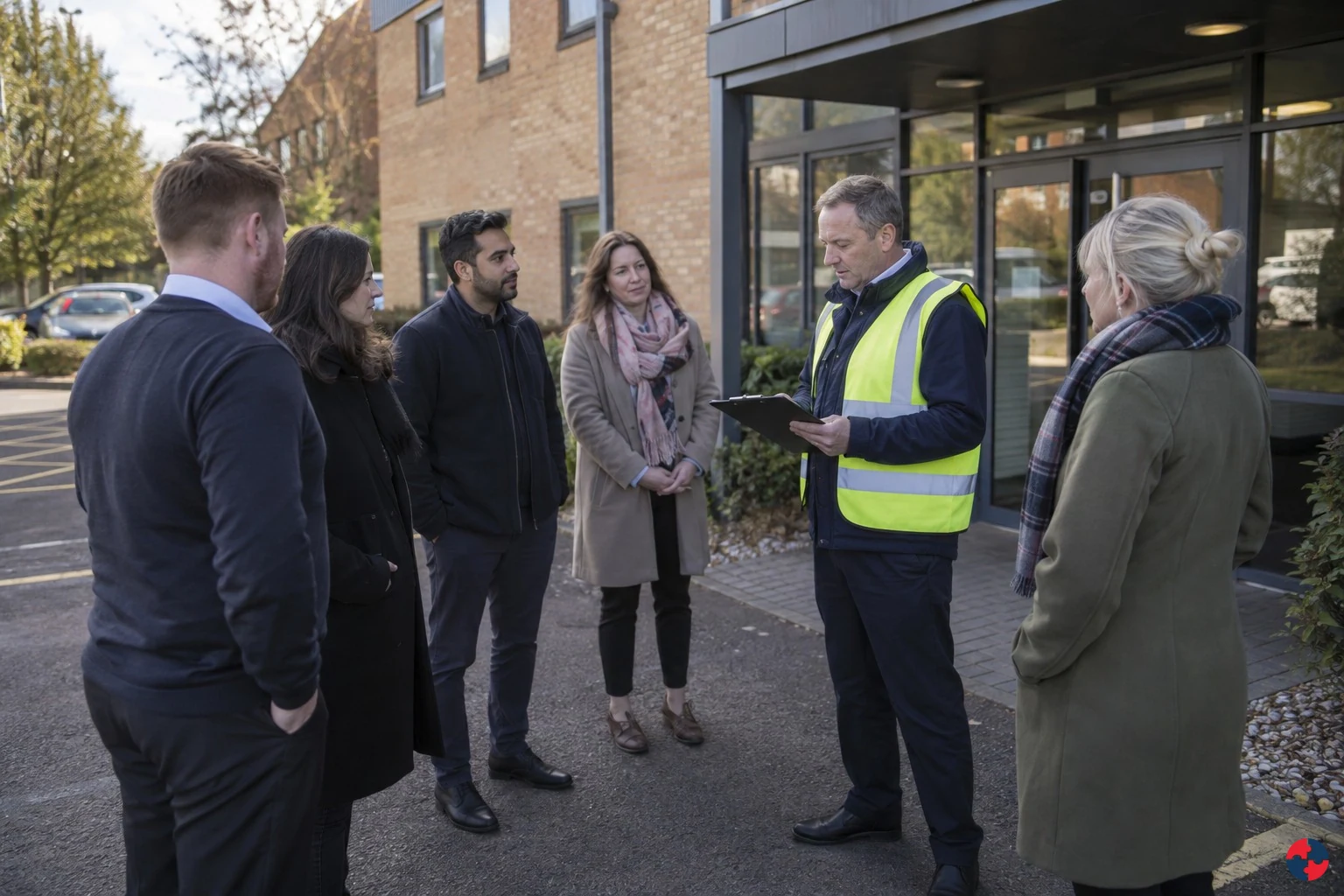
What are the key points about human behaviour in fire?
The key point is that evacuation arrangements must be designed for real people, not ideal behaviour. People may delay, seek confirmation or use a familiar exit during fire.
Turn human behaviour, wayfinding and crowd movement in fire knowledge into a decision
People may delay, seek confirmation or use a familiar exit during fire. Plan for smoke-blocked routes and crowd movement by checking realistic capacity, alternative exits, clear messages and assisted escape, then test the strategy for the actual building and occupants. FRA people-at-risk section and occupancy profile.
the leisure operator worked example
Assessment: Each venue fire risk assessment records likely users, maximum occupancy, pool users, disabled visitors, children, events, contractors and out-of-hours workers. Evidence / response: FRA people-at-risk section and occupancy profile. Warning and communication: Pool alarms, public address, visual warnings where needed and staff radios are tested in live background noise conditions. Evidence / response: Alarm audibility/visibility evidence and test logs.
Fire behaviour warning signs
People wait during drills: Pre-movement delay can use up escape time. Everyone uses main entrance: Crowd flow can overload one route. PEEPs not practised: Assisted escape may fail when needed.
Choose controls for human behaviour, wayfinding and crowd movement in fire
Eliminate: Remove avoidable ignition and obstruction; do not admit more people than safe capacity. Reduce: Use a safer route or lower-density arrangement where the original flow converges. Isolate: Keep smoke compartments and protected routes effective. Control: Provide usable alternative exits, visible signs and suitable audible/visual warnings. Control: Give clear zone-specific messages and trained steward/assistant directions. Read the full control table for qualifications, ownership and verification. Use the actual task and applicable jurisdiction; existing technical approval remains unchanged.
Use the full human behaviour, wayfinding and crowd movement in fire lesson
Use the full topic for the decision points, practical examples, detailed control tables and source scope. HSE guidance applies to Great Britain; use HSENI for the Northern Ireland route and the source’s stated jurisdiction. A simplified guide does not change the page’s technical-review or approval status.

Read all six steps as text
1. What are the key points about human behaviour in fire?
The key point is that evacuation arrangements must be designed for real people, not ideal behaviour.
- Avoid / redesign: Remove avoidable ignition and obstruction; do not admit more people than safe capacity.
- Control the task: Keep smoke compartments and protected routes effective.
- Verify before release: Capacity or route fails: stop admission.
The key point is that evacuation arrangements must be designed for real people, not ideal behaviour. People may delay, seek confirmation or use a familiar exit during fire.
Apply it: Which part of this plan would you check at the workface before authorising the task?
2. Turn human behaviour, wayfinding and crowd movement in fire knowledge into a decision
Use the evidence to improve the actual work arrangement.
- Change at source: Remove avoidable ignition and obstruction; do not admit more people than safe capacity.
- Make it observable: Capacity or route fails: stop admission.
- Keep useful evidence: FRA people-at-risk section and occupancy profile.
People may delay, seek confirmation or use a familiar exit during fire. Plan for smoke-blocked routes and crowd movement by checking realistic capacity, alternative exits, clear messages and assisted escape, then test the strategy for the actual building and occupants. FRA people-at-risk section and occupancy profile.
Apply it: What evidence would show that the change improves this task, rather than only completing a record?
3. the leisure operator worked example
Example: a practical application of the existing topic lesson.
- Assessment: Each venue fire risk assessment records likely users, maximum occupancy, pool users, disabled visitors, children, events, contractors and out-of-hours workers.
- Warning and communication: Pool alarms, public address, visual warnings where needed and staff radios are tested in live background noise conditions.
- Wayfinding: Alternative exits, changing-room routes, emergency lighting and signs are checked after layout changes, events or refurbishments.
Assessment: Each venue fire risk assessment records likely users, maximum occupancy, pool users, disabled visitors, children, events, contractors and out-of-hours workers. Evidence / response: FRA people-at-risk section and occupancy profile. Warning and communication: Pool alarms, public address, visual warnings where needed and staff radios are tested in live background noise conditions. Evidence / response: Alarm audibility/visibility evidence and test logs.
Apply it: At which point would you hold this example, and what evidence would allow it to proceed?
4. Fire behaviour warning signs
Connect the task, the route to the person and the control that can fail.
- People wait during drills: Pre-movement delay can use up escape time.
- Everyone uses main entrance: Crowd flow can overload one route.
- PEEPs not practised: Assisted escape may fail when needed.
People wait during drills: Pre-movement delay can use up escape time. Everyone uses main entrance: Crowd flow can overload one route. PEEPs not practised: Assisted escape may fail when needed.
Apply it: Who could be exposed, including other trades, cleaners, maintainers and people nearby?
5. Choose controls for human behaviour, wayfinding and crowd movement in fire
Start with the stronger practicable options and verify their effect.
- Eliminate: Remove avoidable ignition and obstruction; do not admit more people than safe capacity.
- Reduce: Use a safer route or lower-density arrangement where the original flow converges.
- Isolate: Keep smoke compartments and protected routes effective.
- Control: Provide usable alternative exits, visible signs and suitable audible/visual warnings.
- Control: Give clear zone-specific messages and trained steward/assistant directions.
Eliminate: Remove avoidable ignition and obstruction; do not admit more people than safe capacity. Reduce: Use a safer route or lower-density arrangement where the original flow converges. Isolate: Keep smoke compartments and protected routes effective. Control: Provide usable alternative exits, visible signs and suitable audible/visual warnings. Control: Give clear zone-specific messages and trained steward/assistant directions. Read the full control table for qualifications, ownership and verification. Use the actual task and applicable jurisdiction; existing technical approval remains unchanged.
Apply it: Which stronger option can be used here, and who will verify it before accepting the remaining risk?
6. Use the full human behaviour, wayfinding and crowd movement in fire lesson
Follow the official sources below and retain the task-specific evidence.
- Official guidance: Home Office fire risk assessment offices and shops
- Official guidance: HSE crowd safety risk assessment
- Task decision: FRA people-at-risk section and occupancy profile.
Use the full topic for the decision points, practical examples, detailed control tables and source scope. HSE guidance applies to Great Britain; use HSENI for the Northern Ireland route and the source’s stated jurisdiction. A simplified guide does not change the page’s technical-review or approval status.
Apply it: Which official source and full-topic section will you use to resolve the next decision?
People seek confirmation
Alarms can be ignored if people think they are false, unclear or someone else's responsibility.
Familiar routes dominate
People may head for the way they came in, even when a nearer exit is available.
Staff action changes outcomes
Calm, trained staff can reduce delay and direct people to safer routes.
Smoke changes everything
Visibility, breathing, fear and route choice can change quickly as smoke spreads.
Inclusive planning matters
Disabled people, children, older people, visitors and people with sensory needs need practical escape planning.
What does human behaviour in fire mean?
It means understanding how people perceive danger, make decisions, move and respond during fire conditions.
Fire safety often talks about alarms, doors, routes and signs. Human behaviour connects those controls to the people who must use them. An alarm only works if people hear it, understand it, believe it, know what to do and can move to a place of safety. Home Office fire risk assessment offices and shops
A good fire risk assessment considers perception, recognition, decision-making, wayfinding, crowd flow, mobility, sensory impairment, staff intervention and the effect of smoke and heat. It also accepts that people under stress may not behave like calm people reading a plan.
| Concept | Plain-English meaning | Fire safety implication |
|---|---|---|
| Perception | Noticing cues such as alarm, smoke, smell, heat or staff instructions. | Warnings must be noticeable and credible. Home Office fire risk assessment offices and shops |
| Recognition | Understanding that the cue means fire risk. | Training and drills reduce uncertainty. Home Office fire risk assessment offices and shops |
| Decision | Choosing whether to move, wait, investigate or help others. | Staff roles should remove delay. Home Office fire risk assessment offices and shops |
| Wayfinding | Selecting and following a route. | Routes, signs and lighting must be intuitive. Home Office fire risk assessment offices and shops |
| Crowd movement | How groups move through spaces, doors and stairs. | Capacity, flow and bottlenecks need assessment. Home Office fire risk assessment offices and shops |
Why might people not evacuate immediately?
Delay is common because people try to make sense of the situation before they act.
People may continue a conversation, finish a transaction, collect a phone, look for a manager, wait for a public announcement, follow colleagues, or assume the alarm is a test. In public venues, people may wait for staff because they do not know the building. In workplaces, people may continue a task because previous alarms were false. Home Office fire risk assessment offices and shops
Good emergency planning reduces uncertainty. It uses clear alarms, voice messages where suitable, trained wardens, visible staff direction, routine drills, contractor induction and firm rules about stopping work when the alarm sounds.
| Delay reason | Example | Control |
|---|---|---|
| False alarm history | Workers assume the alarm is another unwanted activation. | Investigate false alarms and reinforce response rules. Home Office fire risk assessment offices and shops |
| Role confusion | Staff wait for a manager before acting. | Define warden and supervisor actions. Home Office fire risk assessment offices and shops |
| Task fixation | Kitchen, control room or maintenance worker tries to finish task. | Train safe shutdown and immediate evacuation triggers. Home Office fire risk assessment offices and shops |
| Social influence | People follow the crowd or wait with colleagues. | Use staff direction and clear messages. Home Office fire risk assessment offices and shops |
| Unfamiliar building | Visitors look for the entrance they used. | Signs, lighting, staff and layout support. Home Office fire risk assessment offices and shops |
How should alarms and emergency communication influence behaviour?
Alarms should trigger a known action, not create confusion.
A ringing bell may be enough in simple premises with trained staff and familiar occupants. Larger, public, noisy, sleeping, multi-occupied or complex premises may need voice alarms, staged messages, visual alarms, staff radios, evacuation teams or different procedures for different zones. Home Office fire risk assessment offices and shops
Communication should be tested in real conditions. A message that sounds clear in a quiet office may fail in a swimming pool, nightclub, warehouse, kitchen, construction site or plant room. Drills should test audibility, visibility, language, staff confidence and visitor response.
| Setting | Behaviour risk | Communication control |
|---|---|---|
| Office | Staff delay because of frequent tests. | Clear test schedule and real-alarm instruction. Home Office fire risk assessment offices and shops |
| Warehouse | Alarm not heard over plant. | Audibility assessment and visual beacons where needed. Home Office fire risk assessment offices and shops |
| Leisure centre | Wet, changing and pool users need staff guidance. | Staff sweeps, public address and route support. Home Office fire risk assessment offices and shops |
| Care setting | Residents may need reassurance and staged support. | Trained staff roles and evacuation strategy. Home Office fire risk assessment offices and shops |
| Construction site | Temporary alarms may not reach all workfaces. | Distinctive warning, induction and muster control. Home Office fire risk assessment offices and shops |
How does wayfinding affect escape?
People need routes that are easy to find, understand and use under stress.
Wayfinding depends on layout, sightlines, signage, lighting, smoke, familiarity, cognitive load, language, disability and crowd density. People often choose familiar routes rather than optimal routes, so the design and management of routes must make the safe route obvious. Home Office fire risk assessment offices and shops
Escape routes should be kept available and unobstructed. Signage should not fight with advertising, decorations or temporary works. In smoke conditions, high-level signs may be obscured and people may need emergency lighting, low-level cues, staff direction or protected routes.
| Control | Why it helps | What to check |
|---|---|---|
| Clear route layout | Reduces decision-making time. | Can a visitor find the exit without local knowledge? Home Office fire risk assessment offices and shops |
| Consistent signage | Supports route choice under stress. | Are signs visible and not contradictory? Home Office fire risk assessment offices and shops |
| Emergency lighting | Maintains route visibility if power fails. | Are tests and defects recorded? Home Office fire risk assessment offices and shops |
| Staff direction | Guides unfamiliar people and redirects from blocked routes. | Are wardens trained and confident? Home Office fire risk assessment offices and shops |
| Housekeeping | Prevents route obstruction and trip hazards. | Are routes inspected daily? Home Office fire risk assessment offices and shops |
How should crowd movement be considered in fire evacuation?
Crowd movement depends on numbers, flow, bottlenecks, behaviour, route width and staff control.
Crowd problems can occur in shops, leisure venues, events, schools, transport hubs, hospitality, places of worship, theatres, stadium concourses and residential common parts. The issue is not only total numbers. It is how people enter, stand, queue, gather belongings, move through doors, use stairs, respond to staff and interact at pinch points. HSE crowd safety risk assessment
A competent assessment should consider maximum occupancy, event layouts, temporary barriers, door widths, stair flows, assisted escape, evacuation timing, staff numbers and what happens if the main entrance is blocked. Staff should be trained to use alternative exits confidently, not simply point people back to the way they came in.
| Factor | Why it matters | Evidence |
|---|---|---|
| Occupant numbers | Route capacity depends on likely people present. | Occupancy calculation and event plan. HSE crowd safety risk assessment |
| Bottlenecks | Doors, stairs, turnstiles and narrow corridors slow movement. | Walkthrough and layout review. HSE crowd safety risk assessment |
| Group behaviour | Families, friends or teams may try to stay together. | Staff briefing and public messaging. HSE crowd safety risk assessment |
| Queue layouts | Barriers can obstruct escape or redirect flow. | Event setup inspection. HSE crowd safety risk assessment |
| Main entrance pull | People may return to familiar entry points. | Alternative exit training and signage. HSE crowd safety risk assessment |
How should people who may need assistance be included?
Escape planning should be dignified, practical and based on consultation, not assumptions.
Agree assisted escape with the person and test the actual route, alarm and staffing. The 2025 English Residential Evacuation Plans Regulations, in force from 6 April 2026, apply only to specified residential buildings; their resident process must not be recast as a universal workplace PEEP requirement. Home Office means of escape for disabled people Fire Safety (Residential Evacuation Plans) (England) Regulations 2025 Residential PEEPs factsheet Home Office fire risk assessment offices and shops
Disabled people, older people, children, pregnant workers, people with temporary injuries, people with sensory impairment, people with neurodivergent needs, visitors unfamiliar with the building and people responsible for others may all need consideration. The fire risk assessment should identify who may be present, not only who is employed.
A personal emergency escape plan should be agreed where a known person may need assistance. For visitors, a generic emergency escape plan may be needed. A workplace evacuation plan should not rely on the fire and rescue service to remove people from the building; the separate in-scope English residential PEEPs process supports fire-service response where required.
| Group | Possible barrier | Control |
|---|---|---|
| Wheelchair user | Stairs or narrow routes. | PEEP, refuge, evacuation lift/chair where suitable and trained assistance. Home Office fire risk assessment offices and shops |
| Hearing impaired person | Alarm may not be heard. | Visual/vibrating alert or buddy arrangement. Home Office fire risk assessment offices and shops |
| Visual impairment | Route finding and hazards. | Clear routes, tactile familiarity and trained support. Home Office fire risk assessment offices and shops |
| Neurodivergent person | Alarm stress, crowding or unclear instructions. | Clear plan, predictable practice and calm support. Home Office fire risk assessment offices and shops |
| Visitor or customer | Unfamiliar exits. | Staff direction, signage and public messaging. Home Office fire risk assessment offices and shops |
| Children or cared-for people | Need adult direction and accountability. | Staff ratios, sweeps and roll-call process. Home Office fire risk assessment offices and shops |
How do smoke, heat and time pressure change behaviour?
A sign does not make a smoke-filled route safe
Low-level cues cannot make a smoke-contaminated route safe. Routine staff sweeps must not require entry into smoke or delay personal escape. During an unsafe exercise, pause the exercise; during a real incident, stop new admission and let the designated lead correct messages and direct people along the assessed safe route. Do not halt an evacuating crowd without the plan’s safe direction or improvise a rescue.
Smoke and heat reduce visibility, breathing safety: smoke may rapidly incapacitate or kill, decision quality and available escape time.
People make better decisions when they can see, breathe and understand what is happening. Smoke can remove those advantages quickly. It can obscure signs, hide exits, cause coughing or panic, change crowd flow and make a familiar route unusable. Heat can make people retreat, rush or abandon belongings. Home Office fire risk assessment offices and shops
The evacuation strategy should therefore assume that time matters. Early detection, credible alarm, short pre-movement time, protected routes, closed fire doors, compartmentation and trained staff all buy time for people to move safely.
| Fire condition | Behaviour effect | Control implication |
|---|---|---|
| Smoke layer | Signs and exits become harder to see. | Emergency lighting and route protection. Home Office fire risk assessment offices and shops |
| Smoke smell | May cause concern but not always action. | Clear alarm and staff instruction. Home Office fire risk assessment offices and shops |
| Heat | People may avoid routes or rush. | Protect escape routes and compartmentation. Home Office fire risk assessment offices and shops |
| Low visibility | People slow down or follow others. | Wayfinding, staff guidance and drills. Home Office fire risk assessment offices and shops |
| Time pressure | Decision quality reduces. | Simple practiced procedures. Home Office fire risk assessment offices and shops |
How should evacuation strategy reflect behaviour?
The strategy should match the building, people, fire risk, staffing and management capability.
A stay-put decision belongs only to a building-specific residential strategy supported by its fire safety design and competent assessment. Do not transplant it into an office, event venue or care setting. Smoke on a familiar route calls for clear alternative-route information and crowd control. Home Office fire risk assessment offices and shops HSE event emergency planning Home Office fire risk assessment offices and shops
Simultaneous evacuation may be suitable for many ordinary workplaces. Phased evacuation, progressive horizontal evacuation, defend-in-place or delayed evacuation arrangements may apply in certain buildings such as care settings, hospitals, residential blocks or complex premises, but only where the building design, compartmentation, staff training and management arrangements support the strategy.
A strategy written in a fire risk assessment is not enough. Staff must understand it, drills must test it and records must show that alarm zones, door condition, emergency lighting, refuges, communication and staffing levels remain suitable.
| Strategy | Where it may apply | Behaviour and management issue |
|---|---|---|
| Simultaneous evacuation | Many simple workplaces. | Everyone leaves when alarm sounds. Home Office fire risk assessment offices and shops |
| Phased evacuation | Larger or taller buildings where staged movement is designed. | People need clear zone instructions. Home Office fire risk assessment offices and shops |
| Progressive horizontal evacuation | Care or healthcare settings in England with suitable compartmentation and staff support. | Staff move people to adjacent safer compartments. Home Office guide for people with fire-safety duties Home Office residential care fire guide |
| Stay put or defend in place | Some high-rise residential buildings in England where the assessed design supports it. | Residents need clear, building-specific instructions. Government high-rise residential fire strategy guidance |
| Event evacuation | Public venues and temporary events. | Staff manage routes, exits, crowd flow and assembly. Home Office fire risk assessment offices and shops |
How does this apply in different sectors?
Sector examples help learners see why the same human behaviour principles need different controls.
An office worker may need a clear alarm and unobstructed stair. A hotel guest may be asleep, unfamiliar with the route and delayed by collecting belongings. A care resident may need staff assistance. A construction worker may be on a changing upper floor with temporary stairs. A nightclub customer may face noise, low light, crowding and alcohol. Each setting changes the human response. Home Office fire risk assessment offices and shops
This is why the fire risk assessment should not copy a generic evacuation plan. It should describe who is present, how they are warned, how they move, who helps them, what can obstruct them and how the plan is tested.
| Sector | Human behaviour issue | Control focus |
|---|---|---|
| Office | False alarm complacency and familiar-route bias. | Drills, warden sweeps and route checks. Home Office fire risk assessment offices and shops |
| Warehouse | Noise, forklifts and long travel distances. | Audibility, beacons, route protection and muster. Home Office factories and warehouses fire guide |
| Care setting | Assisted escape and reassurance. | Staff roles, progressive movement and compartment evidence. Home Office residential care fire guide |
| Hospitality/hotel | Sleeping occupants and unfamiliar routes. | Alarm clarity, staff sweeps and guest information. Home Office sleeping accommodation fire guide |
| Construction | Changing routes, temporary alarms and contractors. | Induction, fire plan updates and daily route checks. HSE general fire safety in construction |
| Residential common parts | Mixed familiarity, mobility and building strategy. | Resident information and common route management. Home Office sleeping accommodation fire guide |
What practical scenarios bring fire behaviour and wayfinding to life?
Scenarios help learners and managers test whether the evacuation plan would work with real people, noise, delay and confusion.
Fire behaviour and wayfinding scenarios — part 1 of 2


Read the complete visual as text
- Leisure centre pool evacuation: Likely human behaviour issue: Swimmers may be barefoot, wet, cold, embarrassed, confused about belongings and dependent on lifeguard direction. Good control response: Pool evacuation procedure, foil blankets or shelter route, trained lifeguards, changing-room sweep and clear assembly plan.
- Nightclub or crowded venue: Likely human behaviour issue: Noise, darkness, alcohol, queues, music, social groups and blocked sightlines can delay response and create pressure at exits. Good control response: Voice messages, trained stewards, managed door flows, alternative exit use, capacity control and no blocked escape routes.
- Hospital or care setting: Likely human behaviour issue: Residents or patients may need reassurance, assisted movement and progressive horizontal evacuation rather than immediate stairs. Good control response: Staff roles, compartmentation evidence, evacuation aids, PEEPs, drills by shift and sufficient staffing. Applicable official guidance Applicable official guidance
Fire behaviour and wayfinding scenarios — part 2 of 2


Read the complete visual as text
- Office with visitors: Likely human behaviour issue: Visitors may follow the host, head to reception or miss local alarm instructions. Good control response: Visitor briefing, host responsibility, warden sweep, clear signs and reception accountability.
- Retail queue or event crowd: Likely human behaviour issue: People may stay in queues, gather bags, seek family members or follow the main entrance. Good control response: Staff direction, public address, queue barrier layout, alternative exits and assembly communication.
Fire behaviour becomes clearer when it is placed into a recognisable situation. People do not simply hear an alarm and move like dots on a plan. They may be wet from a swimming pool, seated in a dark venue, caring for residents, handling cash at a till, queuing with children, working alone, using a wheelchair, speaking another language or trying to finish a task. HSE crowd safety risk assessment
A good fire drill or desktop exercise should therefore ask what people will probably do first, what staff need to say, which route they will naturally choose, where congestion will form, who may need support and what evidence will show whether the plan actually worked.
| Scenario | Likely human behaviour issue | Good control response |
|---|---|---|
| Leisure centre pool evacuation | Swimmers may be barefoot, wet, cold, embarrassed, confused about belongings and dependent on lifeguard direction. | Pool evacuation procedure, foil blankets or shelter route, trained lifeguards, changing-room sweep and clear assembly plan. HSE crowd safety risk assessment |
| Nightclub or crowded venue | Noise, darkness, alcohol, queues, music, social groups and blocked sightlines can delay response and create pressure at exits. | Voice messages, trained stewards, managed door flows, alternative exit use, capacity control and no blocked escape routes. HSE crowd safety risk assessment |
| Hospital or care setting | Residents or patients may need reassurance, assisted movement and progressive horizontal evacuation rather than immediate stairs. | Staff roles, compartmentation evidence, evacuation aids, PEEPs, drills by shift and sufficient staffing. Home Office guide for people with fire-safety duties Home Office residential care fire guide |
| Office with visitors | Visitors may follow the host, head to reception or miss local alarm instructions. | Visitor briefing, host responsibility, warden sweep, clear signs and reception accountability. HSE crowd safety risk assessment |
| Retail queue or event crowd | People may stay in queues, gather bags, seek family members or follow the main entrance. | Staff direction, public address, queue barrier layout, alternative exits and assembly communication. HSE crowd safety risk assessment |
What evidence shows fire behaviour and evacuation are managed?
Evidence should prove that plans reflect people, routes, warning systems, drills and learning.
A good file includes more than the fire risk assessment. It should include occupancy assumptions, evacuation strategy, PEEP or generic emergency escape arrangements, alarm tests, emergency lighting checks, fire door inspections, route inspections, drill reports, training records, defect logs and action close-out. Home Office fire risk assessment offices and shops
Drill records should not simply say 'completed'. They should capture behaviour: delay, wrong route choice, congestion, staff confidence, people left behind, visitors managed, assembly point control and lessons learned.
| Evidence | What it can evidence | What to challenge |
|---|---|---|
| Fire risk assessment | People at risk and escape strategy considered. | Does it match current occupancy and layout? Home Office fire risk assessment offices and shops |
| PEEP/escape plan | Known support needs are planned. | Are staff trained and equipment available? Home Office fire risk assessment offices and shops |
| Drill report | Behaviour and timing were tested. | Were lessons recorded and closed? Home Office fire risk assessment offices and shops |
| Route inspection | Routes remain clear and available. | Are temporary changes captured? Home Office fire risk assessment offices and shops |
| Alarm test | Warning system is working. | Can people hear/see it in real conditions? Home Office fire risk assessment offices and shops |
| Training record | Staff know roles and instructions. | Does it include contractors and out-of-hours teams? Home Office fire risk assessment offices and shops |
Which legal route applies to this task?
Select the instrument for the actual UK nation, activity, premises and threshold. Guidance supports decisions but does not itself create a universal duty.
Fire safety is nation- and premises-specific; the English residential evacuation-plan regulation is a narrow residential route. Management of Health and Safety at Work Regulations 1999 Management of Health and Safety at Work Regulations (NI) 2000
| Nation and setting | Primary law | Companion law or official scope guide | When to use this route |
|---|---|---|---|
| England and Wales premises | Regulatory Reform (Fire Safety) Order 2005 Law / guidance | — | Apply to covered premises and relevant persons. |
| Scotland premises | Fire (Scotland) Act 2005 Law / guidance | Fire Safety (Scotland) Regulations 2006 Law / guidance | Apply Act and supporting regulations together. |
| Northern Ireland premises | Fire and Rescue Services (NI) Order 2006 Law / guidance | Fire Safety Regulations (NI) 2010 Law / guidance | Apply Order and supporting regulations together. |
| Great Britain construction phase | Construction (Design and Management) Regulations 2015 Law / guidance | — | Only where construction duties are triggered. |
| Northern Ireland construction phase | Construction (Design and Management) Regulations (NI) 2016 Law / guidance | — | Use separate 2016 NI construction instrument. |
| Great Britain disability route | Equality Act 2010 Law / guidance | — | Assess reasonable adjustments on the facts. |
| Northern Ireland disability route | Disability Discrimination Act 1995 as amended for NI Law / guidance | — | Use NI disability route, not GB Equality Act. |
| Specified English residential buildings | Fire Safety (Residential Evacuation Plans) (England) Regulations 2025 Law / guidance | Residential PEEPs factsheet Law / guidance | Check building scope and resident process; not a general workplace rule. |
How can the hierarchy of controls reduce crowd and wayfinding risks during fire evacuation?
ERICPD is used here as a planning mnemonic. The linked HSE five-level hierarchy is the official source for the order and relative reliability of controls; the two labels are not identical.
Start at the physical hazard and prefer avoiding or redesigning the exposure before relying on instructions or PPE.
ERICPD is a planning mnemonic. Isolate usually maps to engineering, Discipline sustains controls, and the five-level hierarchy separately names substitution. These candidates require competent assessment of the actual task. HSE five-level hierarchy HSE five-level hierarchy
How can the ERICPD hierarchy of controls reduce crowd and wayfinding risks during fire evacuation?

| ERICPD stage | Five-level mapping | Task intervention | Owner and check | Failure / stop |
|---|---|---|---|---|
| Eliminate | Elimination | Remove avoidable ignition and obstruction; do not admit more people than safe capacity. | Venue lead checks design and occupancy. | Capacity or route fails: stop admission. HSE crowd safety risk assessment |
| Reduce | Substitution | Use a safer route or lower-density arrangement where the original flow converges. | Fire lead models actual occupancy. | New congestion: revise. HSE crowd safety risk assessment |
| Isolate | Engineering | Keep smoke compartments and protected routes effective. | Responsible person checks doors and route. | Smoke or door failure: use safe alternative. Home Office fire risk assessment offices and shops |
| Control: physical | Engineering | Provide usable alternative exits, visible signs and suitable audible/visual warnings. | Competent person tests under realistic conditions. | Signal or route fails: hold occupancy. Home Office fire risk assessment offices and shops |
| Control: method | Administrative | Give clear zone-specific messages and trained steward/assistant directions. | Incident lead tests drill. | Conflicting directions: stop and correct. HSE crowd controls inside venues |
| PPE | PPE | Use task PPE for responders only where assessed; it does not substitute for safe public escape. | Incident lead checks responder plan. | Unprotected rescue attempt: withdraw. HSE event emergency planning |
| Discipline | Sustains controls | Debrief movement, assistance and crowd bottlenecks after drills or events. | Responsible person closes actions. | Repeated bottleneck: redesign. HSE crowd safety risk assessment |
How can the ISO 45001 hierarchy of controls reduce crowd and wayfinding risks during fire evacuation?

| ERICPD stage | Five-level mapping | Task intervention | Owner and check | Failure / stop |
|---|---|---|---|---|
| Eliminate | Elimination | Remove avoidable ignition and obstruction; do not admit more people than safe capacity. | Venue lead checks design and occupancy. | Capacity or route fails: stop admission. HSE crowd safety risk assessment |
| Reduce | Substitution | Use a safer route or lower-density arrangement where the original flow converges. | Fire lead models actual occupancy. | New congestion: revise. HSE crowd safety risk assessment |
| Isolate | Engineering | Keep smoke compartments and protected routes effective. | Responsible person checks doors and route. | Smoke or door failure: use safe alternative. Home Office fire risk assessment offices and shops |
| Control: physical | Engineering | Provide usable alternative exits, visible signs and suitable audible/visual warnings. | Competent person tests under realistic conditions. | Signal or route fails: hold occupancy. Home Office fire risk assessment offices and shops |
| Control: method | Administrative | Give clear zone-specific messages and trained steward/assistant directions. | Incident lead tests drill. | Conflicting directions: stop and correct. HSE crowd controls inside venues |
| PPE | PPE | Use task PPE for responders only where assessed; it does not substitute for safe public escape. | Incident lead checks responder plan. | Unprotected rescue attempt: withdraw. HSE event emergency planning |
| Discipline | Sustains controls | Debrief movement, assistance and crowd bottlenecks after drills or events. | Responsible person closes actions. | Repeated bottleneck: redesign. HSE crowd safety risk assessment |
How should management verify controls for this task?
How should management verify controls for this task?


Read the complete visual as text
- For smoke-blocked familiar exit and crowd movement in a…: For smoke-blocked familiar exit and crowd movement in a public venue, the management check should start with a real control decision: Remove avoidable ignition and obstruction; do not admit more people than safe capacity. Name the person who will test it, keep evidence from the actual work, and reopen the assessment when the failure condition in the hierarchy table occurs. HSE management-system guidance .
- A review should compare the planned control with what…: A review should compare the planned control with what workers and supervisors can use in practice. Record the defect, owner, interim protection, verification and next review trigger so that a policy statement or certificate does not stand in for a working control.
For smoke-blocked familiar exit and crowd movement in a public venue, the management check should start with a real control decision: Remove avoidable ignition and obstruction; do not admit more people than safe capacity. Name the person who will test it, keep evidence from the actual work, and reopen the assessment when the failure condition in the hierarchy table occurs. HSE management-system guidance.
A review should compare the planned control with what workers and supervisors can use in practice. Record the defect, owner, interim protection, verification and next review trigger so that a policy statement or certificate does not stand in for a working control.
How could Riverside Leisure Ltd manage this in practice?

Riverside Leisure Ltd would manage evacuation behaviour by designing alarms, staff roles, wayfinding, crowd control and assisted escape around real users.
Riverside Leisure Ltd is a leisure business with swimming pools, gyms, cafes, event spaces, changing rooms, plant rooms, children, older visitors, contractors, seasonal staff and public occupancy. Evacuation is a human behaviour problem as much as a building problem. Home Office small and medium assembly fire guide
| Management element | How the business would manage it | Evidence to review |
|---|---|---|
| Assessment | Each venue fire risk assessment records likely users, maximum occupancy, pool users, disabled visitors, children, events, contractors and out-of-hours workers. | FRA people-at-risk section and occupancy profile. Home Office small and medium assembly fire guide |
| Warning and communication | Pool alarms, public address, visual warnings where needed and staff radios are tested in live background noise conditions. | Alarm audibility/visibility evidence and test logs. Home Office small and medium assembly fire guide |
| Wayfinding | Alternative exits, changing-room routes, emergency lighting and signs are checked after layout changes, events or refurbishments. | Route inspection and event setup checklist. Home Office small and medium assembly fire guide |
| Staff roles | Duty managers, lifeguards, reception, cafe and cleaners have clear sweep, direction, call and assembly roles. | Training matrix and drill reports. HSE crowd controls inside venues |
| Assisted escape | Known worker support needs are managed through PEEPs and visitor needs through generic support arrangements. | PEEP records and visitor assistance procedure. Home Office means of escape for disabled people |
| Learning | Drills review delay, route choice, crowd pinch points, pool evacuation, visitor confusion and assembly control. | Drill learning log and action tracker. HSE crowd safety risk assessment |
What must each role demonstrate?
Observe a role-specific decision or simulation, record the assessor and evidence, and reassess after a relevant change.
Briefing attendance alone is insufficient evidence that a person can recognise a hold point or act in the field. Home Office fire risk assessment offices and shops
| Role | Demonstration | Assessor and record | Reassess when |
|---|---|---|---|
| Responsible person | Validate site fire strategy, capacity and alternate routes. | Fire specialist reviews drill and assessment. | Layout or occupancy changes. Home Office fire risk assessment offices and shops |
| Steward | Detect congestion and direct people away from smoke-blocked route. | Incident lead observes drill. | Event profile or route changes. HSE crowd controls inside venues |
| Assistant | Practise agreed assisted escape with the person concerned. | Fire lead records safe demonstration. | Person or building needs change. Home Office fire risk assessment offices and shops |
| Communications lead | Issue clear, consistent location-specific messages. | Incident lead observes exercise. | Alarm or message system changes. HSE event emergency planning |
| Venue manager | Close bottlenecks and keep exits available. | Senior manager samples event record. | Capacity or layout changes. HSE crowd safety risk assessment |
How does this support NEBOSH Fire Safety study?
For NEBOSH Fire learners, this topic is about turning human behaviour theory into evacuation decisions.
A good learner answer should explain sensory perception, alarm recognition, pre-movement delay, familiar-route bias, stress, decision-making, crowd flow, smoke effects, disabled escape and staff intervention. It should then connect those points to fire risk assessment and emergency planning. HSE event emergency planning
Scenario answers should avoid saying only 'provide signs'. Better answers explain how signs, lighting, alarms, staff training, drills, route protection, occupancy control and PEEPs work together.
| Prompt | Good answer should include | Weak answer |
|---|---|---|
| Why might people ignore an alarm? | False alarm history, uncertainty, social influence and poor communication. | Because people panic. HSE event emergency planning |
| How does wayfinding affect escape? | Familiar routes, signs, lighting, smoke and staff direction. | Put up exit signs. HSE event emergency planning |
| How should disabled people be included? | Consultation, PEEP/generic plan, equipment, staff training and dignity. | Wait for fire service. Home Office means of escape for disabled people |
| How can drills improve safety? | Test behaviour, staff roles, timing, routes and action close-out. | Tick annual drill box. HSE event emergency planning |
What are the warning signs that evacuation behaviour is not understood?
Warning signs show that the written plan may fail when people are under pressure.
Warning signs are included because failure usually appears before a serious event. Treat these points as prompts for inspection, audit, supervision and management review rather than as simple compliance statements. Home Office fire risk assessment offices and shops
| Warning sign | How it can cause harm | What to do |
|---|---|---|
| People wait during drills | Pre-movement delay can use up escape time. | Improve messages, staff action and alarm credibility. Home Office fire risk assessment offices and shops |
| Everyone uses main entrance | Crowd flow can overload one route. | Train alternative route use. Home Office fire risk assessment offices and shops |
| PEEPs not practised | Assisted escape may fail when needed. | Consult, train and test arrangements. Home Office fire risk assessment offices and shops |
| Routes change without briefing | People may head into blocked or confusing areas. | Update signs, plan and induction. Home Office fire risk assessment offices and shops |
| No visitor plan | Public occupants may not know what to do. | Assign staff direction and information. Home Office fire risk assessment offices and shops |
What do the acronyms and key terms mean?
Acronyms should be understood before they are used in assessments, briefings, audits or learning answers.
Acronyms can exclude newer readers if they are not explained. This section keeps the main terms available at the end of the page so the article stays readable while still supporting learners and audit users.
| Acronym | Meaning | Plain-English use |
|---|---|---|
| FRA | Fire risk assessment | Organised assessment of fire hazards, people at risk and precautions. |
| PEEP | Personal emergency escape plan | Plan for a known person who may need assistance to escape. |
| GEEP | Generic emergency escape plan | General plan for visitors or unknown occupants needing assistance. |
| RSET | Required safe escape time | Time needed for people to reach safety. |
| ASET | Available safe escape time | Time before conditions become unsafe. |
| Warden | Fire warden or marshal | Person with defined fire emergency duties. |
Unlock another resource
You have used this month’s two free downloads. Publish a post in your own words to unlock one more resource, or choose SHARE Individual for 10 downloads per month.
You decide whether to share. If you do, use the relevant platform disclosure tools and do not make claims you do not genuinely hold.