SHARE Knowledge Hub
Workplace Immunisation and Vaccination
Vaccination uses a vaccine to stimulate protection against a specific infection; immunisation is the protection that results. At work, biological agents can reach people through inhalation, contaminated hands, splashes or sharps, and the risk depends on the task and agent. Employers should prevent exposure first and, where an effective vaccine is relevant to assessed work, arrange a clinically advised offer while protecting the worker’s health information.
Understanding Workplace Immunisation and Vaccination
Vaccination uses a vaccine to stimulate protection against a specific infection; immunisation is the protection that results. At work, biological agents can reach people through inhalation, contaminated hands, splashes or sharps, and the risk depends on the task and agent. Employers should prevent exposure first and, where an effective vaccine is relevant to assessed work, arrange a clinically advised offer while protecting the worker’s health information.
Why this matters at work
Some infections have long-term consequences, including chronic hepatitis, post-infectious complications, organ damage and prolonged fatigue. Pregnancy may change the consequences of specific agents for the worker or fetus. Immunocompromised people may develop severe disease from agents that rarely harm healthy adults. The risk assessment should use current agent-specific advice rather than a generic vulnerable-worker label.
Psychological harm can follow a needlestick, uncertain exposure, colleague illness, outbreak, isolation or fear of transmitting infection to family. Prompt factual communication, confidential clinical access and proportionate follow-up reduce harm. Stigma, blame and disclosure of medical information can worsen distress and undermine reporting, so they are control failures as well as people-management failures.
How organisations manage this in practice
Outbreak management combines epidemiology and operational control. Define cases, line-list onset and exposure without over-sharing identities, compare groups, inspect common sources, collect suitable samples through competent channels, implement precautionary controls and update advice as evidence changes. Association is not proof of causation; equally, uncertainty should not delay proportionate prevention.
Susceptibility varies with immunity, vaccination, age, pregnancy, underlying disease, medicines and previous exposure. The employer should consider vulnerability through confidential occupational-health advice and task control, not by asking managers to diagnose people. Controls should be strong enough for the exposed group and should not rely on workers disclosing sensitive information to line management.
A contracted vaccination service is part of the employer control arrangement and should be specified against the occupational risk, not bought as a generic clinic event. The employer should provide the provider with role and exposure information, expected workforce numbers and locations, access needs, likely start dates, escalation arrangements and the current source used for clinical decisions. The provider should demonstrate appropriate clinical governance, qualified staff, consent processes, emergency arrangements, secure records and a route for individual follow-up. Procurement must not transfer the employer duty to assess and control exposure.
What can this page help a workplace decide?
Vaccination can reduce the risk from specific infections, but a workplace decision starts with the actual exposure, the people affected and the controls already in place. This page helps managers and workers ask the right questions and find qualified clinical advice.
Best-practice guide: Immunisation and Vaccination
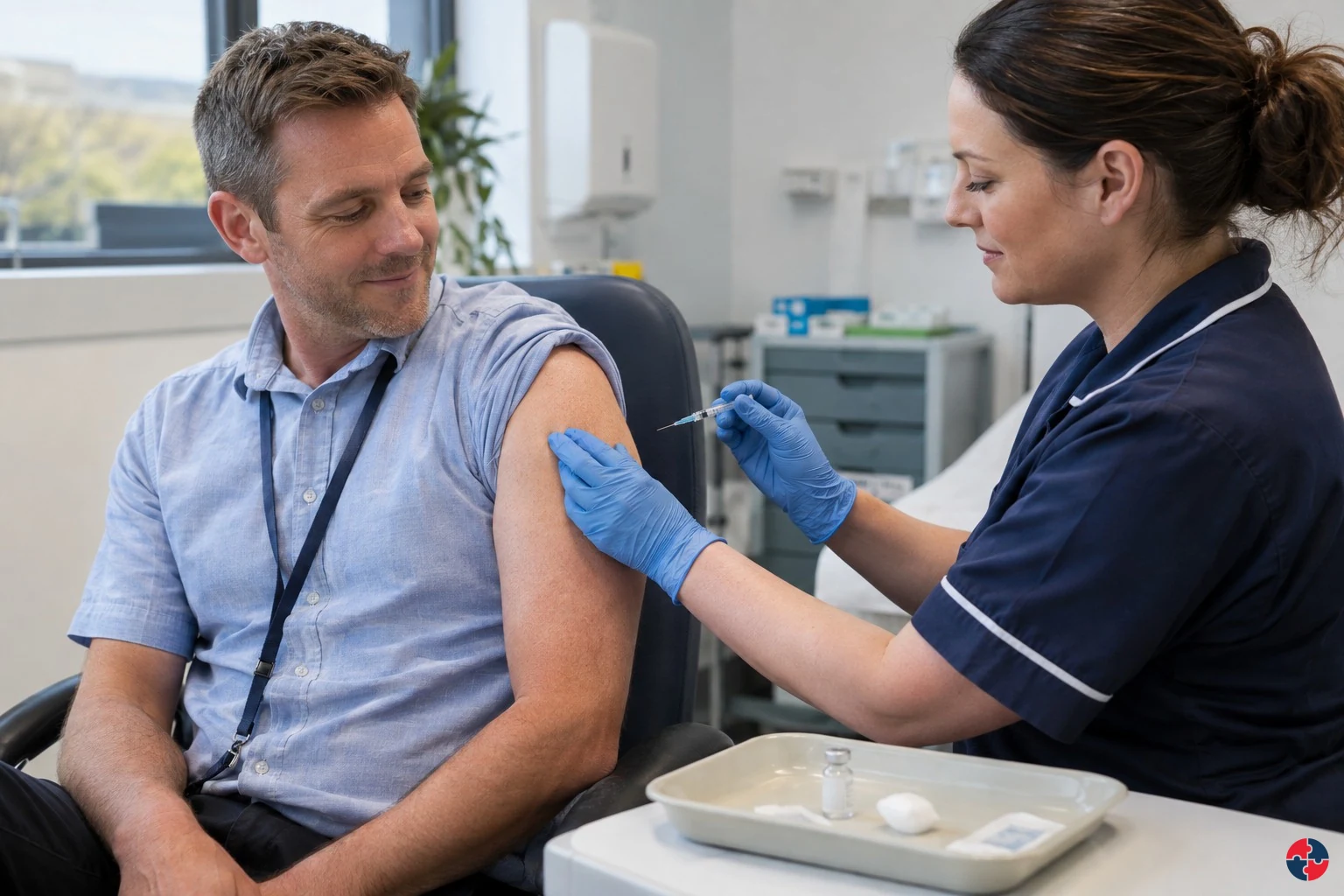
What can this page help a workplace decide?
Vaccination can reduce the risk from specific infections, but a workplace decision starts with the actual exposure, the people affected and the controls already in place. This page helps managers and workers ask the right questions and find qualified clinical advice. Vaccination uses a vaccine to stimulate protection against a specific infection; immunisation is the protection that results.
Turn immunisation and vaccination knowledge into a decision
Vaccination uses a vaccine to stimulate protection against a specific infection; immunisation is the protection that results. At work, biological agents can reach people through inhalation, contaminated hands, splashes or sharps, and the risk depends on the task and agent. Keep the risk assessment, controls, training and incident actions.
Cleaning in a clinical setting after a sharps near miss
Follow the agreed cleaning method and do not handle an unidentified sharp by hand. If a worker declines or has uncertain protection, review other controls and safe work with occupational health; do not assume either immunity or inability to work. Document safe removal and area release under client procedures.
Exposure route and potential harm
Clinical cleaning: discarded sharp punctures skin: Bloodborne infection; hepatitis B can cause long-term liver disease if infection is acquired. Exposure route 2: Close-contact service: infectious respiratory droplets or aerosols are inhaled Acute respiratory illness; severity varies by agent and individual. Exposure route 3: Waste handling or food service: contaminated hands reach mouth Acute gastrointestinal infection; dehydration or more severe effects may occur.
Choose controls for immunisation and vaccination
Elimination: Avoid unnecessary sharps and use a non-invasive method if it meets the clinical or analytical purpose. Substitution: Use a lower-exposure collection method and reduce handling steps; a vaccine is supplementary, not a substitute for exposure control. Engineering: Use engineered safety sharps, closed containers and a controlled work area; place disposal at point of use. Administrative: Assess the biological agent, train the response, offer relevant effective immunisation and record confidential follow-up. Personal protection: Select gloves, eye/face protection and clothing for residual splash/contact; they do not prevent a needlestick. Read the full control table for qualifications, ownership and verification. Use the actual task and applicable jurisdiction; existing technical approval remains unchanged.
Use the full immunisation and vaccination lesson
Use the full topic for the decision points, practical examples, detailed control tables and source scope. HSE guidance applies to Great Britain; use HSENI for the Northern Ireland route and the source’s stated jurisdiction. A simplified guide does not change the page’s technical-review or approval status.

Read all six steps as text
1. What can this page help a workplace decide?
Vaccination can reduce the risk from specific infections, but a workplace decision starts with the actual exposure, the people affected and the controls already in place.
- Avoid / redesign: Avoid unnecessary sharps and use a non-invasive method if it meets the clinical or analytical purpose.
- Control the task: Use engineered safety sharps, closed containers and a controlled work area; place disposal at point of use.
- Verify before release: Clinical/task lead validates method; do not substitute if it compromises care or sample integrity.
Vaccination can reduce the risk from specific infections, but a workplace decision starts with the actual exposure, the people affected and the controls already in place. This page helps managers and workers ask the right questions and find qualified clinical advice. Vaccination uses a vaccine to stimulate protection against a specific infection; immunisation is the protection that results.
Apply it: Which part of this plan would you check at the workface before authorising the task?
2. Turn immunisation and vaccination knowledge into a decision
Use the evidence to improve the actual work arrangement.
- Change at source: Avoid unnecessary sharps and use a non-invasive method if it meets the clinical or analytical purpose.
- Make it observable: Clinical/task lead validates method; do not substitute if it compromises care or sample integrity.
- Keep useful evidence: Keep the risk assessment, controls, training and incident actions.
Vaccination uses a vaccine to stimulate protection against a specific infection; immunisation is the protection that results. At work, biological agents can reach people through inhalation, contaminated hands, splashes or sharps, and the risk depends on the task and agent. Keep the risk assessment, controls, training and incident actions.
Apply it: What evidence would show that the change improves this task, rather than only completing a record?
3. Cleaning in a clinical setting after a sharps near miss
Example: a practical application of the existing topic lesson.
- Setting: A the process operator facilities contractor cleans a healthcare client area and may encounter clinical waste or a discarded sharp.
- Act: Remove or isolate the exposed sharp through the client’s authorised route.
- Hold / review: Stop for an uncovered sharp, damaged container, unknown waste, missing induction or a failed control.
Follow the agreed cleaning method and do not handle an unidentified sharp by hand. If a worker declines or has uncertain protection, review other controls and safe work with occupational health; do not assume either immunity or inability to work. Document safe removal and area release under client procedures.
Apply it: At which point would you hold this example, and what evidence would allow it to proceed?
4. Exposure route and potential harm
Connect the task, the route to the person and the control that can fail.
- Clinical cleaning: discarded sharp punctures skin: Bloodborne infection; hepatitis B can cause long-term liver disease if infection is acquired.
- Exposure route 2: Close-contact service: infectious respiratory droplets or aerosols are inhaled Acute respiratory illness; severity varies by agent and individual.
- Exposure route 3: Waste handling or food service: contaminated hands reach mouth Acute gastrointestinal infection; dehydration or more severe effects may occur.
Clinical cleaning: discarded sharp punctures skin: Bloodborne infection; hepatitis B can cause long-term liver disease if infection is acquired. Exposure route 2: Close-contact service: infectious respiratory droplets or aerosols are inhaled Acute respiratory illness; severity varies by agent and individual. Exposure route 3: Waste handling or food service: contaminated hands reach mouth Acute gastrointestinal infection; dehydration or more severe effects may occur.
Apply it: Who could be exposed, including other trades, cleaners, maintainers and people nearby?
5. Choose controls for immunisation and vaccination
Start with the stronger practicable options and verify their effect.
- Elimination: Avoid unnecessary sharps and use a non-invasive method if it meets the clinical or analytical purpose.
- Substitution: Use a lower-exposure collection method and reduce handling steps; a vaccine is supplementary, not a substitute for exposure control.
- Engineering: Use engineered safety sharps, closed containers and a controlled work area; place disposal at point of use.
- Administrative: Assess the biological agent, train the response, offer relevant effective immunisation and record confidential follow-up.
- Personal protection: Select gloves, eye/face protection and clothing for residual splash/contact; they do not prevent a needlestick.
Elimination: Avoid unnecessary sharps and use a non-invasive method if it meets the clinical or analytical purpose. Substitution: Use a lower-exposure collection method and reduce handling steps; a vaccine is supplementary, not a substitute for exposure control. Engineering: Use engineered safety sharps, closed containers and a controlled work area; place disposal at point of use. Administrative: Assess the biological agent, train the response, offer relevant effective immunisation and record confidential follow-up. Personal protection: Select gloves, eye/face protection and clothing for residual splash/contact; they do not prevent a needlestick. Read the full control table for qualifications, ownership and verification. Use the actual task and applicable jurisdiction; existing technical approval remains unchanged.
Apply it: Which stronger option can be used here, and who will verify it before accepting the remaining risk?
6. Use the full immunisation and vaccination lesson
Follow the official sources below and retain the task-specific evidence.
- Official guidance: UKHSA Green Book collection
- Official guidance: HSE immunisation at work
- Task decision: Keep the risk assessment, controls, training and incident actions.
Use the full topic for the decision points, practical examples, detailed control tables and source scope. HSE guidance applies to Great Britain; use HSENI for the Northern Ireland route and the source’s stated jurisdiction. A simplified guide does not change the page’s technical-review or approval status.
Apply it: Which official source and full-topic section will you use to resolve the next decision?
Workplace vaccination decisions depend on the task, agent, exposure route and who may be affected. Occupational health and current UKHSA guidance and individual clinical advice determine individual suitability and schedules; managers need only the functional information required to control work. The Great Britain and Northern Ireland COSHH routes differ, so use the relevant local legal instrument.
What are vaccination and immunisation?
Vaccination is receiving a vaccine intended to train the immune system against a particular infection. Immunisation is the resulting protection, which can vary by vaccine, person and time. Vaccination does not guarantee that someone cannot become infected or transmit infection.
Vaccines stimulate an immune response without requiring the person to experience the full disease. Some programmes involve more than one dose or later boosters, but the schedule and eligibility change and must come from current UKHSA Green Book collection advice. Clinicians consider a person’s age, health, pregnancy, previous doses and exposure. Managers should not infer immunity from an informal account of vaccination.
Infection prevention also depends on close contact, shared facilities, ventilation, hygiene and whether an unwell worker feels able to stay away. Those factors matter whether or not a vaccine exists. A manager should focus on safe attendance and support, not diagnose symptoms.
When is vaccination an occupational control?
Where work can expose people to a biological agent and an effective vaccine is available, the employer’s competent risk assessment should identify whether it needs to be offered. It supplements exposure controls; it does not replace them.
Examples include some healthcare, laboratory, clinical waste, animal and sharps-related tasks. The pathogen, route of exposure, frequency, consequences and who may be harmed matter. The precise vaccine decision belongs to occupational health using current UKHSA disease chapters. For hepatitis B, UKHSA Green Book hepatitis B chapter 18 explains occupational risk groups and why post-exposure arrangements may differ by task. See HSE immunisation at work.
A general seasonal awareness campaign for a low-exposure office is a different decision from a risk-led occupational offer. Offer clear official information without implying that every worker has the same occupational requirement. HSE says a worker may decline a vaccine or may not respond; the employer must then review whether other controls allow safe work. HSE preventing incidental exposure to infection is the GB regulator route.
What controls come before and alongside a vaccine?
Prevent or reduce exposure at source, use safe systems and suitable facilities, then add a risk-led vaccine offer where appropriate. A vaccine cannot make an uncontrolled sharps or contamination hazard acceptable.
- Before work: identify agents or contaminated materials, routes of contact, vulnerable people, task changes and the controls required. Involve occupational health when clinical suitability or immunity evidence matters.
- During work: use the agreed safe method, hygiene, ventilation or containment, suitable sharps arrangements and assessed PPE. Workers report failures and exposure incidents promptly.
- After work: dispose of contaminated material safely, clean as specified, record incidents and review controls and worker support. Follow the exposure-response pathway without waiting for a routine line-management meeting.
Provide handwashing facilities, cleaning, respiratory hygiene and supportive sickness arrangements so an infectious worker can stay away or work remotely where the role allows. These controls protect co-workers and service users without blaming the person who reports illness.
How can a biological exposure cause harm at work?
An infectious agent can enter through a puncture, splash, inhalation or contaminated hand-to-mouth contact. The resulting illness depends on the agent, dose, route and a person’s susceptibility; a vaccine, where one exists, reduces a specific risk but does not remove the exposure.
The hazard is the infectious agent; an infected person, including a worker, or a specimen, waste, surface or task-generated aerosol may be its reservoir or source. Assess the route by which the agent can reach another person. Discuss exposure without blame, stigma or assumptions about an individual’s health. A sharps injury can transmit a bloodborne virus with potentially long-term liver harm in the case of hepatitis B. Respiratory and gastrointestinal infections can cause acute illness, absence and severe disease in some people. These are possible pathways, not a diagnosis from a workplace observation. Review the actual agent and route before deciding controls or vaccine relevance.
| Task and route | Possible harm | Warning and escalation |
|---|---|---|
| Clinical cleaning: discarded sharp punctures skin | Bloodborne infection; hepatitis B can cause long-term liver disease if infection is acquired. | Uncovered sharp or puncture: stop task and use prompt site clinical incident route. |
| Close-contact service: infectious respiratory droplets or aerosols are inhaled | Acute respiratory illness; severity varies by agent and individual. | Cluster of illness, failed ventilation or worker unwell: review controls and follow current health advice. |
| Waste handling or food service: contaminated hands reach mouth | Acute gastrointestinal infection; dehydration or more severe effects may occur. | Failed handwashing, contaminated material or symptomatic worker: stop affected handling and follow local hygiene/health response. |
For sharps and blood exposure, the employer needs a task-specific incident pathway; a routine sickness conversation is too slow. For respiratory or gastrointestinal illness, current official health advice and work policy guide attendance. Do not use this table to diagnose a person or decide a vaccine schedule.
How should biological exposure controls be chosen?
For sharps or contaminated waste, prevent contact at the task before relying on protective equipment. Safer devices, containment, access control and a tested incident route protect workers; a risk-led vaccine offer supplements these controls.
A risk-led vaccine offer is an additional biological protection for a specific agent and person. It does not sit in place of an elimination or physical-control row, and it does not prove immunity. The employer and occupational health must assess non-take-up, non-response and any hazard introduced by a new control—for example, contaminated PPE removed incorrectly.
| Control priority | Task-specific option and feasibility | Owner, verification, failure and stop point |
|---|---|---|
| Elimination | Avoid unnecessary sharps and use a non-invasive method if it meets the clinical or analytical purpose. | Clinical/task lead validates method; do not substitute if it compromises care or sample integrity. |
| Substitution | Use a lower-exposure collection method and reduce handling steps; a vaccine is supplementary, not a substitute for exposure control. | Clinical/task lead tests workflow; stop a change that increases contact or aerosol risk. |
| Engineering | Use engineered safety sharps, closed containers and a controlled work area; place disposal at point of use. | Equipment lead checks device activation and container position before use; stop if a safety mechanism fails. |
| Administrative | Assess the biological agent, train the response, offer relevant effective immunisation and record confidential follow-up. | Supervisor and occupational health review incidents and vaccine route; hold task for missing exposure-response plan. |
| Personal protection | Select gloves, eye/face protection and clothing for residual splash/contact; they do not prevent a needlestick. | Supervisor checks fit and condition; replace defects and stop on uncontrolled splash exposure. |
These are illustrative controls for the stated task, to be selected and verified by a competent local dutyholder. HSE - Needlestick injuries supports the topic-specific risk route; the exact engineering design and stop decision require site approval.
How do these decisions transfer between sectors?
The same exposure pathway can appear in different tasks, but the vaccine question changes with the agent and frequency of exposure. These examples show the strongest feasible control, the residual safeguard and the point where work must pause.
| Sector and people | Mechanism and harm | Strongest controls and residual safeguard | Check or stop |
|---|---|---|---|
| Healthcare cleaning: cleaner, patients and waste handler | Discarded sharp punctures skin; possible bloodborne infection and long-term harm. | Remove exposed sharp through authorised client route, use closed sharps disposal and safe cleaning method; OH considers hepatitis B offer. | Uncovered sharp, puncture or failed container: stop and use immediate clinical route. |
| Clinical waste logistics: driver and loading team | Leaking or overfilled clinical waste container contacts skin or mucosa; possible infection. | Reject unsafe container, use sealed packaging and segregated loading; assessed PPE and hand hygiene support controls. | Leak, damaged package or unknown contents: isolate and escalate before loading. |
| Hospitality food service: food worker and guests | Infectious worker or poor hand hygiene transfers agent through food or surfaces; acute gastrointestinal illness. | Keep symptomatic worker from food handling under current policy, provide effective handwashing and cleaning; seasonal vaccine awareness is separate. | Symptoms or failed hygiene facility: stop affected food handling and follow food-safety response. |
General manufacturing and construction sites still need hygiene and sickness arrangements. A vaccine-specific occupational example would require a defined biological-agent task; adding one solely to fill a sector list would imply a blanket requirement that the evidence does not support.
How should the offer and follow-up be decided?
The employer identifies the exposure and funds a necessary protective offer; occupational health advises the person on the vaccine and records clinically relevant outcomes. The manager receives only what is needed to implement safe work.
| Stage | Decision question | Who resolves it |
|---|---|---|
| Exposure | Which agent, route and task make infection foreseeable? | Competent assessor with worker input. |
| Controls | Can exposure be removed or reduced further before vaccination? | Employer and task owner. |
| Clinical offer | Is an effective vaccine appropriate, and what should the person know about advantages and limitations? | Occupational health using current UKHSA guidance. |
| Non-take-up or non-response | Can revised controls support safe work without assuming immunity? | Employer with occupational health advice; record functional decision. |
| Review | What change, incident or new clinical guidance would reopen the decision? | Named employer owner and occupational health. |
HSE states that occupational immunisation required as a protective measure must be provided without charging the worker. The worker should understand the benefits, limitations and consequences of non-immunisation, without pressure or public disclosure. There is no universal certificate expiry or vaccination schedule set by this page.
How do these decisions work in ordinary jobs?
The two worked examples show the difference between an occupational exposure decision and a general awareness campaign. Neither decides clinical suitability for a real person.
Cleaning in a clinical setting after a sharps near miss
Task, material and setting: A Crownway Fuels Ltd facilities contractor cleans a healthcare client area and may encounter clinical waste or a discarded sharp. The worker, co-workers, patients and waste handlers may be affected. The client controls clinical areas and local incident arrangements.
People and prerequisites: The contractor and client agree the work boundary, waste and sharps arrangements, induction, supervision and occupational-health referral. The manager does not request detailed medical history. The competent assessment identifies whether a risk-led vaccine offer is appropriate.
Before: Remove or isolate the exposed sharp through the client’s authorised route. Review container placement, safe handling, task instructions and PPE. Occupational health advises on vaccine suitability and explains limitations; the employer funds any occupational protective offer.
During: Follow the agreed cleaning method and do not handle an unidentified sharp by hand. If a worker declines or has uncertain protection, review other controls and safe work with occupational health; do not assume either immunity or inability to work.
Hold or stop: Stop for an uncovered sharp, damaged container, unknown waste, missing induction or a failed control. For an actual puncture or blood exposure, follow the client emergency and prompt clinical assessment route immediately; do not wait for routine HR review.
Completion and hand back: Document safe removal and area release under client procedures. The employer confirms any revised controls and functional work advice before the worker resumes affected duties.
Evidence: Keep the risk assessment, controls, training and incident actions. Occupational health retains confidential vaccine and immune-status details; managers receive only necessary work recommendations.
A seasonal information campaign for office and mobile staff
Task, material and setting: Crownway Fuels Ltd shares current official seasonal-vaccine information with office staff and drivers. Staff work at different sites and some may have personal health concerns, but the campaign is not a finding that each role needs an occupational vaccine.
People and prerequisites: A wellbeing lead checks the official health-service eligibility and access route for the worker’s nation; for England, use the NHS vaccinations hub. Occupational health answers individual clinical questions. HR checks accessibility and privacy wording.
Before: Share current official eligibility information, local appointment access options and a clear statement that choices are private. Review handwashing, ventilation where relevant, cleaning and sickness practices alongside the campaign.
During: Managers avoid asking colleagues to disclose vaccination status in team meetings. If a specific task creates biological exposure, refer it to a separate competent risk assessment and occupational-health process.
Hold or stop: Pause a misleading notice, expired eligibility claim, unauthorised status survey or pressure on a worker to explain a medical decision. Correct the information with the named owner.
Completion and hand back: Review aggregate access feedback and whether infection-control arrangements are working; do not produce a named uptake leaderboard.
Evidence: Keep the source/date, accessible notice, campaign owner and aggregate review. Do not retain unnecessary personal health information.
Who should know a worker’s vaccination status?
Vaccination and immune-status information is health data. Collect it only for a defined lawful purpose, limit access and give line managers the minimum work-related conclusion they need.
Vaccination and immunisation status is health information. Worker health information should be limited to what is needed for a lawful work purpose and kept securely. GOV.UK staff-records guidance says access to sensitive staff records should be restricted. An occupational-health clinician can hold clinical detail and tell a manager whether a worker is fit for a defined task, needs controls or needs review, without disclosing a full medical history. A staff member’s choice should not be turned into a public list or informal group conversation.
Discuss vaccination and health needs privately and document only the work support decision needed by the authorised people. Explain who will see each record, why it is needed, how long it is kept and how the worker can raise a concern. Follow the organisation’s data-protection assessment and retention policy, not an invented page-wide period.
Separate the work decision from the clinical record
Illustrative record: a manager receives “temporary restriction from the assessed exposure task; suitable alternative duty; review on the agreed date.” Occupational health retains the vaccination history, clinical suitability and detailed assessment. The manager records only the functional advice needed to arrange safe work. Clinical consent to vaccination and the employer’s lawful basis and safeguards for processing health data are separate decisions. Check the ICO’s current guidance and its notice that it is under review following the Data (Use and Access) Act.
What changes for pregnancy or reduced immunity?
A new or expectant mother, or a worker with reduced immunity, may need an individual exposure assessment and qualified clinical advice. Managers should adjust the work risk without deciding vaccine safety themselves.
The older HSE pregnancy publication remains useful for identifying exposure routes, but vaccine recommendations can change. Use current UKHSA Green Book collection and the person’s clinician or occupational health for suitability. Do not assume all vaccines are suitable or unsuitable in pregnancy, and do not ask the worker to disclose more than is needed for workplace controls.
Discuss tasks, exposure, facilities, hours and practical changes privately with the worker, and record the agreed work measures and review triggers. Equal access and reasonable adjustments may also matter where disability or other protected needs are present; individual clinical advice stays with qualified professionals.
Which GB and Northern Ireland duties apply?
Great Britain’s COSHH 2002 and Northern Ireland’s COSHH 2003 provide separate routes for biological-agent exposure. The employer assesses and controls the work risk; an effective vaccine may be offered where relevant, with individual suitability handled clinically.
| Place | Primary route | Workplace implication |
|---|---|---|
| Great Britain | COSHH 2002; HSE infection-law guide | Assess biological-agent exposure, prevent or adequately control it, and make effective vaccines available where appropriate. |
| Northern Ireland | COSHH NI 2003; HSENI COSHH; Approved List 2026 | Use NI legislation and HSENI guidance for the work; do not relabel GB regulation as UK law. |
| UK clinical guidance | UKHSA Green Book; UKHSA Green Book collection | Use current disease and programme advice for clinical decisions; these are not a replacement for workplace controls. |
General management and equality duties must be checked for the actual jurisdiction; a Great Britain provision should not be applied automatically to a Northern Ireland workplace. Use the HSENI COSHH route for NI exposure control. Product supply and clinical administration rules are separate from workplace controls, and a manager must not make a clinician’s decision.
What must workers, managers and occupational health do?
Workers should know the exposure controls and incident route. Managers should arrange risk assessment, offer access and implement safe work. Occupational health handles individual clinical suitability, immunity evidence and confidential advice.
- Workers: use the method, report exposure and defects, and seek qualified advice for personal vaccine questions.
- Supervisors: verify facilities and controls, act on exposure incidents promptly, and avoid diagnosis or status pressure.
- Employer and assessor: identify tasks with biological-agent exposure, pay for necessary protective measures, review non-take-up and control failure, and coordinate clients and contractors.
- Occupational health: advise on the specific vaccine, consent, contraindications, follow-up and functional work recommendation using current clinical guidance.
Training should be observed against the actual task and response steps. A generic awareness session does not by itself show competence to handle sharps, manage a clinical incident or administer a vaccine.
Consider a cleaner who finds a used sharp: the worker should make the area safe and report the exposure through the local incident route, while the supervisor checks disposal design, training and anyone else at risk. HSE needlestick guidance addresses prevention and response. Occupational health then handles personal vaccination and exposure advice; the manager needs a control decision, not unrestricted access to an individual’s medical record.
| Role and learning | Demonstration and assessor | Record and reassessment trigger |
|---|---|---|
| Worker: exposure routes, controls, incident reporting and confidential advice route. | Supervisor observes safe task practice and response to a simulated exposure. | Task observation; refresh after incident, task or agent change. |
| Supervisor: verify facilities, controls, escalation and privacy boundaries. | Competent manager tests a changed-task and non-take-up scenario. | Field check and action record; reassess after control failure. |
| Employer or assessor: biological-agent assessment, vaccine offer pathway and resources. | Competent safety or occupational-health reviewer tests the assessment and follow-up decision. | Assessment and decision record; review after guidance or exposure change. |
| Occupational-health clinician: disease-specific indication, consent, contraindications and follow-up. | Clinical lead checks professional scope and current guidance use. | Confidential clinical record and functional advice; update when guidance changes. |
When should work stop or the response escalate?
Stop affected work when a biological exposure control fails or the material and risk are unknown. A puncture, splash or suspected significant exposure needs prompt local incident and clinical assessment; it should not wait for routine management review.
Other warning signs include repeated unsafe disposal, missing handwashing facilities, a campaign using out-of-date eligibility claims, unprotected work continuing on an assumption of immunity, or medical details spreading outside occupational health. Resolve the control failure, record and review the event, and use the actual site emergency and reporting process. The need for statutory incident reporting is fact and jurisdiction specific.
Actual puncture or splash: use the urgent exposure route
For an actual sharps injury or potentially infectious splash, follow immediate first aid in the linked HSE guidance and activate the employer’s urgent clinical pathway. Do not wait for a routine occupational-health appointment. If occupational health is closed or unavailable, use the specified out-of-hours urgent clinical service or emergency department as appropriate; establish that route before work begins.
A found sharp with no puncture or splash is a safe-isolation/disposal and incident-control issue; avoid handling it and use trained arrangements. It is different from an actual exposure requiring urgent clinical assessment. Hepatitis B vaccination does not protect against all bloodborne viruses; there is no vaccine for HIV or hepatitis C. Clinical professionals decide agent-specific post-exposure care.
How can the hierarchy of controls prevent sharps and blood-contact exposure during clinical sampling?
How can the ERICPD hierarchy of controls prevent sharps and blood-contact exposure during clinical sampling?

| Control level | Control for this activity | Owner and verification | Stop / restart decision |
|---|---|---|---|
| Eliminate | Remove unnecessary sampling and sharps use where the clinical decision and a validated alternative permit. | Task owner verifies that the proposed change removes the named hazardous step, including foreseeable cleaning, maintenance and work transferred elsewhere. | If the hazardous step remains, keep it within the task assessment and select the stronger feasible remaining controls. |
| Reduce, including substitution | Use a suitable approved safer-sharp device after clinical and user evaluation. | Competent task/process owner validates suitability, compatibility and new hazards against the actual operating requirements before the alternative is adopted. | Reject an alternative if its performance is unproved or its new hazards are unresolved. |
| Isolate | Arrange the work area so other people cannot contact the sharp and used items remain separate from clean supplies. | Supervisor checks the actual boundary, affected people and connected work; verify separation or isolation before allowing access. | Hold or stop for unsafe device, unavailable disposal, unplanned splash or a sharps injury. |
| Control: physical safeguards | Provide the appropriate safety device, stable workspace and suitable sharps container within safe reach. | Competent equipment/process owner checks clinical procedure, safety-device suitability, container position and exposure response. | Hold or stop for unsafe device, unavailable disposal, unplanned splash or a sharps injury. |
| Control: work method and response | Confirm patient/procedure identity, competent staffing and the exposure-incident route; dispose of sharps directly using the approved method. | Supervisor confirms the work limits, competent cover, communication and stop/restart authority with the people doing this activity. | Hold work when the agreed limits, competent cover or effective communication cannot be maintained. |
| PPE | Use suitable gloves and other standard-precaution protection for the assessed blood/splash exposure; PPE is a residual layer. | Assessor confirms whether personal protection is needed and checks suitability, condition, compatibility and any required fit evidence. | Do not use unsuitable protection or rely on PPE to continue after an essential source control fails. |
| Discipline | Report device failures and exposures promptly and check safe disposal before the next procedure. | Release only after clinical lead accepts the approved method, equipment and competent operator. Retain verification and unresolved restrictions at handover. | Keep the task on hold until required reinstatement evidence and unresolved defects are accepted by the responsible owner. |
How can the ISO 45001 hierarchy of controls prevent sharps and blood-contact exposure during clinical sampling?

| Control level | Control for this activity | Owner and verification | Stop / restart decision |
|---|---|---|---|
| Elimination | Remove unnecessary sampling and sharps use where the clinical decision and a validated alternative permit. | Task owner verifies that the proposed change removes the named hazardous step, including foreseeable cleaning, maintenance and work transferred elsewhere. | If the hazardous step remains, keep it within the task assessment and select the stronger feasible remaining controls. |
| Substitution | Use a suitable approved safer-sharp device after clinical and user evaluation. | Competent task/process owner validates suitability, compatibility and new hazards against the actual operating requirements before the alternative is adopted. | Reject an alternative if its performance is unproved or its new hazards are unresolved. |
| Engineering controls | Arrange the work area so other people cannot contact the sharp and used items remain separate from clean supplies. | Supervisor checks the actual boundary, affected people and connected work; verify separation or isolation before allowing access. | Hold or stop for unsafe device, unavailable disposal, unplanned splash or a sharps injury. |
| Engineering controls | Provide the appropriate safety device, stable workspace and suitable sharps container within safe reach. | Competent equipment/process owner checks clinical procedure, safety-device suitability, container position and exposure response. | Hold or stop for unsafe device, unavailable disposal, unplanned splash or a sharps injury. |
| Administrative controls | Confirm patient/procedure identity, competent staffing and the exposure-incident route; dispose of sharps directly using the approved method. | Supervisor confirms the work limits, competent cover, communication and stop/restart authority with the people doing this activity. | Hold work when the agreed limits, competent cover or effective communication cannot be maintained. |
| PPE | Use suitable gloves and other standard-precaution protection for the assessed blood/splash exposure; PPE is a residual layer. | Assessor confirms whether personal protection is needed and checks suitability, condition, compatibility and any required fit evidence. | Do not use unsuitable protection or rely on PPE to continue after an essential source control fails. |
| Administrative controls | Report device failures and exposures promptly and check safe disposal before the next procedure. | Release only after clinical lead accepts the approved method, equipment and competent operator. Retain verification and unresolved restrictions at handover. | Keep the task on hold until required reinstatement evidence and unresolved defects are accepted by the responsible owner. |
What do the acronyms and key terms mean?
Vaccination is the intervention; immunisation is the resulting protection, which can vary by person and disease.
| Term | Full form | Meaning here |
|---|---|---|
| COSHH | Control of Substances Hazardous to Health | Separate GB and NI rules that include biological-agent exposure. |
| OH | Occupational health | Clinical service advising on work-related health and functional controls. |
| UKHSA | UK Health Security Agency | Publisher of the Green Book vaccination guidance. |
| Biological agent | Technical term | Organism or infectious material that may cause ill health. |
| Post-exposure | After a possible infectious contact | Time-sensitive clinical assessment following a specific event. |
| Functional advice | Work-capability advice | What work and controls are suitable without unnecessary clinical detail. |
Unlock another resource
You have used this month’s two free downloads. Publish a post in your own words to unlock one more resource, or choose SHARE Individual for 10 downloads per month.
You decide whether to share. If you do, use the relevant platform disclosure tools and do not make claims you do not genuinely hold.