SHARE Knowledge Hub
Hazard group
Hazard groups are categories used to organise workplace hazards with similar characteristics, sources of exposure or ways of causing harm. They help employers, managers, supervisors and workers identify what could cause injury or ill health and find relevant guidance for a risk assessment. SHAREhub uses ten hazard groups: physical, chemical, biological, ergonomic, electrical, mechanical, fire and explosion, psychological, construction and environmental hazards.
Examples include harmful noise and vibration, hazardous substances, infection, repetitive or forceful work, electric shock, moving machinery, fire, work-related stress, construction activities and adverse weather. A single task can involve hazards from several groups, so consider the work as a whole.
Use each group to explore who could be harmed, how exposure occurs and which controls can prevent or reduce harm. The guides below connect hazard identification with practical risk reduction, control responsibilities and checks on effectiveness. Hazard groups organise the information; the risk assessment must reflect the actual task, workplace and people involved.
Understanding Hazard group
Hazard groups are categories used to organise workplace hazards with similar characteristics, sources of exposure or ways of causing harm. They help employers, managers, supervisors and workers identify what could cause injury or ill health and find relevant guidance for a risk assessment. SHAREhub uses ten hazard groups: physical, chemical, biological, ergonomic, electrical, mechanical, fire and explosion, psychological, construction and environmental hazards.
Why this matters at work
A hazard is a source or situation with the potential to cause harm. Risk concerns the likelihood and consequences in the actual circumstances. Exposure describes contact with the hazard, including duration, frequency, route and the people affected. A control changes the conditions that permit harm. These concepts must remain distinct: a hazardous substance can be well contained, while an ordinary material can become hazardous through dust generation, heat or movement. Injury and occupational disease may follow different timescales, so an absence of recorded injuries does not prove control of long latency disease.
Risk profiles need both acute events and cumulative exposure. Examples include crushing, shock and collapse alongside hearing loss, vibration related injury, respiratory disease and work related stress. A record of few accidents may conceal repeated exposure or rare catastrophic potential. Review worker feedback, equipment condition and exposure control evidence, not just injury counts. Record the credible consequence and failure conditions without presenting an illustrative worst case as a measured probability.
How organisations manage this in practice
First consider avoiding the activity or hazardous feature. Then reduce risk through design, substitution, enclosure, separation and other engineering measures. Organisational controls, competence and supervision support that design; protective equipment manages remaining exposure when suitable. Check substitution for new hazards and ensure a control does not transfer risk elsewhere. Closing a machine guard may prevent contact but complicate cleaning; enclosing a dusty process may introduce access or maintenance hazards. Consult workers and specialists during design and verify performance after implementation.
Worked process redesign. A food producer proposes gloves and a briefing for manual removal of residue beside a moving mechanism. The review first questions the need for that intervention and considers design and cleaning changes with competent engineers. It then examines separation, equipment controls and residual protective needs for the assessed method. The operations manager resources the approved arrangement and checks implementation; the worker's signature is not the controlling barrier. Any recovery from a control failure is planned separately and does not justify accepting the exposure. A substitute cleaning product also needs its own assessment for new contact, reaction or material-compatibility risks.
Worked garage review. The monthly dashboard has no reportable accidents, yet mechanics describe tingling after tool use and difficulty hearing conversation during a noisy task. The manager records the actual tasks and seeks competent vibration and noise assessment rather than issuing a general wellbeing survey as the exposure control. Procurement and maintenance evidence are examined with the workers, while clinical assessment stays with an appropriate professional. The task review also covers immediate tool movement and access hazards. A green accident indicator is retained as one narrow measure and is not used to close the health-control actions.
What are the ten hazard groups?
SHAREhub organises its guidance into ten hazard groups: physical, chemical, biological, ergonomic, electrical, mechanical, fire and explosion, psychological, construction and environmental hazards. These groups bring related hazards together into manageable sections to support understanding, identification and control. See Managing risks and risk assessment at work and Managing for health and safety (HSG65).
Hazard group guide and practical application — part 1 of 3


Read the complete visual as text
- Hazard group - physical hazards: What to assess: Physical hazards arise from the work environment, energy, movement and exposure. Identify both immediate injury risks and health effects that develop over time.
- Hazard group - chemical hazards: What to assess: Chemical hazards include ill health from exposure and safety risks from reactions, ignition, release and incompatible storage. A safety data sheet informs assessment but is not itself a workplace risk assessment.
- Hazard group - biological hazards: What to assess: Biological exposure can arise incidentally from work or from deliberate handling of agents. The ten teaching categories in this package are not the statutory biological agent Hazard Groups 1 to 4.
- Hazard group - ergonomic hazards: What to assess: Ergonomic assessment examines the fit between people, equipment, work tasks and organisation. Risk depends on force, repetition, posture, duration, recovery and individual needs rather than posture alone.
Hazard group guide and practical application — part 2 of 3


Read the complete visual as text
- Hazard group - electrical hazards: What to assess: Electrical hazards include shock, burns, fire and secondary injury. Assess equipment and work on or near conductors, including temporary supplies and high energy systems.
- Hazard group - mechanical hazards: What to assess: Mechanical hazards arise from movement, contact, loss of stability, ejection and release of energy. Consider production, cleaning, unjamming, setting and maintenance rather than normal operation alone.
- Hazard group - fire and explosion hazards: What to assess: Fire and explosion control addresses fuel, release, ignition, confinement and consequences. Process hazards and general premises fire safety are related but have different assessment and legal routes.
Hazard group guide and practical application — part 3 of 3


Read the complete visual as text
- Hazard group - psychological hazards: What to assess: This group covers psychosocial risks associated with work design, relationships, violence and organisational conditions. Assess the causes in work rather than relying only on individual coping measures.
- Hazard group - construction hazards: What to assess: Construction is an activity based grouping that combines several hazard mechanisms. Plan risk management through design, procurement, site coordination and changing work stages.
- Hazard group - environmental hazards: What to assess: Environmental conditions affect work, travel, access and emergency response. Separate worker exposure from environmental pollution and assess the actual site, season and activity.
Why does SHAREhub use ten hazard groups?
There is no single prescribed list of hazard groups that applies to every workplace, sector and qualification. SHAREhub’s ten groups provide a practical framework for organising information; they are not an exhaustive inventory of hazards or a statutory classification. Specific legal duties and classifications still apply to relevant substances, equipment and activities. Identify and assess all significant hazards arising from the actual work, including those beyond the examples in a group.
Grouping similar hazards makes complex information easier to understand, discuss and use. It helps teams recognise common ways harm can arise, find relevant guidance and plan effective risk reduction. The groups can overlap: construction and environmental conditions also provide contexts in which several hazard mechanisms may occur together.
How does IOSH organise hazards?
The National Examination Board in Occupational Safety and Health (IOSH) organises hazard learning in its National General Certificate (2025 specification) across syllabus Elements 5–11: physical and psychological health; musculoskeletal health; chemical and biological agents; general workplace issues; work equipment; fire; and electricity. Its GNC2 practical assessment uses more detailed categories, such as noise, manual handling, work at height and machinery. Learners should follow the categories and assessment instructions for their own qualification and specification. See IOSH National General Certificate: learner syllabus guide (2025 specification) and IOSH GNC2: practical risk-assessment guidance.
What are IOSH’s common hazard groups?
The Institution of Occupational Safety and Health (IOSH), in its public risk-assessment guide, describes six common groups: mechanical, ergonomic, physical, psychosocial, chemical and biological. Electricity sits alongside noise and vibration within its physical group; work organisation and relationships sit within psychosocial hazards. This illustrates how related hazards can be bundled differently to aid recognition and management. Course terminology may differ, so follow the materials for the relevant IOSH course. See IOSH: Understanding risk assessment — a beginner’s guide.
How do the groups support risk reduction?
Use the groups as prompts for a systematic review, then connect each hazard to the task, people exposed, possible harm and effective controls. A conveyor repair may combine stored mechanical energy, electricity, awkward handling and pressure to restart. Consider these together, select controls that prevent or reduce exposure, assign responsibility and check that the controls work. The aim is a better understanding of the work and a practical reduction in risk.
| Hazard group guide | What to assess |
|---|---|
| Hazard group - physical hazards | Physical hazards arise from the work environment, energy, movement and exposure. Identify both immediate injury risks and health effects that develop over time. |
| Hazard group - chemical hazards | Chemical hazards include ill health from exposure and safety risks from reactions, ignition, release and incompatible storage. A safety data sheet informs assessment but is not itself a workplace risk assessment. |
| Hazard group - biological hazards | Biological exposure can arise incidentally from work or from deliberate handling of agents. The ten teaching categories in this package are not the statutory biological agent Hazard Groups 1 to 4. |
| Hazard group - ergonomic hazards | Ergonomic assessment examines the fit between people, equipment, work tasks and organisation. Risk depends on force, repetition, posture, duration, recovery and individual needs rather than posture alone. |
| Hazard group - electrical hazards | Electrical hazards include shock, burns, fire and secondary injury. Assess equipment and work on or near conductors, including temporary supplies and high energy systems. |
| Hazard group - mechanical hazards | Mechanical hazards arise from movement, contact, loss of stability, ejection and release of energy. Consider production, cleaning, unjamming, setting and maintenance rather than normal operation alone. |
| Hazard group - fire and explosion hazards | Fire and explosion control addresses fuel, release, ignition, confinement and consequences. Process hazards and general premises fire safety are related but have different assessment and legal routes. |
| Hazard group - psychological hazards | This group covers psychosocial risks associated with work design, relationships, violence and organisational conditions. Assess the causes in work rather than relying only on individual coping measures. |
| Hazard group - construction hazards | Construction is an activity based grouping that combines several hazard mechanisms. Plan risk management through design, procurement, site coordination and changing work stages. |
| Hazard group - environmental hazards | Environmental conditions affect work, travel, access and emergency response. Separate worker exposure from environmental pollution and assess the actual site, season and activity. |
Why use hazard groups when assessing a real job?
Hazard groups organise the identification of harm across work activities. The ten groups connect hazard recognition to risk assessment, control design and ongoing checks. It is not a statutory classification and is not evidence that a particular workplace is safe. The central task is to describe how people can be harmed, verify effective controls and manage changes. Use the ten linked guides for deeper mechanisms and sector examples, with the primary source applicable to the site. See Managing risks and risk assessment at work and Managing for health and safety (HSG65).
Use the groups at a planning discussion, site walk-through or change review to prompt questions that a familiar task can otherwise conceal. For example, a machinery repair is not only mechanical: a live supply, solvent cleaning, awkward access and pressure to restart can change the safe arrangement. Follow the job from preparation to disposal and hand-back, then decide which specialist assessments and owners are needed. Group names organise discovery; they do not approve the method.
What is the difference between a hazard, exposure and risk?
A hazard is a source or situation with the potential to cause harm. Risk concerns the likelihood and consequences in the actual circumstances. Exposure describes contact with the hazard, including duration, frequency, route and the people affected. A control changes the conditions that permit harm. These concepts must remain distinct: a hazardous substance can be well contained, while an ordinary material can become hazardous through dust generation, heat or movement. Injury and occupational disease may follow different timescales, so an absence of recorded injuries does not prove control of long latency disease. See Managing risks and risk assessment at work and Managing for health and safety (HSG65).
A container of corrosive concentrate is a source of potential harm; opening and decanting creates splash or skin contact; the potential outcome is a burn. The assessment considers how exposure can occur and how effective the selected controls are. Closed dispensing interrupts the route, while an instruction merely helps people operate the system. Describe this chain so a person can understand why a control matters and recognise when its required condition has been lost.
How can several hazard groups combine in one incident?
Physical, chemical, biological, ergonomic, electrical, mechanical, fire and explosion, psychological, construction and environmental groups are search and teaching aids. Construction combines activities rather than one energy or exposure type; environmental conditions modify many activities. Electrical energy can initiate fire, trigger a fall or move machinery. A needle can cause a puncture and introduce infection. A spill can create slipping, chemical exposure and ignition. Tag all relevant mechanisms and connect controls instead of forcing each issue into a single category. See Managing risks and risk assessment at work and Managing for health and safety (HSG65).
Vehicle movement, visibility and pressure meet at the same yard task
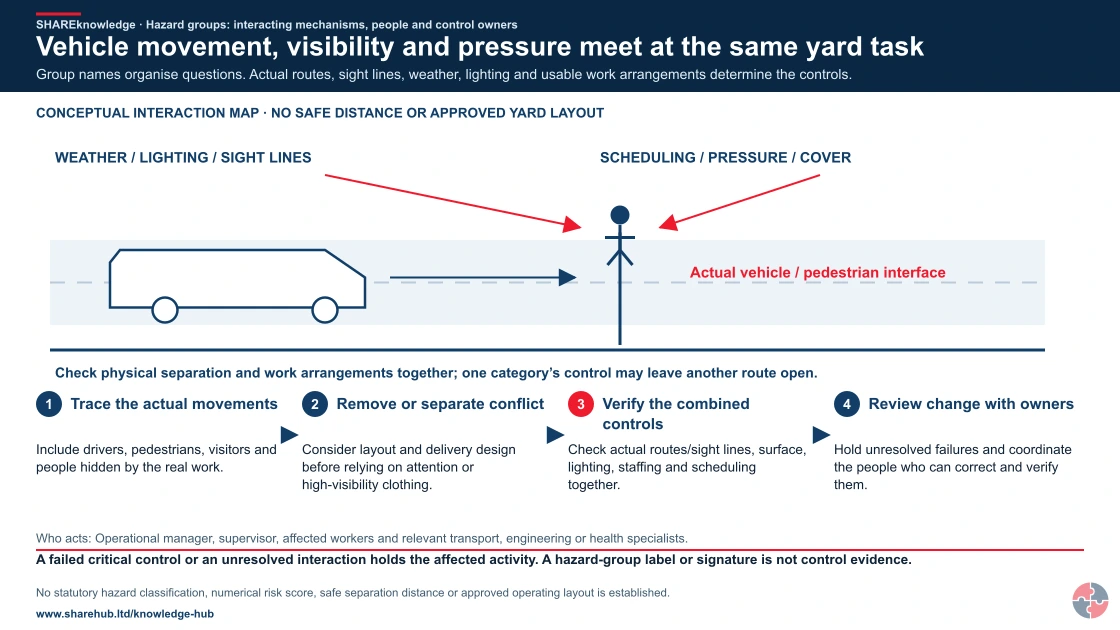
Full written explanation
A complete native outdoor-yard schematic places a vehicle path beside a pedestrian route with a visible crossing/interface. Separate incoming arrows from weather/lighting and from delivery/work pressure join the same people/vehicle interaction, showing why independent category lists can miss a combined failure. The layout is conceptual, supplies no separation distance or approved crossing, and does not clear a pictured yard. Four joined work-review stages identify the actual people and movements, remove or separate conflict where feasible, verify interacting physical and organisational controls, and review changed conditions with named owners. The retained current yard-traffic illustration supports this second setting without proving barrier strength, parking, lighting or actual visibility. Hazard names are not a numerical risk result or permission to operate.
Group names organise questions. Actual routes, sight lines, weather, lighting and usable work arrangements determine the controls.
- Trace the actual movements. Include drivers, pedestrians, visitors and people hidden by the real work.
- Remove or separate conflict. Consider layout and delivery design before relying on attention or high-visibility clothing.
- Verify the combined controls. Check actual routes/sight lines, surface, lighting, staffing and scheduling together.
- Review change with owners. Hold unresolved failures and coordinate the people who can correct and verify them.
When the evidence does not fit: A failed critical control or an unresolved interaction holds the affected activity. A hazard-group label or signature is not control evidence.
Who acts: Operational manager, supervisor, affected workers and relevant transport, engineering or health specialists.
Changed workplace
Industrial maintenance: Connect electrical/mechanical energy, residues, access and handling to actual task-control owners.
Outdoor distribution yard: Join vehicle movement with real visibility, surface, lighting and usable scheduling controls.
Evidence check: No statutory hazard classification, numerical risk score, safe separation distance or approved operating layout is established.
Assign and verify actual controls across interacting hazard mechanisms
Primary references: HSE actual risk assessment and control · HSE maintenance and overlapping risks
Open the complete HD image (new tab)Download image

Assign and verify actual controls across interacting hazard mechanisms
Primary references: HSE actual risk assessment and control · HSE maintenance and overlapping risks
A solvent spill can create inhalation exposure, slipping and ignition risks simultaneously. Cleaning it may introduce manual handling, skin contact and a contractor interface. Removing an ignition source does not contain the spill, and an absorbent material may need compatibility assessment. Use one coordinated decision sequence with specialist input where necessary; avoid separate forms that each assume another team has resolved the interacting hazard.
Which UK jurisdiction and instructions govern the work?
Establish the location before applying a legal route. Health and Safety Executive (HSE) guidance primarily concerns Great Britain; Northern Ireland has separate legislation and the Health and Safety Executive for Northern Ireland (HSENI) regulator. Premises fire, environmental protection and flood arrangements can differ between United Kingdom (UK) nations. An approved code of practice has a different status from an ordinary leaflet; neither is a substitute for checking applicable legislation. The biological agent Hazard Groups 1 to 4 are a separate legal classification and must never be confused with these ten teaching groups. See HSENI: Industries and topics and Introduction to biological hazards at work.
Establish the site location before selecting a legal route. A Great Britain (GB) example of work equipment, dangerous substances or construction coordination must not be turned into a Northern Ireland (NI) duty without checking the applicable instrument. Then distinguish the required legal outcome from regulator guidance, equipment instructions and the organisation's chosen method. If instructions conflict or a proposed use is outside their scope, hold that decision for the responsible competent person instead of selecting whichever reference is convenient.
How do you identify hazards in work as it actually happens?
Begin with observation and worker discussion, not a generic sector checklist alone. Describe the sequence, equipment, substances, energy sources, location and interfaces. Include delivery, storage, commissioning, cleaning, fault finding, maintenance, shutdown and disposal. Compare the intended method with workarounds caused by time pressure, awkward design or inaccessible controls. Review foreseeable failures and degraded conditions. A supermarket refurbishment, for example, exposes contractors, staff and public simultaneously and needs coordinated routes, dust control and fire arrangements. See Managing risks and risk assessment at work and Managing for health and safety (HSG65).
Observe representative cycles and ask what happens when demand rises, material changes, access is blocked or equipment jams. Speak with the cleaner and maintainer as well as the operator. A production method can appear safe while its changeover requires someone to approach stored energy or contamination. Record the exception and why it occurs, then consider design and resource changes before telling staff to be more careful.
How should controls be selected and combined?
First consider avoiding the activity or hazardous feature. Then reduce risk through design, substitution, enclosure, separation and other engineering measures. Organisational controls, competence and supervision support that design; protective equipment manages remaining exposure when suitable. Check substitution for new hazards and ensure a control does not transfer risk elsewhere. Closing a machine guard may prevent contact but complicate cleaning; enclosing a dusty process may introduce access or maintenance hazards. Consult workers and specialists during design and verify performance after implementation. See Managing for health and safety (HSG65) and Working with substances hazardous to health: A brief guide to COSHH.
Begin with the task requirement and strongest feasible option: remove the exposure, change material or method, or physically contain or separate it. Assess new risks introduced by the option and verify performance in actual use. Add procedures, supervision and suitable residual protection where needed. A control combination should remain usable during access and maintenance; forcing people to bypass a guard to complete an essential task reveals a design problem.
How do immediate injuries and long-term ill health differ?
Risk profiles need both acute events and cumulative exposure. Examples include crushing, shock and collapse alongside hearing loss, vibration related injury, respiratory disease and work related stress. A record of few accidents may conceal repeated exposure or rare catastrophic potential. Review worker feedback, equipment condition and exposure control evidence, not just injury counts. Record the credible consequence and failure conditions without presenting an illustrative worst case as a measured probability. See Managing for health and safety (HSG65) and Noise at work: A brief guide to controlling the risks.
A falling load can cause harm immediately; repeated noise, vibration or airborne exposure can cause harm over a different timescale. Absence of a recent accident does not demonstrate that chronic exposure is controlled. Assess the actual task, relevant exposure evidence and effective source controls, then use appropriate competent monitoring or health-surveillance arrangements where needed. Do not treat a symptom report as a diagnosis or wait for illness before improving a failed control.
When is specialist competence needed?
A general assessment supports triage but does not replace specialist work on structural stability, high voltage systems, explosive atmospheres, radiation, containment laboratories, occupational hygiene or water systems. State which decisions can be made locally, what additional evidence is required and who is authorised to approve work. Stop work where a critical control is absent or serious danger is suspected. A permit records coordination and authorisation; it does not itself isolate energy, support an excavation or provide rescue capability. See Electricity at work: Safe working practices and Safe work in confined spaces.
A worker may recognise a damaged supply without being authorised to repair it, and a supervisor may hold a lifting operation without being competent to design it. Define these boundaries in task planning and provide a route to obtain the right advice. Specialist work needs evidence of the relevant knowledge, practical ability and scope, not an impressive general certificate. Missing equipment information, an unidentified material or an uncertain safe state should be escalated before the job proceeds.
How should a hazard be described in a useful assessment?
Avoid entries such as physical hazards present or workers to be careful. A usable statement identifies the activity and mechanism: cleaners may slip on wet tiled access routes during opening hours because pedestrians enter before the surface is dry. Link the control to that mechanism: segregate the cleaning area and verify a dry safe route before reopening. Record the responsible role, timing and evidence. An assessment should also address unplanned spills, accessibility and emergency egress, rather than relying on a warning sign. See Managing risks and risk assessment at work and Preventing slips and trips at work.
Replace a vague entry such as "machinery: wear gloves" with the actual mechanism: "During jam clearance, a person could reach a conveyor nip point or encounter unexpected restart." Record how access is prevented, who establishes and verifies a safe state, what a failed check means and who controls hand-back. That wording supports a real decision and makes it easier to notice a changed product or upstream interface that invalidates the method.
How can managers tell whether controls are working?
Track whether critical checks are completed and defects closed, whether controls perform during real work, and whether repeated problems reveal a design weakness. Useful evidence can include isolation verification, extraction performance, route segregation, water control records, exposure assessments, consultation actions and emergency exercises. Counts of training sessions or forms are supporting activity measures, not proof of effectiveness. Investigate why defects recur and feed lessons into procurement, staffing and design decisions. See Managing for health and safety (HSG65).
Combine leading evidence, such as critical-control checks and corrected defects, with observations and relevant outcome trends. A high completion rate can coexist with repeated guard bypasses or work that exceeds staffing capacity. Sample the actual work and ask what employees do when the method cannot be followed. Managers should know which critical controls are degraded, which work is restricted and whether the corrective action has been verified under realistic demand.
What must be established before assigning a risk score?
Identify the actual activity, foreseeable harm, people exposed and controls already demonstrated to work. Consider start up, normal operation, cleaning, maintenance, breakdown, emergency response and simultaneous work. A numerical matrix may support prioritisation but cannot establish compliance or replace a specialist assessment. Do not assign a residual risk score merely because a proposed control has been written into a form. Keep unknowns explicit and obtain site evidence before deciding that work can proceed. See Managing risks and risk assessment at work and Managing for health and safety (HSG65).
Write a short causal description: the work creates or releases something, a person is exposed by a particular route, and a specified injury or ill-health outcome is foreseeable. Establish whether existing measures work in the actual task before estimating likelihood. An unknown material, unverified safe state or absent critical control is a decision gap, not a reason to select a reassuring number. The responsible manager records what must be resolved and who can authorise the next step.
Who owns each control and how should it be verified?
The dutyholder provides resources and arrangements. The operational manager assigns each control to someone able to implement it. Supervisors verify the controls at the point of work and respond to defects. Workers and representatives explain work as done and report problems. Specialist advisers address limits of local competence. Record the control, responsible role, evidence, check method, due date and escalation route. Completion of a training course or signature alone does not demonstrate effective risk control. See Managing for health and safety (HSG65).
Separate the person who funds and owns the control from the person who performs its check. For an engineered measure, record the accepted performance or condition, who verifies it, what a failed result means and how maintenance is coordinated. For a staffing or organisational measure, check actual cover, authority and staff experience. A signature confirms a recorded action, not effectiveness. The supervisor must be able to hold work and obtain a competent remedy when the required condition is not met.
Who might be affected, including people outside the work team?
Include employees, agency workers, apprentices, contractors, cleaners, maintainers, delivery drivers, service users, visitors and nearby public. Consider inexperience, pregnancy, disability, health conditions, language needs and lone work individually and without stereotyping. Consultation should identify barriers to controls rather than collect unnecessary medical details. Share relevant interface information between employers. A single activity may require several hazard groups; avoid splitting the assessment so that interacting controls have no clear owner. See Managing risks and risk assessment at work and Managing for health and safety (HSG65).
Walk through the job from the perspective of someone who has not received the operator briefing: a cleaner, visiting driver, contractor, new starter or occupant of an adjoining area. Ask whether a control protects them during arrival, normal work, waste removal and emergencies. Agree who controls each shared boundary and how changes are communicated. Individual needs influence a suitable arrangement but do not justify treating an employee, disability or health condition as the hazard.
When should the assessment be reviewed and what evidence matters?
Reassess when equipment, materials, staffing, layout, working hours or environmental conditions change; after incidents, near misses, complaints, symptoms or evidence of failed controls; and through planned risk based review. Verify improvements under realistic demand, not only during an announced inspection. Retain dated observations, measurements where relevant, maintenance records and action closure evidence. No single review interval suits every risk. Health surveillance, exposure monitoring and clinical diagnosis are different activities and require their own competent arrangements. See Managing risks and risk assessment at work and Managing for health and safety (HSG65).
Use a change or failure to test the original assumptions, not merely change the date on the form. A different product, higher throughput, altered route, new shift or contractor may change the harm pathway. Keep observations, applicable measurements, defects and authorisation evidence linked to the task. After correction, verify under representative demand and with affected workers. Repeated workarounds or symptoms require investigation of the design and organisation, even when no injury has been recorded.
How do you put the controls into practice?
Move from recognising harm to deciding, implementing, checking and improving the controls. Give each critical control an owner, a check method and a clear escalation route. See Managing risks and risk assessment at work and Managing for health and safety (HSG65).
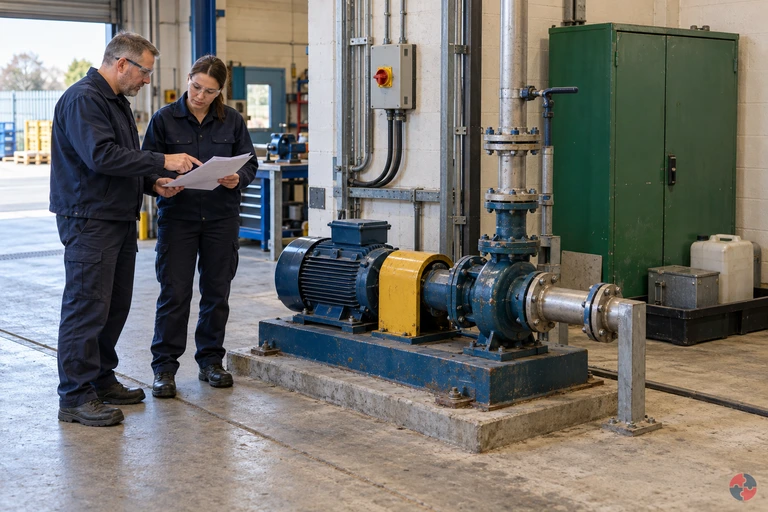
One maintenance task can involve several harm mechanisms
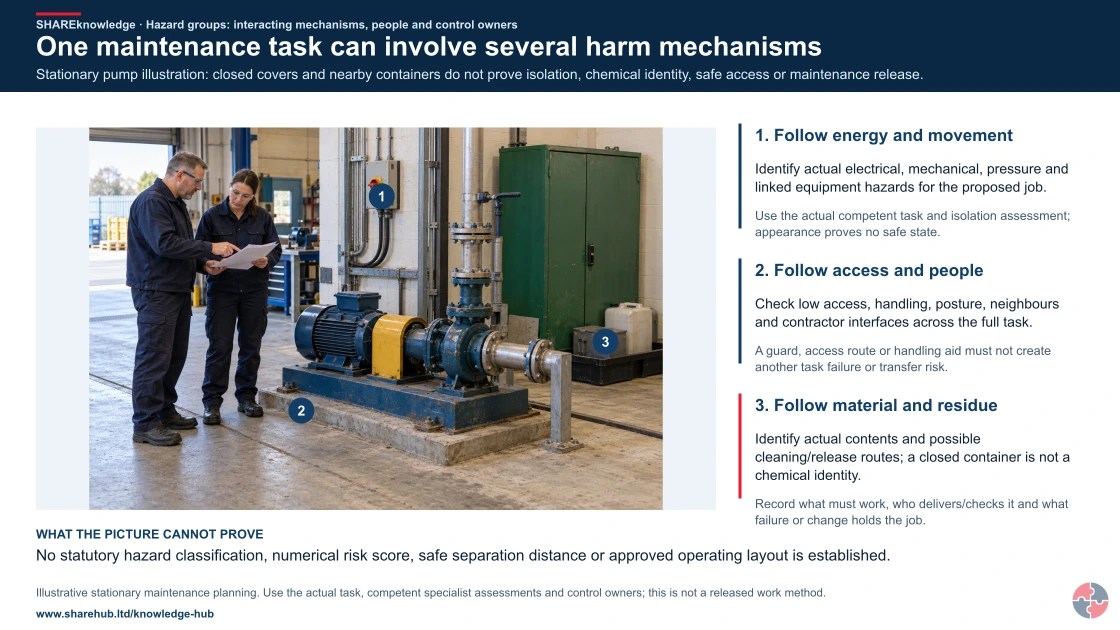
Full written explanation
A new realistic UK workshop illustration shows two maintenance colleagues reviewing inert task papers beside a stationary motor/pump unit on a low fixed plinth. Closed electrical and coupling covers, intact connected pipework and closed nearby containers in a tray provide visible interfaces for questions about electrical/mechanical energy, possible residues or cleaning products, and low access/handling. Numbered prompts link those interfaces to the actual task and affected people rather than certifying any pictured control. The switch position and container contents are not established; no guard is opened, no maintenance is performed and no lifting or isolation method is shown. The existing yard-traffic scene provides a second setting for the native comparison of vehicle movement, visibility/weather and work pressure. Hazard groups remain discovery aids rather than statutory classifications or risk scores.
Stationary pump illustration: closed covers and nearby containers do not prove isolation, chemical identity, safe access or maintenance release.
- Follow energy and movement. Identify actual electrical, mechanical, pressure and linked equipment hazards for the proposed job.
- Follow access and people. Check low access, handling, posture, neighbours and contractor interfaces across the full task.
- Follow material and residue. Identify actual contents and possible cleaning/release routes; a closed container is not a chemical identity.
Change the pathway
- A category does not secure energy. Use the actual competent task and isolation assessment; appearance proves no safe state.
- Controls must work together. A guard, access route or handling aid must not create another task failure or transfer risk.
- Give each control an owner. Record what must work, who delivers/checks it and what failure or change holds the job.
Evidence check: No statutory hazard classification, numerical risk score, safe separation distance or approved operating layout is established.
Assign and verify actual controls across interacting hazard mechanisms
Primary references: HSE actual risk assessment and control · HSE maintenance and overlapping risks
Open the complete HD image (new tab)Download image

Assign and verify actual controls across interacting hazard mechanisms
Primary references: HSE actual risk assessment and control · HSE maintenance and overlapping risks
- Understand the taskObserve people, equipment, materials and interfaces.
- Describe the harmIdentify exposure, energy release and foreseeable failure.
- Control at sourceAvoid, redesign, substitute, contain or separate the hazard.
- Check in real workVerify performance, defects, ownership and change triggers.
| Stage | Action | Who acts | Evidence to retain |
|---|---|---|---|
| Before work | Confirm the actual task, people, equipment, substances, location and abnormal conditions. | Operational manager with competent advice | Assessment, observations, consultation and required specialist checks |
| Control delivery | Avoid or reduce the hazard at source; coordinate controls where mechanisms overlap. | Responsible manager and authorised implementers | Design decisions, control checks, action owners and completion evidence |
| During work | Supervise the real activity; check that critical controls remain effective and workers can report problems. | Supervisor and workers | Checks, defects, changes and escalations |
| Stop and restart | Stop the affected activity when serious danger or a failed critical control is suspected. Restart only through the competent site authorisation arrangements. | Supervisor and authorised competent person | Reason for stopping, corrective action, verification and restart authority |
| Review | Revisit controls after change, incidents, near misses, symptoms or repeated defects. Check effectiveness rather than counting completed forms. | Manager, Occupational safety and health (OSH) adviser and worker representatives | Dated review, closure evidence and lessons for design and procurement |
How do ERICPD and the hierarchy of controls help?
Select stronger controls first and check how each measure interrupts the actual harm pathway. The five-level hierarchy considers elimination, substitution, engineering controls, administrative controls and personal protective equipment. Personal protective equipment (PPE) is a last resort, not the default answer. See HSE: Managing risk using PPE and Managing for health and safety (HSG65).
Eliminate, Reduce, Isolate, Control, PPE, Discipline (ERICPD) is a related learning mnemonic: Eliminate, Reduce, Isolate, Control, PPE and Discipline. Reduction can include substitution or changing the process; isolation commonly involves engineered separation. Procedural controls are administrative measures. Discipline means sustaining arrangements through supervision, maintenance and learning, not blaming workers or replacing a stronger design.
Do not treat the two frameworks as identical statutory ladders. Record why a higher-order option is or is not reasonably practicable for the actual activity, whether substitution creates new risks, who delivers the measure and how performance will be verified. Several levels can be needed together; an enclosure may still need maintenance and suitable arrangements for access.
What does each role need to know and demonstrate?
People need learning and demonstrated competence for the decisions they actually make, not the same course at every organisational level. See Managing risks and risk assessment at work and Managing for health and safety (HSG65).
For hazard groups, frontline learning must enable staff to identify the task, harm route and interacting groups. Supervisors need to challenge a checklist that omits cleaning, contractors or failure. Design, procurement and specialist assessment require deeper competence in control selection, ownership and evidence of effectiveness. Awareness, supervised practice, assessment and authorisation are different stages; an attendance record alone does not establish competence or permit specialist intervention.
Assess practical understanding with the actual task and credible abnormal conditions. The assessor must be competent for the scope being tested; authorisation should state its boundaries. Reassess after a material change, a defect, a demonstrated gap or work outside that scope rather than assuming one fixed refresher interval suits every role.
| Role | Learning and decisions | Assessment, evidence and reassessment |
|---|---|---|
| Nearby staff and new starters | Recognise the relevant exposure, usable routes, warning signs and reporting or emergency arrangements. | Supervisor checks a practical explanation and scenario response; retain briefing scope and gaps. Repeat when routes or conditions change. |
| Frontline users | Demonstrate how to identify the task, harm route and interacting groups, including the checks, limits and stop decision. | Competent task assessor observes representative practice and a defect scenario; record task, equipment/material scope and authorisation. Reassess for changed methods or performance gaps. |
| Specialist workers and maintainers | Demonstrate the applicable technical method, safe state, interface controls and hand-back; do not infer specialist skill from general awareness. | Competent specialist assesses work within a defined scope; retain method, assessment and authorisation evidence. New equipment, material or fault type may need a new decision. |
| Supervisors and coordinators | Demonstrate how to challenge a checklist that omits cleaning, contractors or failure, manage a changed condition and hold or release work. | Manager or competent reviewer tests a realistic planning and stop/restart scenario; retain observed decisions and corrective actions. Review following interface failures. |
| Managers, purchasers and designers | Make and resource decisions on control selection, ownership and evidence of effectiveness, including the stronger-control options and residual risks. | Competent review of specifications, trials, procurement acceptance and effectiveness evidence; record decision owner and outstanding actions. Reassess after process or organisational change. |
| OSH advisers, technical specialists and auditors | Distinguish jurisdiction and source limits, test representative evidence and recognise the boundary of their competence. | Appropriately competent review of the actual assessment, sources, sampling and closed actions; retain scope and limitations. Escalate missing technical information rather than inventing a conclusion. |
How can the hierarchy of controls guide control selection for different workplace hazards?
The control hierarchy becomes useful when each selected measure changes the actual exposure or energy pathway and has an owner, an effectiveness check and a failure response. See HSE: Managing risk using PPE and Managing risks and risk assessment at work.
The following illustrative decisions connect Eliminate, Reduce, Isolate, Control, PPE and Discipline with the five-level hierarchy. They are not a universal method statement. Test removal and substitution first; where a stronger option is rejected, explain its feasibility, new risks and task requirements rather than simply moving down to training or PPE. Several layers often remain necessary for access, cleaning and foreseeable failure.
How can the ERICPD hierarchy of controls guide control selection for different workplace hazards?

| ERICPD / five-level application | Task-specific measure and harm interruption | Owner, verification, limitations and stop point |
|---|---|---|
| Eliminate / Elimination | Remove the need to enter a tank by designing external inspection and cleaning. The planner must demonstrate that inspection coverage and cleaning effectiveness remain adequate; reject the option if it conceals an unresolved condition. | Designer and asset manager; approved method and verified task outcome. Avoided entry removes the entry exposure, but external handling and chemical hazards still need assessment. Guidance: Safe work in confined spaces. |
| Reduce / Substitution / source reduction | Replace a solvent-based cleaning step with a demonstrably suitable lower-hazard process, checking compatibility, performance, waste and any new exposure before approval. | Purchaser with competent assessment; product and process trial. Hold substitution for unidentified material, unacceptable new hazards or failure to meet the task specification. Guidance: Working with substances hazardous to health: A brief guide to COSHH. |
| Isolate / Engineering where physical separation is designed | Enclose the remaining process, capture release at source and separate people from moving or falling material. Physical containment differs from a sign telling people not to approach. | Competent designer and maintainer; commissioning and operational checks. Stop if the enclosure, capture or protective system cannot maintain the assessed condition. Guidance: Safe use of work equipment; Working with substances hazardous to health: A brief guide to COSHH. |
| Control / Administrative arrangements; engineered control remains engineering | Coordinate cleaning, production and maintenance, with clear access and isolation authorisation. A schedule and permit organise decisions but do not physically contain energy or contamination. | Supervisor; task brief, observed practice and controlled hand-back. Hold when another team can defeat the control or the conditions change without reassessment. Guidance: Guidance on permit-to-work systems: A guide for the petroleum, chemical and allied industries; Electricity at work: Safe working practices. |
| PPE / Personal protective equipment where applicable | Select compatible protection for the remaining route: hearing, respiratory, eye, hand or body protection according to the actual assessment. Fit, use, cleaning and replacement must be specified. | Manager and competent selector; user demonstration and condition records. PPE cannot make an uncontained explosive atmosphere or an unstable structure safe. Guidance: HSE: Managing risk using PPE; Noise at work: A brief guide to controlling the risks. |
| Discipline / Sustain every selected level through maintenance, supervision and learning | Maintain guards, extraction, routes and competence; investigate workarounds and change the design where repeated failure persists. This is sustained assurance, not blaming an injured worker. | Manager and worker representatives; defect trends, closed actions and retests. Repeated failures or overdue critical repairs require escalation and restricted work. Guidance: Managing for health and safety (HSG65); Safe use of work equipment. |
How can the ISO 45001 hierarchy of controls guide control selection for different workplace hazards?

| ERICPD / five-level application | Task-specific measure and harm interruption | Owner, verification, limitations and stop point |
|---|---|---|
| Eliminate / Elimination | Remove the need to enter a tank by designing external inspection and cleaning. The planner must demonstrate that inspection coverage and cleaning effectiveness remain adequate; reject the option if it conceals an unresolved condition. | Designer and asset manager; approved method and verified task outcome. Avoided entry removes the entry exposure, but external handling and chemical hazards still need assessment. Guidance: Safe work in confined spaces. |
| Reduce / Substitution / source reduction | Replace a solvent-based cleaning step with a demonstrably suitable lower-hazard process, checking compatibility, performance, waste and any new exposure before approval. | Purchaser with competent assessment; product and process trial. Hold substitution for unidentified material, unacceptable new hazards or failure to meet the task specification. Guidance: Working with substances hazardous to health: A brief guide to COSHH. |
| Isolate / Engineering where physical separation is designed | Enclose the remaining process, capture release at source and separate people from moving or falling material. Physical containment differs from a sign telling people not to approach. | Competent designer and maintainer; commissioning and operational checks. Stop if the enclosure, capture or protective system cannot maintain the assessed condition. Guidance: Safe use of work equipment; Working with substances hazardous to health: A brief guide to COSHH. |
| Control / Administrative arrangements; engineered control remains engineering | Coordinate cleaning, production and maintenance, with clear access and isolation authorisation. A schedule and permit organise decisions but do not physically contain energy or contamination. | Supervisor; task brief, observed practice and controlled hand-back. Hold when another team can defeat the control or the conditions change without reassessment. Guidance: Guidance on permit-to-work systems: A guide for the petroleum, chemical and allied industries; Electricity at work: Safe working practices. |
| PPE / Personal protective equipment where applicable | Select compatible protection for the remaining route: hearing, respiratory, eye, hand or body protection according to the actual assessment. Fit, use, cleaning and replacement must be specified. | Manager and competent selector; user demonstration and condition records. PPE cannot make an uncontained explosive atmosphere or an unstable structure safe. Guidance: HSE: Managing risk using PPE; Noise at work: A brief guide to controlling the risks. |
| Discipline / Sustain every selected level through maintenance, supervision and learning | Maintain guards, extraction, routes and competence; investigate workarounds and change the design where repeated failure persists. This is sustained assurance, not blaming an injured worker. | Manager and worker representatives; defect trends, closed actions and retests. Repeated failures or overdue critical repairs require escalation and restricted work. Guidance: Managing for health and safety (HSG65); Safe use of work equipment. |
Verify the combination, not just each item in isolation. A protective enclosure can obstruct maintenance, substitution can introduce a different exposure, and a procedure can depend on staffing that is not available. Ask workers how the arrangement operates under pressure and observe the foreseeable exception. A control with no practical check or no authority to stop is not yet a dependable operational arrangement.
How can a warehouse refit expose several hazard groups at once?
Manage this activity by preventing exposure at source, coordinating the affected people and verifying the planned controls before release. A distribution centre replaces a conveyor while dispatch remains active. Delivery staff, fitters, operators, cleaners and visiting drivers share interfaces. Moving loads, electrical and mechanical energy, drilling dust, awkward lifting and production pressure can combine; a worker stepping away from a dust plume may enter a vehicle route. See Managing risks and risk assessment at work and Safe use of work equipment.
Illustrative SHARE workplace example
What must be agreed before work starts?
The operations manager and contractor coordinator map the sequence and affected people before work. They first examine whether dispatch can be moved or the installation completed outside operation. Competent equipment and electrical people plan the safe state and hand-back, while the layout plan separates traffic and work. A worker briefing explains the usable route, stop authority and how a change is reported.
What changes, stops or hand-back decisions matter?
During installation, the supervisor checks actual barriers, contamination control and simultaneous activities, not just the signed method. A moved barrier, unidentified service or unplanned restart is a hold point. After installation, authorised people verify the equipment and protective arrangements, then the manager confirms routes and housekeeping before dispatch resumes. Keep design decisions, changes, checks and release evidence together so one group's control does not undermine another.
How should jurisdiction, local rules and management assurance be handled?
Apply the law and regulator guidance for the work location, then use competent task and equipment information to establish the practical arrangements. See Managing risks and risk assessment at work and Managing for health and safety (HSG65).
HSE guidance generally addresses Great Britain; Northern Ireland has its own instruments and HSENI route. Construction, dangerous substances, equipment and other specialist topics need the applicable instrument, not a GB duty copied into an NI answer. Fire arrangements also differ across the UK nations. Foreign project examples require destination-specific official advice and competent local assessment.
Distinguish a legal duty, regulator guidance, an organisation's rule and an illustrative SHARE method. A management system can link assessment, procurement, competence, maintenance, consultation and corrective action; a certification label or an unverified standard clause does not authorise work. For this group, sample evidence on control selection, ownership and evidence of effectiveness and compare the recorded method with the activity observed on site. Resolve conflicts or missing technical information with the responsible competent person.
Acronyms and terms
These terms distinguish the source of harm, the exposure route and the controls needed for the actual work.
| Letters or term | Expansion or definition | Meaning in this topic |
|---|---|---|
| UK | United Kingdom | A geographical description, not one identical set of health-and-safety instruments. |
| GB | Great Britain | England, Scotland and Wales; HSE guidance is generally framed for this jurisdiction. |
| NI | Northern Ireland | A separate health-and-safety legal route overseen by HSENI. |
| HSE | Health and Safety Executive | The GB regulator and a publisher of official workplace guidance. |
| HSENI | Health and Safety Executive for Northern Ireland | The NI regulator; check its applicable requirements and advice. |
| OSH | Occupational safety and health | Preventing work-related injury and ill health. |
| PPE | Personal protective equipment | Equipment worn for remaining exposure; it does not replace stronger source controls. |
| COSHH | Control of Substances Hazardous to Health | The GB hazardous-substance assessment and exposure-control route. |
| DSEAR | Dangerous Substances and Explosive Atmospheres Regulations | The GB route for relevant dangerous-substance fire, explosion and other safety risks. |
| CDM | Construction (Design and Management) | Construction duty and coordination arrangements; check the applicable GB or NI instrument. |
| PUWER | Provision and Use of Work Equipment Regulations | GB requirements for suitable work equipment, protection and competent use. |
| ERICPD | Eliminate, Reduce, Isolate, Control, PPE, Discipline | A learning mnemonic for selecting and sustaining controls; not a statutory ladder. |
| Hazard | A source or condition with potential for harm | Describe what creates harm, rather than calling a person the hazard. |
| Exposure | A route or contact connecting source and person | Consider dose, duration and circumstances where relevant. |
| Critical control | A measure essential to the safe arrangement | Define its required condition, check, owner and failure response. |
| Hand-back | Controlled return to operation or use | Confirm people, equipment, protection and outstanding conditions before release. |
Example handy documents
Useful records connect the actual task to control ownership, checks, stop decisions and verified hand-back. See Managing risks and risk assessment at work and Managing for health and safety (HSG65).
The following are examples of documents an organisation could create or adapt, not downloadable files or a complete safe system. Use the task-specific information and competent review before applying them. Keep private health information outside general operational records.
What should a task and harm-route assessment contain?
Record people, source, exposure or energy, foreseeable harm, existing controls, stronger options, residual uncertainty and the responsible decision owner.
What should a critical-control check and defect log contain?
Record the required condition, check method, responsible person, failed result, restricted work and verified corrective action.
What should a change and hand-back record contain?
Capture changed material, equipment, staffing, layout or conditions; prerequisites, hold decisions, competent verification and restart authority.
What should a competence and authorisation record contain?
Name the assessed task and scope, practical evidence, assessor, limits, supervision and reassessment triggers.
What should an operational learning review contain?
Link observations, complaints, near misses or relevant exposure evidence to a design or organisational change and an effectiveness check.